VTEX vs commercetools: is B2B assembled or composed?
B2B Suite apps or API resources: through a commerce leader's lens, where the work on quoting, permissions, and buyer hierarchy lives.

Editorial note: CWS Platform competes with VTEX and with commercetools. This comparison uses only each vendor's public documentation, with the address next to each fact and the date of each record cited.
Short answer: VTEX fits the team that wants B2B assembled from B2B Suite apps, with organizations, cost centers, predefined roles, and quoting, accepting that one VTEX quoting app, Order Quote, is on the list of deprecated apps. commercetools fits the team that wants to compose B2B on APIs, with Business Units, roles the team defines, and binding quotes, accepting that add-ons carry their own terms and pricing.
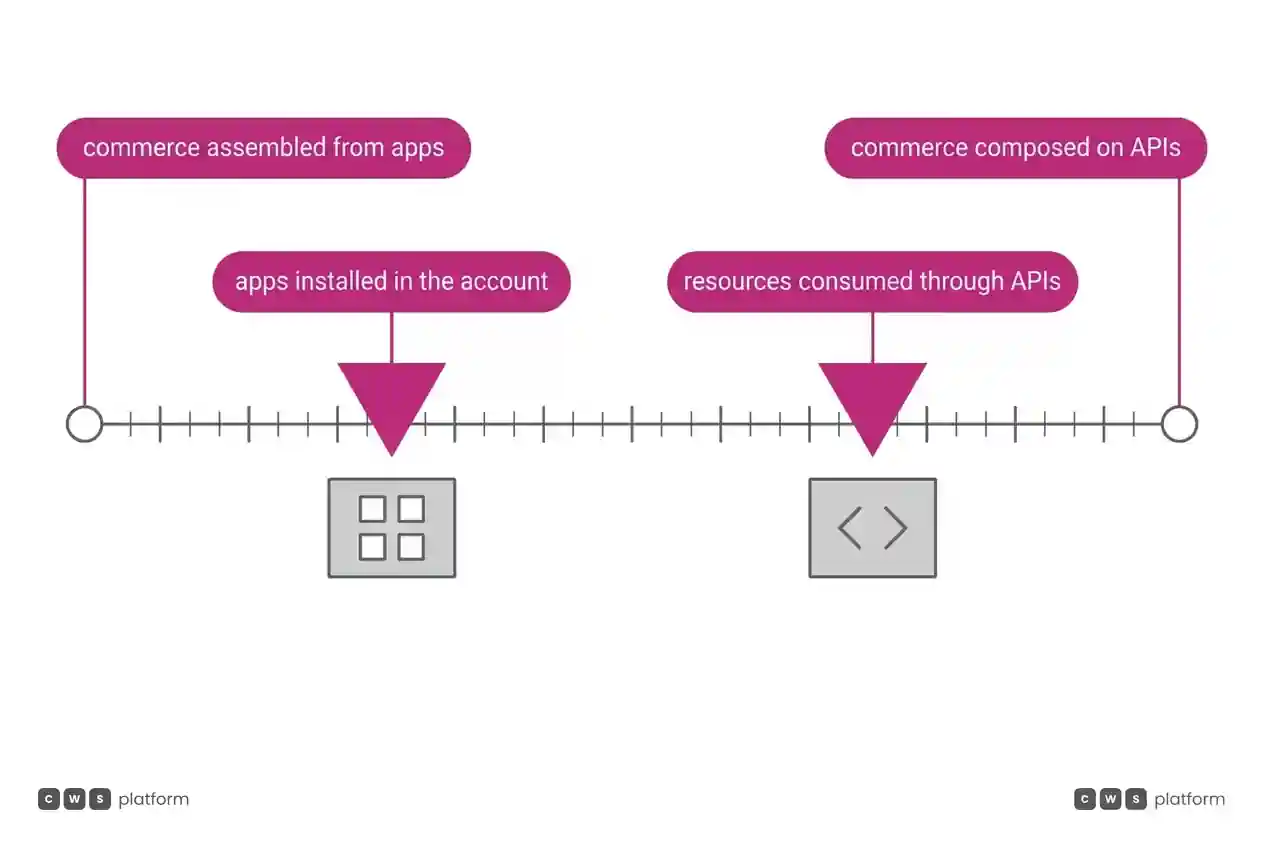
A commerce leader comparing VTEX and commercetools is choosing who assembles the company's B2B channel and who keeps assembling it after go-live. In one model, B2B arrives as apps installed in the account, with roles and screens already designed. In the other, it arrives as API resources the team combines and presents however it likes. What changes is where the work on quoting, permissions, and buyer hierarchy lives, and how long it stays open.
The map of platform models is in the three B2B commerce platform models, and the other comparisons are in the comparisons hub, including VTEX vs Adobe Commerce and commercetools vs Spryker.
VTEX and commercetools side by side
The table sums up what each vendor's documentation records; where the source does not cover a point, the cell says so.
| criterion | VTEX | commercetools |
|---|---|---|
| Platform model | Composable, multi-tenant cloud platform with more than 750 API endpoints | B2B Commerce package on the commercetools Platform, with Merchant Center and REST and GraphQL APIs |
| Native B2B or extension | B2B Suite apps installed through VTEX IO; B2B Buyer Portal for selected accounts | B2B Commerce package resources: Business Units, Associate Roles, Approval Rules, and Quotes |
| Customer and contract pricing | Price tables per organization; contracts in the B2B Buyer Portal (selected accounts) | Standalone Prices and Business Unit prices, with quantity tiers |
| Quoting | B2B Quotes & Carts app, with statuses and price adjustments | Quote Request, Staged Quote, and binding Quote, with renegotiation |
| Credit and payment terms | Customer credit among the gateway's payment methods | Not documented |
| ERP integration | REST APIs and connectivity for ERP, WMS, and carriers | Connect (managed integration runtime) and asynchronous Import API |
| Billing model | Not covered by the sources used here, except custom Master Data entities, billed by document volume | Not covered by the sources used here, except features delivered as Add-Ons |
| Implementation | Apps installed through VTEX IO, with dependencies declared in the theme | commercetools Frontend as SaaS or a Store Launchpad template copied into the project |
Pricing and commercial rules: who buys, in which role
On VTEX, the buyer's rules start with the organization. The B2B Organizations app groups a company's users into an organization with its own price tables, payment methods, and product collections, split into cost centers with their own shipping addresses. Roles come predefined: Storefront Permissions ships a set that runs from the organization admin to the buyer, including the approver and the sales representative.
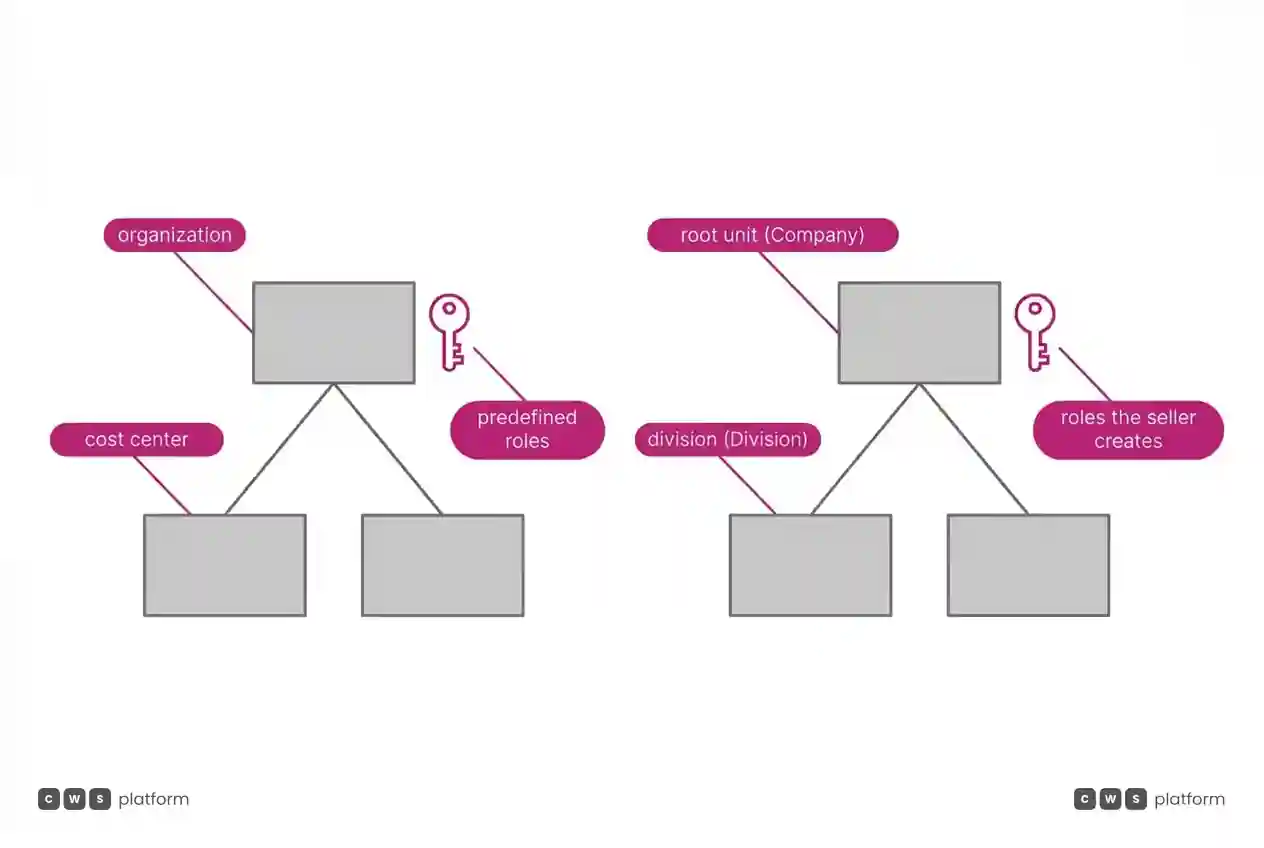
On commercetools, the rules start with the Business Unit. Business Units model the company (Company) and its divisions (Division) as a hierarchy, and divisions inherit Stores, associates with their roles, and approval rules from the units above. Roles do not come out of the box: with Associate Roles, the seller creates each role with the permissions it wants, separating what an associate does with their own orders from what they do with colleagues' orders. The B2B Commerce package adds Standalone Prices, Business Unit prices, and quantity tiers.
Both sides have a public record on how large the permission model or the hierarchy can get.
- On the VTEX side, it is recorded in VTEX's documentation, on a page dated June 9, 2026, that, in the B2B Buyer Portal permission model (available for selected accounts), custom storefront resources are capped per account: "An account can have a maximum of 10 custom storefront resources." (guide to custom storefront roles and resources).
- On the commercetools side, it is recorded in commercetools' documentation, accessed on October 16, 2026, in the limit-increase guidance, as a design recommendation: "Flatten Business Unit hierarchies and reduce per-user role fan-out." (commercetools limit-increase guidance).
The evaluation question is the same on both sides: bring your largest accounts' real structure to the demo, with units, roles, and specific permissions, and ask how it gets modeled on the platform.
Quoting and assisted selling
On VTEX, B2B Suite quoting runs through the B2B Quotes & Carts app. Per the B2B Quotes GraphQL API, a quote stores the cart's items, quantities, and prices, moves through statuses such as PENDING, REVISED, DECLINED, and PLACED, accepts price adjustments, and can be applied back to the cart. The representative role in Storefront Permissions gives the rep assistance and buyer impersonation within the same cost center.
VTEX documents more than one quoting app, and each one's status matters. It is recorded in VTEX's documentation, on a page dated October 9, 2026, that the Order Quote app is on the list of deprecated apps, and the same page defines the term: "A deprecated app refers to an application no longer supported or maintained by VTEX" (VTEX IO deprecated apps list). In the demo, ask which quoting app the proposal includes and what its support status is.
On commercetools, quoting is a cycle of API resources. Per the Quotes overview, the buyer creates a Quote Request from the cart, the seller builds a Staged Quote with items, quantities, validity, and discounts, and the Quote sent is a binding offer the buyer can accept, decline, or ask to renegotiate. Assisted Selling lets the rep take over the customer's cart in Merchant Center, lock it during the session, and hand it back for the buyer to place the order.
ERP integration: where the connector is written
On VTEX, integration starts from the platform's APIs. The REST API guide splits modules such as Catalog, Checkout, and Logistics, and the VTEX Commerce Platform page describes connectivity for ERP, WMS, and carriers.
On commercetools, the connector is project code running in a vendor-hosted environment. Connect runs small integration applications in JavaScript, TypeScript, or Java. The Import API takes batch loads asynchronously, and the best-practices guide recommends up to 300 calls per second per project.
On both, ask for the integration design for customers, pricing, and orders, with the name of whoever maintains each part.
Cost and billing model
In the VTEX sources used here, the platform's billing model is not covered. Per the extensibility guide, native Master Data entities are free, and custom ones are billed monthly in tiers, by total document volume.
On commercetools, the B2B Commerce package describes features delivered as Add-Ons, such as HIPAA support and load testing. It is recorded in commercetools' documentation, accessed on October 16, 2026, that these packages carry their own conditions: "Add-Ons are subject to additional terms and pricing." (commercetools add-ons page).
The proposal question is the same on both sides: what is in the base contract and what becomes its own line item, in writing, including apps, data entities, and add-ons.
Implementation and upkeep: B2B that keeps being assembled
On VTEX, B2B enters the account by installation. B2B Organizations is installed from the VTEX IO command line, brings Storefront Permissions in as a dependency, and requires declaring the dependency in the theme.
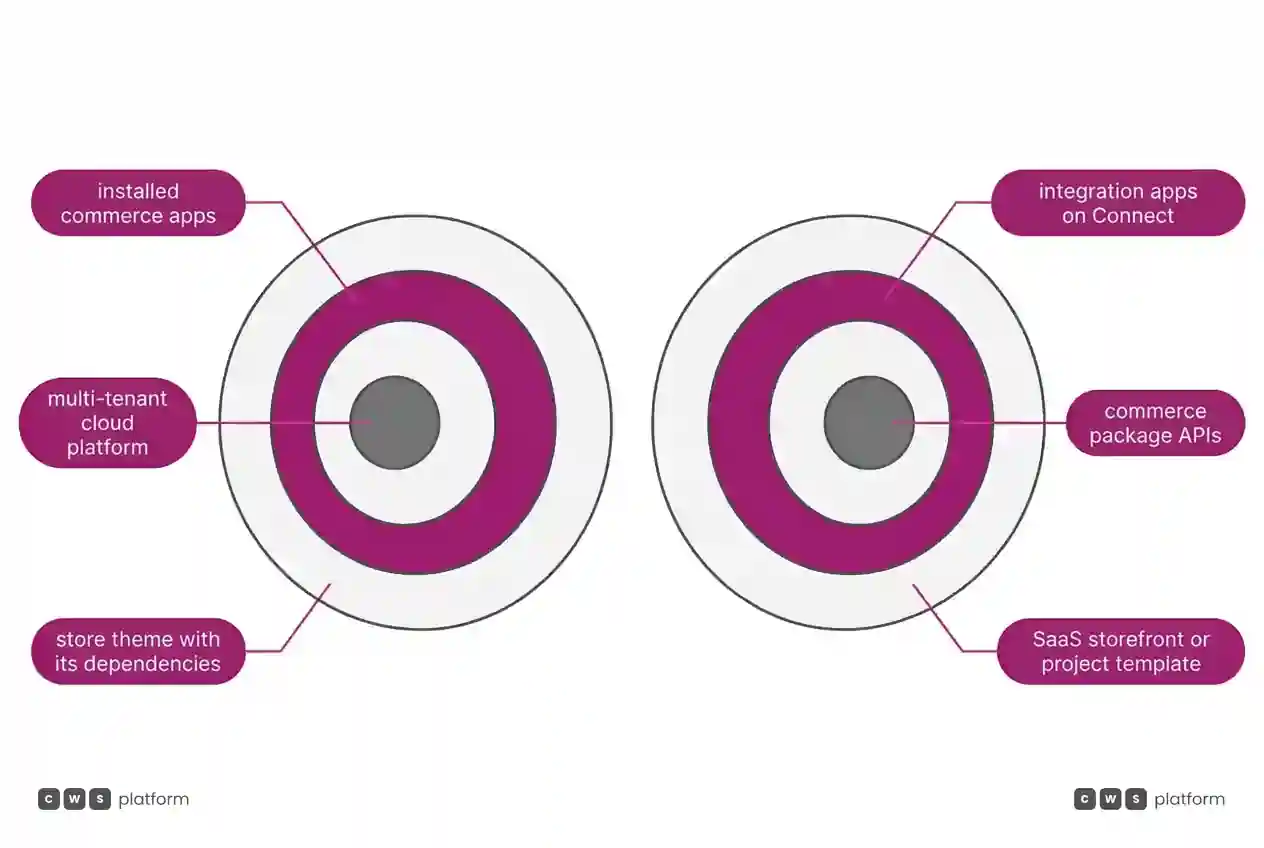
On commercetools, the team picks the storefront path. Per the Store Launchpads overview, commercetools Frontend is SaaS with automatic updates, and the Store Launchpad for B2B Manufacturing is a template copied into the project and maintained by the developer, with screens for Business Units, approvals, shopping lists, and quick order, per the B2B Launchpad overview.
On both, implementation does not end at go-live. Ask for the first-year upkeep plan, with an owner for each part.
When to choose VTEX
B2B assembled from apps. B2B Organizations arranges buyers into organizations and cost centers, with their own price tables, payment methods, and addresses.
Roles already designed. Storefront Permissions ships predefined roles for the organization admin, approver, buyer, sales manager, and sales representative.
Quotes and saved carts in one app. The B2B Quotes API covers quotes with statuses, price adjustments, and saved carts.
Retail and B2B in one operation. The VTEX Commerce Platform page describes ecommerce, physical stores, marketplace, and B2B under the same order orchestration.
When to choose commercetools
A hierarchy the team models. Business Units arrange the company and its divisions, with inherited Stores, associates, and approval rules.
Permissions built to fit. Associate Roles are created by the seller, with granular permissions and the option to let the buyer assign the role.
Approval by order rule. Approval Rules set criteria by currency, country, or order value, with requester and approver roles.
Formal negotiation. The Quotes cycle covers quote requests, binding offers, renegotiation, and conversion to an order.
When neither fits
Some companies do not want to assemble B2B from apps or compose it in code, because their commercial rules change often. For them there is a third model, described in the post on the three B2B commerce platform models: bringing the commercial rules into the platform.
That is the CWS Platform model. Commercial policy is stored as parameters in the CDL Workspace, configuration instead of code, and price tables, rules, and contracts are configured in the platform or arrive from the ERP and CRM by API. Customer and sales rep use the same interface and work on the same order: the rep builds the cart and sends the customer a link to close it, and the order records who built the cart and who chose the payment. A rep's discount goes through tiered approval. Every customer runs the same version. The platform has 11 modules, 6 AI Agents, and 1,029 parameters.
To read each vendor against that model, there are two comparisons: VTEX B2B Commerce vs CWS Platform and B2B sales portal: commercetools vs CWS Platform.
If the choice between assembling and composing does not fit what your team can sustain, it is worth talking to a CWS Platform specialist before you lock in the architecture.
Frequently asked questions
VTEX vs commercetools: which is better for B2B?
It depends on who will assemble and maintain B2B. VTEX fits the team that wants B2B assembled from B2B Suite apps, with organizations, cost centers, predefined roles, and quoting. commercetools fits the team that wants to compose B2B on APIs, with Business Units, team-defined roles, rule-based approval, and binding quotes.
Is B2B ready-made or assembled?
On VTEX, B2B arrives through B2B Suite apps installed via VTEX IO, and features such as contracts live in the B2B Buyer Portal, which VTEX describes as available for selected accounts. On commercetools, the B2B Commerce package delivers its features as APIs and Merchant Center, and the buyer's screens come from commercetools Frontend or from a template the team maintains. Both involve implementation work; what changes is who does it.
How does each handle buyer hierarchy and permissions?
VTEX arranges buyers into organizations and cost centers with predefined roles; in the B2B Buyer Portal permission model, available for selected accounts, its documentation records a cap of 10 custom storefront resources per account. commercetools arranges buyers into Business Units with inheritance and seller-defined roles, and its limit-increase guidance recommends flattening the hierarchy and reducing per-user role fan-out.
Which needs a bigger technical team?
On VTEX, B2B means installing apps, declaring dependencies in the theme, and tracking each app's status. On commercetools, the team writes integrations in Connect and, if it uses the Store Launchpad template, maintains the storefront.
Brands mentioned in this article
 VTEX


- Adobe Commerce
Trademarks and logos belong to their respective owners. Mention does not imply partnership or endorsement.
"responsive, technically engaged, and willing to work through complex commercial rules (negotiated pricing, credit, customer-specific conditions) rather than pushing generic answers"
Does your implementation never end?
Request an assessment of your operation or talk straight to a specialist, whichever you prefer.
I'd rather get the next articles on implementation
A weekly roundup of new articles on implementation, only in weeks when there is one. No spam, and you can leave in one click.