VTEX vs Salesforce Commerce Cloud: can B2B and retail coexist?
Retail promotions and distributor price tables on the same platform, read in each vendor's documentation.

Editorial note: CWS Platform competes with both VTEX and Salesforce. This comparison uses only each vendor's public documentation, with the address next to each fact and the date of each record cited.
Short answer: VTEX fits companies that want to add B2B to a retail operation that is already unified, with promotions from the native module and price tables per organization in the B2B Organizations app. Salesforce Commerce Cloud fits companies that want to run B2B and D2C in the same Salesforce org, with shared data and processes and prices set through price books. With both, measure first how B2B promotions and price tables coexist with B2C ones.
VTEX and Salesforce Commerce Cloud serve both the consumer and the B2B channel on the same platform. When a Director of Commerce compares the two, the decision is rarely about the storefront. It is about what happens when a promotion designed for retail and a price table negotiated with a distributor start living in the same place. When one channel's rules spill into the other, the channels start fighting each other.
This piece reads both platforms through that coexistence, without a ranking. The map of platform models is in the three B2B commerce platform models, and the other vendor readings are in the comparisons hub.
VTEX and Salesforce Commerce Cloud side by side
The table sums up what each vendor's documentation says about the points that weigh on the B2B channel.
| criterion | VTEX | Salesforce Commerce Cloud |
|---|---|---|
| Platform model | Composable, multitenant cloud platform with more than 750 API endpoints | Store created from templates, customized in Experience Builder, and configured with Lightning features |
| Native B2B or extension | B2B Suite apps installed through VTEX IO; the B2B Buyer Portal is available for selected accounts | B2B Commerce in the same org that can run the D2C channel |
| Customer-specific pricing and contracts | Price tables per organization in the B2B Organizations app; contracts in the B2B Buyer Portal (selected accounts) | Price books and entitlements imported by CSV; buyers associated with accounts and groups |
| Quotes | B2B Quotes & Carts app, with quotes created from the cart | Not documented |
| Credit and payment terms | Customer credit among the gateway's payment methods | Not documented |
| ERP integration | REST APIs; external inventory and shipping integrated by API with ERP, PIM, or WMS | Asynchronous CSV import and Data Loader for large loads; custom B2B checkout with third-party providers |
| Billing model | Not documented in the sources for this comparison, except custom Master Data entities, billed by document volume | Not documented |
| Implementation | Apps installed through VTEX IO, with dependencies declared in the theme | Store built from templates, with access controlled by profiles and permission sets |
Pricing and promotions: B2B next to B2C
On VTEX, the promotions module has six types, from Regular to Campaign Benefit, and applies discounts to products, shipping, or trade policies depending on the purchase context. A campaign promotion requires a campaign audience that defines the eligible customer groups. On the negotiated-price side, the B2B Organizations app gives each buying organization its own price tables.
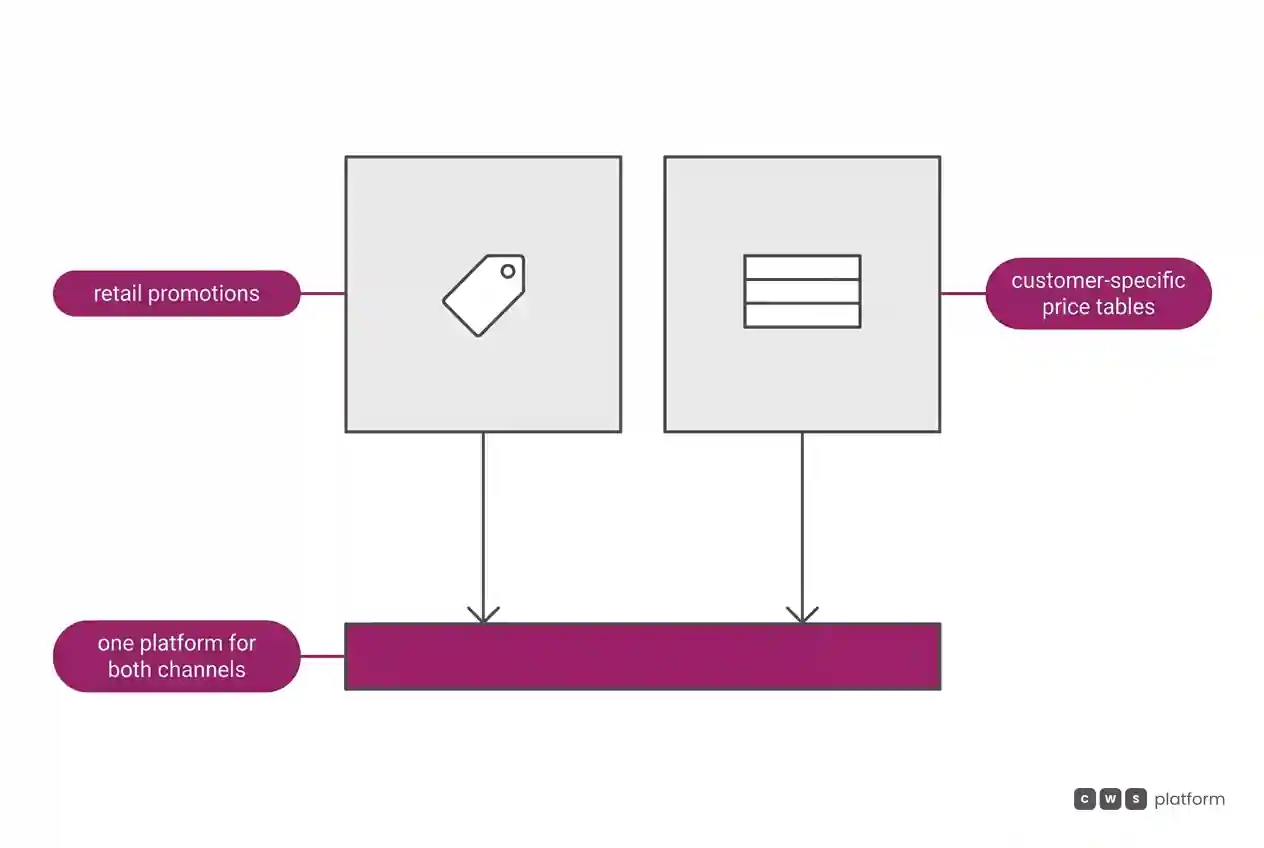
On Salesforce, the B2B Commerce introduction records that the same org can run B2B and D2C channels with shared data and processes, and that price books and entitlements are loaded by CSV. In B2C, according to the getting started guide, Business Manager administers products, customers, orders, and promotions.
Three public records touch that coexistence.
- On the VTEX side, recorded by VTEX as a known issue, still open as of November 5, 2026: promotions that depend on a minimum or maximum amount may fail when applied to items with a unit multiplier ("Promotions that depend on a minimum or maximum amount may fail when applied to items with a unit multiplier.", VTEX known issue).
- On the Salesforce side, recorded in Salesforce's documentation, accessed on October 9, 2026: the cap is 5,000 promotions per org, counting inactive ones ("This limit includes both active and inactive promotions.", promotion limits).
- Also on the Salesforce side, recorded in Salesforce's documentation, accessed on October 9, 2026: each pricing call evaluates at most 25 price books, and a store accepts 5 assigned price books ("Price books above the 25 limit are not included in the price evaluation.", price book limits).
Each record calls for a question in the demo. For VTEX, test a minimum-amount promotion on an item sold by the case, with a unit multiplier, a common format in a B2B catalog. For Salesforce, ask how the promotion cap is shared when B2B and D2C sit in the same org, and how to structure customer-specific pricing without going past 25 price books per call.
Quotes and assisted selling
The B2B channel also has the sales rep who manages the accounts. On VTEX, the B2B Quotes & Carts app stores items, quantities, and prices from the cart, and quote queries accept filters by organization, cost center, and status, according to the quotes GraphQL API. The Storefront Permissions roles include the sales manager and the sales representative, who act on behalf of the buyer.
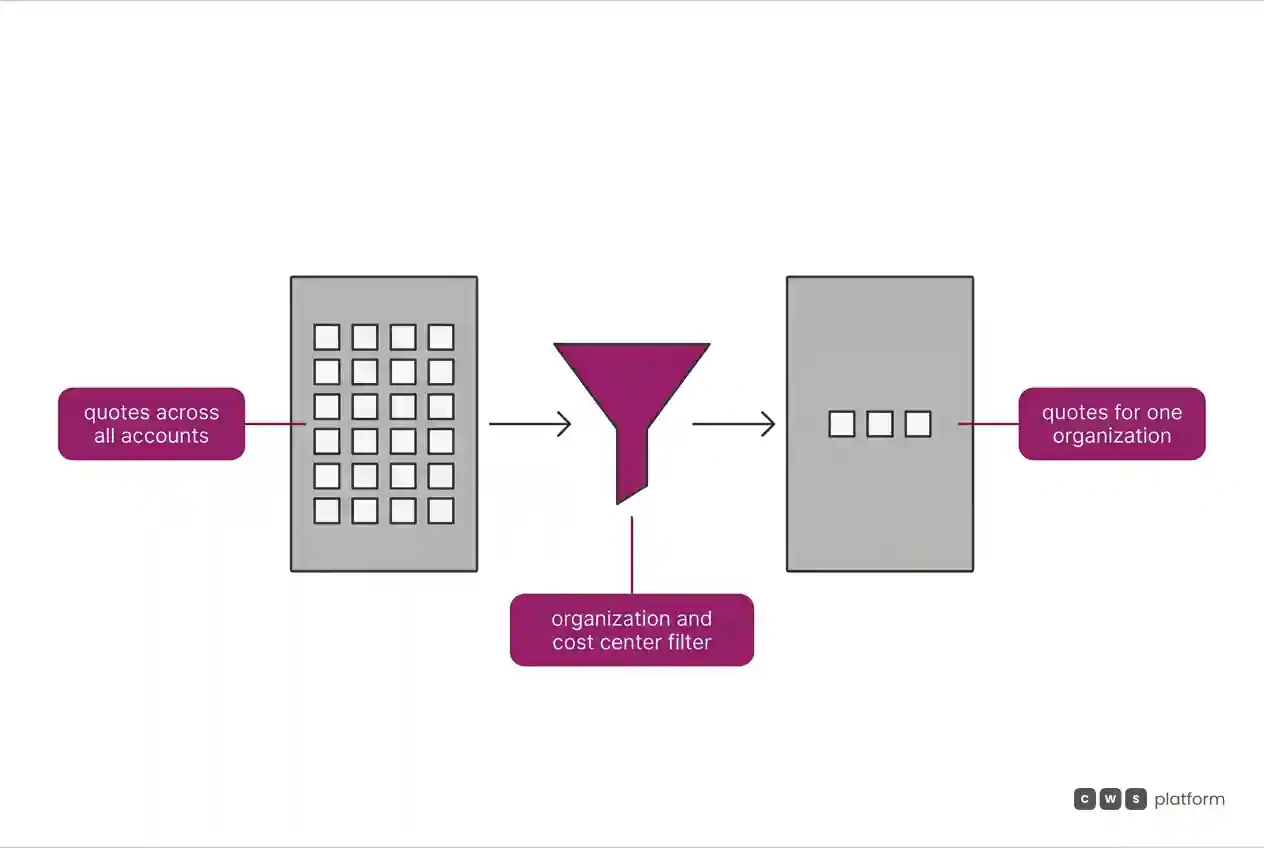
There is one record here.
- On the VTEX side, recorded by VTEX as a known issue, still open as of November 5, 2026: on the My Quotes page, a user with the permission to see all quotes and carts cannot search for an organization in the organization and cost center filter (“When logging in to the My Quotes page with a user that has "Access All Quotes and Carts" permission and opening the "Organization and Cost Center" Filter, the user will not be able to search for an organization.”, VTEX known issue).
On Salesforce, the sources approved for this comparison describe access through profiles and permission sets, and buyers associated with accounts and groups, with self-registration or guest browsing (B2B Commerce introduction). Quotes and assisted selling are not documented in those sources. For VTEX, ask in the demo how a manager who sees every quote finds the ones for a single organization. For Salesforce, ask the vendor to show, in its own documentation, how quotes and rep-assisted selling work in B2B Commerce.
ERP integration: where the price table comes from
VTEX's fulfillment guide says that managing inventory and shipping externally requires API integration with the back office, whether ERP, PIM, or WMS, and the platform page mentions connectivity with ERP, WMS, and carrier partners.
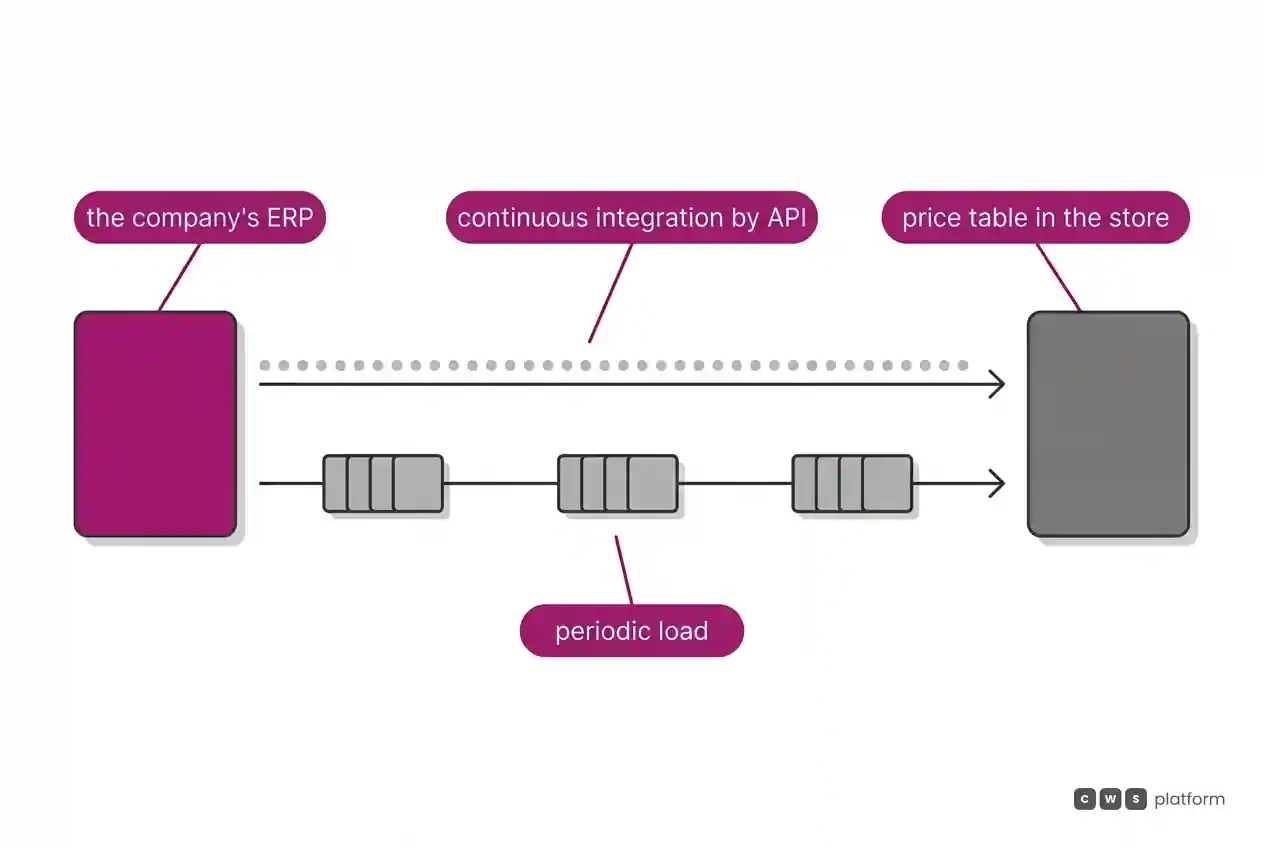
On Salesforce, the B2B Commerce introduction describes accounts, products, price books, and entitlements imported by CSV, asynchronously, up to 10,000 products per session, with export of up to 300,000 products and a recommendation to use Data Loader for large loads. B2B stores use only a custom checkout, in which third-party providers supply the services.
The question is the same for both: does the ERP price table arrive through continuous integration or periodic loads, and who maintains that bridge.
Cost and billing model
The sources for this comparison say little about billing. On VTEX, the extensibility guide says that in Master Data, native entities are free and custom entities are billed monthly, in tiers, by document volume. On Salesforce, billing is not described in the Commerce Cloud sources used here.
With both, ask in writing what is in the base contract, what is an add-on, and whether B2B and D2C are licensed together or separately.
Implementation and ongoing support
VTEX is a multitenant cloud platform: the B2B apps are installed through VTEX IO, and B2B Organizations brings Storefront Permissions as a required dependency and must be declared in the theme manifest (B2B Organizations). Campaign audiences and their promotions only work in the store's main account, according to the campaign promotion page.
On Salesforce, the B2B store starts from templates, is customized in Experience Builder, and configured with Lightning features, and access is controlled by profiles and permission sets (B2B Commerce introduction).
Ask where each channel rule is stored and who changes it when the policy changes.
When to choose VTEX
Retail and B2B under the same orchestration. VTEX unifies ecommerce, physical stores, marketplace, and B2B under the same order orchestration, with global inventory visibility, according to the VTEX Commerce Platform page.
A range of promotion mechanics. The promotions module offers six types, including Buy Together, More For Less, and Progressive Discount, with coupons tied to one or more promotions.
Lots of ready-made integrations. The composability guide lists more than 750 API endpoints and more than 900 ready-made integrations with payment providers and marketplaces.
When to choose Salesforce Commerce Cloud
B2B and D2C in the same org. The same Salesforce org can run both channels with shared data and processes, according to the B2B Commerce introduction.
Several storefronts by brand, locale, or channel. In B2C, one site can expose several storefronts with distinct URLs by brand, locale, or channel, according to the B2C Commerce getting started guide.
Access by profiles and buyer groups. Buyers associated with accounts and groups, with profiles and permission sets, self-registration, and guest browsing, according to the same B2B Commerce introduction.
When neither fits
In some operations the B2B channel is not an extension of retail: it is the main channel, with customer-specific price tables, contracts, and sales reps, and the company does not want its rules to depend on B2C rules. For those, there is a third model, described in the three B2B commerce platform models: bring the commercial rules into the platform.
That is the CWS Platform model. Price tables, rules, and contracts are configurable in the platform and can come from the ERP or CRM by API, and thousands of promotions can run at the same time. Commercial policy lives in parameters in the CDL Workspace. One sales rep serves thousands of customers, customer and rep use the same interface, and the rep can build the cart and send the link for the customer to close. The rep's discount goes through multi-level approval. The platform brings together 11 modules, 6 AI Agents, and 1,029 parameters.
The vendor-by-vendor readings against CWS are in VTEX B2B Commerce vs CWS Platform and assisted sales and the digital counter: Salesforce vs CWS Platform. If your retail promotions and your distributor price tables need to coexist without running into each other, it is worth talking to a CWS Platform specialist and testing that scenario with your own data.
Frequently asked questions
VTEX or Salesforce Commerce Cloud: which is better for B2B?
It depends on where B2B comes in. VTEX fits companies that want to add B2B to a unified retail operation, with B2B Suite apps and promotions from the native module. Salesforce Commerce Cloud fits companies that want B2B and D2C in the same Salesforce org, with shared data and processes.
Which one handles B2B promotions better?
The two handle promotions differently, and each has a public record worth testing. VTEX has six promotion types, and records as a known issue that minimum or maximum amount promotions may fail on items with a unit multiplier. Salesforce documents a cap of 5,000 promotions per org, counting inactive ones.
How does each one handle customer-specific price tables?
On VTEX, the B2B Organizations app gives each buying organization its own price tables, and contracts live in the B2B Buyer Portal, for selected accounts. On Salesforce, price books and entitlements are loaded by CSV, and the documentation records that each pricing call evaluates at most 25 price books, with 5 assigned per store.
Can you run B2B and B2C on the same platform?
On both, yes. VTEX unifies ecommerce, physical stores, marketplace, and B2B under the same order orchestration. Salesforce lets you run B2B and D2C in the same org, with shared data and processes, and it is worth asking how the promotion and price book limits are shared across the channels.
Read Also
Brands mentioned in this article
 VTEX
- Salesforce
Trademarks and logos belong to their respective owners. Mention does not imply partnership or endorsement.
"responsive, technically engaged, and willing to work through complex commercial rules (negotiated pricing, credit, customer-specific conditions) rather than pushing generic answers"
Are your channels competing for the same customer?
Request an assessment of your operation or talk straight to a specialist, whichever you prefer.
I'd rather get the next articles on channel conflict
A weekly roundup of new articles on channel conflict, only in weeks when there is one. No spam, and you can leave in one click.