VTEX vs SAP Commerce Cloud: what can a CFO predict before signing?
Through a CFO lens: which variable each vendor uses to build the proposal and what can reach the invoice after signing.

Editorial note: CWS Platform competes with both VTEX and SAP. This comparison uses only each vendor's public documentation, with the address next to each fact and the date of each record cited.
Short answer: VTEX fits companies that want a composable, multi-tenant platform with many prebuilt integrations and B2B delivered through apps; contracts and organizational units belong to the B2B Buyer Portal, available for selected accounts. SAP Commerce Cloud fits companies that already run SAP's ERP; the edition tied to it requires SAP Finance licenses as a prerequisite. For the CFO, the difference lies in what can be predicted before signing.
Before signing, a CFO needs two answers worth getting in writing: which variable the vendor uses to price the proposal, and what can reach the invoice afterward without a new negotiation. VTEX and SAP answer them differently. The broader map is in our post on the three B2B commerce platform models, and the other comparisons are in the comparisons hub.
VTEX and SAP Commerce Cloud side by side
The table summarizes what each vendor's documentation records on the eight points that matter in B2B.
| point | VTEX | SAP Commerce Cloud |
|---|---|---|
| Platform model | Composable, multi-tenant cloud platform, with microservices and more than 750 API endpoints | Modular platform on public cloud (version 2211), extended through extensions and AddOns |
| Native B2B or extension | B2B Suite apps (organizations, cost centers, quotes, and permissions); the B2B Buyer Portal is available for selected accounts | Account-based buying, customer-specific catalogs, and multi-step approval |
| Customer and contract pricing | Price table, payment methods, and collection per buying organization; contracts in the B2B Buyer Portal, for selected accounts | Contract prices in the buyer's account; prices and discounts replicated from SAP S/4HANA or SAP ERP |
| Quotes | B2B Quotes & Carts app, with quotes created from the cart, price adjustments, and a status cycle | Quotes converted to orders by the buyer; RFQ through SAP CPQ via SAP Cloud Integration |
| Credit and payment terms | Customer credit among the methods accepted by the Payment Gateway | Not documented in the sources for this comparison |
| ERP integration | Connectivity for ERP, WMS, and carrier integrations; REST APIs | SAP Commerce Cloud Integration with ERP package; cloud ERP edition with connectivity managed by SAP |
| Billing model | License basis not documented in the sources for this comparison; custom Master Data entities billed by document volume | Blocks of 50,000 orders per year or GMV |
| Deployment | VTEX IO apps installed through the CLI; built-in or plug-and-play components | Builds from a Git repository and build manifest in the Cloud Portal; cloud ERP edition with a standard implementation of about 12 weeks |
Pricing and commercial rules: what comes in your account's package
At VTEX, the B2B Organizations app groups business users into organizations that share commercial rules: each organization can have its own payment methods, price tables, and product collections, and is split into cost centers with their own shipping addresses, according to the B2B Organizations documentation. Contracts, organizational units, scopes, and spending controls live in the B2B Buyer Portal, which the B2B Buyer Portal page describes as available for selected accounts.
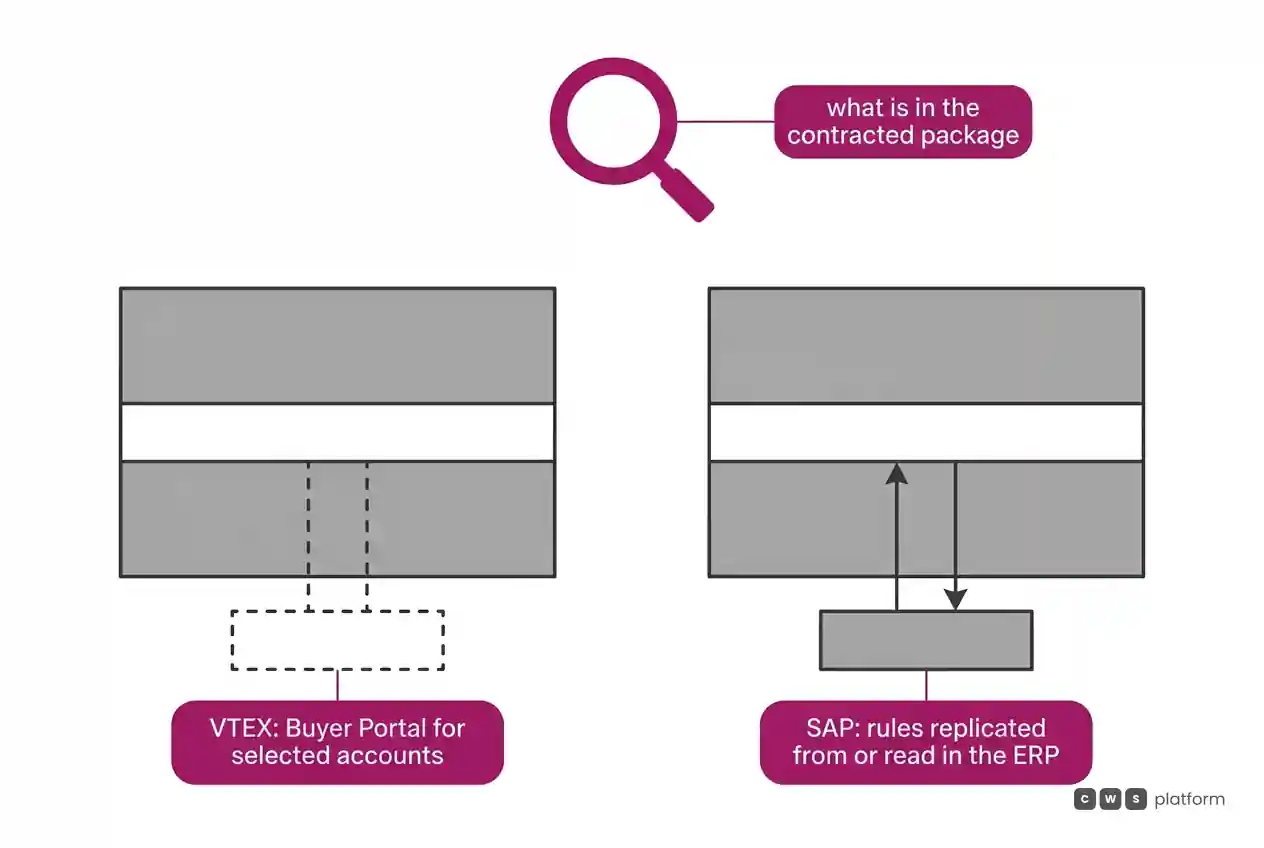
In SAP Commerce Cloud, promotions run on a rule engine that combines conditions and actions, according to the payments and promotions page. Catalog prices can be replicated from SAP ERP or SAP CRM, and in the cloud ERP edition price, inventory, and order status are read from SAP Cloud ERP as the source of truth.
For the CFO, the question before signing is whether the capability is in the package the company is buying. At VTEX, confirm in writing whether the company's account is among those selected for the B2B Buyer Portal, if contracts and organizational units are in scope. At SAP, confirm whether the rule will run replicated from the ERP or read from it, because each design calls for a different team and operating cost.
Quotes and assisted selling
At VTEX, the B2B Quotes & Carts app stores quotes in a quotes entity in Master Data V2 and works with the READY, PENDING, REVISED, DECLINED, EXPIRED, and PLACED statuses, with filters by organization and cost center, according to the B2B Quotes documentation and the quotes GraphQL API.
In SAP Commerce Cloud, the service agent works in the same storefront interface customers use, according to the Assisted Service Module documentation. Complex quotes go from Commerce to SAP CPQ through SAP Cloud Integration and come back as orders bound for SAP S/4HANA, as the quote-to-cash integration course describes.
At VTEX, quotes live in Master Data, and the extensibility guide records that native entities are free while custom entities are billed monthly, in tiers, by document volume: ask which of the two your quote volume falls under. At SAP, ask whether CPQ and SAP Cloud Integration are in the proposal or under separate contracts.
ERP integration
The VTEX Commerce Platform page records order orchestration with global inventory visibility and connectivity for ERP, WMS, and carrier integrations. The composability guide cites more than 900 prebuilt integrations with payment providers and marketplaces.
At SAP, price and discount replication from SAP S/4HANA or SAP ERP runs on SAP Cloud Integration, with the "SAP Commerce Cloud Integration with ERP" package, according to the price replication documentation. In the cloud ERP edition, connectivity is managed by SAP itself.
For companies on SAP's ERP, SAP offers a product path, with the prerequisites covered in the next section. For another ERP, ask both vendors who builds and maintains the connector, and on which invoice that cost appears.
Cost and billing model: what the proposal asks you to price
Recorded in VTEX's documentation, accessed on November 5, 2026: the contact form on the Get started page asks for the annual GMV range in US dollars ("Annual GMV (USD) * Select your annual GMV range", VTEX Get started page).
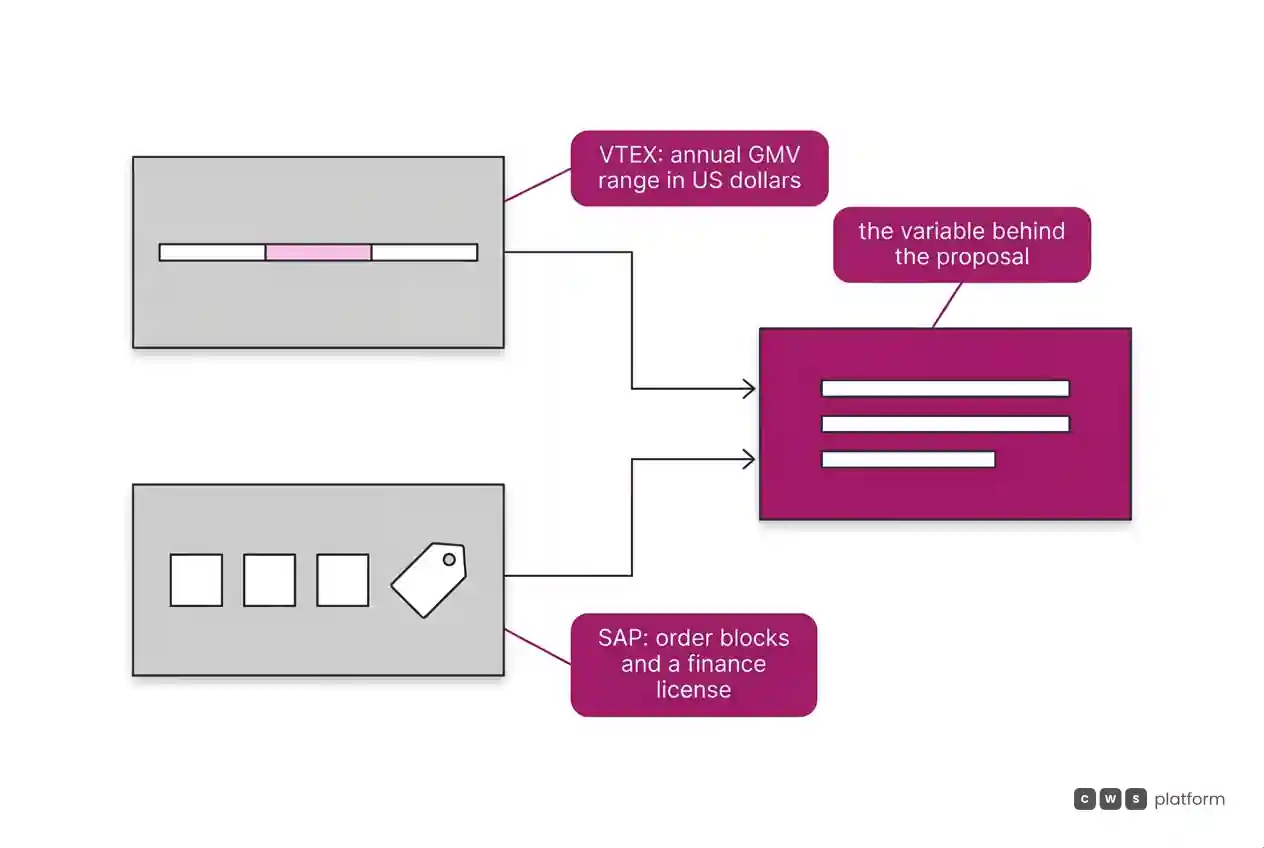
The SAP Commerce Cloud plans and pricing page records platform billing in blocks of 50,000 orders per year or by GMV. Recorded in SAP's documentation, in a page dated September 15, 2026: the cloud ERP edition is sold in blocks of 10,000 orders per year and has SAP Finance licenses as a prerequisite ("In blocks of 10000 Orders per year", cloud ERP edition page).
Both records show which variable each proposal starts from: VTEX asks for the annual GMV range; SAP sells in blocks of orders or GMV and, in the cloud ERP edition, requires a finance license first. For companies that report in another currency, the dollar range also depends on the exchange rate. What the CFO can predict before signing is the variable, not the amount. Ask both vendors for the tier table in writing and, at SAP, for the cost of the SAP Finance licenses if the company does not have them yet.
Deployment and maintenance: what reaches the invoice afterward
Recorded in VTEX's documentation, accessed on November 5, 2026: the App Store page states that an app's cost is automatically added to the VTEX invoice right after purchase ("The costs will be automatically added to your VTEX invoice immediately after you buy the app.", Extensions Hub App Store).
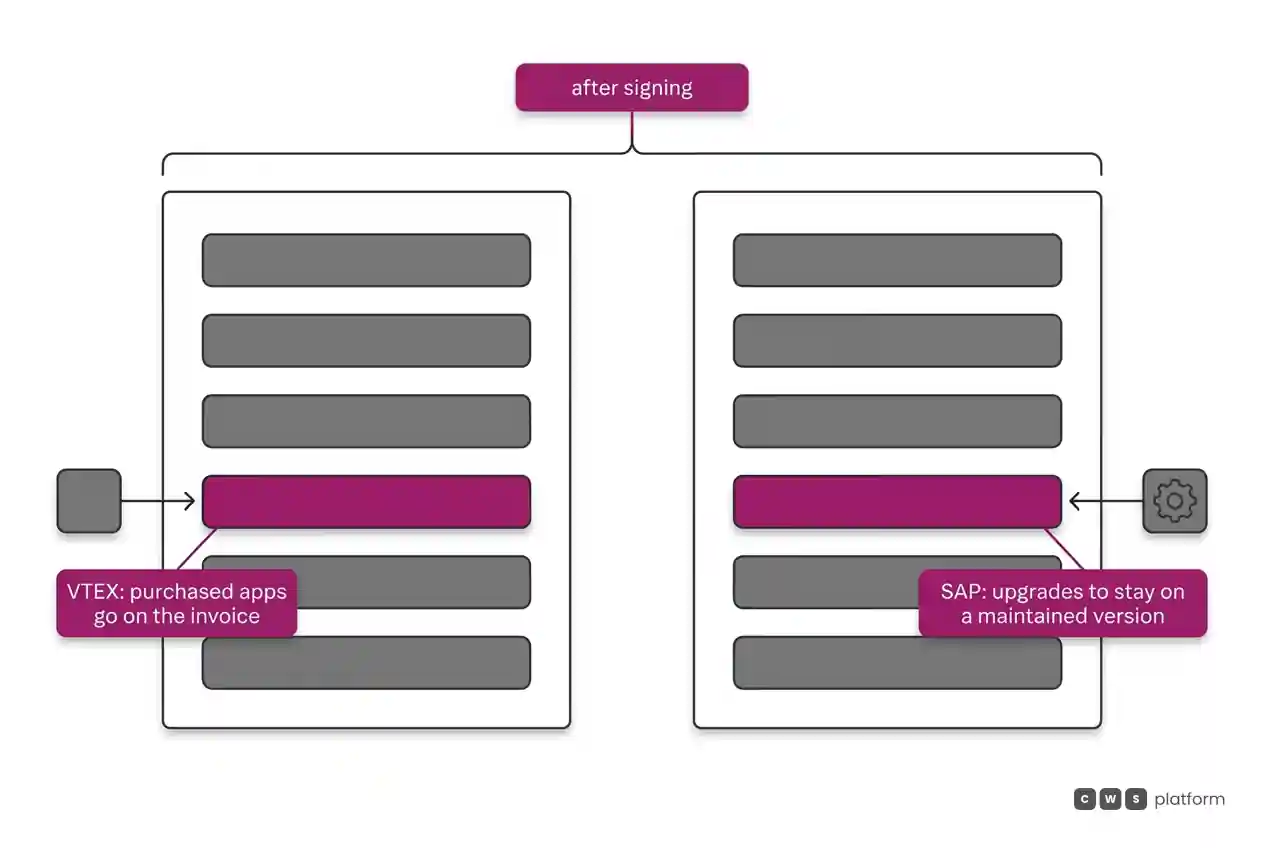
Recorded in SAP's documentation, in a page dated September 9, 2026: SAP states that continuing to run a version without maintenance can put the customer in breach of the SAP contract and lead to its termination ("you could be in breach of your SAP contract", SAP Commerce Cloud maintenance policy).
After signing, the bill changes along different paths: at VTEX, each app purchased reaches the invoice at the moment of purchase; at SAP, the release calendar carries contractual weight, and upgrades enter the budget as a recurring project. Ask VTEX for the list of apps the operation will use, with prices, and ask SAP for the release calendar for the contract term.
When to choose VTEX
A prebuilt integration ecosystem. The composability guide records more than 750 API endpoints and more than 900 prebuilt integrations with payment providers and marketplaces.
Retail, marketplace, and B2B in one operation. The VTEX Commerce Platform page describes ecommerce, physical stores, marketplace, and B2B under the same order orchestration.
Accounts organized by organization and cost center. B2B Organizations separates buyers by organization and cost center, and bulk import loads organizations, cost centers, and members from a spreadsheet.
When to choose SAP Commerce Cloud
Companies already on SAP's ERP. The cloud ERP edition runs integrated with SAP Cloud ERP, with connectivity managed by SAP, and SAP's announcement on commerce built for ERP cites a standard implementation of about 12 weeks.
One portal for orders from every channel. The same announcement describes a self-service B2B portal that centralizes orders, invoices, contracts, and shipments generated digitally and through external channels such as EDI, email, phone, and field sales.
High-complexity quoting. SAP CPQ controls discounts with guardrails and handles quotes with more than 10,000 lines.
When neither fits
VTEX and SAP Commerce Cloud start from different places, but both fit the model of a storefront platform that takes on B2B. Our post on the three B2B commerce platform models describes a third path: moving commercial rules into the platform.
That is the CWS Platform model. Pricing is a platform license plus an integration license, with no percentage of sales or GMV; in a marketplace operation, the split percentage is the marketplace owner's commission, not CWS's. All customers run the same version. Price tables, rules, and contracts are configurable in the platform and can come from the ERP or CRM through APIs, with commercial policy stored as parameters in the CDL Workspace. The platform includes 11 modules, 6 AI Agents, and 1,029 parameters.
How each vendor compares with that model is covered in VTEX vs CWS Platform on three-year B2B cost and SAP Commerce Cloud vs. CWS Platform: Does Your License Scale with Sales Volume?. If the proposal still leaves open lines, talk to a CWS Platform specialist with your real volume and scope.
Frequently asked questions
VTEX or SAP Commerce Cloud: which costs less over three years?
The sources for this comparison do not include prices for either one. What can be compared before signing is the variable: VTEX asks for the annual GMV range in US dollars to build the proposal, and SAP sells in blocks of orders per year or GMV. The three-year model only closes with both proposals and the same volume scenarios.
How does each one bill?
At SAP, the pricing page records blocks of 50,000 orders per year or GMV, and the cloud ERP edition is sold in blocks of 10,000 orders per year, with SAP Finance licenses as a prerequisite. At VTEX, the billing basis is not in the sources for this comparison; what is recorded is that the contact form asks for the annual GMV range.
What reaches the invoice beyond the license?
At VTEX, the cost of an App Store app is added to the invoice right after purchase, and custom Master Data entities are billed monthly by document volume. At SAP, what weighs after signing is the release cycle: running a version without maintenance can put the customer in breach of contract, so upgrades need to be in the budget.
Which one makes sense for companies that already run SAP?
The cloud ERP edition of SAP Commerce Cloud runs integrated with SAP Cloud ERP, with connectivity managed by SAP, and requires SAP Finance licenses as a prerequisite. VTEX documents connectivity for ERP integrations. For SAP customers, the comparison is between maintaining a connector and buying the dedicated edition with its prerequisites.
Brands mentioned in this article
 VTEX

- SAP Commerce Cloud
Trademarks and logos belong to their respective owners. Mention does not imply partnership or endorsement.
"responsive, technically engaged, and willing to work through complex commercial rules (negotiated pricing, credit, customer-specific conditions) rather than pushing generic answers"
Is selling more not turning into margin?
Request an assessment of your operation or talk straight to a specialist, whichever you prefer.
I'd rather get the next articles on margin and discounts
A weekly roundup of new articles on margin and discounts, only in weeks when there is one. No spam, and you can leave in one click.