VTEX vs. CWS Platform: what is the B2B total cost over three years?
A fee on order value, add-ons under subscription agreements, and extensions on the invoice: how to build the three-year spreadsheet through the CFO lens.

Editorial note: an architecture comparison between VTEX and CWS Platform, written for those who answer as CFO. Every fact about VTEX comes from its public documentation or from the annual report it filed with the SEC, with the address next to it.
The platform proposal reaches the CFO with a year-one number. The question the CFO has to answer is a different one: what does the bill look like in year three, if the digital channel works? For a manufacturer or distributor, working almost always means moving into the portal the orders that arrive today by phone, email, and field reps. Most of the volume in digital B2B tends to sit in the existing book of business, not in new customers.
That detail changes the spreadsheet. When a platform's main cost line is a percentage of order value, every order that moves into the portal takes with it a slice of revenue the company already had. The channel can lower the cost of transacting across the distribution chain, which is the reason it exists, and still hand back part of that gain on the platform invoice.
This comparison looks at VTEX and CWS Platform from that angle only: what goes into the three-year bill. It is not a feature ranking. The overall map is in the post on the three B2B commerce platform models, and the other vendor reads are in the comparisons hub.
What VTEX does well
VTEX removes part of the cost of building. According to its composability guide, it runs as a composable, multitenant cloud commerce platform, with more than 750 API endpoints and more than 900 ready-made integrations with payment providers and marketplaces. A ready-made integration is a connector the project does not have to write.
The Extensions Hub brings discovery, contracting, installation, and management of extensions into the admin panel, split into App Store, App Management, and Partners. Per the Extensions Hub announcement, purchases and subscriptions happen in the Admin and are billed on the VTEX invoice, in local currency, with no credit card at checkout.
And the documentation explains how a data line is billed. Per the extensibility guide, in Master Data native entities are free and custom entities are billed monthly, in tiers, based on the total volume of documents.
Where the architecture diverges
The divergence that matters to the CFO sits in two records: one on how the main billing line is built, the other on what sits outside it.
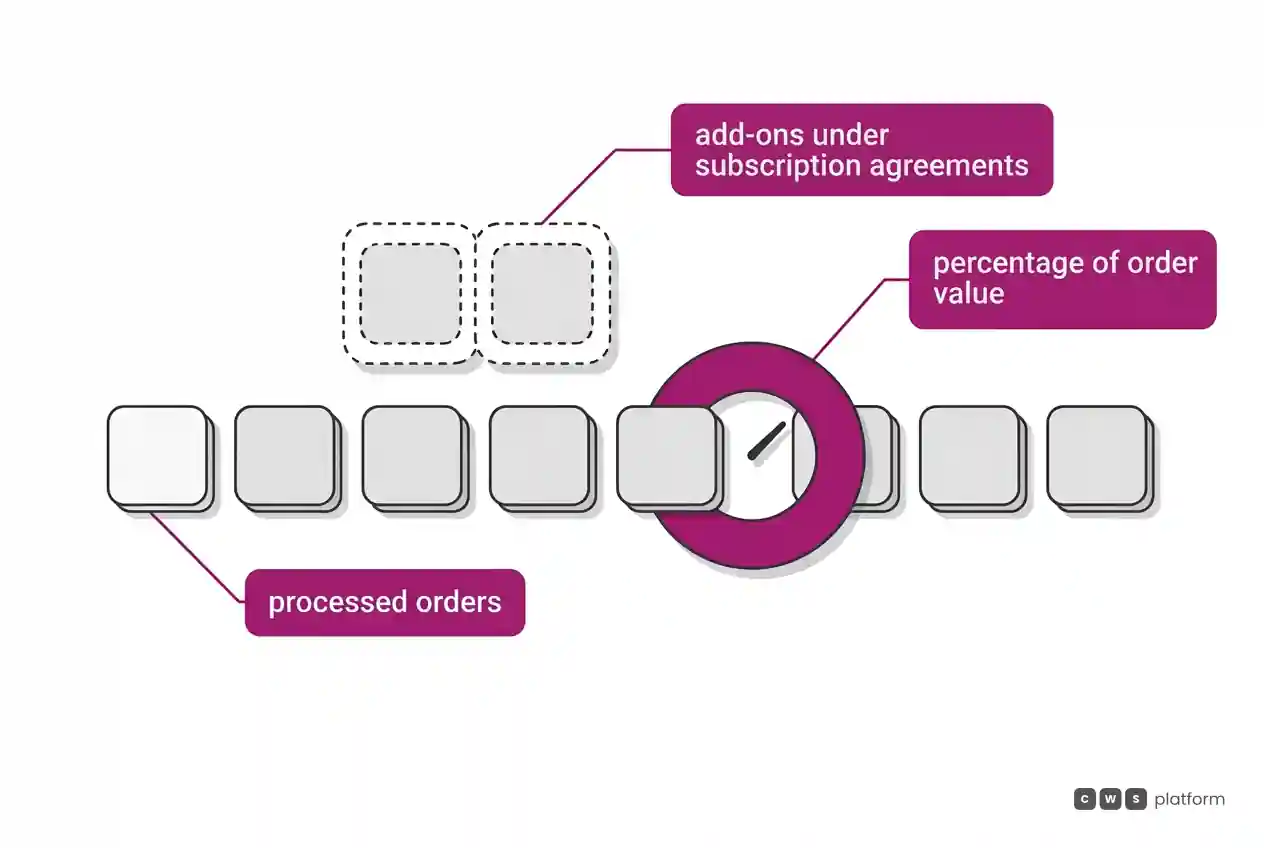
- limitation recorded in the 20-F annual report VTEX filed with the SEC, accessed on November 5, 2026: VTEX states that the transaction-based fee accounts for most of its subscription revenues and is primarily structured as a take rate or percentage of the total value of orders processed through its platform ("The transaction-based fee accounts for most of our subscription revenues and is primarily structured as a take rate or percentage of the total value of the orders processed through our platform", https://www.sec.gov/Archives/edgar/data/1793663/000119312526076504/ck0001793663-20251231.htm).
- limitation recorded in VTEX's documentation on September 22, 2026: VTEX states that add-on products can be purchased separately through a subscription agreement ("They can be purchased separately through a subscription agreement.", https://help.vtex.com/en/docs/tracks/add-on-products).
The first record says which variable drives the bill. If most subscription revenue comes from a percentage of the value of orders processed, the main line grows in the same proportion as the value flowing through the platform. In B2B, with high average order values and recurring reorders, that variable weighs more each year. The rate itself is whatever the contract says; what the report makes clear is the base it applies to.
The second record says where to look for the rest. An add-on product bought through a subscription agreement is its own line in the spreadsheet, with its own contract. Before signing, it is worth asking for the list of what the operation will use that is not in the base contract.
On CWS Platform, pricing is a platform license plus an integration license, with no percentage of sales or of GMV. When the operation is a marketplace, the split percentage is the marketplace owner's commission, not CWS's. And all customers run the same version of the platform.
| decision | VTEX, per the documented mechanism | CWS Platform |
|---|---|---|
| How the main billing line is built | Transaction-based fee, primarily structured as a percentage of the total value of orders processed, per the 20-F | Platform license plus integration license, with no percentage of sales or GMV |
| What sits outside the base contract | Add-on products, purchased separately through a subscription agreement | A question for any vendor's contract, with the list in writing |
| Extensions and custom data | Apps billed on the VTEX invoice; Master Data custom entities billed by document volume | REST APIs and webhooks; price tables, rules, and contracts can come from the ERP and CRM through APIs |
| Percentage in a marketplace | Not covered by the sources in this comparison | The split percentage is the marketplace owner's commission |
The financial decision is knowing which variable drives the three-year bill: the value flowing through the platform, or the contracted license.
What changes in operations, through the CFO lens
For the CFO, the difference shows up in how the spreadsheet is built, in five lines.
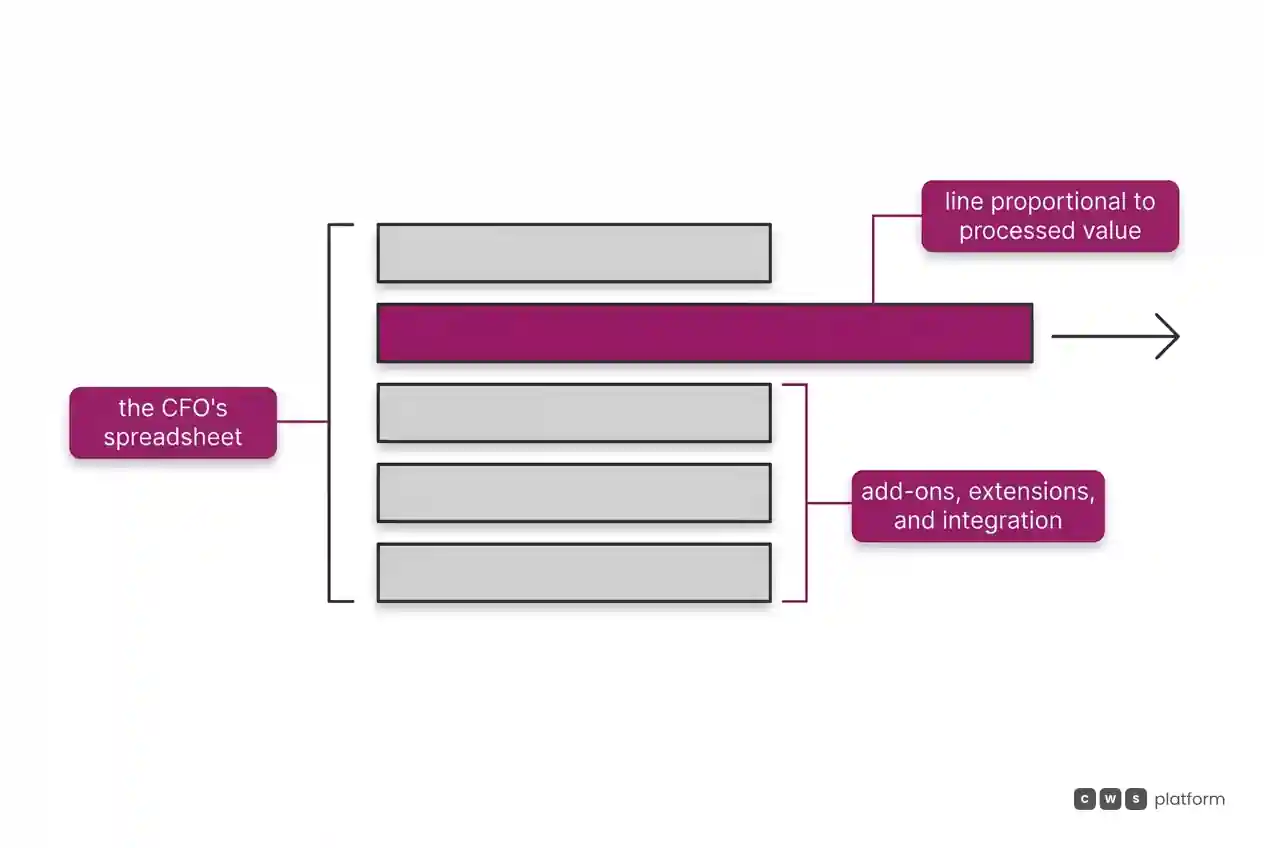
The first is the channel's projected GMV, year by year, split in two: orders migrating from current channels and new orders. The split matters because, when billing is based on order value, migrating the existing book of business also enters the base. Run three scenarios, conservative, base, and optimistic, not a single number.
The second is the line proportional to processed value. It multiplies each scenario by the contract rate and, by construction, grows with the channel. Ask the vendor in writing which orders enter the base: those placed by sales reps, cancelled ones, returned ones.
The third is add-ons. Each product bought through a subscription agreement goes in as its own line, with the start date and term of its contract.
The fourth is extensions and data. Apps bought in the App Store go on the VTEX invoice, and Master Data custom entities enter the bill by document volume. If the project stores commercial rules in a custom entity, the volume of those rules becomes cost too.
The fifth is implementation and ERP integration, which applies to any vendor and tends to be the most underestimated line.
On CWS, the line proportional to processed value comes out of the spreadsheet: the license is a platform license and an integration license, with no percentage of sales. What is left to compare is the value of the licenses against the size of the channel the company expects to have, and the channel's effect on the transaction cost of each order. For anyone looking at enterprise value, not only at the year's results, the digital channel's margin also enters the read on the multiple.
When to choose VTEX
VTEX fits scenarios with these characteristics:
A channel that starts small and prefers variable cost. Choose this architecture when the company wants the main billing line to follow transacted value, as described in the 20-F annual report accessed on November 5, 2026 and recorded above, and accepts that this line grows with the channel.
Consumer retail and retail marketplaces. Choose this architecture when the operation serves end consumers, with ecommerce, physical stores, and marketplace under the same order orchestration, as the VTEX Commerce Platform page shows.
A partner and app ecosystem. Choose this architecture when the strategy depends on many ready-made integrations and on contracting extensions and partners through the Extensions Hub, with billing concentrated on the VTEX invoice.
When CWS Platform is the right choice in this scenario
CWS Platform is the right choice when the digital channel will absorb the existing B2B book of business and the CFO does not want a cost line tied to the value sold.
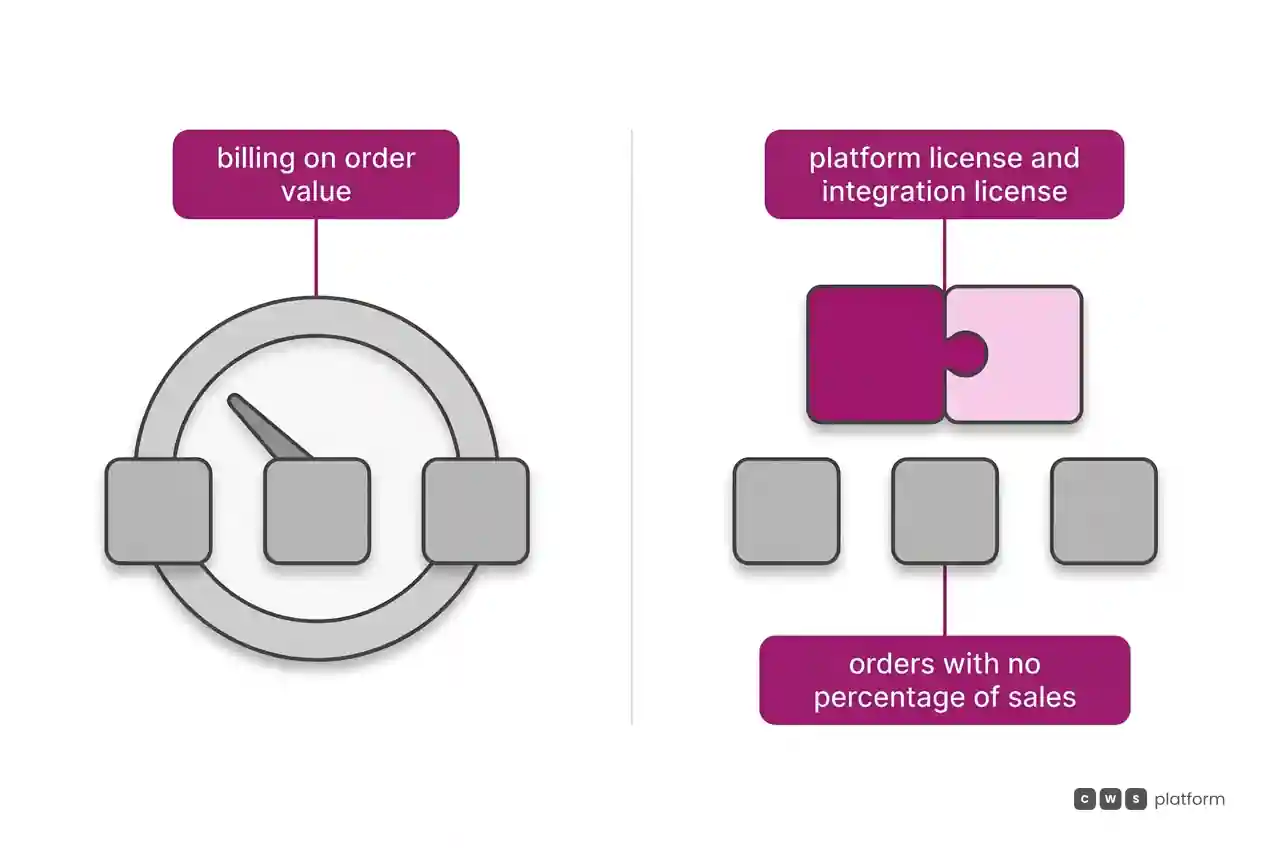
An existing book of business moving to digital. Choose this architecture when most of the channel's volume is orders that arrive today through other means. The license is a platform license and an integration license, with no percentage of sales or GMV.
A marketplace with its own commission. Choose this architecture when the company will run a marketplace and wants the split percentage to be only its own commission, as marketplace owner.
One version for every customer. Choose this architecture when the channel needs every customer on the same version of the platform. The platform brings together 11 modules, 6 AI Agents, and 1,029 parameters.
Commercial rules that come from the ERP. Choose this architecture when price tables, rules, and contracts already live in the ERP or CRM. They can reach the platform through APIs, and tax comes from the ERP or from the tax engine the company already uses.
Where to go from here
If the question is still which platform model fits your operation, the starting point is the three B2B commerce platform models. To see the same bill built with another vendor, the comparison what goes into the math when the digital channel grows reads it through the CFO lens.
If the decision depends on the volume your channel will carry, it is worth talking to a CWS Platform specialist and building, with your real GMV and orders, the three scenarios of the spreadsheet. The page When Selling More Doesn't Mean Earning More covers the pain behind this scenario in depth, without talking about any vendor.
Read more
- Sales tax engines, state nexus, and ERP sync: where tax compliance lives in B2B e-commerce
- B2B system integration architecture: what to integrate first and how
- B2B customer portals and self-service ordering
Comparisons with other vendors
To compare VTEX with other platforms, without CWS Platform in the middle:
- VTEX vs Adobe Commerce: which one handles the typical B2B order?
- VTEX vs Salesforce Commerce Cloud: can B2B and retail coexist?
- VTEX vs SAP Commerce Cloud: what can a CFO predict before signing?
- VTEX vs. commercetools: Packaged B2B Suite or Composable APIs?
- VTEX vs Spryker: which fits a B2B marketplace with sellers?
- VTEX vs Optimizely: what goes on the B2B bill?
- VTEX vs OroCommerce: what can change after an order is invoiced?
- B2B ecommerce platforms: the 9 leading options compared
Brands mentioned in this article
 VTEX



- Adobe Commerce
- Salesforce
- SAP Commerce Cloud
- Optimizely
- OroCommerce
Trademarks and logos belong to their respective owners. Mention does not imply partnership or endorsement.
"responsive, technically engaged, and willing to work through complex commercial rules (negotiated pricing, credit, customer-specific conditions) rather than pushing generic answers"
Is selling more not turning into margin?
Request an assessment of your operation or talk straight to a specialist, whichever you prefer.
I'd rather get the next articles on margin and discounts
A weekly roundup of new articles on margin and discounts, only in weeks when there is one. No spam, and you can leave in one click.