B2B Sales Channels: How to Align Field Reps, Inside Sales, Customer Portals, and Marketplaces
How to unify pricing tiers, order capture, and sales incentives to eliminate channel conflict and reduce the cost to serve.

TL;DR
- The five most common B2B sales channels are outside sales reps (or field reps), inside sales and phone reps, self-service B2B portals, marketplaces, and messaging apps such as WhatsApp.
- They coexist without conflict when three fundamentals are shared across all of them: the exact same price list per account, the exact same order in the exact same system, and an aligned commission structure.
- Every channel has a different cost to serve. The right question is not which channel is best, but rather which account and which transaction type belongs in which channel.
- A channel map becomes policy when each route has a clearly defined role, an owner, and documented rules, especially for orders that begin in one channel and close in another.
B2B sales channels are the paths through which business buyers place orders: field sales reps, inside sales teams, self-service B2B portals, marketplaces, and messaging platforms such as WhatsApp or SMS, as well as physical branch counters for distributors with brick and mortar locations. These channels coexist smoothly when a business treats every route as an entry point for the same master order, governed by the same pricing rules and operating logic, rather than as competing silos fighting over the same account.
Almost every distributor and manufacturer operates three or four of these channels simultaneously, often without having made a deliberate strategic choice. A new channel is introduced because an important customer requested it, because a competitor launched one, or because messaging apps were already on everyone's phone. The result is an operating map built on accidental accumulation.
What Are the Core B2B Sales Channels
Outside sales and field reps. They visit client locations, negotiate commercial terms, and open new accounts. This is the most expensive channel per order, but it remains the most effective for relationship building and complex, high-touch sales.
Inside sales and phone reps. They manage larger books of business by phone, email, and messaging at a significantly lower cost per order. They typically handle replenishment for small and mid-market accounts.
Self-service B2B portal. Customers log in to view their specific pricing, check live inventory, and build orders independently. It is the lowest cost-to-serve channel for recurring, high-frequency replenishment.
Marketplaces. These can be third-party platforms where the company operates as a vendor, or proprietary marketplaces where the company curates third-party suppliers. They generate net new demand, but operate under external commercial rules, data boundaries, and take rates.
Messaging channels (WhatsApp and text). In modern distribution, messaging is rarely an isolated channel. In practice, it serves as the medium through which field reps and inside sales reps communicate with buyers, and where orders frequently get negotiated off the record.
Why Channels Conflict
Sales channels do not conflict by nature. They conflict because each channel was stood up with its own independent commercial rules. The field rep exercises historical discretion over discretionary discounts. The web portal launches with formal list pricing. The inside sales rep quotes from a manager's local spreadsheet. The marketplace team posts pricing determined by the e-commerce team.
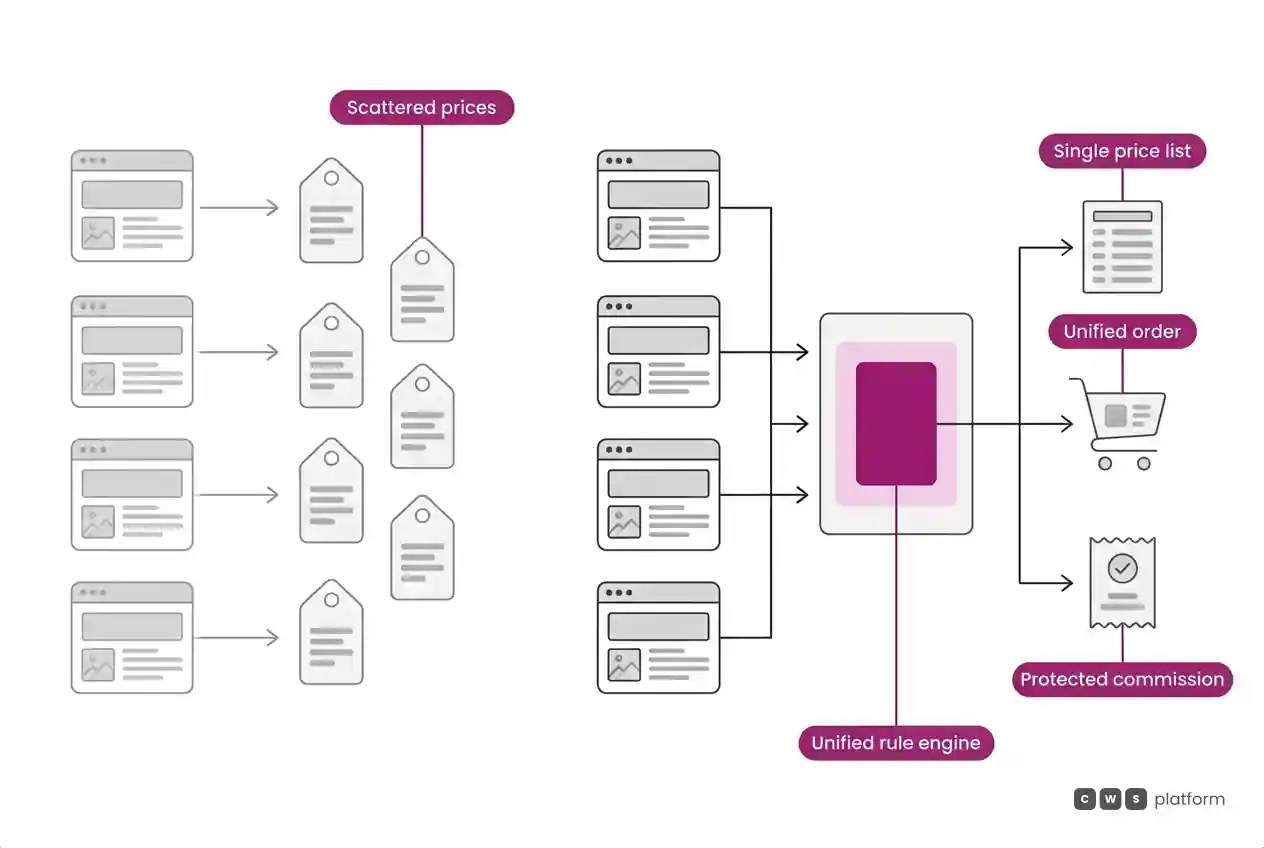
To the buyer, this appears as four conflicting prices for the exact same SKU. Buyers quickly learn which channel offers the steepest discount, shifting to use the remaining channels purely for reference and inventory checks. The result is what we define as B2B channel conflict: artificial portal adoption, surrendered gross margins, and a cost to serve that fails to decline.
What Must Be Shared Across All Channels
In practical implementations, channel harmony depends on three non-negotiable operational decisions:
1. One price list per account. A customer's contracted pricing must be a single system record, queried equally by the portal, the field rep, the inside sales team, and the marketplace where applicable. Any variance between channels must exist as an explicit, rule-based incentive, such as a documented discount for self-service digital orders.
2. One order, one system. An order might originate via messaging and be completed inside the portal, or begin as an online draft and be finalized by an account executive. What cannot happen is each channel maintaining its own order record that requires manual re-entry into the ERP.
3. Commission plans that do not penalize low-cost channels. If a field rep is only compensated on orders they enter manually, they will actively pull accounts away from the digital portal. The model that works ensures that account reps receive commission credit for assigned accounts regardless of which channel captures the order.
How to Assign Roles to Each Channel
The practical question is not which channel is superior. It is determining which transaction type belongs in which channel based on the underlying cost to serve. A straightforward channel matrix cross-references customer complexity with transaction complexity.
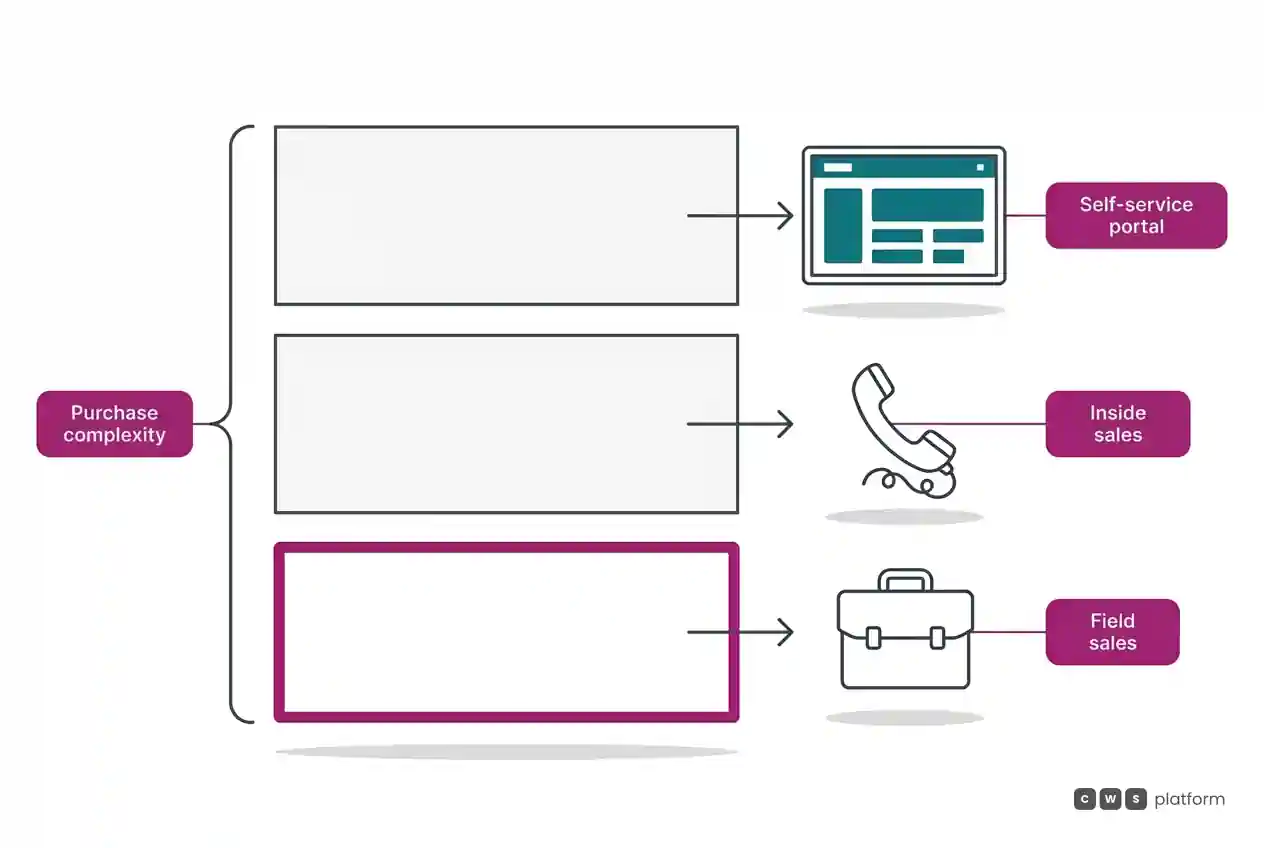
- Routine reorders from small accounts: Self-service portal, supported by inside sales for accounts that encounter friction.
- Routine reorders from major accounts: Self-service portal, freeing outside sales reps to focus on annual contract reviews, category expansion, and strategic exceptions.
- New, technical, or custom-configured purchases: Consultative sales reps, with the proposed quote pushed directly into the digital portal for customer approval.
- Unassigned, net-new demand: Third-party marketplaces and inbound search, paired with clear governance on which team inherits the customer when they return for subsequent orders.
The same logic applies to partner programs and indirect sales channels. A scalable partner channel prioritizes routes by customer lifetime value against customer acquisition cost, locking in lead registration rules, deal protection, and payout structures before operational friction occurs.
Where Messaging Fits In
Messaging channels require a deliberate policy because reps are already using them informally. There are two operating approaches: treating messaging as an enterprise account channel where conversation history and transactions route through central software, or treating it as the rep's personal phone line where commercial commitments happen without an audit trail. The mechanics of these choices are analyzed in messaging apps in B2B.
Next Steps
Map your sales channels on a single page: for each channel, define the owner, target accounts, price lists used, where transactions are recorded, and how commission is structured. Wherever two channels provide contradictory answers for the same account, you have found an active channel conflict. Operating a platform that centralizes pricing and order management across all commercial touchpoints is the focus of CWS Platform's B2B digital sales portal.
Frequently Asked Questions
What are the main B2B sales channels?
Outside sales and field reps, inside sales and phone teams, self-service B2B portals, marketplaces (third-party or proprietary), and messaging channels, as well as branch trade counters for organizations with physical storefronts.
What is an omnichannel B2B strategy?
It is the process of mapping specific customer segments and purchase types to the most cost-effective channel, while maintaining unified pricing, a single order management record, and clear commission attribution across every touchpoint.
How do you prevent B2B channel conflict?
By implementing account-specific pricing unified across all channels, formalizing any channel-specific price differences as explicit business rules, and compensating sales reps for all orders originating from their assigned book of business regardless of entry point.
Does a B2B portal replace inside sales teams?
Not necessarily. The portal absorbs standard replenishment orders from buyers who already know their part numbers. Inside sales reps transition away from manual data entry to onboarding unengaged accounts, providing technical quotes, and recovering dormant buyers.
Related Articles
- B2B systems integration: what to integrate first and how
- B2B sales fundamentals and core definitions
About This Publication
An article by CWS Platform's Cost of Sales publication, addressing B2B sales channels and cross-channel commercial policies. Does not cite specific client data or confidential financial metrics.
Brands mentioned in this article
 WhatsApp
Trademarks and logos belong to their respective owners. Mention does not imply partnership or endorsement.
"responsive, technically engaged, and willing to work through complex commercial rules (negotiated pricing, credit, customer-specific conditions) rather than pushing generic answers"
Are your channels competing for the same customer?
Request an assessment of your operation or talk straight to a specialist, whichever you prefer.
I'd rather get the next articles on channel conflict
A weekly roundup of new articles on channel conflict, only in weeks when there is one. No spam, and you can leave in one click.