VTEX vs Spryker: which fits a B2B marketplace with sellers?
Through a commerce leader's lens: what the seller controls in the catalog and the channel, and how each platform handles the winning offer and the merchant relationship.

Editorial note: CWS Platform competes with VTEX and with Spryker. This comparison uses only each vendor's public documentation and VTEX's official forum, with the address next to each fact and the date of each record cited.
Short answer: VTEX fits the team that wants to open a B2B marketplace on the same platform as its retail business, with Seller Portal, seller management, and connectors to external marketplaces, accepting that a Seller Portal seller cannot change the marketplace catalog. Spryker fits the team that wants a B2B marketplace organized around commercial relationships, with merchant pricing per buyer business unit, accepting that choosing the winning offer has no built-in ranking.
A commerce leader comparing VTEX and Spryker for a B2B marketplace is deciding who controls each piece of the channel: the catalog, the price, the relationship with the buyer, and the offer that shows up first. Each of those pieces can sit with the operator or with the seller, and each choice changes where channel conflict appears.
The map of platform models is in the three B2B commerce platform models, and the other comparisons are in the comparisons hub, including VTEX vs Salesforce Commerce Cloud and commercetools vs Spryker.
VTEX and Spryker side by side
The table sums up what each vendor's documentation records; where the source does not cover a point, the cell says so.
| criterion | VTEX | Spryker |
|---|---|---|
| Platform model | Composable, multitenant cloud platform, with retail, marketplace, and B2B under the same order orchestration | Merchant Portal for the merchant, Back Office for the operator, and APIs split by profile (Storefront, Back Office, Merchant) |
| B2B native or by extension | B2B Suite apps, such as B2B Organizations, installed through VTEX IO | Platform features: Company Account with business units, Request for Quote, and approval |
| Customer and contract pricing | Price tables per buyer organization | Merchant Custom Prices: merchant pricing per buyer business unit |
| Quoting | B2B Quotes & Carts app, with statuses and price adjustment | Request for Quote with versions, edited by the sales rep |
| Credit and net terms | Customer credit among the payment gateway's methods | Not documented |
| ERP integration | Marketplace Protocol for catalog and orders; connectivity to ERP, WMS, and carriers | Merchant API and Merchant Data Exchange API for the merchant's systems; Data Exchange API for the operator's systems |
| Billing model | Not covered by the sources used here, except custom Master Data entities, billed by document volume | Not covered by the sources used here |
| Implementation | Seller Portal as a VTEX IO edition declared by a sponsor; B2B apps installed through VTEX IO | Order process as state machines in project code; updates through Code Upgrader |
Pricing and commercial rules: what the seller controls
On VTEX, a seller can come in through its own edition of the platform: per the Seller Portal guide, Seller Portal is an edition built for sellers to sell on VTEX marketplaces, with a sponsor that can be VTEX itself or a VTEX marketplace. The Seller Portal Catalog API handles the seller's products, variations, brands, and categories, and B2B Organizations sets price tables and payment methods per buyer organization.
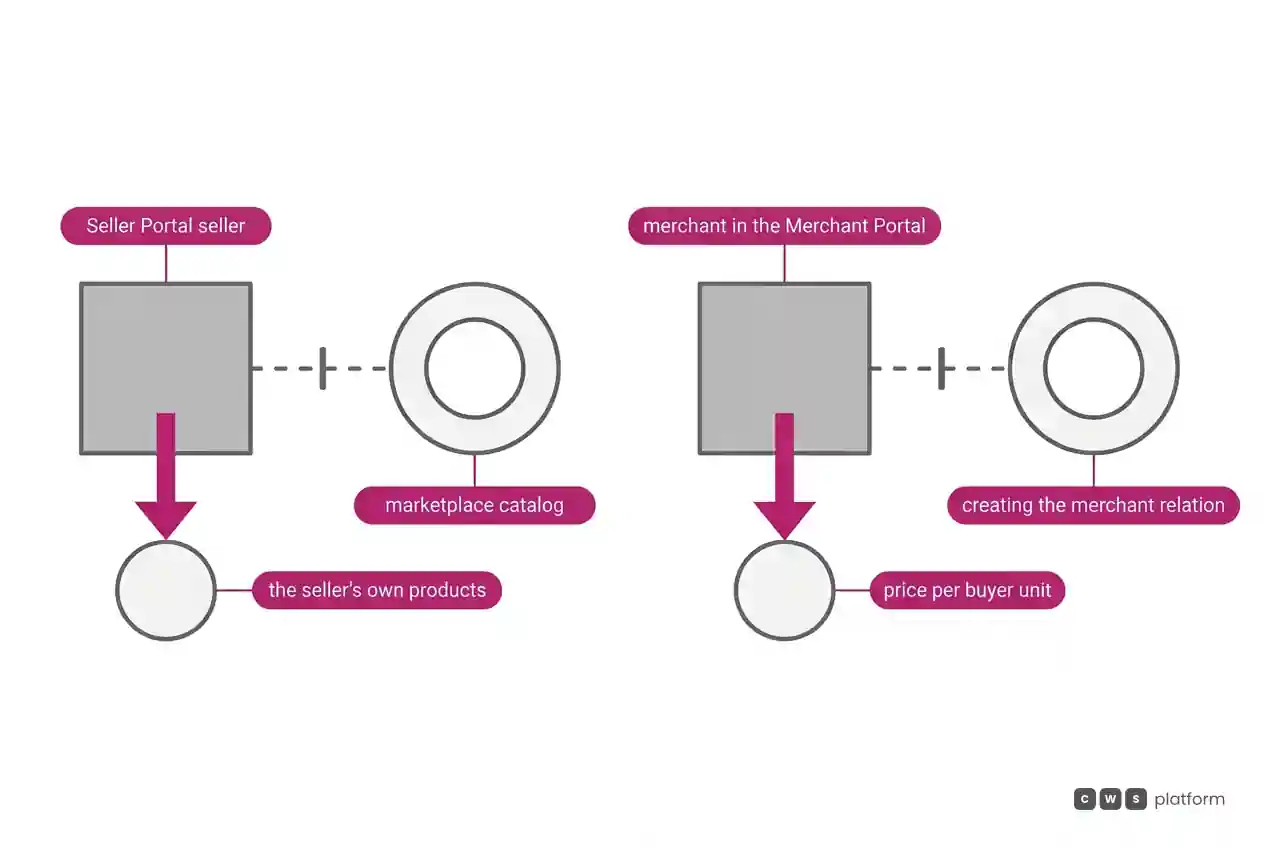
On Spryker, the rule runs through the relationship between merchant and buyer. Marketplace Merchant Custom Prices let the merchant set prices for the business units of B2B customers, in the Merchant Portal or the Back Office. The merchant relationship works as a price dimension, and the buyer sees the price of its relationship, or the default price when the relationship has no value set.
Both sides record what the seller does not control alone.
- On the VTEX side, it is recorded in VTEX's documentation, on a page dated September 16, 2024, that a Seller Portal seller does not touch the marketplace catalog: "Sellers cannot modify the VTEX marketplace catalog and cannot sell products shared with other marketplaces." (guide to choosing between a standard account, a franchise account, and Seller Portal).
- On the Spryker side, it is recorded in Spryker's documentation, accessed on October 16, 2026, that the merchant relationship does not start in the merchant's portal: "Merchants can’t create a merchant relation in the Merchant Portal." (merchant B2B contracts and contract requests overview).
In the demo, ask who creates and maintains the product, the relationship with the buyer, and the price of that relationship.
Quoting and assisted selling: the offer the buyer sees
On VTEX, per the B2B Quotes GraphQL API, a quote stores the cart's items, quantities, and prices, moves through statuses such as PENDING, REVISED, and PLACED, accepts price adjustments, and can be filtered by organization and cost center. The sources used here do not cover how VTEX chooses among offers from different sellers for the same product.
On Spryker, per Request for Quote, the buyer creates the request from the cart, the sales rep changes prices, quantities, and shipping and sets the validity, and each return to the buyer creates a new version.
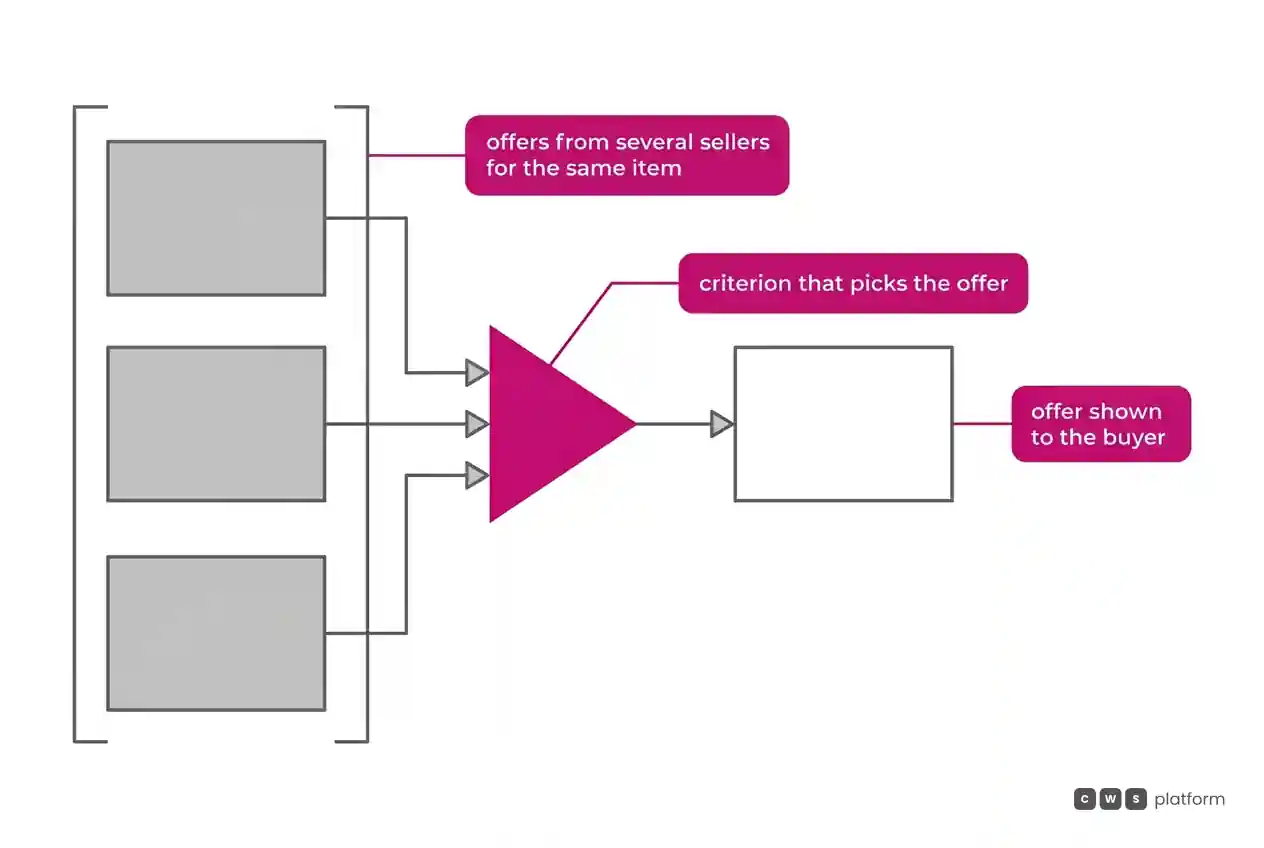
With several merchants on the same item, the order of offers becomes a commercial rule. It is recorded in Spryker's documentation, on a page dated September 8, 2026, that the marketplace has no buy-box ranking: "no built-in buy-box ranking (the default winner is the first offer published)" (guide to handling price explosion and ERP-owned pricing in B2B). With both vendors, ask which criterion decides the offer shown first and who configures it.
ERP integration: each seller's order
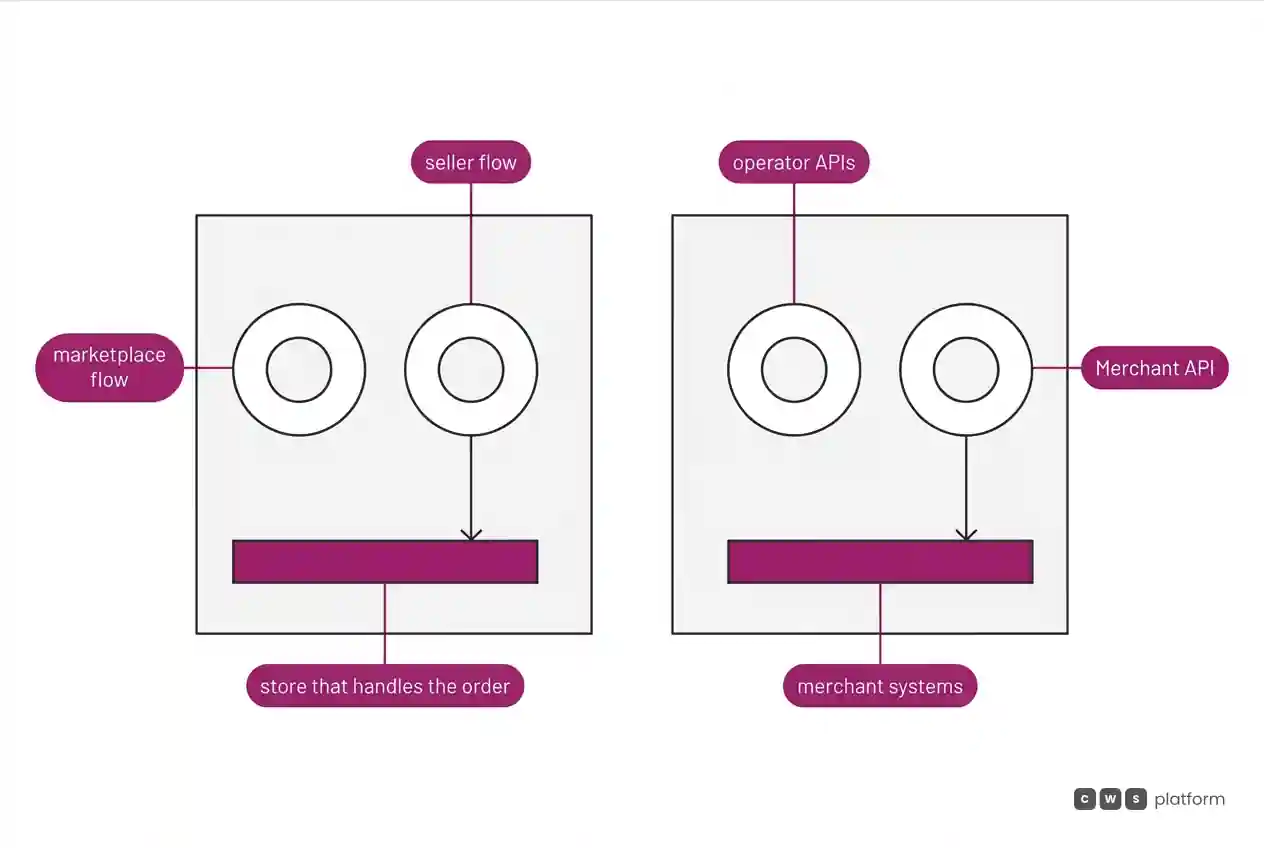
On VTEX, per the orders overview, the marketplace flow is visible only to the store that made the sale, and the seller flow only to the store that handles the order. The Marketplace Protocol covers catalog and orders, with fulfillment simulation, payment, and cancellation calls on the external seller side.
The seller's account type changes what it can do. It is recorded by VTEX on its official community forum, in a February 2024 reply on a thread accessed on November 6, 2026, that a Seller Portal account has limited functionality compared with a main account ("Uma conta do tipo Seller Portal tem funcionalidades limitadas quando comparada com uma conta principal", in Portuguese in the original; thread on marketplace integration).
On Spryker, integration is split by profile. The API guide separates the Merchant API, scoped to a single merchant's data, the Merchant Data Exchange API, for bulk loads with the merchant's systems, and the Data Exchange API, for the operator's bulk operations with ERP, PIM, OMS, and BI, each with its own credentials.
With both, ask for the design of how a seller's order reaches that seller's ERP.
Cost and billing model: who carries the channel's workload
The sources used here for the two vendors do not cover the platform's billing model. On VTEX, the extensibility guide records that custom Master Data entities are billed monthly in tiers by document volume, and the guide to adding a seller records that a white label seller requires a contractual provision with VTEX.
On Spryker, the cost to watch is operational: since the merchant cannot create the commercial relationship in the Merchant Portal, as recorded above, ask who opens each relationship between merchant and buyer and how much of that work falls on the operator's team.
The proposal question is the same for both: what becomes a separate line item or a separate team as the number of sellers grows.
Implementation and support: who maintains the marketplace
On VTEX, the seller experience is declared in code by the sponsor: per the Seller Portal guide, Seller Portal is a VTEX IO application whose pages come from an Edition App, standardized for the sellers of that edition. Seller management lives in the Admin, where the operator adds sellers and sets them to active or paused.
On Spryker, the order process is project code: per the OMS guide, the order lifecycle is modeled as XML state machines, with events triggered by the state, the Back Office, an API call, or a timeout. Per how Code Upgrader works, updates arrive in groups through pull requests, and major versions are left for manual upgrade.
With both, ask for the first-year support plan, including support for sellers.
When to choose VTEX
Marketplace and retail in the same operation. The VTEX Commerce Platform page describes ecommerce, physical stores, marketplace, and B2B under the same order orchestration.
Seller management in the Admin. Seller management shows active and paused sellers and pending offers; the guide to adding a seller accepts VTEX stores, external stores, and white label sellers.
A ready-made seller edition. Seller Portal gives the seller a standardized edition of the platform to sell on VTEX marketplaces.
External marketplaces. The marketplace overview offers native connectors for orders, products, prices, and inventory, plus the Marketplace Network to find sellers and marketplaces.
When to choose Spryker
Merchant pricing per buyer unit. Merchant Custom Prices let the merchant set prices for the business units of B2B customers.
Buyers organized as companies. Company Account structures the buying company into business units and users, with configurable roles and permissions.
Formal negotiation with the sales rep. Request for Quote covers the request, editing by the rep, validity, and versions until the quote becomes a cart.
APIs for the merchant. The API guide separates buyer, operator, and merchant APIs, each with its own credentials.
When neither fits
In some operations the marketplace is not the goal but the result of digitizing a distribution network that already exists. For them there is a third model, described in the post on the three B2B commerce platform models: moving commercial rules into the platform.
That is the CWS Platform model. CDL Workspace is a single system for the whole ecosystem, and commercial policy is stored as parameters, configuration instead of code. Price tables, rules, and contracts are configurable in the platform or come from the ERP and CRM through APIs. The sales rep builds a cart with the items and the source of each one and sends the link for the customer to close, and net-terms payment supports split deliveries from multiple sources. Billing is a platform license plus an integration license, with no percentage of sales; the split percentage in a marketplace is the marketplace owner's commission, not CWS's. The platform has 11 modules, 6 AI Agents, and 1,029 parameters.
To read each vendor against that model, there are two comparisons: B2B marketplace: VTEX or CWS Platform and B2B marketplace: Spryker or CWS Platform.
If neither design fits the relationship your network has with its buyers, talk to a CWS Platform specialist before you lock in the architecture.
Frequently asked questions
VTEX or Spryker: which is better for a B2B marketplace?
It depends on where the channel's rules live. VTEX fits the team that wants the marketplace on its retail platform, with Seller Portal, seller management, and connectors to external marketplaces. Spryker fits the team that wants the marketplace organized around commercial relationships between merchant and buyer, with pricing per business unit.
What does the seller control in each?
On VTEX, a Seller Portal seller manages its own products through the Seller Portal Catalog API, and the documentation records that it cannot modify the marketplace catalog. On Spryker, the merchant sets prices for buyers' business units in the Merchant Portal, and the documentation records that it cannot create the merchant relationship in the Merchant Portal.
How does each decide the winning offer?
On Spryker, the documentation records that the marketplace has no built-in buy-box ranking and that the default winning offer is the first one published. The VTEX sources used here do not cover how it chooses among offers from different sellers for the same product. With both, ask in the demo for the criterion and who configures it.
Can a seller and a buyer have a commercial contract?
On Spryker, yes: the merchant relationship between merchant and buyer is a price dimension, and the buyer sees the price of its relationship or the default. On VTEX, the sources used here document the rule per buyer organization in B2B Organizations and do not cover a contract negotiated between a seller and a buyer.
Read next
Brands mentioned in this article
 VTEX


- Salesforce
Trademarks and logos belong to their respective owners. Mention does not imply partnership or endorsement.
"responsive, technically engaged, and willing to work through complex commercial rules (negotiated pricing, credit, customer-specific conditions) rather than pushing generic answers"
Are your channels competing for the same customer?
Request an assessment of your operation or talk straight to a specialist, whichever you prefer.
I'd rather get the next articles on channel conflict
A weekly roundup of new articles on channel conflict, only in weeks when there is one. No spam, and you can leave in one click.