B2B marketplace: VTEX or CWS Platform?
Who owns the price on each line of a mixed cart, and how long a seller's trade policy takes to reach the offer, from the seat of whoever closes the payouts.

Editorial note: an architecture comparison between VTEX and CWS Platform for the B2B marketplace with sellers scenario, where one operator brings manufacturers and distributors together to sell to businesses and resellers in the same channel. The person who decides here is the CFO. Every fact about VTEX comes from its public documentation and its official known issues page, with the address next to it.
For the CFO of a marketplace operator, every line in a mixed cart is three things: revenue that belongs to a specific seller, the base for the operator's commission, and a promise made to that seller about its price. When the price applied to a line is not the seller's price, the error does not show up at checkout. It shows up at month-end close, when the seller disputes the payout, the commission was calculated on the wrong base, and someone has to adjust an order the buyer has already received.
That is why the financial question for a B2B marketplace is not how many sellers it can hold. It is who owns the price on each line, and how long a change in commercial policy takes to reach the offer the buyer sees.
The overall map of models is in the three B2B commerce platform models, and the other vendors we have assessed are in the comparisons hub. What VTEX B2B delivers out of the box is covered in what comes ready in VTEX B2B commerce, and the license math in the B2B total cost over three years.
What VTEX does well
VTEX treats the marketplace as part of the product. Per the Marketplace module overview, it organizes the operation in both directions: the store can sell on external channels and can bring third-party products into its own catalog. The Connections section handles connectors for orders, products, tracking, prices, and inventory, and Marketplace Network works as a mutual catalog for sellers and marketplaces to find each other.
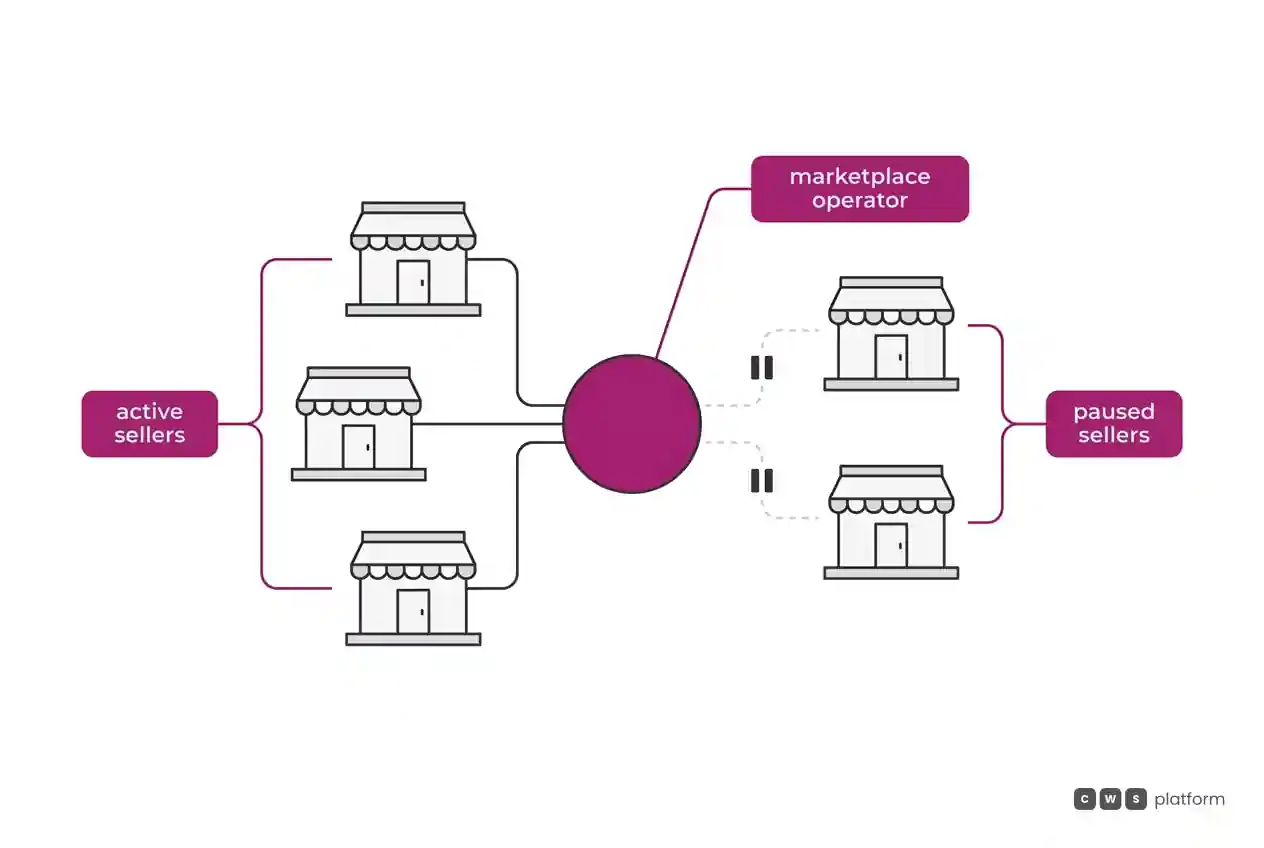
Control over the seller base is documented too. Per the Seller Management guide, the operator adds sellers, switches each one between active and paused directly in the list, and tracks four indicators: integrated sellers, active sellers, paused sellers (off the storefront and not receiving orders), and pending offers over a 180-day window. The seller registration guide accepts VTEX stores, external stores, and white-label sellers.
Where the architecture diverges
The divergence that matters to a CFO sits in two records from VTEX itself, both on the path between a seller's commercial rule and the order line:
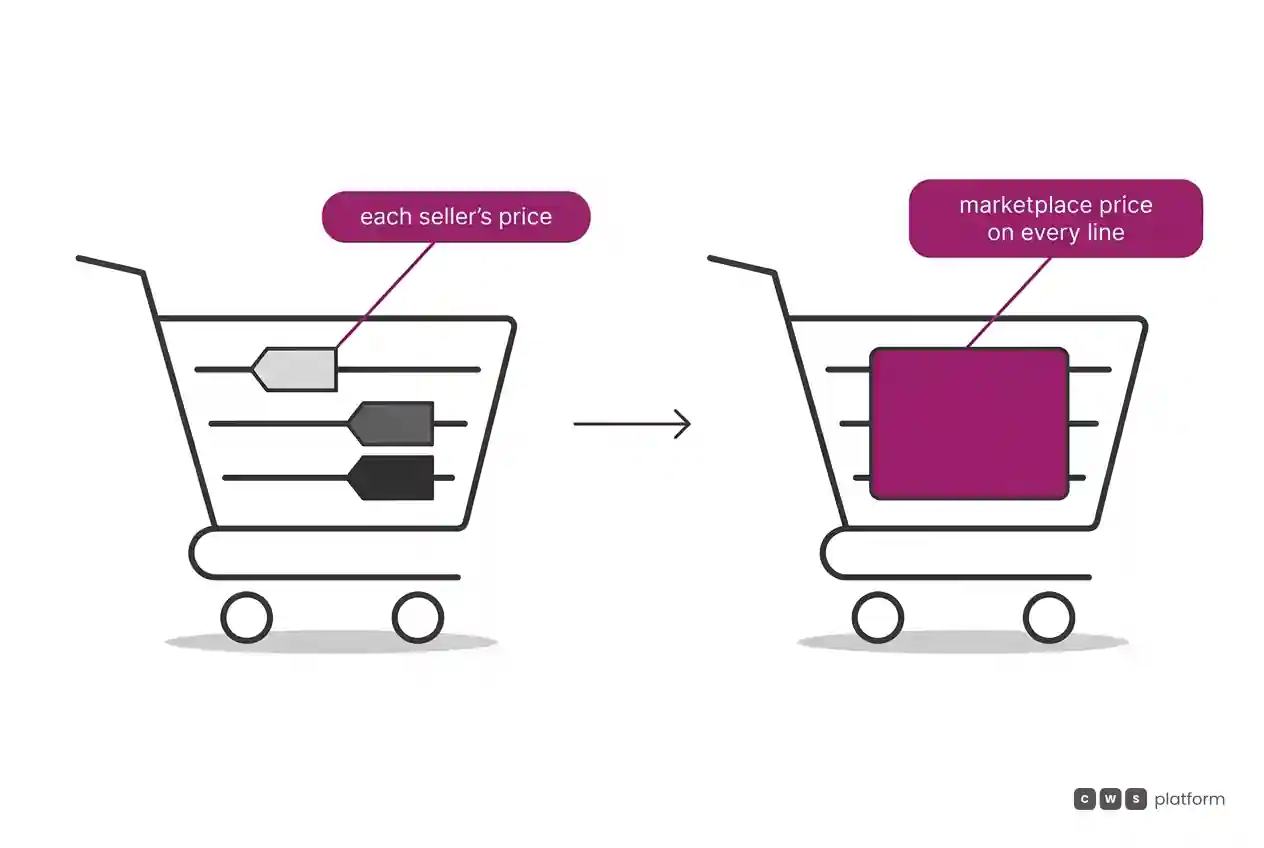
- recorded by VTEX as a known issue, still open as of November 5, 2026 (open since May 2026): with seller price override enabled, any cart with at least one item from an overridden seller applies the marketplace price to all items, including items from sellers that should not be overridden ("any cart that includes at least one item from an overridden seller ends up applying the marketplace price to all items in the cart, including items from sellers that should not be overridden.", https://help.vtex.com/en/known-issues/marketplace-price-override-applies-to-all-cart-items-regardless-of-the-seller)
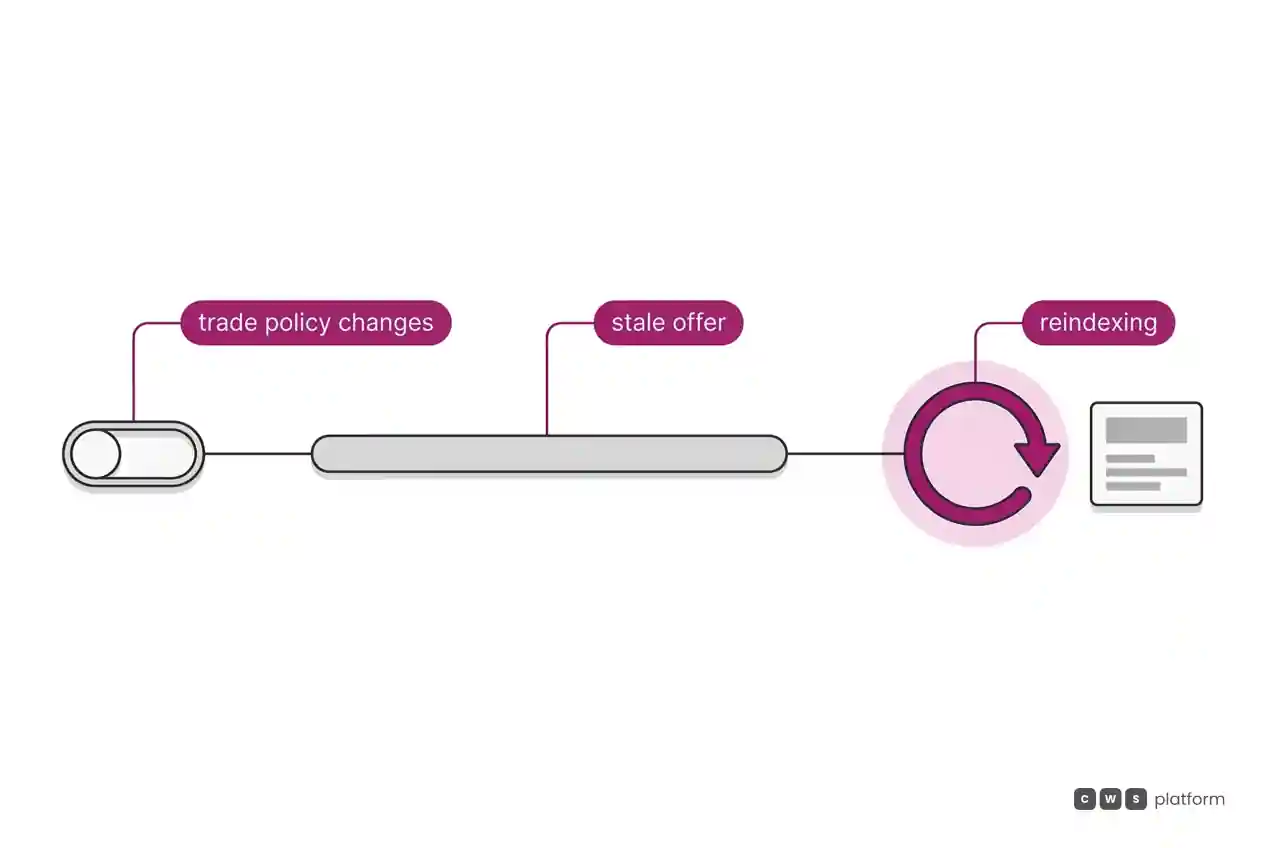
- recorded by VTEX as a known issue, still open as of November 5, 2026 (open since May 2024): when a seller's available trade policies change, the information is not automatically updated in the indexer for that seller's products ("the information is not automatically updated at the indexer of products related to that specific seller", https://help.vtex.com/en/known-issues/update-sellers-available-trade-policies-does-not-trigger-automatic-indexation)
The first record is about who controls the price inside the cart. An operator overrides the price of some sellers, for example to standardize the terms for a category. But a B2B buyer rarely buys from one seller: a replenishment cart mixes suppliers. When an overridden item lands in that cart, the marketplace price applies to every line. In the books, it is seller revenue that differs from what was agreed and commission on the wrong base.
The second record is about timing. In a B2B marketplace, trade policies decide who buys what and on which terms. When a seller joins or leaves a policy, the indexer for that seller's products does not follow on its own, and until someone reindexes, the offer may reflect a condition that no longer applies. For finance, a sale made under an expired condition is a dispute with the seller.
On CWS Platform, price tables, rules, and contracts are configurable on the platform itself and can come from the ERP or CRM through an API, and commercial policy sits in parameters of the Commerce Rules Engine (CDL Workspace), on the principle of configuration over code.
| decision | VTEX, per the documented mechanism and records | CWS Platform |
|---|---|---|
| Who owns the price on each line | With override enabled, the open known issue applies the marketplace price to every item in a cart that has an overridden seller | A question for the demo: in a cart with several sellers, where does each line's price come from? On CWS, tables, rules, and contracts are configurable or come from the ERP and CRM through an API |
| What happens when a seller's policy changes | The open known issue says the indexer for the seller's products is not updated automatically | A question for the demo: how long does the offer take to reflect the change? On CWS, commercial policy sits in parameters of the Commerce Rules Engine |
| How the operator tracks the seller base | Seller Management with active or paused status and pending offers over a 180-day window | CDL Workspace as a single system for the entire ecosystem |
The financial decision is to ask any vendor to demonstrate, with a real multi-seller cart, where each line's price comes from.
What changes in B2B marketplace operations
In B2B, price is not a stored value: it is the output of a rule whose inputs include the item's origin, volume, payment terms, and who is buying. In a marketplace, the origin is the seller. If the rule loses the origin along the way, the error moves from the channel to the close.
Through the CFO's lens, this changes three routines. Payouts: every multi-seller order creates a revenue split, and it only closes without adjustment if each line carried the right price. Renegotiation: a new contract with a seller or an exit from a policy are calendar events, and the question is whether the offer follows the same day or waits for a manual task. And network trust: a B2B marketplace only lasts if every party in it gains, and a seller who disputes payouts every month starts selling around you.
Two questions bring this point into any evaluation. In a cart with several sellers, does each line's price come from that seller's rule, and how is that proven on the order? And how much of the monthly reconciliation exists only to correct what the transaction should have done right?
On CWS Platform, the order records who built the cart and who chose the payment, and the same order accepts more than one payment method, with the rules combined in CDL Workspace and maintained through an API.
When to choose VTEX
VTEX fits scenarios where the marketplace is an extension of a retail operation:
A retail marketplace connected to external channels. Choose this architecture when the operation wants to sell on third-party marketplaces and bring sellers into its own store, with connectors for orders, products, prices, and inventory, as the Marketplace module overview describes.
An ecosystem of ready-made integrations. Choose this architecture when the value lies in plugging in payment providers and marketplaces that are already integrated; the composability documentation cites more than 750 API endpoints and more than 900 ready-made integrations.
A seller base that comes and goes often. Choose this architecture when the operator needs to pause and reactivate sellers without undoing their registration, as the Seller Management guide describes.
When CWS Platform is the right choice in this scenario
CWS Platform is the right choice when the marketplace is B2B and commercial policy changes often and needs to live in parameters, not in code.
Prices from tables, contracts, or the ERP. Choose this architecture when prices originate in a price table, a contract, or the ERP. Price tables, rules, and contracts are configurable on the platform and can come from the ERP or CRM through an API.
Commercial policy in parameters. Choose this architecture when policy is revisited with every contract. The Commerce Rules Engine (CDL Workspace) keeps commercial policy in parameters, and CDL Workspace is a single system for the entire ecosystem.
A license with no percentage of sales. Choose this architecture when the platform's pricing model weighs on the operator's numbers. CWS charges a platform license plus an integration license, with no percentage of sales; the split percentage in the marketplace is the marketplace owner's commission, not CWS's.
Payment and delivery the B2B way. Choose this architecture when the buyer pays on net terms and receives in parts. Net terms work with split shipments, scheduled deliveries, multiple ship-to addresses, and multiple ship-from locations, with the customer's credit limit maintained on the platform.
Where to go from here
If your question is still which architecture fits your operation, before any vendor, the path is the seven questions that separate B2B commerce architectures.
If the decision depends on how much of your close is payout reconciliation, it is worth talking to a CWS Platform specialist and mapping, with your sellers and your trade policies, where each line's price is born and where it is checked. The pages When Selling More Doesn't Mean Earning More and When Channels Fight Each Other cover the pain behind this scenario in depth, without talking about any vendor.
Read more
- Buybox in the B2B Marketplace: Why the Lowest Price Cannot Decide Alone
- How to Build a Viable B2B Marketplace: The 4 Conditions That Define Operations
- B2B Marketplace
Comparisons with other vendors
To compare VTEX with other platforms, without CWS Platform in the middle:
- VTEX vs Adobe Commerce: which one handles the typical B2B order?
- VTEX vs Salesforce Commerce Cloud: can B2B and retail coexist?
- VTEX vs SAP Commerce Cloud: what can a CFO predict before signing?
- VTEX vs. commercetools: Packaged B2B Suite or Composable APIs?
- VTEX vs Spryker: which fits a B2B marketplace with sellers?
- VTEX vs Optimizely: what goes on the B2B bill?
- VTEX vs OroCommerce: what can change after an order is invoiced?
- B2B ecommerce platforms: the 9 leading options compared
Brands mentioned in this article
 VTEX



- Adobe Commerce
- Salesforce
- SAP Commerce Cloud
- Optimizely
- OroCommerce
Trademarks and logos belong to their respective owners. Mention does not imply partnership or endorsement.
"responsive, technically engaged, and willing to work through complex commercial rules (negotiated pricing, credit, customer-specific conditions) rather than pushing generic answers"
Is selling more not turning into margin?
Request an assessment of your operation or talk straight to a specialist, whichever you prefer.
I'd rather get the next articles on margin and discounts
A weekly roundup of new articles on margin and discounts, only in weeks when there is one. No spam, and you can leave in one click.