B2B and B2C in one network: VTEX or CWS Platform?
Who gets paid when a sale uses another party's inventory, and what availability promises as the network grows, from the seat of whoever answers for the whole network.

Editorial note: an architecture comparison between VTEX and CWS Platform for the complex retail scenario, the network that sells to businesses and to consumers at the same time, with stores in many markets, a sales counter, field reps, and local inventory. The person who decides here is the CEO. Every fact about VTEX comes from its public documentation and its official known issues page, with the address next to it.
From the outside, the network looks like retail: stores, a storefront, in-store pickup. On the inside, a large share of revenue is business-to-business: the repair shop that buys on net terms, the reseller with its own pricing, the job site that receives in three deliveries. The CEO of a network like this asks whether the network's economics and the promise made to customers hold up as it grows.
And the network grows by combination, not by addition. Every new store adds inventory, delivery modes, covered regions, and one more party that needs to be paid for the sale it helped make. The right architecture is the one that keeps paying every party and keeps promising what is true when the number of combinations doubles.
The overall map of models is in the three B2B commerce platform models, and the other vendors we have assessed are in the comparisons hub. For what VTEX B2B delivers out of the box, see what comes ready in VTEX B2B commerce; for warehouse selection in the delivery promise, multi-store inventory: VTEX or CWS Platform.
What VTEX does well
VTEX has a documented design for unifying retail channels. Per the Unified Commerce guide, order processing and order management (OMS) are unified, so an order started in one channel is visible to and processed by the others, and the catalog is accessible to every integrated channel. The guide also describes endless aisle, where an in-store purchase ships from another store or a distribution center; mixed carts, with one item picked up and another delivered; and buy online, pick up in store.
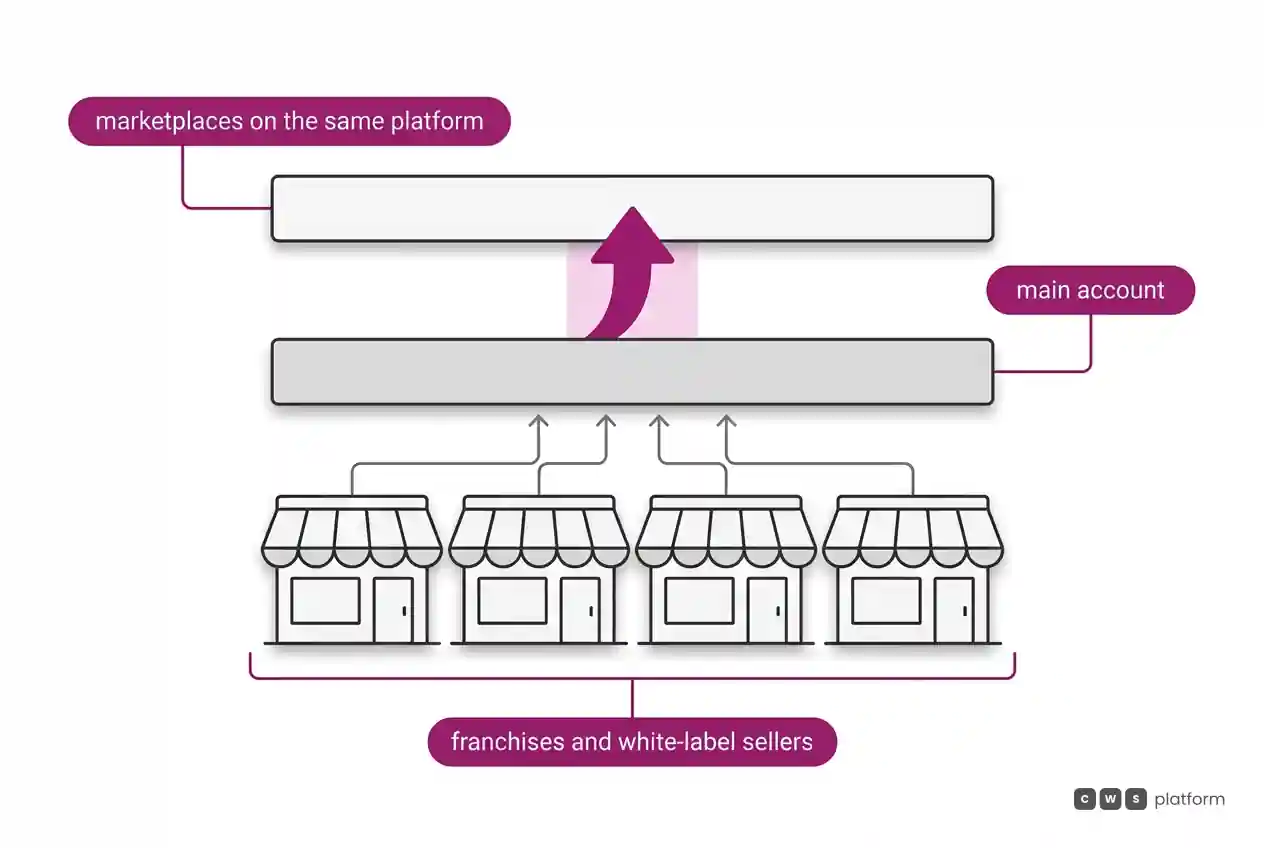
For networks with franchises, Multilevel Omnichannel Inventory makes the inventory of franchise accounts or white-label sellers available on the VTEX marketplaces the main account is connected to, without a point-to-point integration with each franchise. VTEX discontinued the feature for external marketplaces.
Where the architecture diverges
The divergence that matters to a CEO sits in the two points from the opening, the network's economics and the promise, and VTEX records both:
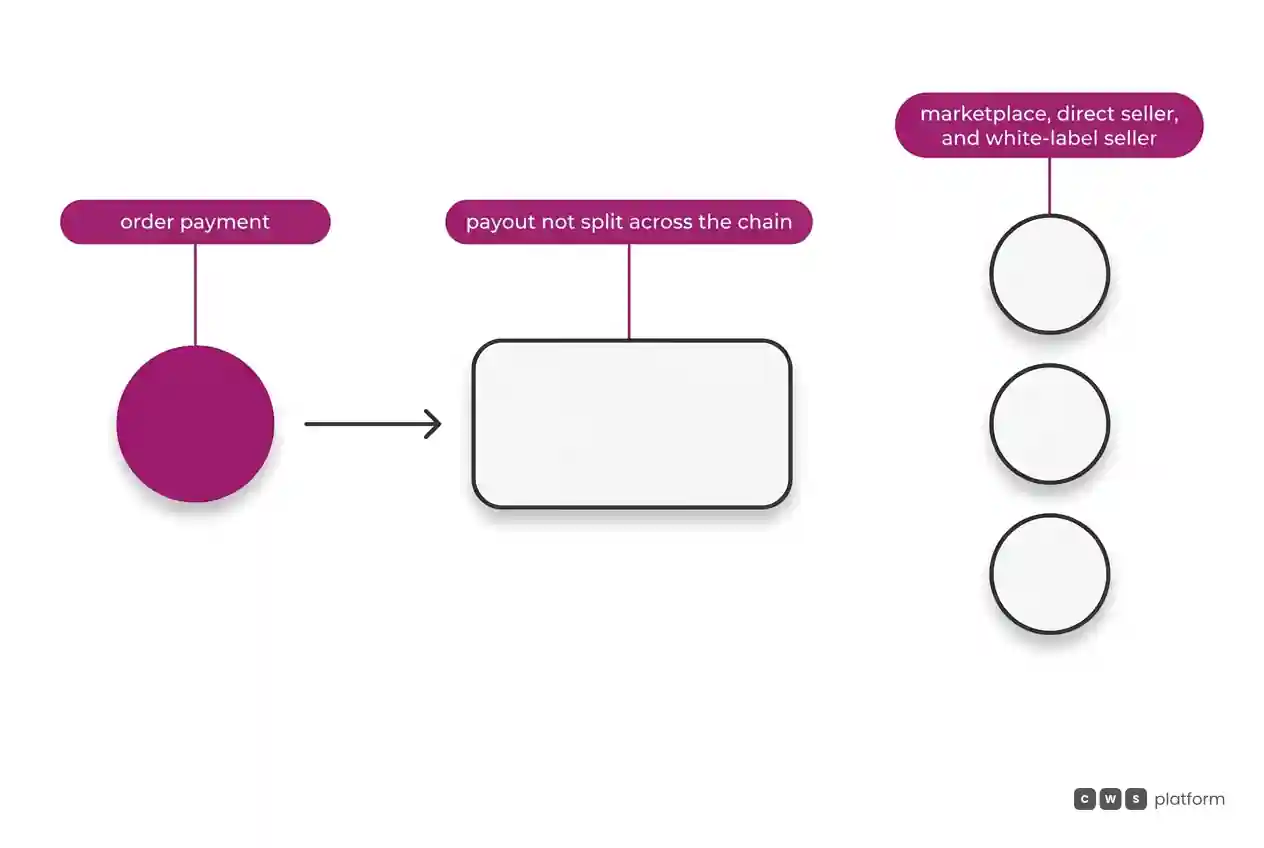
- limitation recorded in VTEX's documentation on January 6, 2025: in Multilevel Omnichannel Inventory, payouts cannot be split among the entire supply chain, meaning across the marketplace, the direct seller, and white-label sellers ("You cannot split payouts among the entire supply chain (marketplace, direct seller, and white-label sellers).", https://help.vtex.com/en/docs/tutorials/multilevel-omnichannel-inventory)
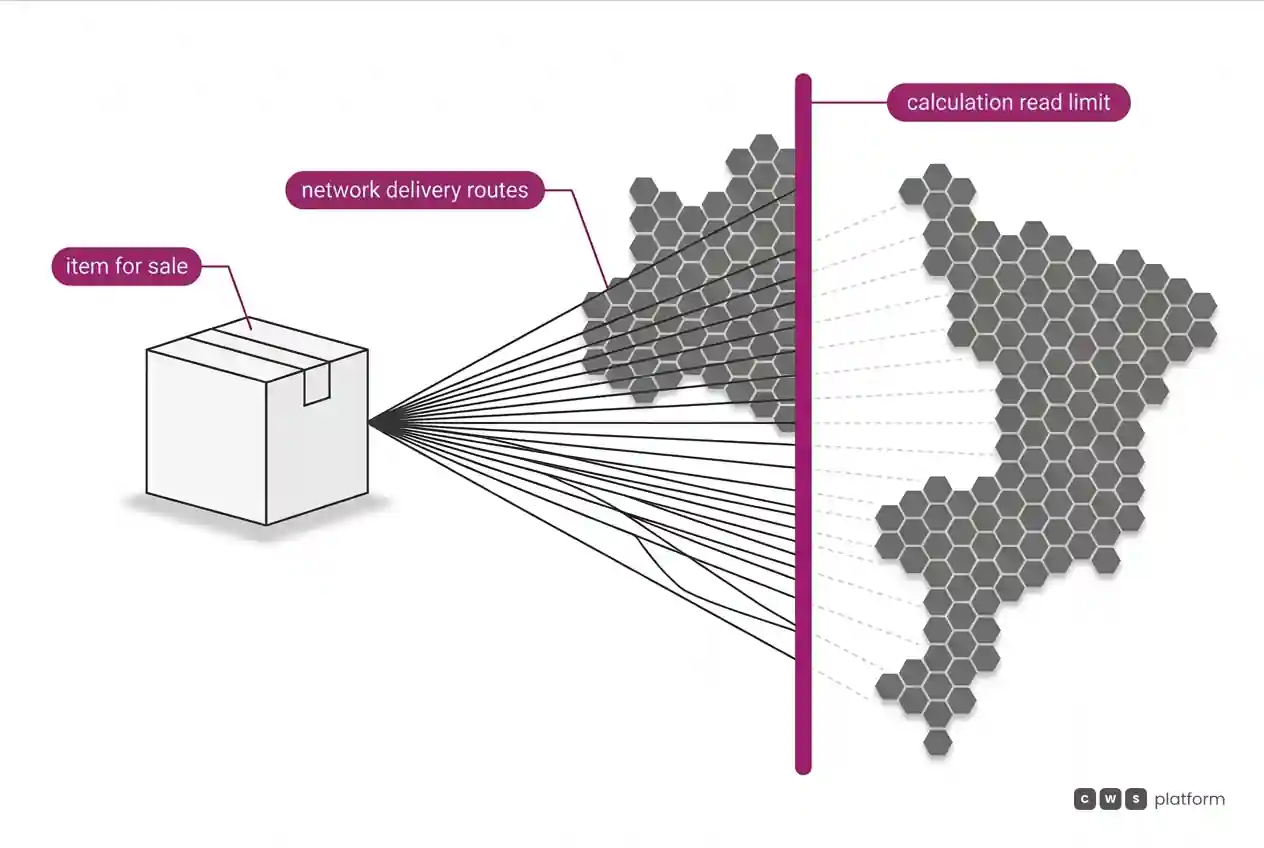
- recorded by VTEX as a known issue, still open as of November 5, 2026 (open since May 2024): the response of the available quantity calculation has a read limit of 10,000 delivery routes, routes beyond that are disregarded, and the system may return an inconsistent response ("this response has a read limit of 10,000 routes, so when a calculation results in more than 10,000, the remaining routes are disregarded, which can cause the system to return an inconsistent response.", https://help.vtex.com/en/known-issues/availablequantity-value-inconsistent-due-to-the-large-number-of-routes-created-to-deliver-the-item)
The first record is about who gets paid. Multilevel inventory solves the product side; the money side does not follow. If the payout is not split across the whole chain inside the transaction, the share owed to the franchise or white-label seller that supplied the item is settled through another process, later. A party that gets paid later, through a different path, starts asking whether it is worth putting its own inventory into the brand's channel.
The second record is about scale. In a network with many stores, warehouses, and delivery modes, the possible combinations for getting an item to a customer grow faster than the number of stores. The record says that above 10,000 routes, the rest are left out of the calculation and the available quantity may come back inconsistent. It is a limit that shows up precisely when the network succeeds and grows.
On CWS Platform, CDL Workspace is a single system for the entire ecosystem, and pricing is a platform license plus an integration license, with no percentage of sales.
| decision | VTEX, per the documented mechanism and records | CWS Platform |
|---|---|---|
| How the network's inventory reaches the channel | Multilevel inventory offers franchise and white-label inventory on connected VTEX marketplaces, without point-to-point integration; discontinued for external marketplaces | Net terms with split shipments, scheduled deliveries, multiple ship-to addresses, and multiple ship-from locations |
| Who gets paid when a sale uses another party's inventory | In multilevel inventory, the payout is not split across the whole chain | A question for any vendor: is each party's payout a rule of the transaction? On CWS, a license with no percentage of sales; the split percentage is the marketplace owner's commission |
| What the channel promises as the network grows | Open known issue: above 10,000 routes, the rest are disregarded and the response may be inconsistent | A question for any vendor's load test, using the number of combinations in your network |
The strategic decision is whether the network will settle what each party earned inside the sale or in a separate process, and whether the availability promise has been tested at the size the network wants to reach.
What changes in complex retail operations
A complex retail network does not win by having a digital channel. It wins when the digital channel is the operation it already has, digitized, and not an online store sitting next to it. The network's marketplace is a consequence: it emerges when stores, franchises, and the counter sell through the same system, and it only lasts if every party in it profits.
Through the CEO's lens, this changes three decisions. The first is the network's economics: when a consumer order ships from a franchise's inventory, how much the franchise receives, through which path, and how fast. The second is the promise: the availability the portal shows is what the network delivers, also when it has twice as many stores. The third is the operating model: the counter, the field, and the portal use the same pricing and credit rules, or each has its own version of the truth.
Two questions help bring this point into any evaluation. First: is each party's payout a rule of the transaction or a reconciliation done later? Second: how many combinations of store, warehouse, and delivery mode does your network have today, how many will it have in three years, and has availability been tested at that volume?
On CWS Platform, price tables, rules, and contracts are configurable on the platform and can come from the ERP or CRM through an API and all customers run the same version of the platform.
When to choose VTEX
VTEX fits scenarios where the network is, first and foremost, consumer retail:
Omnichannel B2C retail. Choose this architecture when the center of the operation is the end consumer and the network needs endless aisle, mixed carts, and in-store pickup, as the Unified Commerce guide describes.
Franchises selling on VTEX marketplaces. Choose this architecture when the goal is to bring franchise inventory to the VTEX marketplaces connected to the main account without integrating each one, as the Multilevel Omnichannel Inventory guide describes.
A D2C operation with an integration ecosystem. Choose this architecture when the brand sells direct to consumers and wants to plug in payment providers and marketplaces that are already integrated, which the composability documentation counts at more than 900.
When CWS Platform is the right choice in this scenario
CWS Platform is the right choice when the network looks like retail from the outside and runs as business-to-business on the inside.
A single system for the network. Choose this architecture when stores, franchises, the counter, and the portal need the same rules. CDL Workspace is a single system for the entire ecosystem, and the Commerce Rules Engine keeps commercial policy in parameters, on the principle of configuration over code.
Net terms that ship from several places. Choose this architecture when the business customer buys on net terms and receives in parts. Net terms work with split shipments, scheduled deliveries, multiple ship-to addresses, and multiple ship-from locations, with the customer's credit limit maintained on the platform.
Counter and field on the same interface. Choose this architecture when reps sell at the counter and in the field. Customer and sales rep use the same interface, the rep builds a cart with the items and the source of each one and sends the link for the customer to complete the purchase, and one sales rep serves thousands of customers.
A license with no percentage of sales. Choose this architecture when the platform's pricing model enters the math of the network's expansion. CWS charges a platform license plus an integration license, with no percentage of sales.
Where to go from here
If your question is still which architecture fits your operation, before any vendor, the path is the seven questions that separate B2B commerce architectures.
If the decision depends on how your network will grow, it is worth talking to a CWS Platform specialist and designing, with your stores, franchises, and delivery modes, where each party gets paid and where the availability promise is calculated. The pages When Channels Fight Each Other and When Selling More Doesn't Mean Earning More cover the pain behind this scenario in depth, without talking about any vendor.
Comparisons with other vendors
To compare VTEX with other platforms, without CWS Platform in the middle:
- VTEX vs Adobe Commerce: which one handles the typical B2B order?
- VTEX vs Salesforce Commerce Cloud: can B2B and retail coexist?
- VTEX vs SAP Commerce Cloud: what can a CFO predict before signing?
- VTEX vs. commercetools: Packaged B2B Suite or Composable APIs?
- VTEX vs Spryker: which fits a B2B marketplace with sellers?
- VTEX vs Optimizely: what goes on the B2B bill?
- VTEX vs OroCommerce: what can change after an order is invoiced?
- B2B ecommerce platforms: the 9 leading options compared
Brands mentioned in this article
 VTEX



- Adobe Commerce
- Salesforce
- SAP Commerce Cloud
- Optimizely
- OroCommerce
Trademarks and logos belong to their respective owners. Mention does not imply partnership or endorsement.
"responsive, technically engaged, and willing to work through complex commercial rules (negotiated pricing, credit, customer-specific conditions) rather than pushing generic answers"
Are your channels competing for the same customer?
Request an assessment of your operation or talk straight to a specialist, whichever you prefer.
I'd rather get the next articles on channel conflict
A weekly roundup of new articles on channel conflict, only in weeks when there is one. No spam, and you can leave in one click.