B2B sales reps: VTEX or CWS Platform?
The rep app, B2B Suite roles, and the order history a rep sees when stepping into an account, through the lens of whoever owns the sales force.

Editorial note: an architecture comparison between VTEX and CWS Platform for the scenario of a B2B portal run together with the sales force, where field reps and inside sales serve their book of business through the same channel the customer uses to buy. The person who decides here is the VP of Sales. Every fact about VTEX comes from its public documentation and from the known issues page it maintains, with the address next to it.
The B2B portal goes live, customers start ordering on their own, and three months later the VP of Sales finds that half the reps are still sending orders by text message and spreadsheet. It is not resistance to digital. The portal was designed for the buyer, and the rep was left outside: unable to see what the customer sees, without the book of business organized the way the rep actually covers it, and with no place to prepare a replenishment order before the visit.
When that happens, the digital channel becomes a channel running parallel to the sales force, and the two compete for the same account. The cost shows up twice: in the order that gets rekeyed and in the commission dispute at month end.
So the question that separates platforms in this scenario is not whether the portal has a rep area. It is where the rep works and what the rep sees when stepping into the customer's account. This comparison looks at VTEX and CWS Platform from that angle only. The overall map is in the post on the three B2B commerce platform models, and the other matchups are in the comparisons hub.
What VTEX does well
VTEX has an application built for the rep. VTEX Sales App is a mobile and desktop interface for assisted selling in physical stores, with connectivity and device requirements set out in the Sales App prerequisites. The interface accepts extensions at eight predefined points, from the cart to the product page and the menu, as the Sales App extensibility announcement shows.
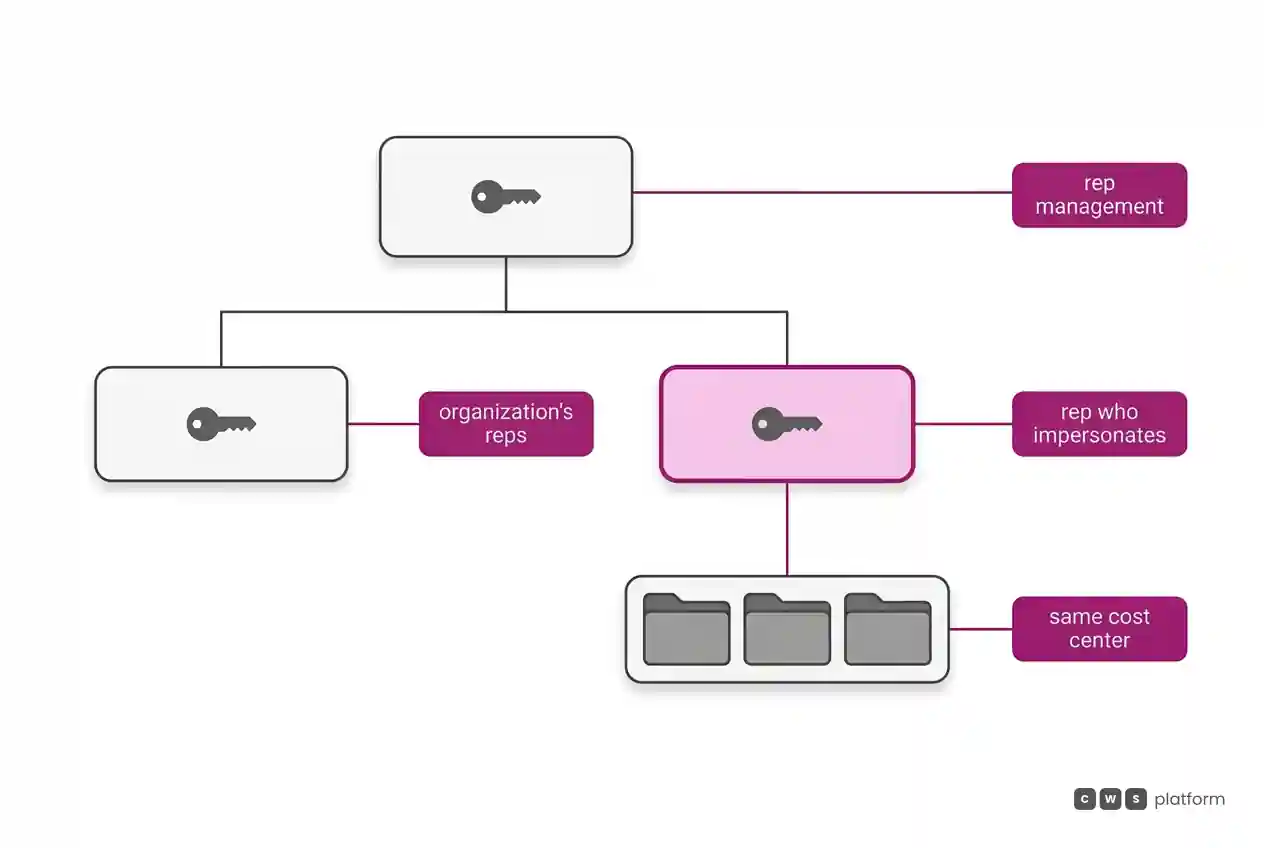
In B2B, the rep's role is modeled in the B2B Suite. The Storefront Permissions app ships a predefined set of roles: sales-admin to manage reps, sales-manager to manage the organization's reps and impersonate, and sales-representative to assist and impersonate within the same cost center. On the customer side, the B2B Organizations app, installed through VTEX IO, groups business users into organizations with their own payment methods, price tables, and product collections, and splits each organization into cost centers with their own ship-to addresses.
For an operation that cleanly separates who buys, who approves, and who serves the account, that is a ready-made role taxonomy, configured in the Admin.
Where the architecture diverges
The divergence that matters to a VP of Sales sits in two records from the vendor itself, one about the rep's channel and one about what the rep sees while serving the account:
- limitation recorded in VTEX's documentation on August 26, 2025: VTEX answers that it is not yet possible to use VTEX Sales App in a B2B business model ("Can VTEX Sales App be used in a B2B business model? This is not possible yet.", https://help.vtex.com/en/docs/tutorials/vtex-sales-app-faq)
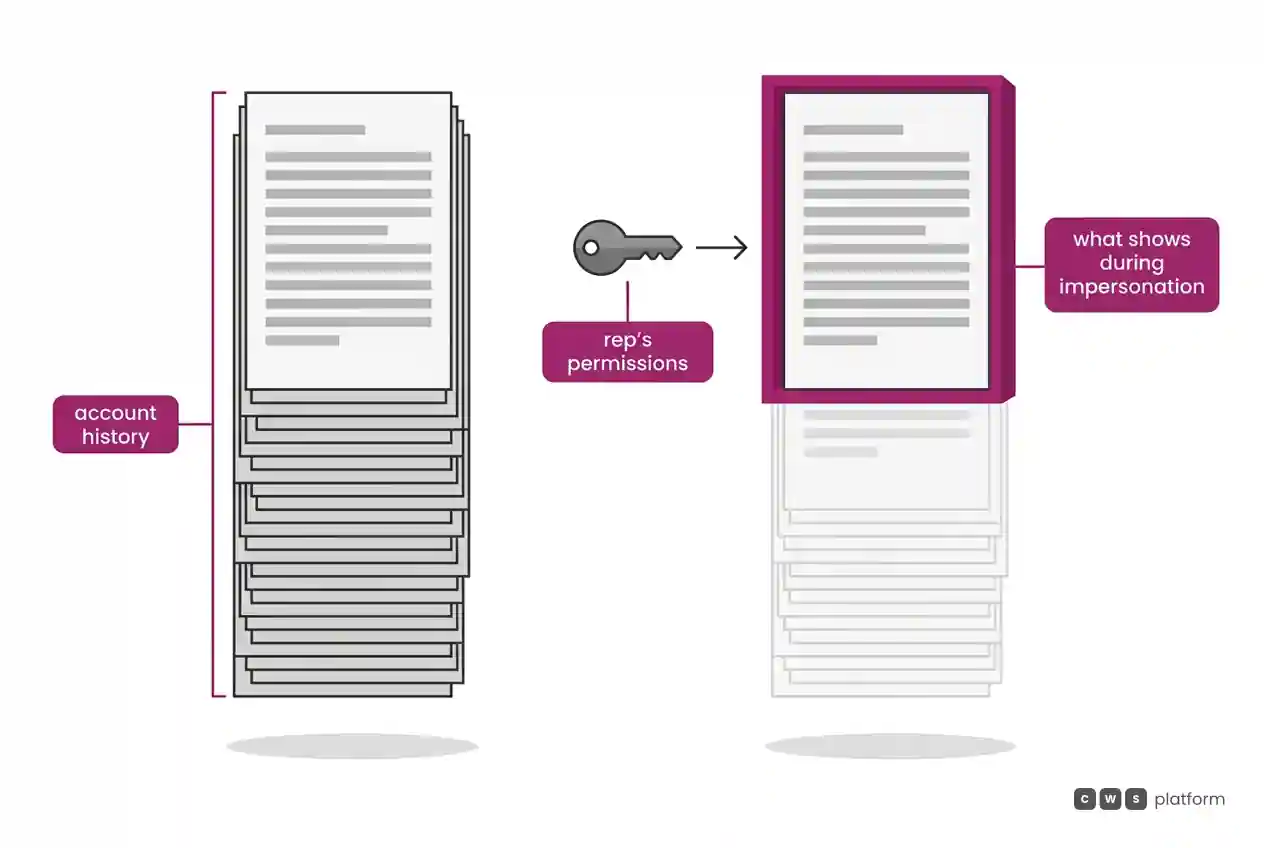
- recorded by VTEX as a known issue, still open as of November 5, 2026 (accessed on that date): since October 2025, when a sales representative impersonates another user, the B2B Orders History page shows only the orders the representative has access to ("When a sales representative user impersonates another user only the orders that the sales representative has access to are displayed in the B2B Orders History page.", https://help.vtex.com/en/known-issues/b2b-orders-history-considers-sales-representative-roles-when-impersonating-an-user)
The first record defines the channel. The application VTEX designed for the rep serves the store counter and the sales floor, and the FAQ itself says the B2B model is not covered yet. In B2B, the rep works inside the storefront, through the B2B Suite roles, entering the buyer's session by impersonation.
The second record is about what happens on that entry. When the rep impersonates the buyer, the B2B order history follows the rep's permissions instead of the customer's. For a rep preparing a visit by looking at what the account bought over the last few months, that changes the conversation: the rep may be looking at a slice of the history without knowing it.
On CWS Platform, customer and sales rep use the same interface, on the same order, and one sales rep serves thousands of customers. The rep builds a cart with the items and the source of each one and sends the link for the customer to complete the purchase.
| decision | VTEX, per the documented mechanism | CWS Platform |
|---|---|---|
| Where the rep works | Sales App for physical stores; for B2B, the FAQ records that the app does not support it yet, and the rep works in the storefront through B2B Suite roles | Customer and sales rep use the same interface, on the same order |
| How the rep enters the account | sales-representative role, impersonating within the same cost center |
One sales rep serves thousands of customers |
| What the rep sees while serving | Open known issue: during impersonation, B2B order history follows the representative's permissions | A question for any vendor, with a real account's history in the demo |
The sales decision is whether your reps will work in a channel designed for them or step in as guests in a channel designed for the buyer.
What changes in a portal run with the sales force
While the portal is still winning over the book of business, the rep is the one who brings the customer into digital. The rep shows the portal during the visit, prepares the first cart, explains the terms. If the portal does not serve the rep, the rep has no reason to bring the customer there, and self-service does not grow.
Three questions help bring this point into any evaluation.
First: does the rep work in the same channel as the customer or in a separate application, and does that application cover the B2B model. The answer decides whether you run one channel or two.
Second: when the rep steps into the customer's account, is what the rep sees what the customer sees. Order history, commercial terms, and open carts need to be the account's, not those of the rep's permissions. Ask for an account with real history in the demo and compare both views side by side.
Third: does commercial policy travel with the rep. Discounts, price tables, and contracts need to be the same on the order the rep builds and on the order the customer builds, or the commission turns into a negotiation.
On CWS Platform, price tables, rules, and contracts are configured on the platform and can come from the ERP or CRM through an API. The sales rep's discount goes through multi-level approvals, and commercial policy sits in parameters of the Commerce Rules Engine (CDL Workspace), on the principle of configuration over code. The cart holds 250 line items by default, and that is configurable, which matters to a rep who builds an account's entire replenishment order before the visit.
When to choose VTEX
VTEX fits scenarios with these characteristics:
Retail with in-store associates. Choose this architecture when the rep serves customers at the counter or on the floor and needs a dedicated app on the device, as the Sales App prerequisites describe.
Omnichannel retail operations. Choose this architecture when an order starts in one channel and is fulfilled in another, with endless aisle, mixed carts, and in-store pickup, as the Unified Commerce overview describes.
An ecosystem of apps and integrations. Choose this architecture when the company wants to compose its store with partners and apps, backed by more than 750 API endpoints and more than 900 ready-made integrations, as the composability page records.
When CWS Platform is the right choice in this scenario
CWS Platform is the right choice when the sales force is a user of the portal, not a visitor.
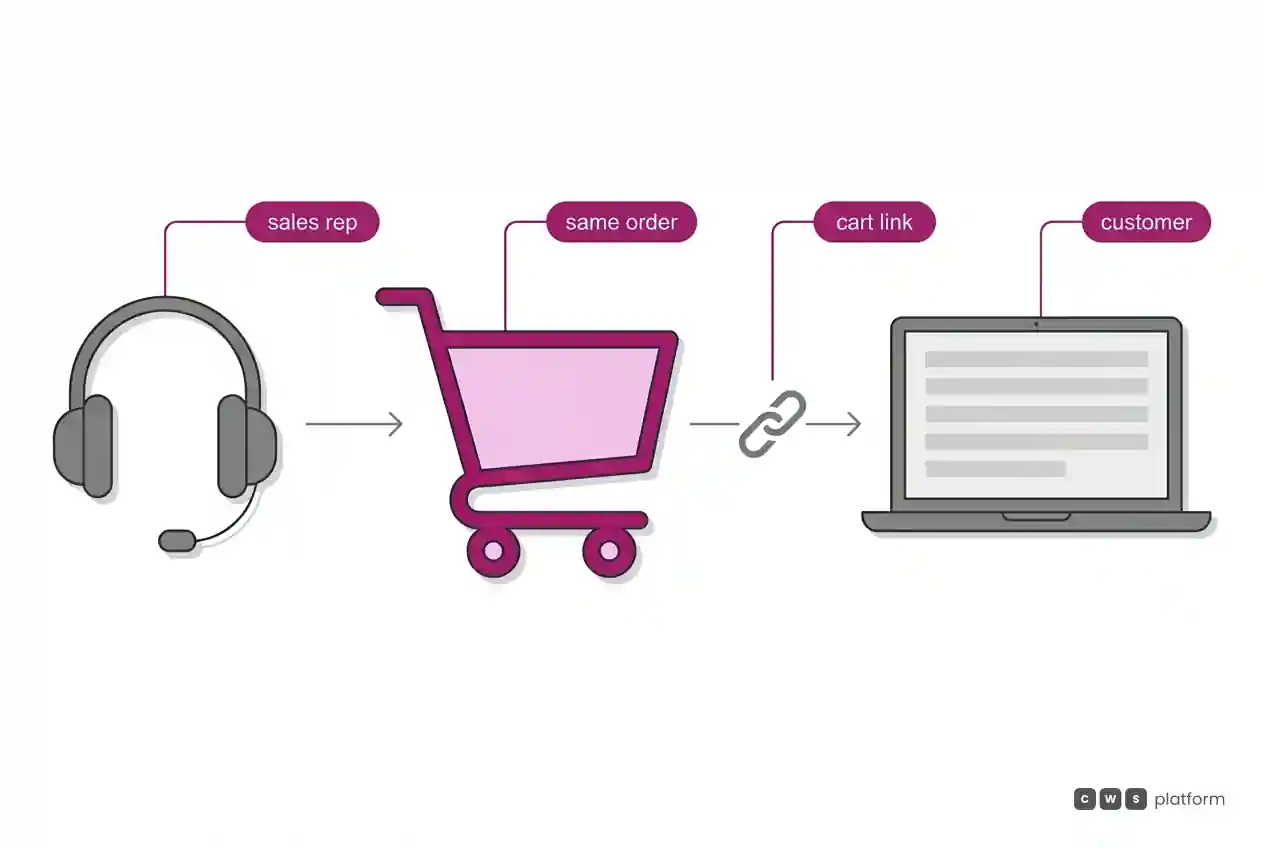
One channel for customer and rep. Choose this architecture when the rep and the buyer need to work in the same place. Customer and sales rep use the same interface and work on the same order.
A large book of business per rep. Choose this architecture when each rep covers many accounts. One sales rep serves thousands of customers, and CDL Workspace is a single system for the entire ecosystem.
Replenishment that starts with the rep. Choose this architecture when the rep prepares the order before the customer does. The rep builds the cart with the items and the source of each one and sends the link, and the order records who built the cart and who chose the payment.
The same commercial policy on both sides. Choose this architecture when discounts and terms need to match on the rep's order and the customer's order. Tables, rules, and contracts live on the platform or arrive from the ERP and CRM through an API, and the sales rep's discount goes through multi-level approvals.
Where to go from here
If your question is still which architecture fits your operation, before any vendor, the path is the seven questions that separate B2B commerce architectures.
If the decision depends on how your reps serve accounts today, it is worth talking to a CWS Platform specialist to map, with each rep's real book of business, the path of the order from the rep to the customer. The pages When Channels Fight Each Other and When Selling More Doesn't Mean Earning More cover the pain behind this scenario in depth, without talking about any vendor.
Read more
- State Taxes, Compliance, and Invoicing: Managing Fiscal Complexity in B2B E-Commerce
- Enterprise Systems Integration in B2B: Prioritization and Architectural Sequencing
- B2B Portals and Order Capture (Self-Service)
Comparisons with other vendors
To compare VTEX with other platforms, without CWS Platform in the middle:
- VTEX vs Adobe Commerce: which one handles the typical B2B order?
- VTEX vs Salesforce Commerce Cloud: can B2B and retail coexist?
- VTEX vs SAP Commerce Cloud: what can a CFO predict before signing?
- VTEX vs. commercetools: Packaged B2B Suite or Composable APIs?
- VTEX vs Spryker: which fits a B2B marketplace with sellers?
- VTEX vs Optimizely: what goes on the B2B bill?
- VTEX vs OroCommerce: what can change after an order is invoiced?
- B2B ecommerce platforms: the 9 leading options compared
Brands mentioned in this article
 VTEX



- Adobe Commerce
- Salesforce
- SAP Commerce Cloud
- Optimizely
- OroCommerce
Trademarks and logos belong to their respective owners. Mention does not imply partnership or endorsement.
"responsive, technically engaged, and willing to work through complex commercial rules (negotiated pricing, credit, customer-specific conditions) rather than pushing generic answers"
Are your channels competing for the same customer?
Request an assessment of your operation or talk straight to a specialist, whichever you prefer.
I'd rather get the next articles on channel conflict
A weekly roundup of new articles on channel conflict, only in weeks when there is one. No spam, and you can leave in one click.