VTEX vs. CWS Platform: what do VTEX known issues say about maintenance?
The public known issues list, the bulk extraction timeout, and a request limit with no guarantee: the maintenance math through the lens of whoever owns technology.

Editorial note: an architecture comparison between VTEX and CWS Platform, written for those who answer as CIO or CTO. Every fact about VTEX comes from its public documentation, its official known issues page, and its official forum, with the address next to it.
A platform demo shows what works. For the years that follow, the technology team lives with what does not: the nightly ERP sync that runs out of time, the call that comes back rejected at the peak of a price update, the known defect nobody knows when will leave the queue. That is maintenance, and it decides how many people the digital channel consumes after go-live.
Two questions help measure that cost before signing. What does the vendor's public list of known issues show about how long items stay open? And what does the vendor guarantee about the limits of the APIs the integration will depend on? Every retry, every queue, and every manual reconciliation is transaction cost that never shows up in the license.
This comparison looks at VTEX and CWS Platform from that angle only. It is not a feature ranking. The overall map is in the post on the three B2B commerce platform models, and the other vendor reads are in the comparisons hub.
What VTEX does well
VTEX exposes its platform broadly through APIs. According to its developer documentation, core capabilities come from more than 70 shared microservices, accessible through REST APIs. The list of REST APIs splits the APIs by domain, such as Catalog, Checkout, and Logistics, with credentials managed through the License Manager API, using AppKeys and AppTokens.
For custom data, Master Data works as a key-document database, with a Data Plane and a Control Plane. Without the record id, a query uses /search, backed by indexes, or /scroll, for bulk extraction.
The documentation also states its concurrency rules, which saves discovering them in production. The Checkout API overview warns that operations that modify data cannot run in parallel and that the API client must queue them. And VTEX publishes an open known issues page, with a status for each item.
Where the architecture diverges
The divergence that matters to the CIO or CTO starts on that very page. According to the VTEX known issues page, accessed on November 5, 2026, 1,458 of the 2,070 published items were open (Backlog or Scheduled) and 244 were marked No Fix; the median age of the open items was 3.2 years. Open, here, means the status on the page on the day it was accessed, not a claim that the problem affects every account: many items describe specific scenarios. The number is a dated snapshot and changes over time.
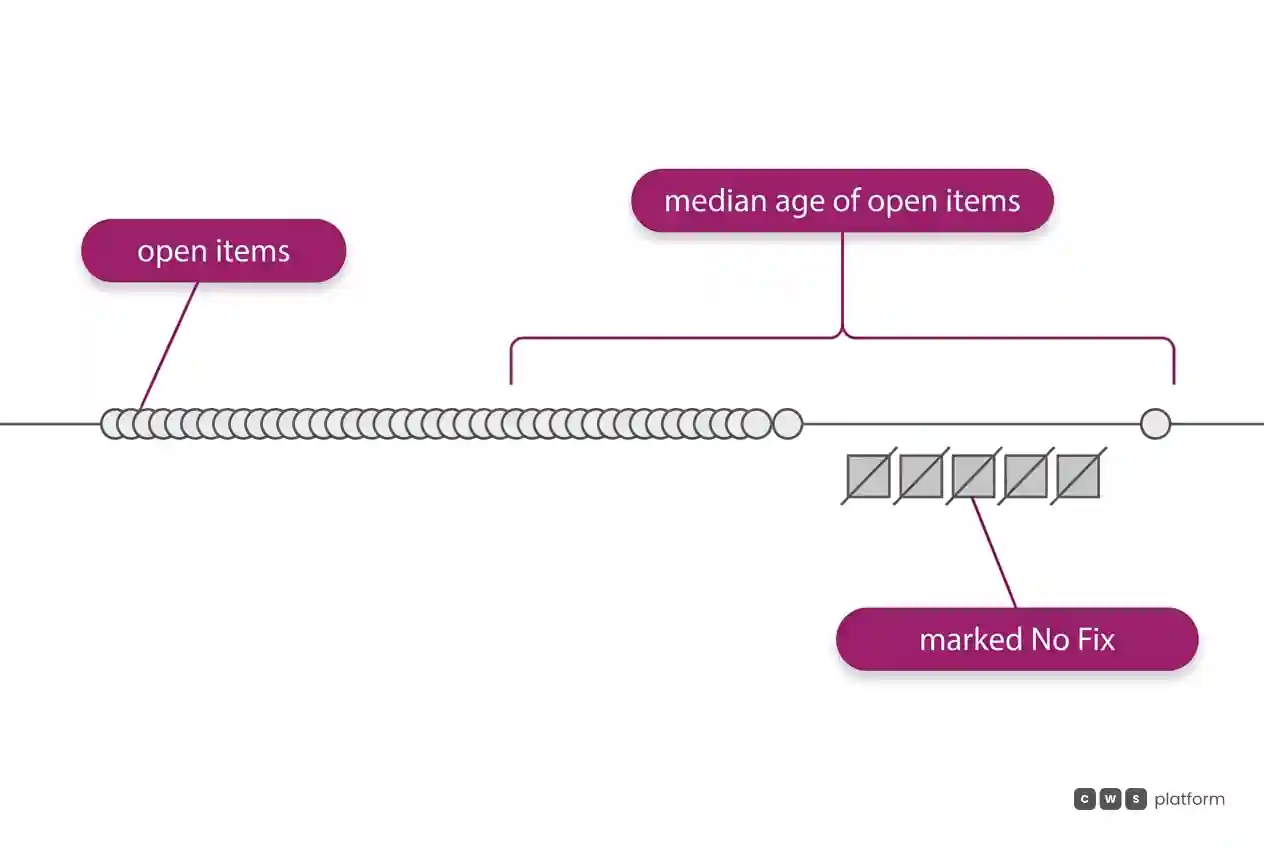
Two records show how this touches a B2B integration:
- recorded by VTEX as a known issue, still open as of November 5, 2026 (open since June 2019): when requesting large amounts of data through the scroll endpoint, Master Data may time out ("In some cases, when requesting large amounts of data through our scroll endpoint, Master Data will timeout.", https://help.vtex.com/en/known-issues/master-datas-scroll-endpoint-sometimes-returns-a-408-error).
- issue recorded on VTEX's official forum, accessed on November 5, 2026: in a reply on its official forum, in January 2024, VTEX answers that it cannot be 100% certain that the request limit error will not occur on the pricing API ("Infelizmente, eu não posso te dar 100% de certeza de que esse problema não irá ocorrer", in Portuguese in the original, https://community.vtex.com/t/limite-de-requisicao-rest/37825).
The first matters because /scroll is the documented path for bulk extraction, which is exactly what nightly loads into the ERP, BI, and reconciliation do. With the timeout recorded as an open known issue, the integration has to be born with paging, retries, and a resume point, and someone has to watch for the load that stopped halfway.
The second matters because, in B2B, price changes often and per customer. A price table coming from the ERP can generate large volumes of updates at once. Without a guarantee that the request limit will not trip, the integration needs a queue, progressive backoff, and a rule for what happens to price while the update has not finished. Added to the documented checkout rule of queuing writes, that design is work for the customer's team, before and after go-live.
On CWS Platform, the architecture is API-first, with REST APIs and webhooks. Price tables, rules, and contracts can come from the ERP or CRM through APIs, tax comes from the ERP or from the tax engine the customer already uses, and the customer's credit limit is kept in the platform. Commercial policy lives in Commerce Rules Engine parameters, and all customers run the same version. The two questions in this comparison apply to any vendor, CWS included.
| decision | VTEX, per the documented mechanism | CWS Platform |
|---|---|---|
| What the public list shows | On November 5, 2026, 1,458 of 2,070 items open, 244 No Fix, median age of open items 3.2 years | A question for any vendor: the list, the status, and the age of the items |
| Bulk data extraction | Master Data /scroll, with a timeout recorded as an open known issue |
REST APIs and webhooks for ERP, CRM, and the customer's systems |
| Request limit on the pricing API | No guarantee the error will not occur, per a reply on the official forum in January 2024 | Price tables can come from the ERP through APIs; the limit is a question for the contract |
| Where B2B commercial terms live | In the B2B Organizations app, on VTEX IO: payment methods, price tables, and collections per organization | Commerce Rules Engine parameters, with all customers on the same version |
The technical decision is knowing, before signing, how much of the maintenance will live with the company's team and how much will live in the platform.
What changes in operations, through the CIO/CTO lens
For the technology team, the difference shows up in three routines. The first is due diligence. Before choosing any platform, filter the public list of known issues by the modules the project will use and read three things: how many items are open, how many were marked as having no planned fix, and how long the open ones have been waiting. Then take the items that touch your scenario to the vendor and ask for the plan for each one.
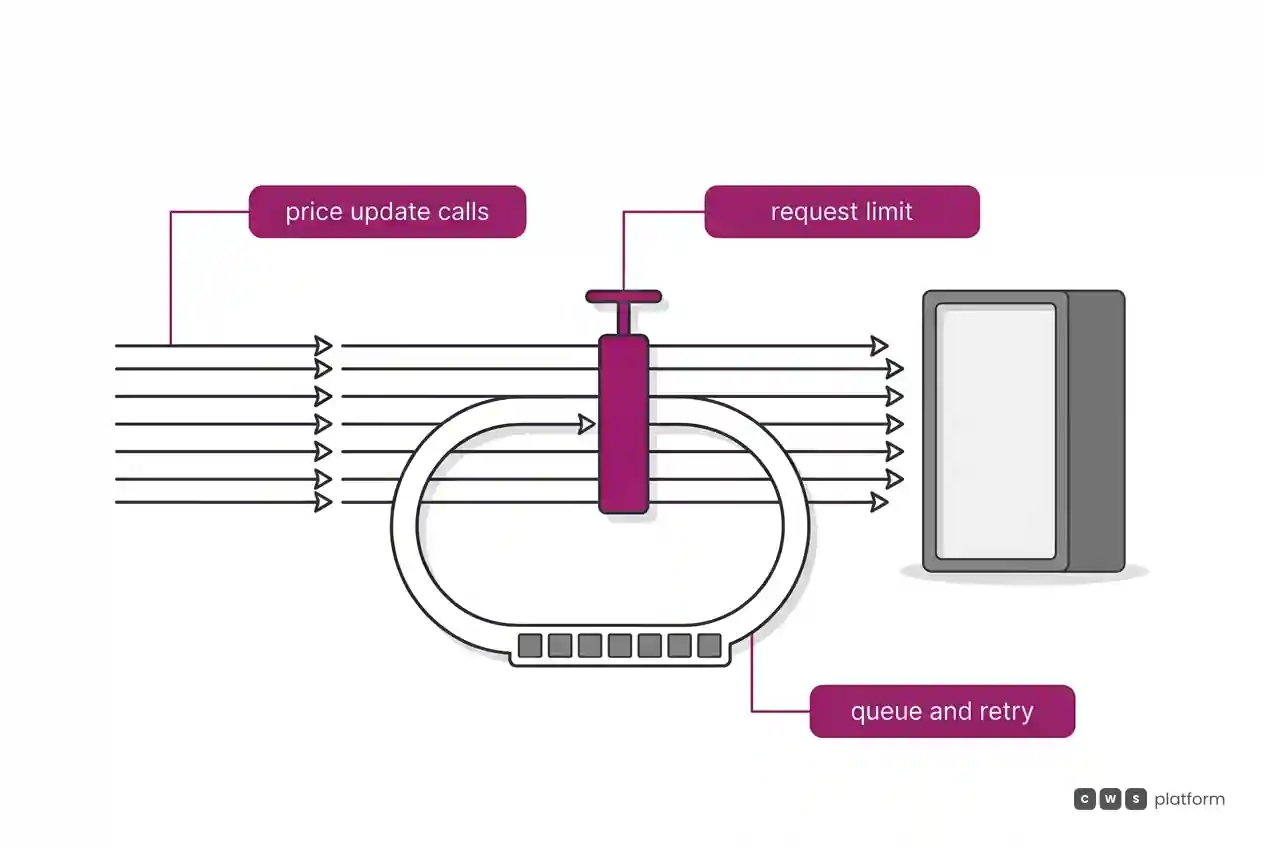
The second is integration design. Every limit without a guarantee and every open known issue becomes a requirement: retries, a queue, progressive backoff, a resume point, an alert. That has a build cost and, above all, a maintenance cost, because someone has to look at the alert at three in the morning.
The third is the lifecycle of custom code. Per the documentation on VTEX composable components, components are either Built-in, already installed, or Plug-and-play, which require installation and, in some cases, configuration; those outside these two categories require a development step or complex configuration. The more commercial logic lives in custom code, the larger the inventory the team has to track. It is worth asking the vendor who maintains each app after go-live and drawing, as in a RACI, who is responsible for each part: platform, integration, and operations.
On CWS, the commercial rule lives in parameters, on the principle of configuration over code, and the platform brings together 11 modules, 6 AI Agents, and 1,029 parameters, with all customers on the same version.
When to choose VTEX
VTEX fits scenarios with these characteristics:
A technical team that wants to build on the platform. Choose this architecture when there is a team to develop and maintain VTEX IO apps and to integrate dozens of microservices through the REST APIs.
Consumer retail and retail marketplaces. Choose this architecture when the operation serves end consumers, with ecommerce, physical stores, and marketplace under the same order orchestration, as the VTEX Commerce Platform page describes.
An ecosystem of ready-made integrations. Choose this architecture when the strategy depends on the more than 900 ready-made integrations with payment providers and marketplaces cited in the composability guide.
When CWS Platform is the right choice in this scenario
CWS Platform is the right choice when the ERP is the source of the rules and the technology team does not want commercial policy to become custom code to maintain.
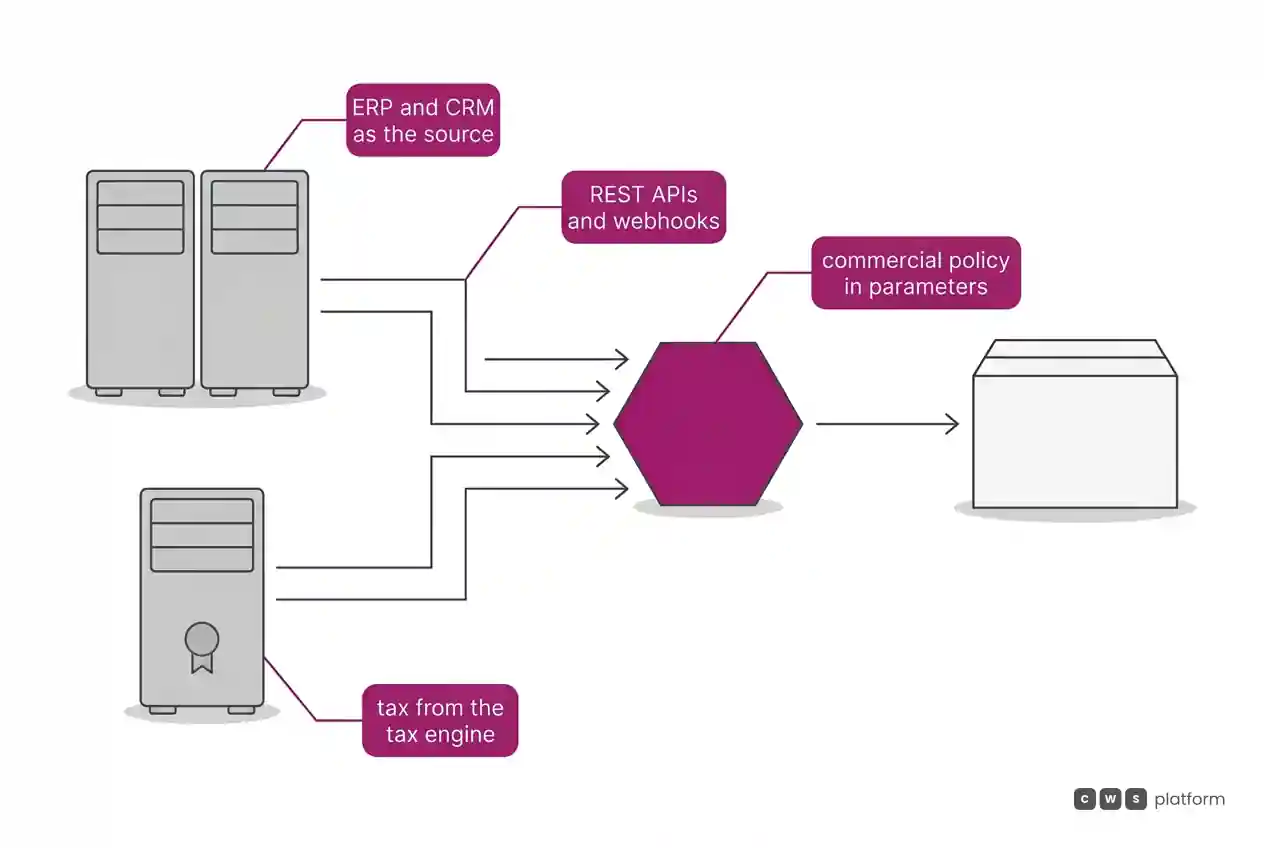
ERP as the source, platform through APIs. Choose this architecture when price, rules, and contracts originate in the ERP or CRM. CWS is API-first, with REST APIs and webhooks, and tax comes from the ERP or from the tax engine the company already uses.
Commercial policy in parameters. Choose this architecture when the rules change often and should not become an app. The Commerce Rules Engine, in CDL Workspace, keeps policy in parameters.
One version for every customer. Choose this architecture when the team does not want to maintain its own version of the platform. All customers run the same version.
Customer credit inside the platform. Choose this architecture when the credit limit has to follow the order. It is kept in the platform, granted in CDL Workspace or through APIs.
Where to go from here
If the question is still which platform model fits your operation, the starting point is the three B2B commerce platform models. For the cost of keeping rules integrated with another vendor, the comparison what does it cost to keep commercial rules integrated? looks at the ERP and CRM side.
If the decision depends on your real integration, it is worth talking to a CWS Platform specialist and mapping, with your own price, order, and credit flows, where each rule will live. The page When Integration Breaks Everything covers the pain behind this scenario in depth, without talking about any vendor.
Read more
- How to Modernize B2B Sales Without an ERP Migration
- Your ERP Is Not the Problem. What Governs What Happens on Top of It Is.
- Enterprise AI Without Replacing Your ERP
Comparisons with other vendors
To compare VTEX with other platforms, without CWS Platform in the middle:
- VTEX vs Adobe Commerce: which one handles the typical B2B order?
- VTEX vs Salesforce Commerce Cloud: can B2B and retail coexist?
- VTEX vs SAP Commerce Cloud: what can a CFO predict before signing?
- VTEX vs. commercetools: Packaged B2B Suite or Composable APIs?
- VTEX vs Spryker: which fits a B2B marketplace with sellers?
- VTEX vs Optimizely: what goes on the B2B bill?
- VTEX vs OroCommerce: what can change after an order is invoiced?
- B2B ecommerce platforms: the 9 leading options compared
Brands mentioned in this article
 VTEX



- Adobe Commerce
- Salesforce
- SAP Commerce Cloud
- Optimizely
- OroCommerce
Trademarks and logos belong to their respective owners. Mention does not imply partnership or endorsement.
"responsive, technically engaged, and willing to work through complex commercial rules (negotiated pricing, credit, customer-specific conditions) rather than pushing generic answers"
Is integration holding your operation back?
Request an assessment of your operation or talk straight to a specialist, whichever you prefer.
I'd rather get the next articles on ERP integration
A weekly roundup of new articles on ERP integration, only in weeks when there is one. No spam, and you can leave in one click.