Dealer marketplace: VTEX or CWS Platform?
Who changes the catalog the buyer sees and how each dealer's system responds at the moment of purchase, from the seat of whoever owns the network's official portal.

Editorial note: an architecture comparison between VTEX and CWS Platform for the dealer marketplace scenario, where a network of light or heavy vehicle dealers opens an official portal for vehicle owners, with the local dealer up front and the other dealers and the factory as backup. The person who decides here is the Director of Commerce. Every fact about VTEX comes from its public documentation, with the address next to it.
On a dealer portal, the buyer is not looking for a product. The buyer is looking for the part that fits their vehicle, and wants to know whether the nearest dealer has it. Both answers depend on things the network already has and no general marketplace has: the fitment knowledge that lives at each dealer's parts counter, and the inventory that lives in each dealer's management system.
For a Director of Commerce, the official portal only beats the general marketplace if that knowledge and that inventory reach the portal without losing their owner. That comes down to two architecture questions: who can change the catalog the buyer sees, and how each dealer's system talks to the portal at the moment of purchase.
The overall map of models is in the three B2B commerce platform models, and the other vendors we have assessed are in the comparisons hub. What VTEX B2B delivers out of the box is in what comes ready in VTEX B2B commerce, and each seller's price in a mixed cart is in B2B marketplace: VTEX or CWS Platform.
What VTEX does well
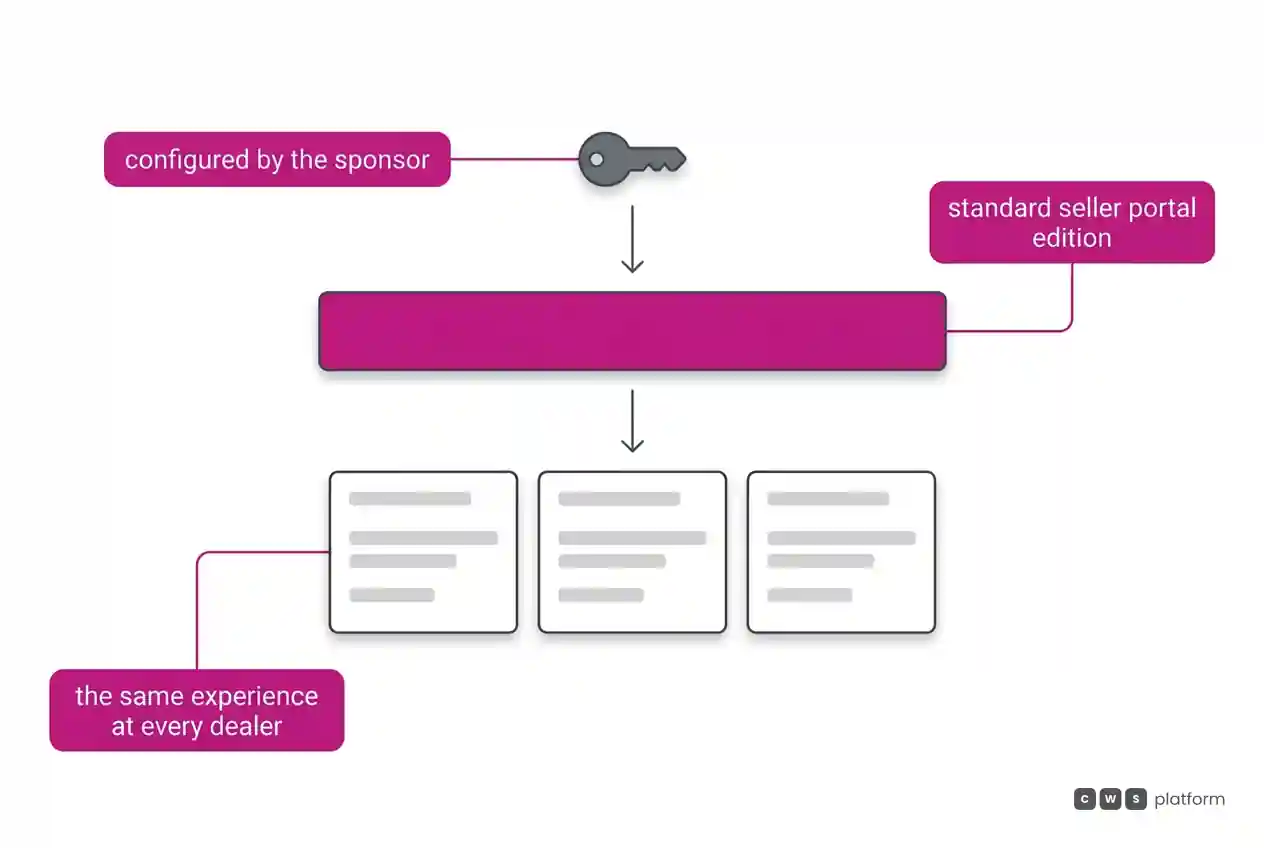
VTEX offers dealers a ready-made portal for selling on the brand's marketplace. Per the Seller Portal Edition App guide, Seller Portal is an edition of the platform built for sellers to sell on VTEX marketplaces, built as a VTEX IO application. The pages the seller sees are declared in an Edition App, the experience is standardized for every seller in that edition, and the edition is configured by a sponsor, which can be VTEX itself or a VTEX marketplace with a custom edition.
The seller also has its own catalog. The Seller Portal Catalog API lets it create, edit, and read products, variations, brands, and category trees, with a stated limit of 100,000 products per Seller Portal account.
And a dealer that already runs its own system can join as an external seller. The Marketplace Protocol documentation update describes the calls on the external seller side, including fulfillment simulation, payment processing, and order cancellation endpoints.
Where the architecture diverges
The divergence that matters to a Director of Commerce sits in the two questions from the opening, the catalog and the conversation with the dealer's system, and VTEX records both:
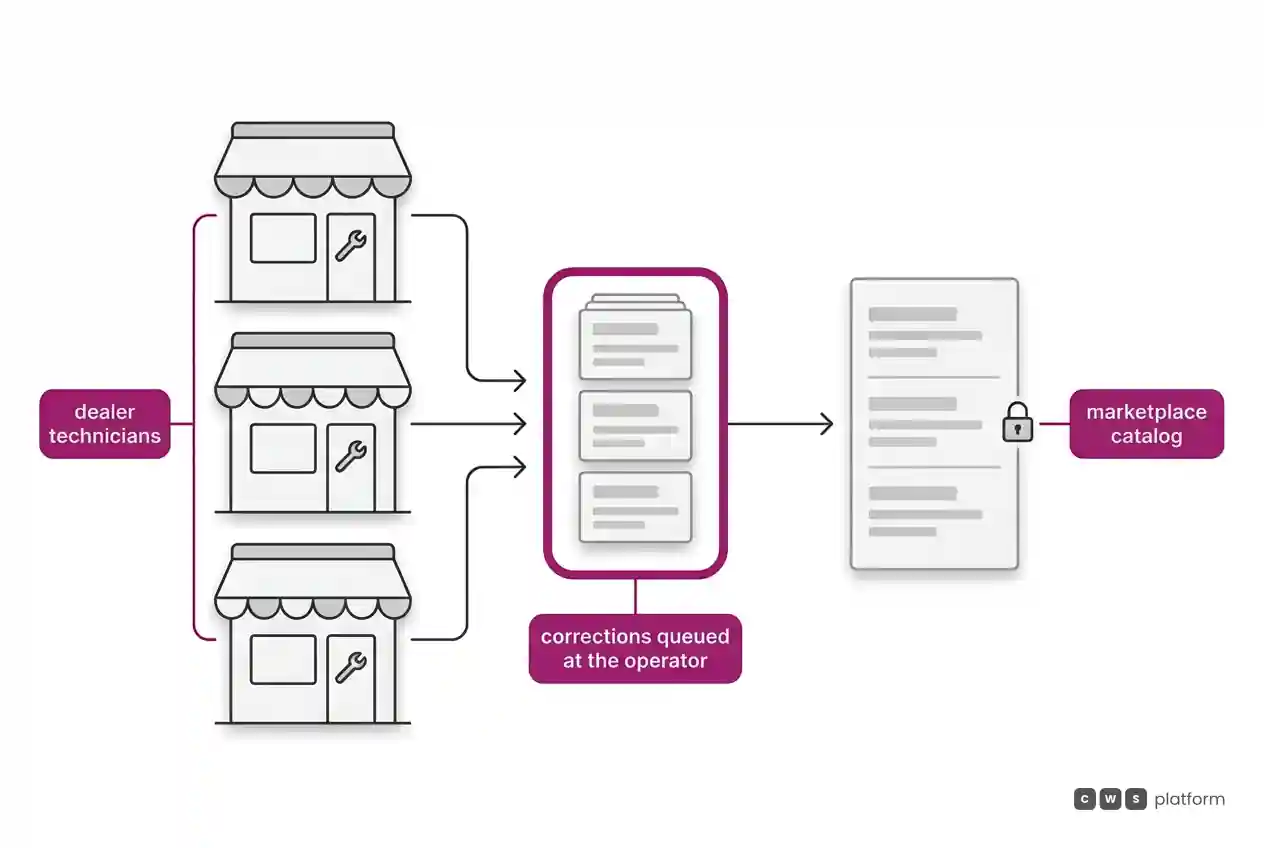
- limitation recorded in VTEX's documentation, accessed on November 5, 2026: on the page that guides the choice between a standard account, a franchise account, and Seller Portal, VTEX states that sellers cannot modify the VTEX marketplace catalog and cannot sell products shared with other marketplaces ("Sellers cannot modify the VTEX marketplace catalog and cannot sell products shared with other marketplaces.", https://help.vtex.com/en/docs/tutorials/choosing-between-standard-account-franchise-account-or-seller-portal)
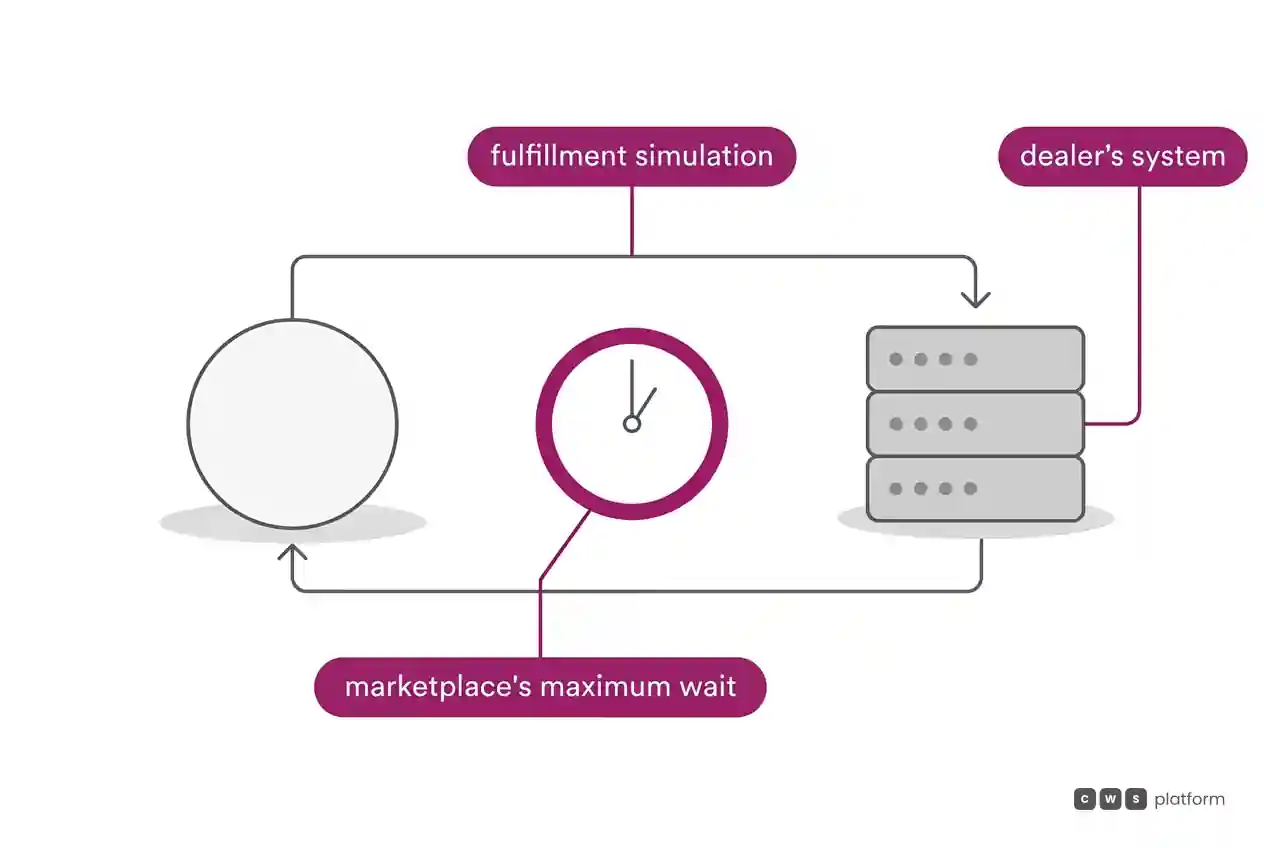
- limitation recorded in VTEX's documentation on December 18, 2025: in the external seller integration guide, the maximum time VTEX marketplaces wait for a response from the fulfillment endpoint is 2.5 seconds ("The maximum time that VTEX marketplaces wait for a response from the fulfillment endpoint is 2.5 seconds.", https://developers.vtex.com/docs/guides/external-seller-integration-connector)
The first record is about who changes the catalog. In a dealer network, the fitment catalog gets better through the people who serve customers: the dealer's technician knows which part superseded which, and which variant applies to the local fleet. If the seller cannot modify the marketplace catalog, every correction goes through the operator, who becomes a queue. And the second half matters to a dealer that also sells through other channels.
The second record is about the conversation at the moment of purchase. A dealer that joins as an external seller keeps inventory and pricing in its own system, and that system is what answers the fulfillment simulation. The marketplace waits for that answer for 2.5 seconds at most. In practice, each dealer's management system becomes part of the portal's buying experience, and each dealer's integration stops being only a data project and becomes a response-time commitment.
On CWS Platform, CDL Workspace is a single system for the entire ecosystem. CWS is API-first, with REST APIs and webhooks, and price tables, rules, and contracts can come from the ERP or CRM through an API; tax comes from the ERP or the tax engine each dealer already uses.
| decision | VTEX, per the documented mechanism and records | CWS Platform |
|---|---|---|
| Who changes the marketplace catalog | Sellers cannot modify the marketplace catalog; in Seller Portal, the seller keeps its own catalog through the Catalog API, up to 100,000 products per account | A governance question for any vendor: who edits vehicle fitment, and with what approval |
| How the dealer's system talks to the portal | The external seller answers the fulfillment simulation, with the marketplace waiting 2.5 seconds at most | API-first, with REST APIs and webhooks; tables, rules, and contracts can come from the ERP or CRM through an API |
| How the brand standardizes dealer operations | Seller Portal with an Edition App configured by a sponsor | CDL Workspace as a single system for the entire ecosystem |
The commerce decision is whether the dealer is a storefront that receives a finished catalog or a party that contributes what it knows, and how much of the portal will depend on the response time of each system in the network.
What changes in dealer marketplace operations
The official portal does not beat the general marketplace on catalog size. It wins on technical knowledge, integrated availability, and service from people who understand the vehicle. All three live at the dealers, and the architecture decides whether they reach the portal or stay at the counter.
There is also the network math. Building the portal together spreads each dealer's investment and multiplies the return, but only if the cost of joining does not repeat dealer by dealer. When each dealer has to guarantee its own response time to the portal, part of the investment becomes individual again, and dealers with older systems join last.
Two questions help bring this point into any evaluation. First: who edits a part's vehicle fitment, and how does a correction made by one dealer's technician reach all the others? Second: with inventory in each dealer's system, how long does each system take to respond at peak, and what does the buyer see when it is slow?
On CWS Platform, customer and sales rep use the same interface, and the order records who built the cart and who chose the payment.
When to choose VTEX
VTEX fits scenarios where dealers act as merchants on a retail marketplace:
Merchants that need a ready, standardized portal. Choose this architecture when the network wants to give every seller the same experience, defined by a sponsor, as the Seller Portal Edition App guide describes.
A seller with its own catalog within the account limit. Choose this architecture when each dealer keeps its own catalog of products, variations, and brands within the limit of 100,000 products per account, as the Seller Portal Catalog API describes.
A retail marketplace with external sellers already integrated. Choose this architecture when dealers already have mature integrations that answer the external seller protocol, with fulfillment simulation and cancellation, as the Marketplace Protocol update describes.
When CWS Platform is the right choice in this scenario
CWS Platform is the right choice when the brand, the dealers, and the factory need the same rules in a single system, with each dealer's ERP integrated through an API.
A single system for the network. Choose this architecture when the network's commercial policy has to apply equally at every dealer. CDL Workspace is a single system for the entire ecosystem, and the Commerce Rules Engine keeps commercial policy in parameters, on the principle of configuration over code.
The dealer's rep on the same order. Choose this architecture when technical service closes the sale. Customer and sales rep use the same interface, the rep builds a cart with the items and the source of each one and sends the link for the customer to complete the purchase, and one sales rep serves thousands of customers.
An order that ships from several dealers. Choose this architecture when the part the local dealer lacks comes from another dealer or the factory. Net terms work with split shipments, scheduled deliveries, multiple ship-to addresses, and multiple ship-from locations, and the same order accepts more than one payment method.
Where to go from here
If your question is still which architecture fits your operation, before any vendor, the path is the seven questions that separate B2B commerce architectures.
If the decision depends on how your dealers serve customers today, it is worth talking to a CWS Platform specialist and designing, with the network's real catalog and systems, who contributes what and how each dealer joins the portal. The pages When the Catalog Becomes Chaos and When Integration Breaks Everything cover the pain behind this scenario in depth, without talking about any vendor.
Comparisons with other vendors
To compare VTEX with other platforms, without CWS Platform in the middle:
- VTEX vs Adobe Commerce: which one handles the typical B2B order?
- VTEX vs Salesforce Commerce Cloud: can B2B and retail coexist?
- VTEX vs SAP Commerce Cloud: what can a CFO predict before signing?
- VTEX vs. commercetools: Packaged B2B Suite or Composable APIs?
- VTEX vs Spryker: which fits a B2B marketplace with sellers?
- VTEX vs Optimizely: what goes on the B2B bill?
- VTEX vs OroCommerce: what can change after an order is invoiced?
- B2B ecommerce platforms: the 9 leading options compared
Brands mentioned in this article
 VTEX



- Adobe Commerce
- Salesforce
- SAP Commerce Cloud
- Optimizely
- OroCommerce
Trademarks and logos belong to their respective owners. Mention does not imply partnership or endorsement.
"responsive, technically engaged, and willing to work through complex commercial rules (negotiated pricing, credit, customer-specific conditions) rather than pushing generic answers"
Is your catalog getting in the way of the sale?
Request an assessment of your operation or talk straight to a specialist, whichever you prefer.
I'd rather get the next articles on catalog management
A weekly roundup of new articles on catalog management, only in weeks when there is one. No spam, and you can leave in one click.