Multi-branch B2B portal: VTEX or CWS Platform?
The price the buyer sees while searching and where each branch's boundary lives: multi-branch self-service from the seat of whoever runs operations.

Editorial note: an architecture comparison between VTEX and CWS Platform for a distributor with multiple branches where the B2B customer buys on its own in the portal, with the pricing and terms of the branch that serves it. The person who decides here is the COO. Every fact about VTEX comes from its public documentation, its known issues page, and VTEX's own replies on its official forum, with the address next to it.
A multi-branch distributor's self-service portal is measured by the order that never reaches a sales rep's desk. The buyer logs in, searches for the item, sees the price from their own price list at the branch that serves them, and checks out. When any of those steps shows something else, the buyer does what they always did: calls the branch. The routine order goes back to the phone, inside sales rekeys it, and the portal becomes a lookup catalog.
For the COO, the cost is not in the order that fails. It is in the order that succeeds the expensive way: every call to confirm a price is rep time spent on an order the customer wanted to place alone.
This comparison looks at VTEX and CWS Platform through two questions only: is the price the buyer sees while searching their own, and where does each branch's boundary live. It is not a feature ranking. The overall map is in the post on the three B2B commerce platform models, and what VTEX ships ready-made for B2B is covered in the comparison on what comes out of the box in VTEX B2B.
What VTEX does well
VTEX has a documented structure for corporate accounts. Per the B2B Organizations app documentation, business users are grouped into organizations that share commercial rules, and each organization can have its own payment methods, price tables or price lists, and product collections. Each organization is split into one or more cost centers, each with its own shipping addresses. The app is installed on VTEX IO, with Storefront Permissions as a dependency for roles.
To get the base live, bulk import loads organizations, cost centers, and members through the Bulk Import API, from a spreadsheet.
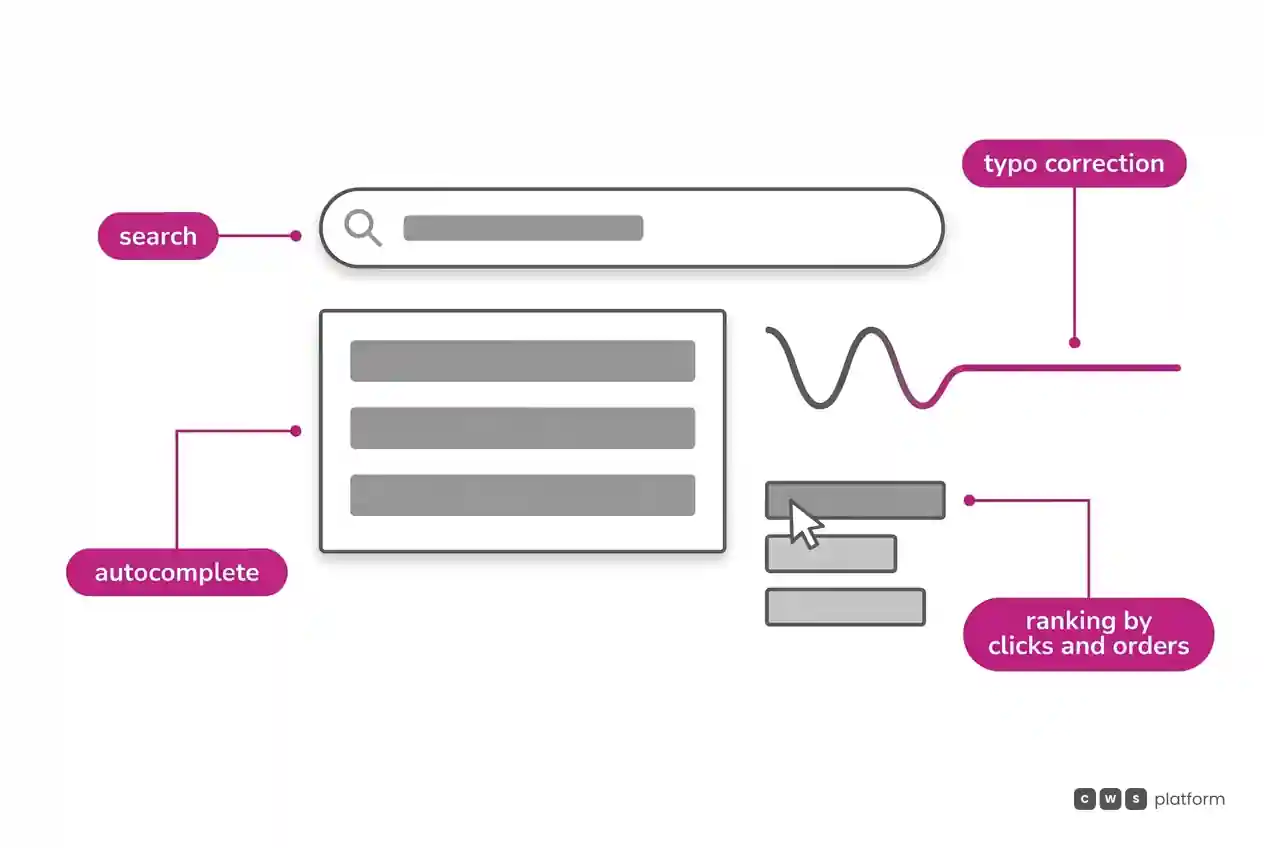
For discovery, Intelligent Search offers autocomplete, customizable filters, and typo correction covering plural, singular, and gender variations, and ranks results based on click and order history.
Where the architecture diverges
The divergence that matters to a COO sits in two records from VTEX itself:
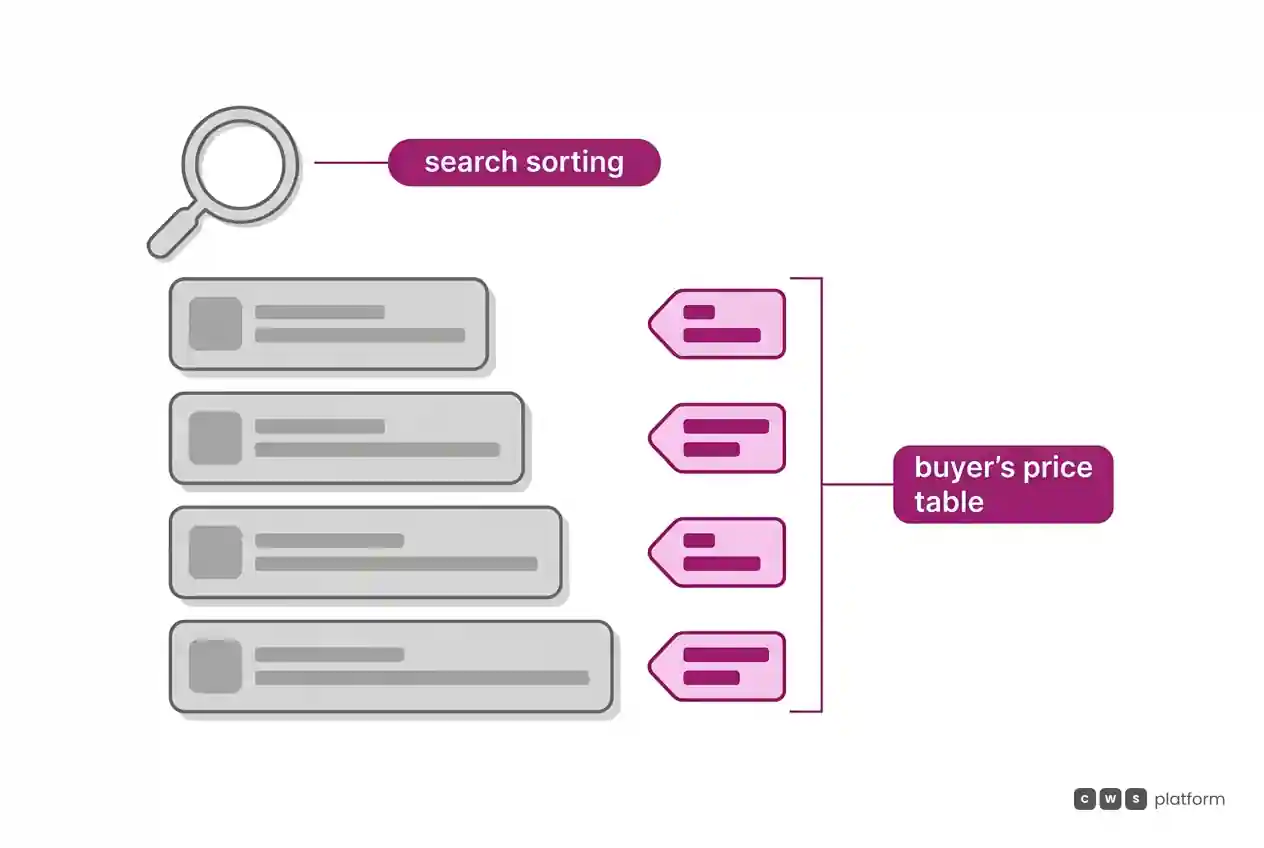
- issue recorded by VTEX as a known issue, still open as of November 5, 2026 (open since August 2024): prices from specific price tables are not considered when sorting or filtering products, and search cannot sort or filter products based on price tables ("It creates the limitation that the search can not sort and filter products based on the price tables.", https://help.vtex.com/en/known-issues/prices-from-specific-price-tables-are-not-considered-when-sorting-or-filtering-products)
- issue recorded on VTEX's official forum, accessed on November 5, 2026: a store that runs on trade policies, without a white-label seller, asks for regionalization, and, in a reply on its official forum, in January 2024, VTEX answers that the requested regionalization cannot be done with trade policies alone ("infelizmente apenas com as políticas comerciais não é possível fazer esse processo", quoted in Portuguese as in the original, https://community.vtex.com/t/regionalizacao/37833)
The first record is about the moment the buyer decides. In a B2B portal, the price list is what sets one customer apart from another. When the buyer filters by price range or sorts from low to high, they expect the result to follow their own price list. While the issue stays open, sorting and filtering do not follow price tables, and the list the buyer sees may not reflect the price they will pay.
The second record is about where the branch exists. If trade policies are not enough to separate what each territory sees, the alternative operations will evaluate is treating the branch as a seller. The documentation on adding a seller states that a white-label seller requires a contractual provision with VTEX, requires a franchise account created through support, and does not allow the seller type to be changed after registration. For the COO, that turns each branch's boundary into an account structure decision, made early and hard to undo.
On CWS Platform, price tables, rules, and contracts are configured on the platform and can come from the ERP or CRM through an API, with customizable decimal places. Commercial policy sits in parameters of the Commerce Rules Engine (CDL Workspace), on the principle of configuration over code.
| decision | VTEX, per the documented mechanism | CWS Platform |
|---|---|---|
| The price the buyer sees while searching | Open known issue: search does not sort or filter by price tables | A question for any vendor's demo: log in as a buyer at a branch with its own price list and filter by price |
| Where the branch boundary lives | VTEX's forum reply (January 2024): the requested regionalization cannot be done with trade policies alone; a white-label seller requires a contractual provision | Tables, rules, and contracts configured on the platform, commercial policy in parameters; the per-branch rule goes into the demo |
| Account credit and delivery | Payment methods per organization; cost centers with their own addresses | Customer credit limit maintained on the platform; net terms with split shipments to multiple addresses from multiple ship-from locations |
The operations decision is whether a branch will be a set of rules inside the same operation or a white-label seller, provided for in the VTEX contract and with its own franchise account.
What changes in a multi-branch B2B portal
For whoever runs operations, the difference shows up in three routines. The first is search. In B2B, price is not a stored value: it is the output of a function of customer, branch, volume, and terms. A portal that sorts by a reference price sends the buyer back to the phone exactly where price matters most. That is why search should be tested with a real buyer's identity, not an administrator's.
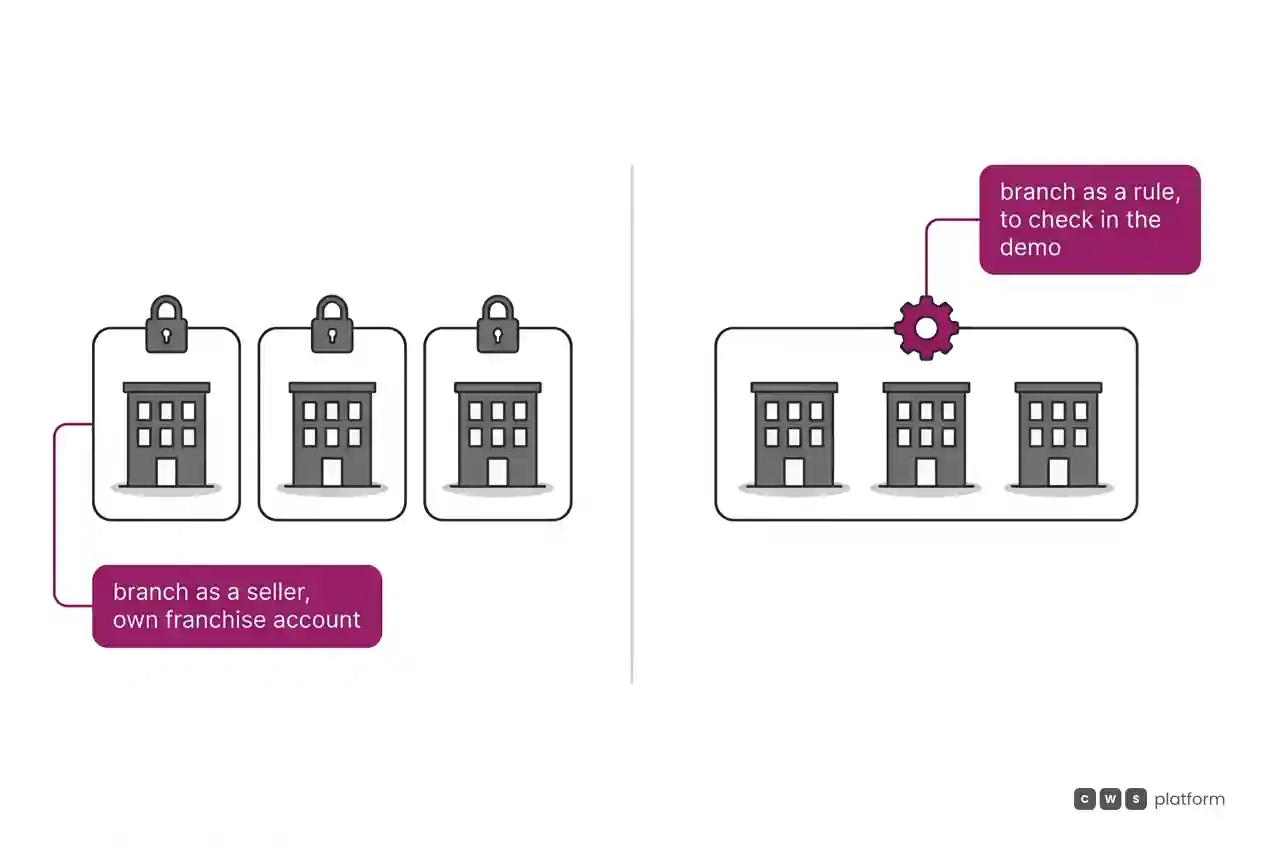
The second is the branch map. Distributors open branches, change service areas, merge territories. If the branch boundary lives in an account structure, every change to the map becomes a project. That is why it is worth taking a new branch and a territory change to any vendor's demo, and measuring what each one requires.
The third is the order that still needs a rep. Going digital does not take the rep out of the path: it measures self-service, and the rep covers where the customer gets stuck. On CWS Platform, one sales rep serves thousands of customers, customer and sales rep use the same interface, and the order records who built the cart and who chose the payment. That kind of record is what lets you measure how much volume already flows on its own.
Three questions bring this point into any evaluation. First: as a buyer at a branch with its own price list, does filtering by price follow that list? Second: what changes in registration and contracts when a new branch comes in? Third: when the buyer gets stuck, does the rep step into the same order or open another one?
When to choose VTEX
VTEX fits scenarios with these characteristics:
Corporate accounts with common rules per organization. Choose this architecture when customers are organized into organizations and cost centers, with payment, pricing, and collections per organization, as the B2B Organizations app describes.
Search driven by buyer behavior. Choose this architecture when the portal benefits from autocomplete, typo correction, and ranking by click and order history, and price does not vary by price list, as Intelligent Search describes.
An ecosystem of apps and partners. Choose this architecture when the operation wants to contract and install apps, connectors, and partners from its own admin panel, as the Extensions Hub describes.
When CWS Platform is the right choice in this scenario
CWS Platform is the right choice when each customer buys under its own price list, rules, and contract.
Customer pricing on the platform. Choose this architecture when each customer has its own price list, rules, and contract. They are configured on the platform or received from the ERP and CRM through an API, with customizable decimal places.
Commercial policy in parameters. Choose this architecture when commercial policy changes often. It sits in parameters of the Commerce Rules Engine, on the principle of configuration over code, and CDL Workspace is a single system for the entire ecosystem. Take a new branch and a territory change to the demo.
A rep who covers where the customer gets stuck. Choose this architecture when self-service coexists with assisted selling. The rep builds the cart and sends the link for the customer to complete the purchase, and the rep's discount goes through multi-level approvals.
Account credit and terms. Choose this architecture when the buyer purchases on net terms. The customer's credit limit is maintained on the platform, net terms work with split shipments, scheduled deliveries, multiple ship-to addresses, and multiple ship-from locations, and tax comes from the ERP or the tax engine the company already uses.
Where to go from here
If your network also sells to consumers through stores, the comparison on multi-store inventory in VTEX and CWS Platform looks at the delivery promise. If your question is still which architecture fits your operation, the path is the seven questions that separate B2B commerce architectures, and the other comparisons are in the comparisons hub.
If the decision depends on how your branches sell today, it is worth talking to a CWS Platform specialist to design the portal around your real price lists and territories. The pages When the Catalog Becomes Chaos and When Channels Fight Each Other cover the pain behind this scenario in depth, without talking about any vendor.
Read more
- Sales Tax, Exemption Certificates, and Electronic Invoicing: Tax Architecture in Modern B2B E-Commerce
- Enterprise System Integration in B2B Commerce: What to Connect First and How
- B2B Self-Service Portals and Order Management
Comparisons with other vendors
To compare VTEX with other platforms, without CWS Platform in the middle:
- VTEX vs Adobe Commerce: which one handles the typical B2B order?
- VTEX vs Salesforce Commerce Cloud: can B2B and retail coexist?
- VTEX vs SAP Commerce Cloud: what can a CFO predict before signing?
- VTEX vs. commercetools: Packaged B2B Suite or Composable APIs?
- VTEX vs Spryker: which fits a B2B marketplace with sellers?
- VTEX vs Optimizely: what goes on the B2B bill?
- VTEX vs OroCommerce: what can change after an order is invoiced?
- B2B ecommerce platforms: the 9 leading options compared
Brands mentioned in this article
 VTEX



- Adobe Commerce
- Salesforce
- SAP Commerce Cloud
- Optimizely
- OroCommerce
Trademarks and logos belong to their respective owners. Mention does not imply partnership or endorsement.
"responsive, technically engaged, and willing to work through complex commercial rules (negotiated pricing, credit, customer-specific conditions) rather than pushing generic answers"
Is your catalog getting in the way of the sale?
Request an assessment of your operation or talk straight to a specialist, whichever you prefer.
I'd rather get the next articles on catalog management
A weekly roundup of new articles on catalog management, only in weeks when there is one. No spam, and you can leave in one click.