Multi-store inventory: VTEX or CWS Platform?
Which store fulfills each item, what happens to a warehouse taken out of operation, and who explains the order afterward: the delivery promise from the COO's seat.

Editorial note: an architecture comparison between VTEX and CWS Platform for a business that sells through its website and a network of physical stores, with inventory spread across stores and warehouses. The person who decides here is the COO. Every fact about VTEX comes from its public documentation and from the known issues page VTEX publishes, with the address next to it.
The website's promise fits on one line: "arrives Thursday" or "pick it up today at the downtown store." Behind it sits a choice the customer never sees and the COO pays for: which store or warehouse fulfills each item in the cart. When that choice is wrong, the order lands at a location that does not have the item, someone calls another store, the delivery date slips, and an order that should have flowed on its own becomes manual work.
In a store network, the problem is rarely a lack of inventory. It is a promise built on stock that is not where the system thinks it is, or on a routing rule nobody can explain afterward. Every order rerouted by hand is a transaction cost that does not show up in the license, but does show up in store payroll and in the freight paid twice.
This comparison looks at VTEX and CWS Platform from that angle only: the delivery promise in a network of stores. It is not a feature ranking. The overall map is in the post on the three B2B commerce platform models, and what VTEX ships ready-made for B2B is covered in the comparison on what comes out of the box in VTEX B2B.
What VTEX does well
VTEX describes unified commerce for retail well. Per its Unified Commerce documentation, processing and order management are unified, so an order started in one channel is visible to and processed by the others. The same documentation describes the scenarios a store network runs every day: the endless aisle (a purchase in the physical store shipped from another store or a distribution center), the mixed cart (one item picked up in store and another delivered to the home from a different stock location), and in-store pickup for an order placed online.
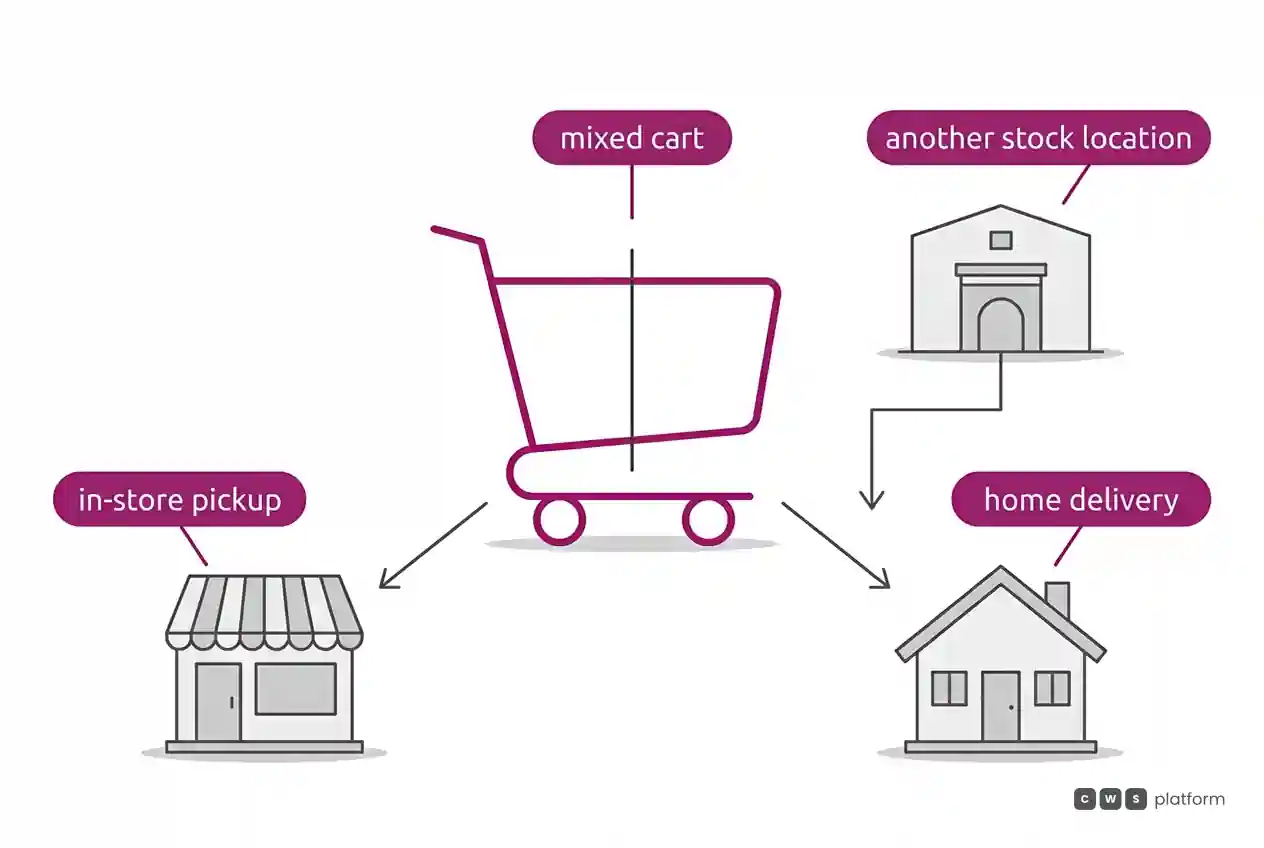
On inventory, the inventory module associates catalog items with warehouses, shows availability and reserved items, supports a critical stock level alert, and accepts loads through a spreadsheet or the Inventory API. At checkout, the fulfillment documentation describes a three-step flow once the shopper enters a location: check availability and identify where the item ships from, define where and when the carrier picks it up, and calculate the shipping cost and delivery time offered.
For stores that pick and deliver, VTEX Pick and Pack manages picking, packing, and delivery from physical stores and warehouses, with a last-mile module for an in-house fleet.
Where the architecture diverges
The divergence that matters to a COO sits in two entries on VTEX's known issues page:
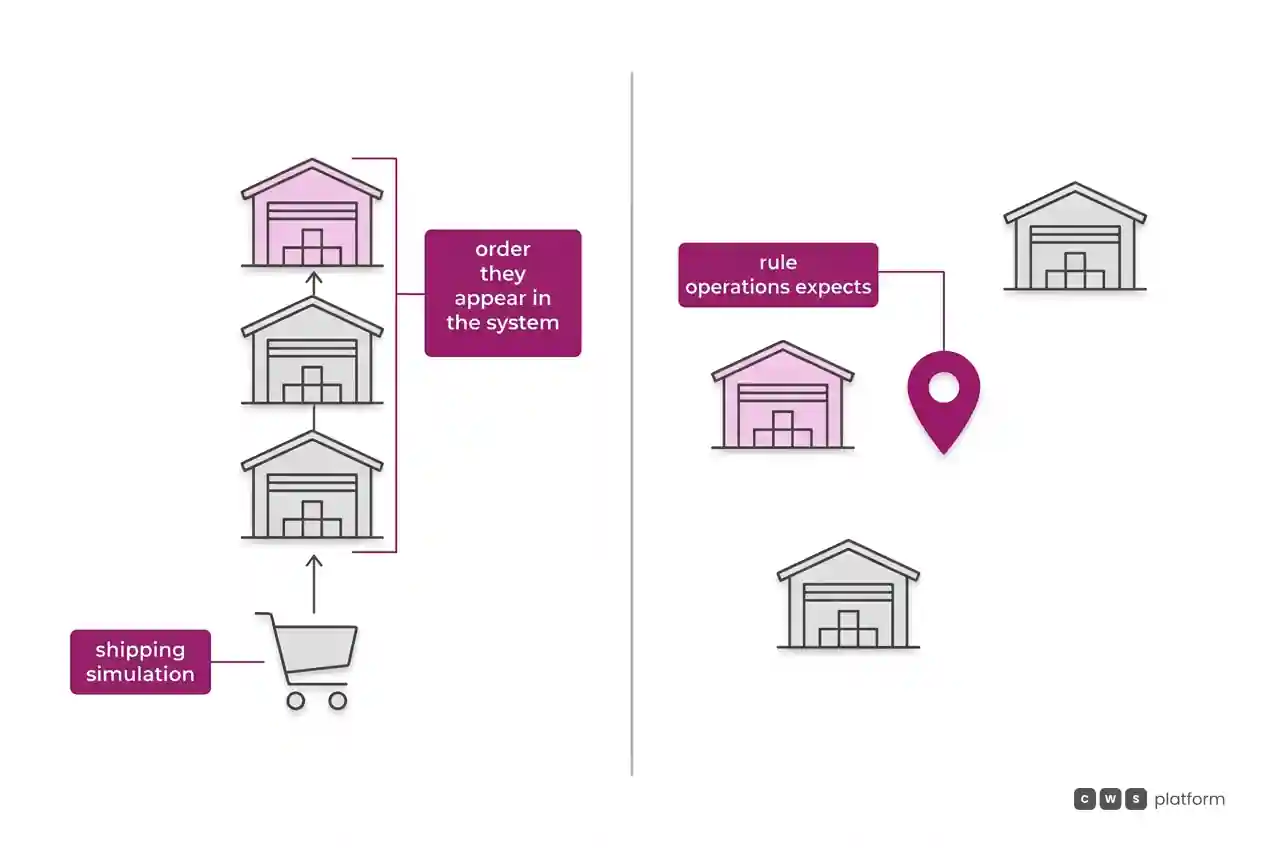
- issue recorded by VTEX as a known issue, still open as of November 5, 2026 (open since August 2025): warehouse prioritization is not deterministic during shipping simulation, and the choice of which warehouse fulfills each item is based on the order in which warehouses appear in the system ("the selection process for which warehouse will fulfill each item is based on the order in which warehouses appear in the system.", https://help.vtex.com/en/known-issues/warehouse-prioritization-is-not-deterministic-during-shipping-simulation)
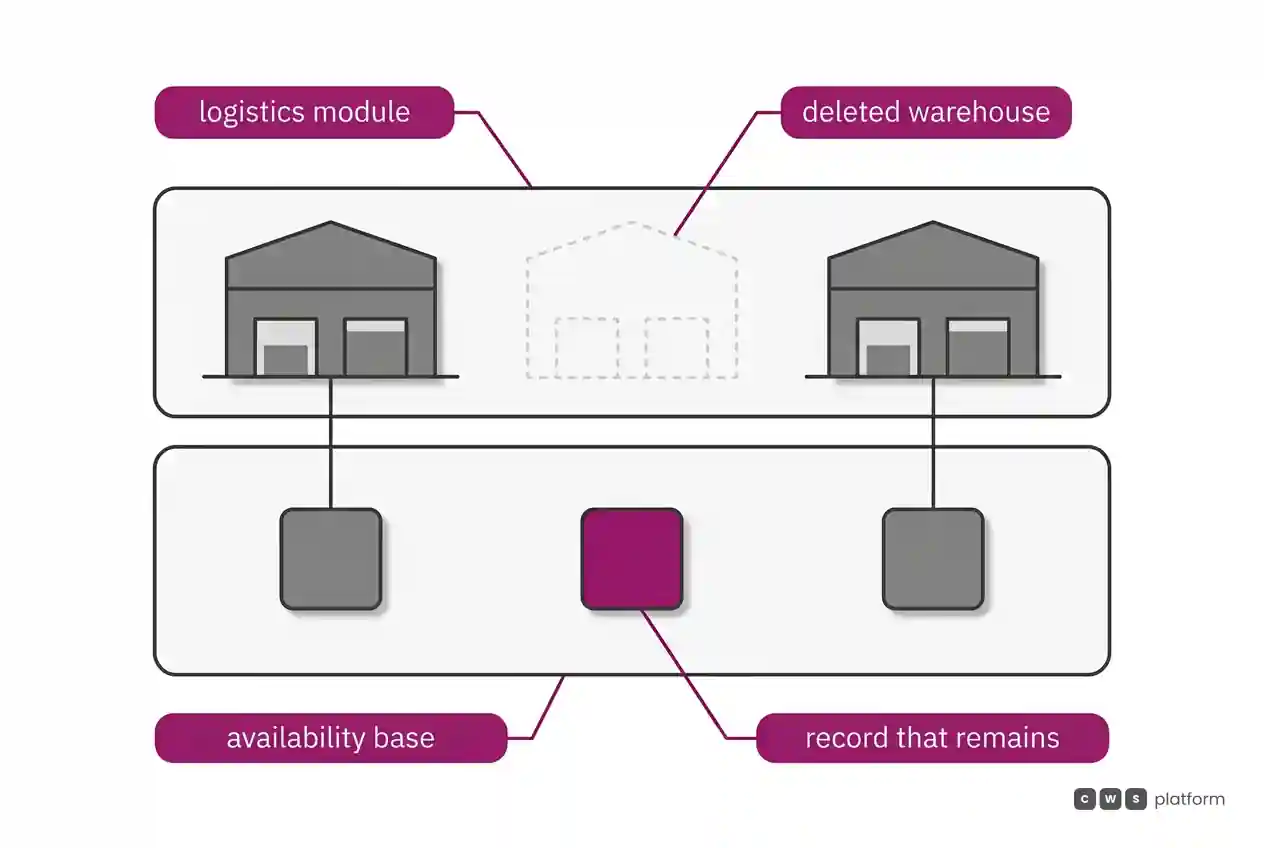
- issue recorded by VTEX as a known issue, published in June 2025, and VTEX marked it No Fix (accessed on November 5, 2026): excluded warehouses continue to return stock availability in the simulation and in the availability API, because a warehouse deleted in the Logistics module can remain registered in the availability inventory base ("When a warehouse is deleted in the Logistics module, it can remain registered in the availability inventory base.", https://help.vtex.com/en/known-issues/excluded-warehouses-continue-to-return-stock-availability-in-the-simulation-and-availability-api)
The first record changes who decides where an order ships from. Operations expects a business rule: the closest store, the one with the most stock, the one that ships cheapest. While the issue stays open, the order in which warehouses appear in the system enters that decision, and that order comes to weigh as part of the logistics rule.
The second record is about a store's life cycle. A network opens, closes, and remodels locations. If a deleted warehouse can keep showing as available, closing a store becomes a procedure with more steps than deleting a record. Since VTEX marked the item No Fix, it is worth asking the vendor, in writing, for the procedure to take a location out of operation without its stock still being promised.
On CWS Platform, a sales rep builds a cart with the items and the source of each one and sends the link for the customer to complete the purchase. Net terms work with split shipments, scheduled deliveries, multiple ship-to addresses, and multiple ship-from locations. CWS is API-first, with REST APIs and webhooks to talk to the ERP and to store systems.
| decision | VTEX, per the documented mechanism | CWS Platform |
|---|---|---|
| Where each item ships from | Checkout checks availability and identifies where the item ships from; open known issue: the choice follows the order in which warehouses appear in the system | The sales rep builds the cart with the items and the source of each one |
| What happens to a deactivated location | A deleted warehouse can remain in the availability base; VTEX marked it No Fix | A question for any vendor's demo: delete a location and simulate the same cart right after |
| One order, several ship-from points | Endless aisle, mixed cart, and in-store pickup; Pick and Pack for picking in stores | On net terms, split, scheduled shipments to multiple addresses from multiple ship-from locations |
The operations decision is knowing, before signing, whether the rule that picks the store is written by operations or is a side effect of the order in which warehouses appear in the system.
What changes in multi-store operations
For whoever runs operations, the difference shows up in three routines. The first is setup: creating a warehouse is usually an implementation task, done once and forgotten. When the order in which warehouses appear in the system weighs on the choice, setup needs an owner, criteria, and review, like any other logistics rule.
The second is opening and closing locations. A warehouse is the unit where operations happen, not just a balance: it has stock, staff, hours, and routes. Every change to the store map needs a runbook, with a test at the end: the cart that used to ship from the closed store now ships from where?
The third is explaining the order after the fact. When a customer complains about the delivery date, someone has to rebuild the order's path. On CWS Platform, the order records who built the cart and who chose the payment, and the cart a sales rep builds carries the source of each item.
Three questions bring this point into any evaluation. First: which rule picks the warehouse, who writes it, and where it is recorded. Second: what happens to the promised stock of a location that left operation. Third: when automatic routing gets it wrong, how does the store fix the order without opening a parallel process over the phone.
When to choose VTEX
VTEX fits networks that sell to the end consumer:
B2C retail with endless aisle and in-store pickup. Choose this architecture when the center of the operation is the consumer buying online and in store, as the Unified Commerce documentation describes.
Stores that pick and deliver. Choose this architecture when stores handle picking and last-mile delivery with an in-house fleet, as VTEX Pick and Pack describes.
An ecosystem of ready-made integrations. Choose this architecture when the network depends on many payment and marketplace partners: the composability documentation cites more than 750 API endpoints and more than 900 ready-made integrations.
When CWS Platform is the right choice in this scenario
CWS Platform is the right choice when the network also sells through sales reps, and the source of each item needs to be in the order instead of being decided later.
A store rep who builds and sends. Choose this architecture when the rep serves the customer and the goods may ship from another location. The rep builds the cart with the items and the source of each one and sends the link for the customer to complete the purchase. Customer and sales rep use the same interface, and the order records who built the cart and who chose the payment.
One order, multiple sources. Choose this architecture when the same order ships from more than one place. Net terms work with split shipments, scheduled deliveries, multiple ship-to addresses, and multiple ship-from locations.
Commercial rules that operations maintains. Choose this architecture when promotions and terms change by market. Commercial policy sits in parameters of the Commerce Rules Engine (CDL Workspace), on the principle of configuration over code, thousands of promotions can run at the same time, and all customers run the same version of the platform.
Where to go from here
For the order after checkout, the comparison on order changes in VTEX and CWS Platform follows the same operations lens. If your question is still which architecture fits your network, the path is the seven questions that separate B2B commerce architectures, and the other comparisons are collected in the comparisons hub.
If the decision depends on how your stores serve customers today, it is worth talking to a CWS Platform specialist to map, with your own locations, where each order should ship from. The pages When Channels Fight Each Other and When Integration Breaks Everything cover the pain behind this scenario in depth, without talking about any vendor.
Comparisons with other vendors
To compare VTEX with other platforms, without CWS Platform in the middle:
- VTEX vs Adobe Commerce: which one handles the typical B2B order?
- VTEX vs Salesforce Commerce Cloud: can B2B and retail coexist?
- VTEX vs SAP Commerce Cloud: what can a CFO predict before signing?
- VTEX vs. commercetools: Packaged B2B Suite or Composable APIs?
- VTEX vs Spryker: which fits a B2B marketplace with sellers?
- VTEX vs Optimizely: what goes on the B2B bill?
- VTEX vs OroCommerce: what can change after an order is invoiced?
- B2B ecommerce platforms: the 9 leading options compared
Brands mentioned in this article
 VTEX



- Adobe Commerce
- Salesforce
- SAP Commerce Cloud
- Optimizely
- OroCommerce
Trademarks and logos belong to their respective owners. Mention does not imply partnership or endorsement.
"responsive, technically engaged, and willing to work through complex commercial rules (negotiated pricing, credit, customer-specific conditions) rather than pushing generic answers"
Are your channels competing for the same customer?
Request an assessment of your operation or talk straight to a specialist, whichever you prefer.
I'd rather get the next articles on channel conflict
A weekly roundup of new articles on channel conflict, only in weeks when there is one. No spam, and you can leave in one click.