VTEX vs. CWS Platform: do B2B quotes close the way the rep negotiated them?
A formal quoting cycle, unit multipliers, and a locked checkout after acceptance, through the lens of whoever owns the sales number.

Editorial note: an architecture comparison between VTEX and CWS Platform, written for those who answer as VP of Sales. Every fact about VTEX comes from its public documentation and from the known issues page it maintains, with the address next to it.
For whoever owns the number, the quote is the most expensive moment in a B2B sale. The rep spends days building the proposal, negotiates price and quantity with the buyer, the customer accepts, and the order that comes out of it has to be exactly what was agreed. When it is not, the deal goes back to the table: the buyer pushes back on the amount, the rep rebuilds the proposal, the manager approves again the discount already approved once.
Every one of those loops costs days of sales cycle and a slice of margin, because the second round of negotiation rarely closes at the first round's price. And the cost never shows up in a license report; it shows up in the quote-to-order conversion rate and in the team's morale.
The question that separates platforms here is not whether there is a quoting module. It is whether the quote carries the rule for how the product is sold, and whether it can take a last-minute adjustment without starting over. This comparison looks at VTEX and CWS Platform from that angle only. What comes ready-made in VTEX B2B is covered in the comparison of VTEX B2B commerce and CWS Platform, the overall map is in the three B2B commerce platform models, and the other matchups are in the comparisons hub.
What VTEX does well
VTEX has a formal quoting cycle. The B2B Quotes & Carts app stores items, quantities, and prices from the current cart in its own Master Data V2 entity, and the quotes GraphQL API manages the READY, PENDING, REVISED, DECLINED, EXPIRED, and PLACED statuses.
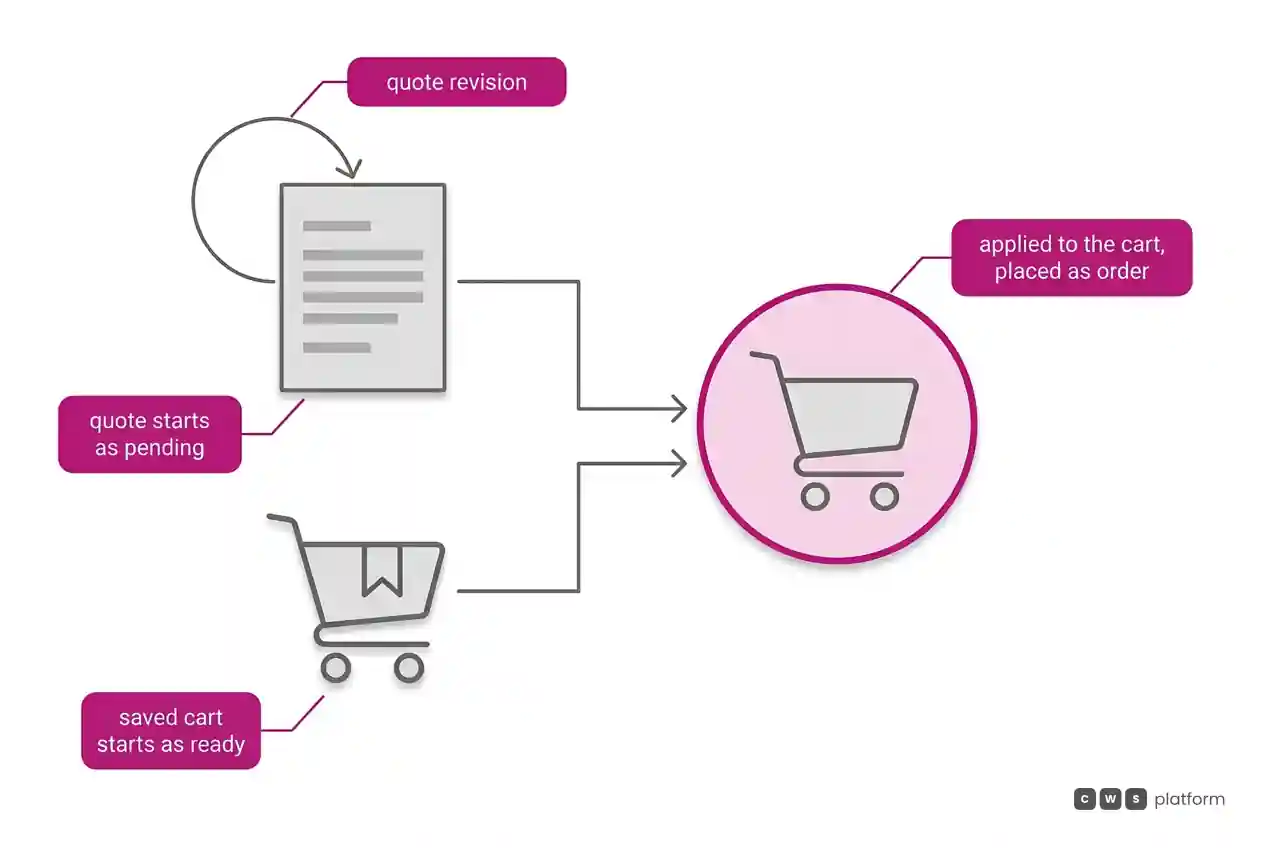
The cycle covers the back and forth of a negotiation. Creating a quote sets it to PENDING, or a saved cart to READY; updating it lets you change quantities, apply price adjustments, and move the status; and applying it to the cart carries the accepted quote into the order, with the option of clearing the cart first. Queries filter by organization, cost center, status, and text, and there is a hierarchy of parent and child quotes.
Roles are designed too. In the Storefront Permissions app, the customer-buyer can save carts or generate quotes when B2B Quotes is installed, and the customer-approver creates orders from saved carts and quotes. For an operation that requires a formal proposal before any commitment, it is a complete flow.
Where the architecture diverges
The divergence that matters to a VP of Sales sits in two records from the vendor itself, one about the quote's value and one about what happens after it is accepted:
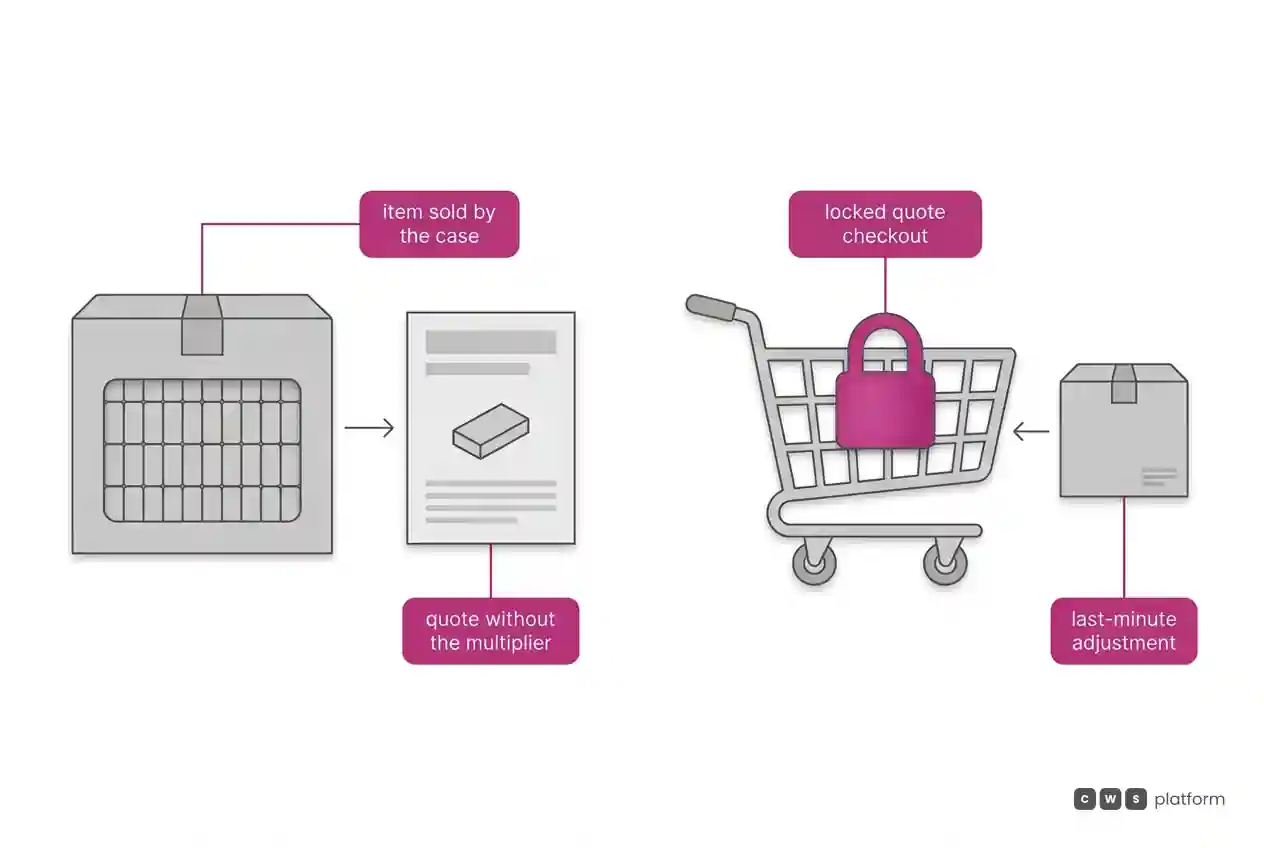
- recorded by VTEX as a known issue, still open as of November 5, 2026 (accessed on that date): since October 2025, when a quote is created with items that have a unit multiplier, only the original, non-multiplied quantity is considered ("When creating a quote with items that have an unit multiplier configuration only the original, non multiplied, quantity is considered while the multiplied quantity is disregarded.", https://help.vtex.com/en/known-issues/incorrect-values-in-quotes-on-items-with-unity-multiplier-configuration)
- limitation recorded in VTEX's documentation, accessed on November 5, 2026: with B2B Checkout Settings, a quote checkout is locked and quantities cannot be changed nor products added or removed ("If the B2B Checkout Settings app is installed, the checkout will be in a “locked” state until the order is placed, meaning that product quantities cannot be changed, and products cannot be added or removed.", https://developers.vtex.com/docs/apps/vtex.b2b-quotes)
The first record is about value. A unit multiplier is how a B2B catalog says an item ships by the case, the bundle, or the pack. Those are exactly the items a distributor sells most. While the issue stays open, the quote for those items counts the quantity without the multiplication, and the amount the rep presents has to be checked by hand before it reaches the buyer.
The second record is about acceptance. The lock protects what was negotiated, and that is a legitimate safeguard. The side effect is that the last-minute adjustment, one more case, an item swapped because it is out of stock, does not fit in the quote checkout: it goes back to the quote. Taken together, the two records describe the cycle a VP of Sales wants to avoid, where the quote amount has to be checked by hand and the final adjustment reopens the proposal.
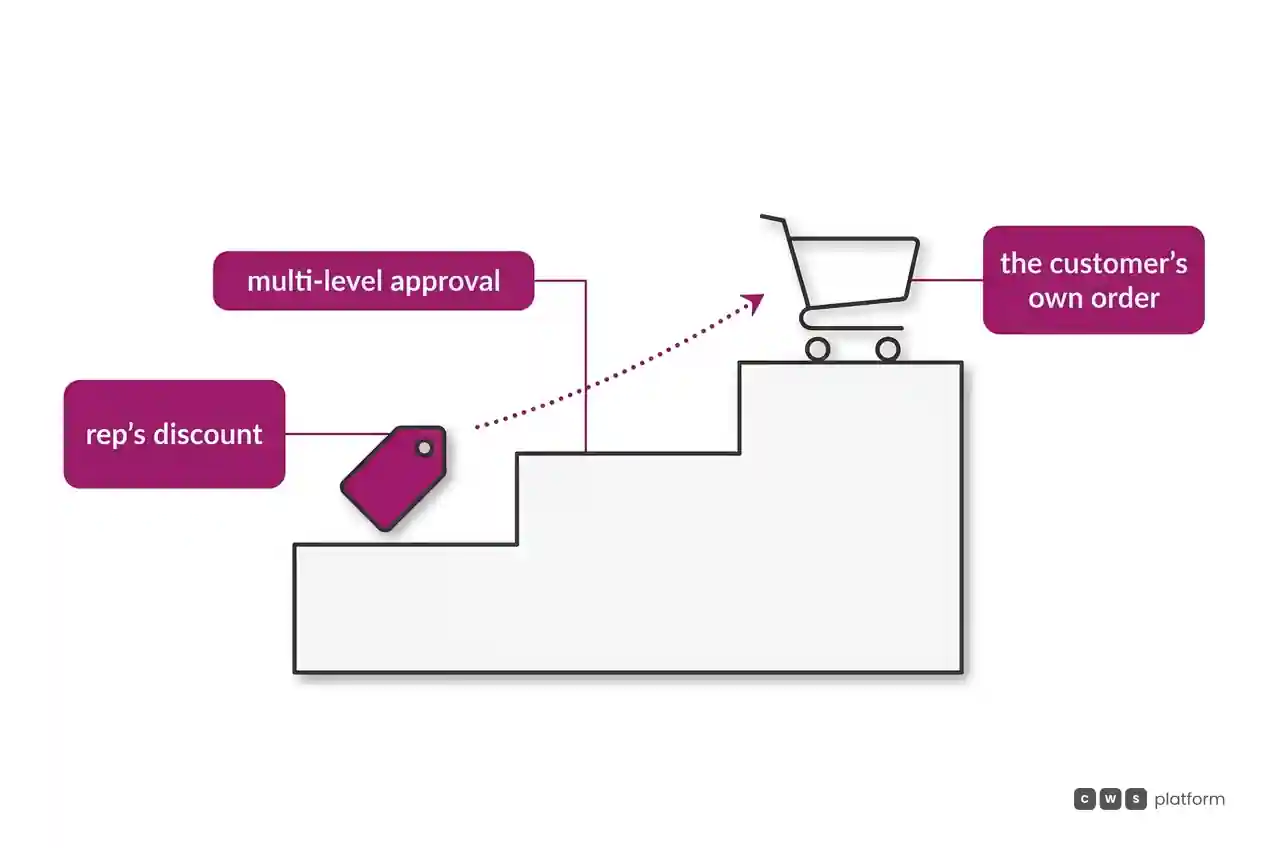
On CWS Platform, customer and sales rep work on the same order. The rep builds the cart with the items and the source of each one and sends the link for the customer to complete the purchase, and the sales rep's discount goes through multi-level approvals.
| decision | VTEX, per the documented mechanism | CWS Platform |
|---|---|---|
| How the proposal reaches the buyer | In a B2B Quotes & Carts quote, with its own statuses, applied to the cart afterwards | In the cart the rep builds and sends to the customer as a link |
| How pack pricing gets in | Open known issue: the quote counts the quantity without the unit multiplier | A question for any vendor, with a quote for items sold by the case in the demo |
| What happens to an adjustment after acceptance | With B2B Checkout Settings, the quote checkout is locked until the order is placed | A question for any vendor, with a real adjustment in the demo |
| How the discount is governed | Price adjustments when updating the quote | The sales rep's discount goes through multi-level approvals |
The sales decision is whether the accepted quote carries the pack rule and takes the last adjustment without going back to the table.
What changes in operations, through the VP of Sales lens
For the sales force, the difference shows up in three routines.
The first is the proposal. A quote is only good when every term in it is already validated at the moment the buyer accepts: the right price table, the quantity in the right pack, payment terms and discount within policy. A term validated after acceptance is a negotiation reopened. In any demo, ask for a quote with items sold by the case and check the amount line by line.
The second is the discount. A rep whose only lever is price will pull that lever to the limit. When the discount is approved on the same order the customer is going to complete, the approval stays with the proposal to the end, instead of being redone every time the proposal moves to a different place. On CWS Platform, the sales rep's discount goes through multi-level approvals, and commercial policy sits in parameters of the Commerce Rules Engine (CDL Workspace), on the principle of configuration over code.
The third is the close. A B2B buyer rarely accepts the whole proposal without one last adjustment. On CWS, the rep builds the cart and sends the link; the cart holds 250 line items by default, and that is configurable, and thousands of promotions can run at the same time. The order records who built the cart and who chose the payment, which separates the rep's work from the buyer's work when commission is calculated.
When to choose VTEX
VTEX fits scenarios with these characteristics:
A formal proposal before commitment. Choose this architecture when the buyer's culture requires a quote with its own statuses, with a revision step before it becomes an order, as the quotes GraphQL API describes.
Retail and retail marketplaces. Choose this architecture when the volume is in consumer sales and the marketplace, with search, one-click checkout, and digital wallets, as the VTEX Commerce Platform page describes.
An ecosystem of apps and integrations. Choose this architecture when the company wants to compose its store with partners and apps, backed by more than 750 API endpoints and more than 900 ready-made integrations, as the composability page records.
When CWS Platform is the right choice in this scenario
CWS Platform is the right choice when the rep's proposal can start in the cart the customer is going to complete.
A proposal built by the rep. Choose this architecture when replenishment or the proposal starts with the rep. The rep builds the cart with the items and the source of each one and sends the link, and customer and sales rep work on the same order.
Commercial terms that follow the account. Choose this architecture when each customer has its own price table, contract, and promotions. Price tables, rules, and contracts are configured on the platform, with customizable decimal places, or arrive from the ERP and CRM through an API.
Discounts with governance. Choose this architecture when the rep's discount needs approval. The discount goes through multi-level approvals, and the customer's credit is maintained on the platform.
Net terms with split shipments. Choose this architecture when the accepted proposal turns into deliveries on different dates and to different places. Net terms work with split shipments, scheduled deliveries, multiple ship-to addresses, and multiple ship-from locations.
Where to go from here
If your question is still which architecture fits your operation, before any vendor, the path is the seven questions that separate B2B commerce architectures. If the question is who changes commercial rules day to day, the comparison Optimizely Configured Commerce or CWS Platform: can you change commercial rules without a ticket? covers it.
If the decision depends on how your quotes turn into orders today, it is worth talking to a CWS Platform specialist and walking, with a real proposal from your team, the path from negotiation to invoicing. The page When Selling More Doesn't Mean Earning More covers the pain behind this scenario in depth, without talking about any vendor.
Read more
- Sales Tax, VAT, and Compliance: Where Tax Engines Live in B2B E-Commerce
- B2B Systems Integration: What to Connect First and How
- B2B Customer Portals and Self-Service Ordering
Comparisons with other vendors
To compare VTEX with other platforms, without CWS Platform in the middle:
- VTEX vs Adobe Commerce: which one handles the typical B2B order?
- VTEX vs Salesforce Commerce Cloud: can B2B and retail coexist?
- VTEX vs SAP Commerce Cloud: what can a CFO predict before signing?
- VTEX vs. commercetools: Packaged B2B Suite or Composable APIs?
- VTEX vs Spryker: which fits a B2B marketplace with sellers?
- VTEX vs Optimizely: what goes on the B2B bill?
- VTEX vs OroCommerce: what can change after an order is invoiced?
- B2B ecommerce platforms: the 9 leading options compared
Brands mentioned in this article
 VTEX



- Optimizely
- Adobe Commerce
- Salesforce
- SAP Commerce Cloud
- OroCommerce
Trademarks and logos belong to their respective owners. Mention does not imply partnership or endorsement.
"responsive, technically engaged, and willing to work through complex commercial rules (negotiated pricing, credit, customer-specific conditions) rather than pushing generic answers"
Is selling more not turning into margin?
Request an assessment of your operation or talk straight to a specialist, whichever you prefer.
I'd rather get the next articles on margin and discounts
A weekly roundup of new articles on margin and discounts, only in weeks when there is one. No spam, and you can leave in one click.