Assisted selling: VTEX or CWS Platform?
The counter rep buys on the customer's behalf: what the order keeps from that purchase and whose credit shows on the telesales screen, through the lens of whoever owns the channel.

Editorial note: an architecture comparison between VTEX and CWS Platform for the assisted selling scenario, where a counter or telesales rep steps into the portal on the customer's behalf and completes the purchase for them. The person who decides here is the Director of Commerce. Every fact about VTEX comes from its public documentation and from the known issues page it maintains, with the address next to it.
Early morning, at the branch counter. A regular customer walks in with a handwritten list, the counter rep opens the portal on the customer's behalf, builds the order, checks the payment terms, and completes the purchase on the account's credit. Within minutes, the customer leaves with picking already under way. This is assisted selling working as it should: the rep does for the customer what the customer would do alone.
What happens next decides whether that sale helps or hurts the digital channel. At month end, someone will ask who placed that order, whether it was self-service or the counter, and who gets the commission. And at the moment of closing, the rep needs to have seen the customer's credit, not some other number.
For a Director of Commerce, the question that separates platforms here is not whether the rep can buy on the customer's behalf. It is what the order keeps from that purchase and what the screen shows while it happens. This comparison looks at VTEX and CWS Platform from that angle only. The rep's channel is covered in the comparison B2B sales reps: VTEX or CWS Platform?, what comes ready-made in VTEX B2B is in the comparison of VTEX B2B commerce and CWS Platform, the overall map is in the three B2B commerce platform models, and the other matchups are in the comparisons hub.
What VTEX does well
VTEX has a mature unified commerce architecture. Per the Unified Commerce overview, an order started in one channel is visible to and processed by others, the catalog is accessible to every integrated channel, and there are endless aisle, mixed cart, and in-store pickup scenarios.
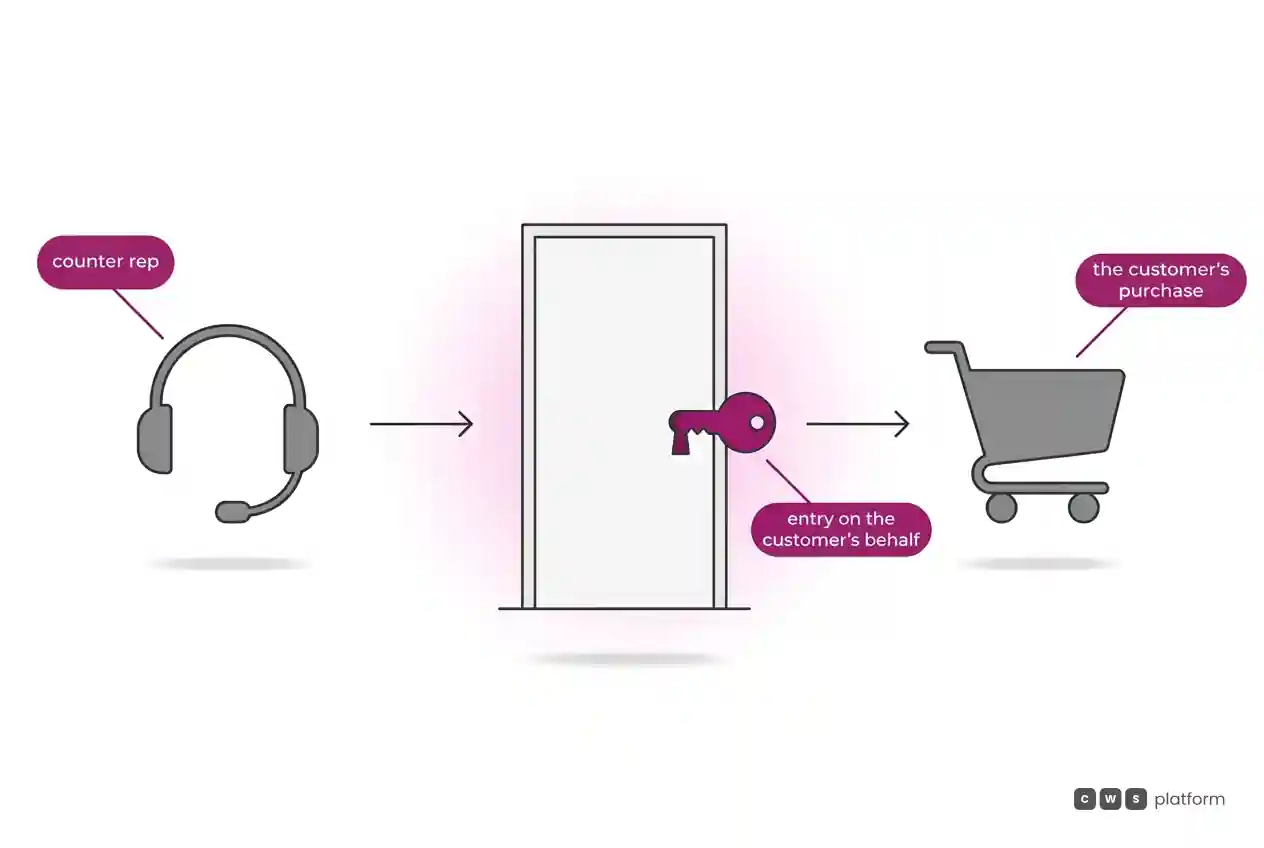
In the B2B Suite, buying on the customer's behalf is built into the roles. The Storefront Permissions app ships store-admin, with general impersonation, sales-manager, which manages the organization's reps and impersonates, and sales-representative, which assists and impersonates within the same cost center. Validation happens on every action: when a user acts on the storefront, permissions are checked against the assigned role, as the page on permissions management in B2B Suite describes.
On payments, the gateway accepts, among other methods, cards, digital wallets, gift cards, and customer credit, as the payments overview lists.
Where the architecture diverges
The divergence that matters to a Director of Commerce sits in two records from the vendor itself, both about the moment someone buys on the customer's behalf:
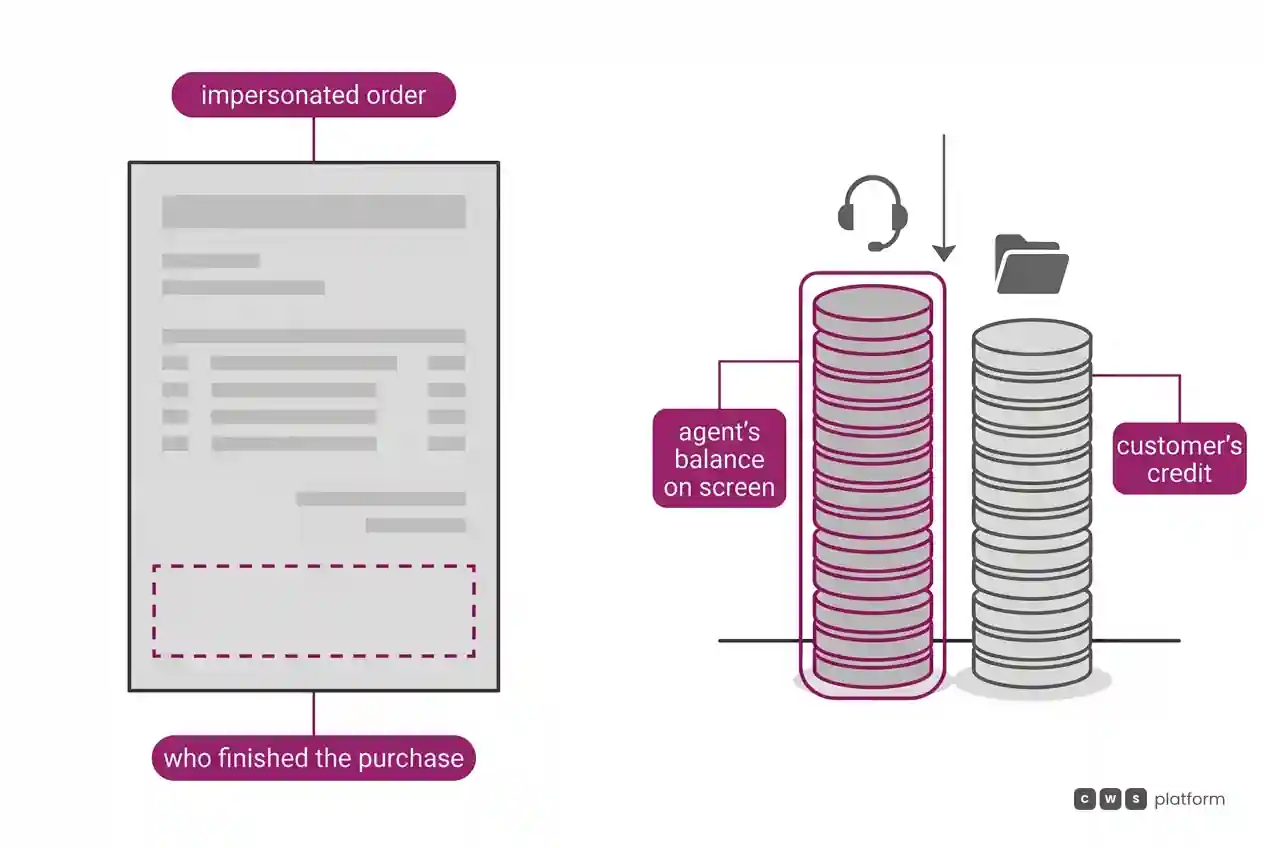
- recorded by VTEX as a known issue, still open as of November 5, 2026 (accessed on that date): since June 2024, when a user with the proper permissions impersonates another member of the organization, no information about who finished the purchase is registered in the order ("When an email has the proper permissions and impersonates another member, no impersonation information about who finished the purchase is registered in the order.", https://help.vtex.com/en/known-issues/b2b-organizations-impersonate-feature-doesnt-register-information-in-orders)
- recorded by VTEX as a known issue, still open as of November 5, 2026 (accessed on that date): since February 2026, during telesales impersonation, the balance displayed is the telesales agent's own credit instead of the impersonated customer's credit ("the balance displayed corresponds to the telesales agent’s own credit instead of the impersonated customer’s credit.", https://help.vtex.com/en/known-issues/my-credits-displays-agents-balance-not-customers-during-telesales-impersonation)
The first record is about authorship. When the counter rep completes the purchase on the customer's behalf, the order does not keep the fact that it was the rep. As far as the order is concerned, the purchase belongs to the customer. That erases exactly the information a Director of Commerce uses to measure the channel: how much of the volume is self-service and how much went through a rep.
The second record is about credit. During impersonation, the balance shown in My Credits is the agent's, not the customer's. In telesales, where the decision to close on net terms is made by looking at the screen, the number guiding the conversation is the wrong one. Both issues are open, and while they are, assisted selling calls for a parallel record of authorship and a separate check on credit.
On CWS Platform, the order records who built the cart and who chose the payment, and customer and sales rep work on the same order. The customer's credit limit is maintained on the platform, as an account balance granted in CDL Workspace or through the credit limit API.
| decision | VTEX, per the documented mechanism | CWS Platform |
|---|---|---|
| How the rep buys for the customer | Impersonation through B2B Suite roles, validated on every action | Customer and sales rep use the same interface, on the same order |
| What the order keeps from assisted selling | Open known issue: during impersonation, the order does not register who finished the purchase | The order records who built the cart and who chose the payment |
| Which credit shows during service | Open known issue: in telesales, the balance displayed is the agent's | The customer's credit limit maintained on the platform, in CDL Workspace or through an API |
| How the customer pays | Gateway with cards, wallets, gift cards, and customer credit | More than one payment method on the same order, with rules in CDL Workspace maintained through an API |
The commerce decision is whether the order will keep who built the cart and who chose the payment, or whether that will be rebuilt outside it.
What changes in assisted selling operations
Assisted selling done well is what moves the customer from the counter to the portal. The rep who completes the purchase for the customer today is the same one who, tomorrow, shows the customer how to do it alone. For that to work, the platform has to tell the two apart, or self-service never shows up in the report.
Three questions help bring this point into any evaluation.
First: when the rep completes the purchase on the customer's behalf, does the order show who built it, who chose the payment, and who finished it. Ask in the demo for an order completed through impersonation and open its record.
Second: during service, is the credit on screen the customer's. In B2B, credit is a condition of sale, and the rep decides the payment terms by looking at that number.
Third: does the counter order come out the same as the portal order. Commercial terms, discounts, and payment methods need to match, or the digital channel and the counter start competing for the same customer.
On CWS Platform, the rep builds a cart with the items and the source of each one and sends the link for the customer to complete the purchase, when the customer prefers to finish alone. The sales rep's discount goes through multi-level approvals, and net terms work with split shipments, scheduled deliveries, multiple ship-to addresses, and multiple ship-from locations.
When to choose VTEX
VTEX fits scenarios with these characteristics:
Physical stores with floor associates. Choose this architecture when assisted selling happens in retail, with the associate connected to the unified base and the OMS through Sales App, as the Unified Commerce overview describes.
Omnichannel retail with shared inventory. Choose this architecture when the order starts in a store and is fulfilled by another store or a distribution center, with endless aisle and in-store pickup, as the same Unified Commerce overview describes.
Payments across many providers. Choose this architecture when the operation needs to connect acquirers, anti-fraud, and wallets through standardized connectors, as the payments overview describes.
When CWS Platform is the right choice in this scenario
CWS Platform is the right choice when the order needs to record who built the cart and who chose the payment, and the customer's credit decides the close.
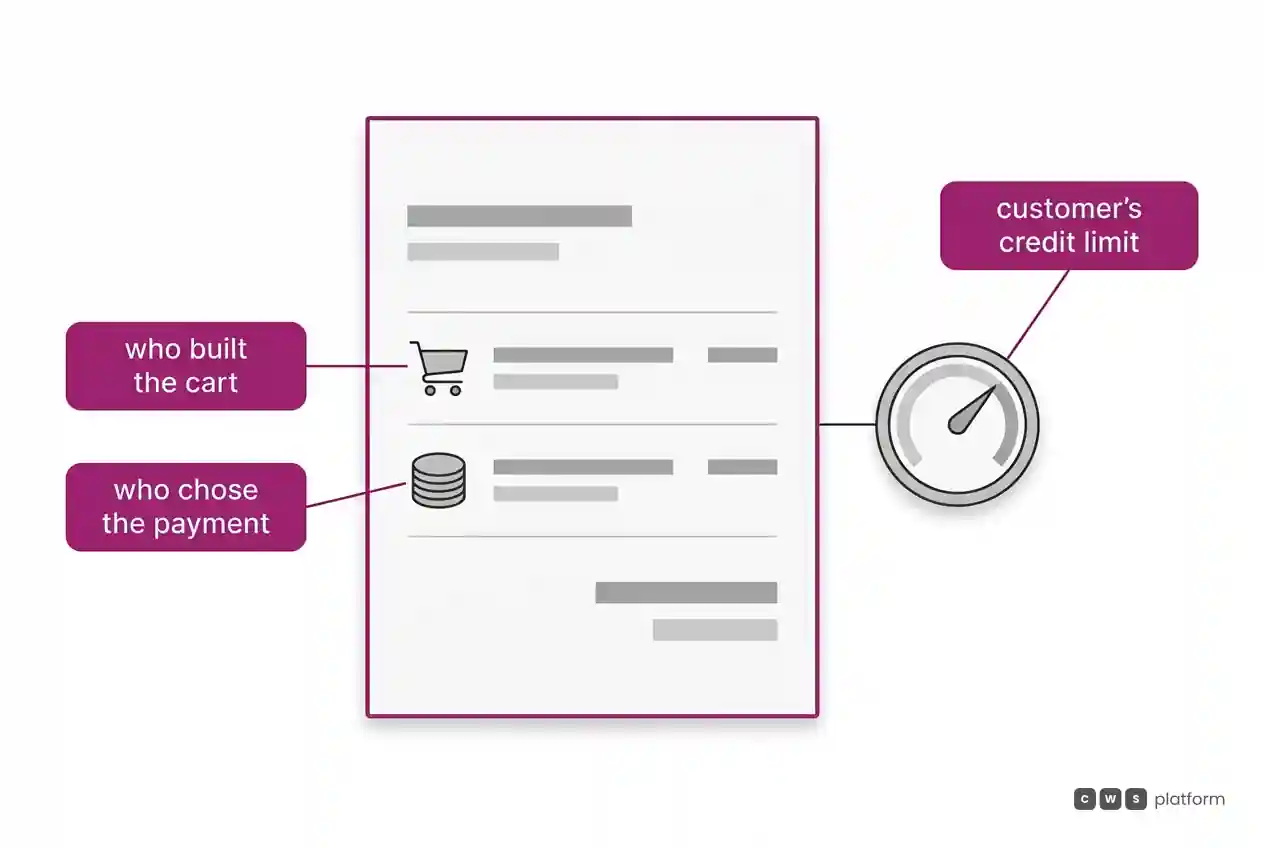
Who built the cart and who paid, on the order. Choose this architecture when the channel needs to separate self-service from the counter. The order records who built the cart and who chose the payment.
The customer's credit during service. Choose this architecture when the rep closes on net terms at the counter or in telesales. The customer's credit limit is maintained on the platform, granted in CDL Workspace or through an API.
Counter and portal on the same order. Choose this architecture when the rep and the customer take turns on the same purchase. Customer and sales rep use the same interface, and the rep can build the cart and send the link for the customer to complete.
Combined payment. Choose this architecture when part of the order goes on net terms and part through another method. The same order accepts more than one payment method, with the rules combined in CDL Workspace and maintained through an API.
Where to go from here
If the question is how each account's commercial terms reach the platform, the comparison Spryker or CWS Platform: where does customer pricing travel in the ERP integration? covers it. If your question is still which architecture fits your operation, the path is the seven questions that separate B2B commerce architectures.
If the decision depends on how your counter and telesales teams serve customers today, it is worth talking to a CWS Platform specialist and walking, with a real order completed by a rep, the path of authorship and credit through to the channel report. The page When Channels Fight Each Other covers the pain behind this scenario in depth, without talking about any vendor.
Read more
- Sales tax and regulatory compliance: architectural realities in B2B e-commerce
- B2B systems integration: prioritization and sequencing frameworks
- B2B customer portal and self-service ordering
Comparisons with other vendors
To compare VTEX with other platforms, without CWS Platform in the middle:
- VTEX vs Adobe Commerce: which one handles the typical B2B order?
- VTEX vs Salesforce Commerce Cloud: can B2B and retail coexist?
- VTEX vs SAP Commerce Cloud: what can a CFO predict before signing?
- VTEX vs. commercetools: Packaged B2B Suite or Composable APIs?
- VTEX vs Spryker: which fits a B2B marketplace with sellers?
- VTEX vs Optimizely: what goes on the B2B bill?
- VTEX vs OroCommerce: what can change after an order is invoiced?
- B2B ecommerce platforms: the 9 leading options compared
Brands mentioned in this article
 VTEX



- Adobe Commerce
- Salesforce
- SAP Commerce Cloud
- Optimizely
- OroCommerce
Trademarks and logos belong to their respective owners. Mention does not imply partnership or endorsement.
"responsive, technically engaged, and willing to work through complex commercial rules (negotiated pricing, credit, customer-specific conditions) rather than pushing generic answers"
Are your channels competing for the same customer?
Request an assessment of your operation or talk straight to a specialist, whichever you prefer.
I'd rather get the next articles on channel conflict
A weekly roundup of new articles on channel conflict, only in weeks when there is one. No spam, and you can leave in one click.