← The Cost of Selling Transformation Blockers
When Implementation Never Ends

B2B Portal Go-Live Checklist: Must-Haves vs. What Can Wait
Rushing a B2B portal go-live without separating hard blockers from post-launch enhancements risks order processing and cash flow. Here is what is non-negotiable.
Read →
B2B Customer Portal Launched but Nobody Uses It: Driving Post-Go-Live Adoption
When your B2B self-service portal goes live but buyers still call or email reps, adoption is broken. Learn how to drive real post-launch traction.
Read →
How to Test a B2B Platform Before Buying: Sandboxing with Real Data and Business Logic
Learn how running real pricing rules and edge cases in a dedicated sandbox protects your B2B commerce rollout from costly post-contract surprises.
Read →
The 4 Types of B2B AI and the Operational Risk of Each
Treating conversational bots and transactional agents as identical leads wholesale distributors into costly implementation traps and margin leakages.
Read →
B2B Customer Portal Onboarding: Credentialing, Accounts, and Dealer Approvals Without Go-Live Delays
B2B portal rollouts frequently stall over first-time logins and account approval rules rather than technical integrations. Here is how to resolve it.
Read →
Spryker vs SAP Commerce Cloud: what does the contract guarantee?
A CFO comparison of Spryker and SAP Commerce Cloud for B2B: pricing, quotes, ERP integration, billing, and maintenance, with each vendor's public records on support SLAs, the update tool, extensions being removed, and unsupported versions.
Read →
Optimizely vs Adobe Commerce: what changes with each new version?
A CTO comparison of Optimizely Configured Commerce and Adobe Commerce: price calculation, quotes, ERP integration, version costs, front end, and upgrades, based on each vendor's documentation.
Read →
VTEX vs commercetools: is B2B assembled or composed?
A comparison for commerce leaders between VTEX and commercetools in B2B: pricing, quoting, ERP integration, billing, and implementation, with each vendor's public records on quoting, permissions, and buyer hierarchy.
Read →
B2B ecommerce platforms: the 9 leading options compared
SAP Commerce Cloud, Salesforce Commerce Cloud, Adobe Commerce, VTEX, commercetools, Spryker, OroCommerce, Optimizely Configured Commerce, and CWS Platform compared through the three platform models, with what to bring to each demo.
Read →
commercetools vs Salesforce Commerce Cloud: who decides the rebuild?
An architecture comparison for the CTO between commercetools and Salesforce Commerce Cloud in B2B: pricing, quoting, ERP integration, billing, and implementation, with each vendor's public records on what changes in the store when the platform changes.
Read →
VTEX vs. CWS Platform: what comes ready in VTEX B2B commerce?
A comparison for the Director of Commerce: at VTEX, B2B Buyer Portal and the B2B contracts that depend on it are available to selected accounts, and outside it B2B is assembled from VTEX IO apps. On CWS Platform, price tables, rules, and contracts are configurable and all customers run the same version.
Read →
Mandatory Updates: Who Pays for Customization at Each Version in SAP, Salesforce, and Adobe
Who carries the customization to the new version? What the public documentation of SAP, Salesforce, and Adobe records about updates and migration.
Read →
One System for the Whole Ecosystem: How Many Tools Does Your Team Need to Learn?
How many tools do your team and your sellers need to learn to operate the channel? What the public documentation of SAP, Salesforce, and Adobe records by role.
Read →
Adobe Commerce vs CWS Platform: Who Upgrades When Versions Hit EOL?
What happens to the operation when the version in production reaches the end of support? A comparison between Adobe Commerce and CWS Platform for the CTO.
Read →
Salesforce vs. CWS Platform: Who Rebuilds the Storefront When Frameworks Change?
When the technical base of the store changes, who redoes the work? A maintenance comparison between Salesforce and CWS Platform for the CTO.
Read →
The 5 value layers of a digital platform
B2B platform value is built in layers: from digital presence to governed commercial decisions, orchestration, secure AI, and services. Each layer enables the next.
Read →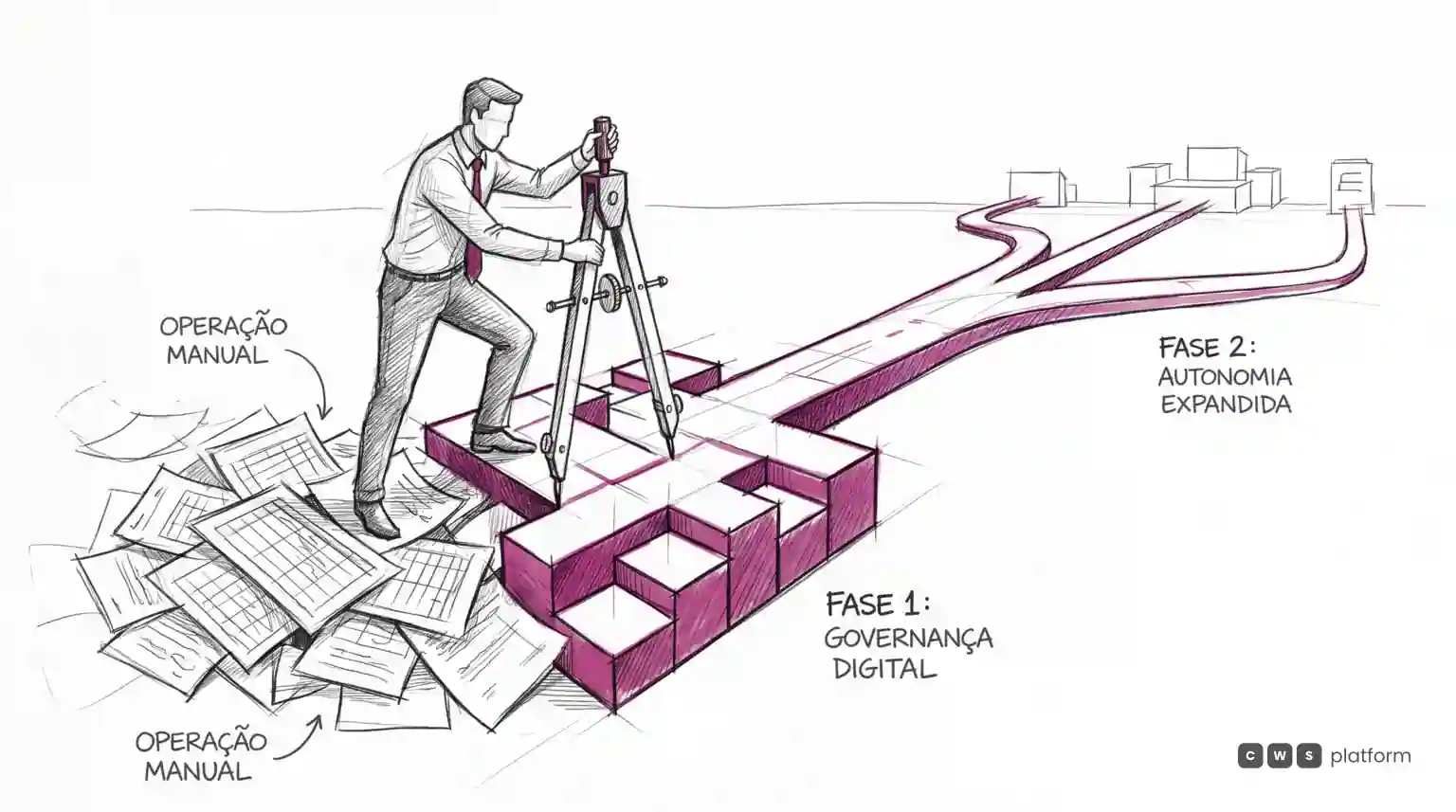
Two-Phase Digital Transformation: Sales as the Adoption Engine
B2B digital adoption accelerates when technology removes operational work from sales reps without weakening their customer relationships. Buyer and AI autonomy should follow governed pricing, credit, inventory, and approval rules.
Read →
The AI Agent Is in the ERP, but the Implementation Never Ends
Connecting an AI agent to the ERP does not finish the project when rules, approval authority, and exceptions remain implicit. For the CTO, decision governance becomes the central challenge.
Read →
The never-ending implementation and the board still waiting for ROI
For the CEO who approved the budget, named a sponsor, and is still watching the go-live slip quarter after quarter: the problem was never the technology — it was the absence of formalized commercial rules ready to govern what the system was supposed to execute.
Read →
Your B2B digitization project never goes live because commercial decisions were never mapped
Most stalled B2B digitization projects share the same root cause: the scope was built around data flows, not decision flows. Until commercial governance is treated as an architectural prerequisite, go-live keeps getting pushed.
Read →
The Seller Who Joined the Platform and Never Made a Sale
Onboarding a seller and activating a seller are two very different things. The hidden cost of partners who exist in the system but are invisible to buyers.
Read →
Why so many B2B sales AI projects blow the budget
Agentic AI projects in B2B cost far more than planned, and the model is rarely to blame. It is the boundary nobody drew between what is a rule and what is inference.
Read →