Fashion wholesale: VTEX or CWS Platform?
A size and color order that goes in as parallel batches and an export that can time out above 200 SKUs: the season order from the seat of whoever owns the number.

Editorial note: an architecture comparison between VTEX and CWS Platform for the fashion wholesale scenario, where the sales rep takes the season's order as a size and color matrix for multi-brand retailers. The person who decides here is the VP of Sales. Every fact about VTEX comes from its public documentation and its known issues page, with the address next to it.
In fashion, the wholesale order is born large. A multi-brand retailer does not buy a shirt: it buys the style in four colors and five sizes, and each combination is a SKU. A season order with 25 styles in that matrix already adds up to 500 SKUs, before any replenishment. The VP of Sales owns the number, and for that role the size and color order is the center of the cycle: it is where prebooking turns into a commitment to production, delivery, and commission.
The question that separates platforms in this scenario is not whether the retailer can buy through the portal. It is whether the matrix order goes into the cart whole when the rep types it in or uploads the spreadsheet, and whether it comes out whole into the report the sales team uses to track the book of business. An order that goes in halfway turns into a call from the retailer; an order that does not show up in the report turns into a side spreadsheet.
This comparison looks at VTEX and CWS Platform from that angle only. It is not a feature ranking. The overall map of models is in the post on the three B2B commerce platform models, and the full series is in the comparisons hub, starting with the comparison of what VTEX B2B commerce delivers out of the box.
What VTEX does well
VTEX has its own path for bulk ordering. Quick Order, installed as a VTEX IO app, creates the quick order route on the storefront and offers four ways to add items to the cart: a text area, a spreadsheet upload, item-by-item predictive search, and a category tree.
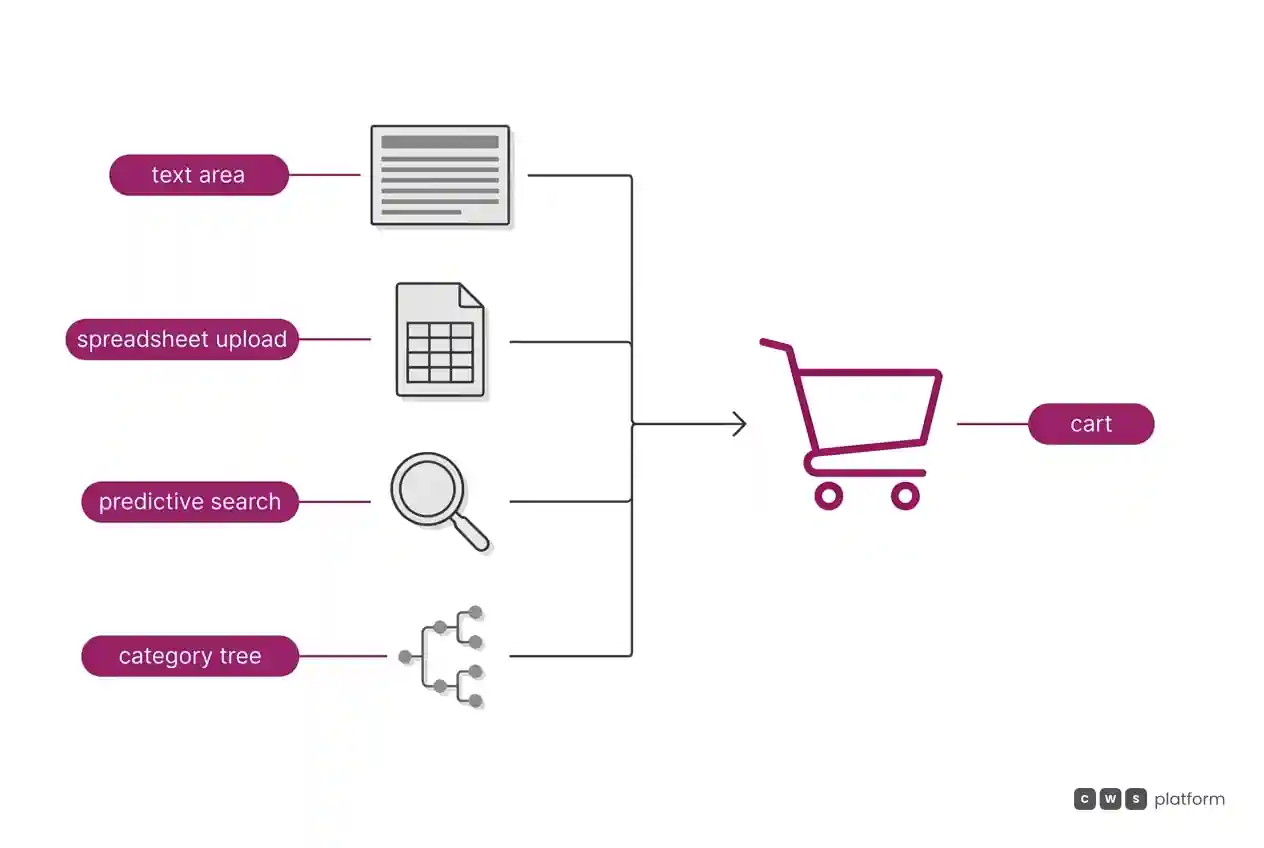
Per the documentation for version 0.7.2 of the app, text and spreadsheet entries use the SKU Reference ID and the quantity, and the system then validates the codes to confirm availability before checkout. With predictive search and categories, items go straight in, in bulk or one at a time.
Behind the cart, Checkout gathers purchase data in the OrderForm structure, and the Checkout API overview documents a clear usage rule: operations that modify data cannot run in parallel, and the requester must queue them to avoid overwritten values or concurrency errors.
Where the architecture diverges
The divergence that matters to a VP of Sales sits in two lines of VTEX's known issues page, one on the way a large order comes in and one on the way it goes out:
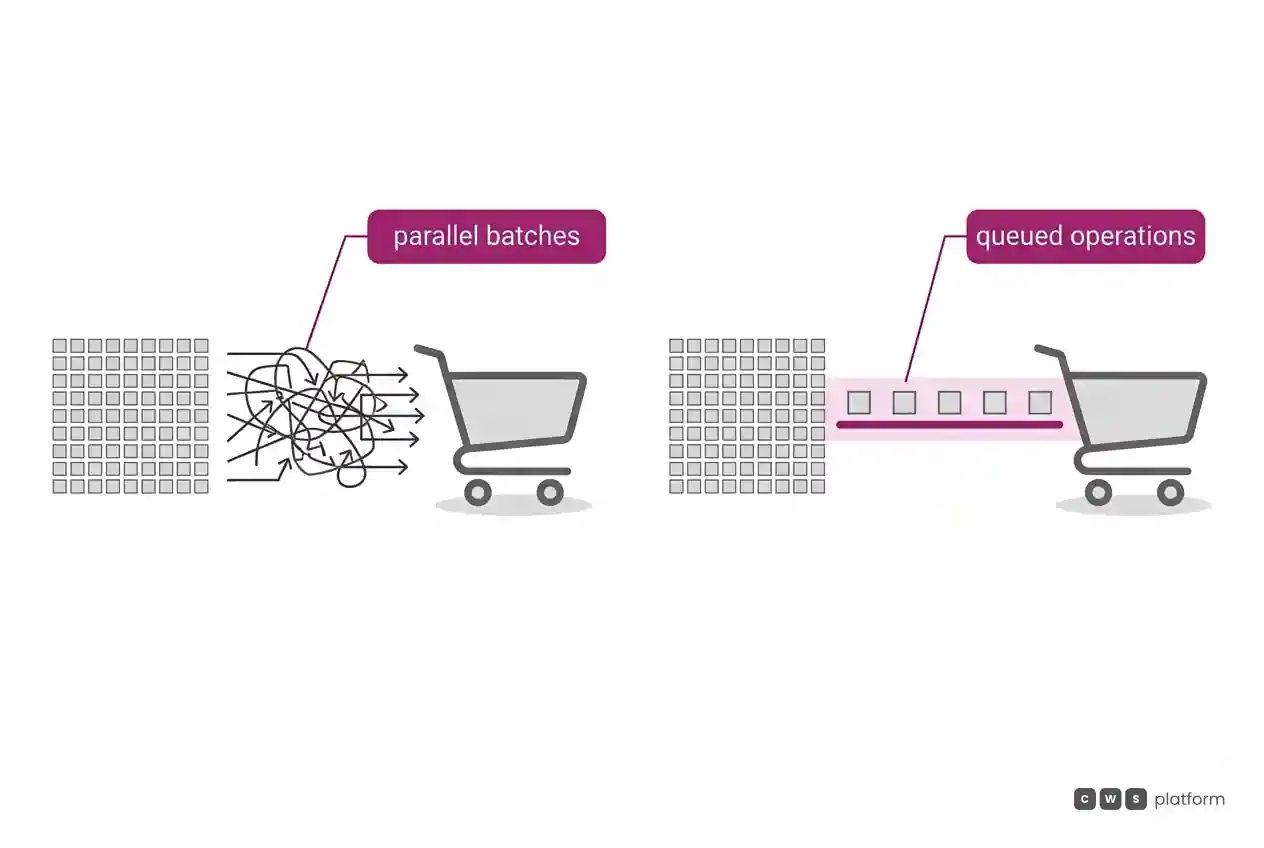
- recorded by VTEX as a known issue, still open as of November 5, 2026 (open since August 2026): Quick Order adds items to the cart in batches of 10, with parallel calls to the checkout APIs, which may cause concurrency issues for large batches ("Quickorder App splits item addition to cart on batches of 10 items and calls checkout APIs in parallel. This may lead to concurrency issues for large batches of items.", https://help.vtex.com/en/known-issues/quickorder-app-concurrency-issues-when-adding-items)
- recorded by VTEX as a known issue, published in November 2022; VTEX marked it No Fix (page accessed on November 5, 2026): exporting orders with an average of more than 200 products can time out during file generation, and the issue was caused by a store with multiple orders of more than 200 SKUs each ("the issue was caused by a store that has multiple orders with more than 200 SKUs per order", https://help.vtex.com/en/known-issues/exporting-orders-with-an-average-of-more-than-200-products-can-give-a-timeout-in-the-file-generation-process)
The first record is about the way in. The matrix order is exactly the large batch a rep pastes into the text field or uploads as a spreadsheet. The app splits that batch into groups of 10 and calls checkout in parallel, while the Checkout API documentation itself asks for modifying operations to be queued. While the issue stays open, checking the cart after the load becomes part of the rep's routine.
The second record is about the way out. Because VTEX marked the item No Fix, orders above 200 SKUs are a design condition for export, and in fashion wholesale that is the normal shape of a season order. A sales team that tracks the book of business, quota, and commission from the exported file needs another path for those orders, and that path goes into the project scope.
On CWS Platform, the cart holds 250 line items by default, and that is configurable, and the order goes out to the ERP and CRM through REST APIs and webhooks, because CWS is API-first. The order records who built the cart and who chose the payment. The largest matrix order from last season, though, is a test for any vendor, CWS included: the honest proof is to load that order and get it out whole on the other side before signing.
| decision | VTEX, per the mechanism and the records | CWS Platform |
|---|---|---|
| How the matrix order comes in | Quick Order by text, spreadsheet, search, or categories; batches of 10 with parallel calls, open issue | Cart with 250 line items by default, configurable; the rep builds it and sends the link |
| How the large order reaches the team | Exporting orders with more than 200 SKUs can time out, marked No Fix | REST APIs and webhooks to the ERP and CRM; the largest matrix order goes into the proof |
| Who is recorded on the order | A question for the demo, with the rep's real role | The order records who built the cart and who chose the payment |
| How the season is delivered | A question for the demo, with the real delivery calendar | Net terms with split shipments, scheduled deliveries, multiple ship-to addresses, and multiple ship-from locations |
The sales decision is whether the matrix order will be the platform's normal case or a special order handled outside it.
What changes in fashion wholesale operations
A fashion season runs on a calendar. The rep visits the retailer or hosts them in the showroom, takes the prebook order, and delivery happens in windows across the season. When the matrix order does not go in or come out whole through the digital channel, the rep goes back to the spreadsheet, and the VP of Sales loses the visibility digital was supposed to provide.
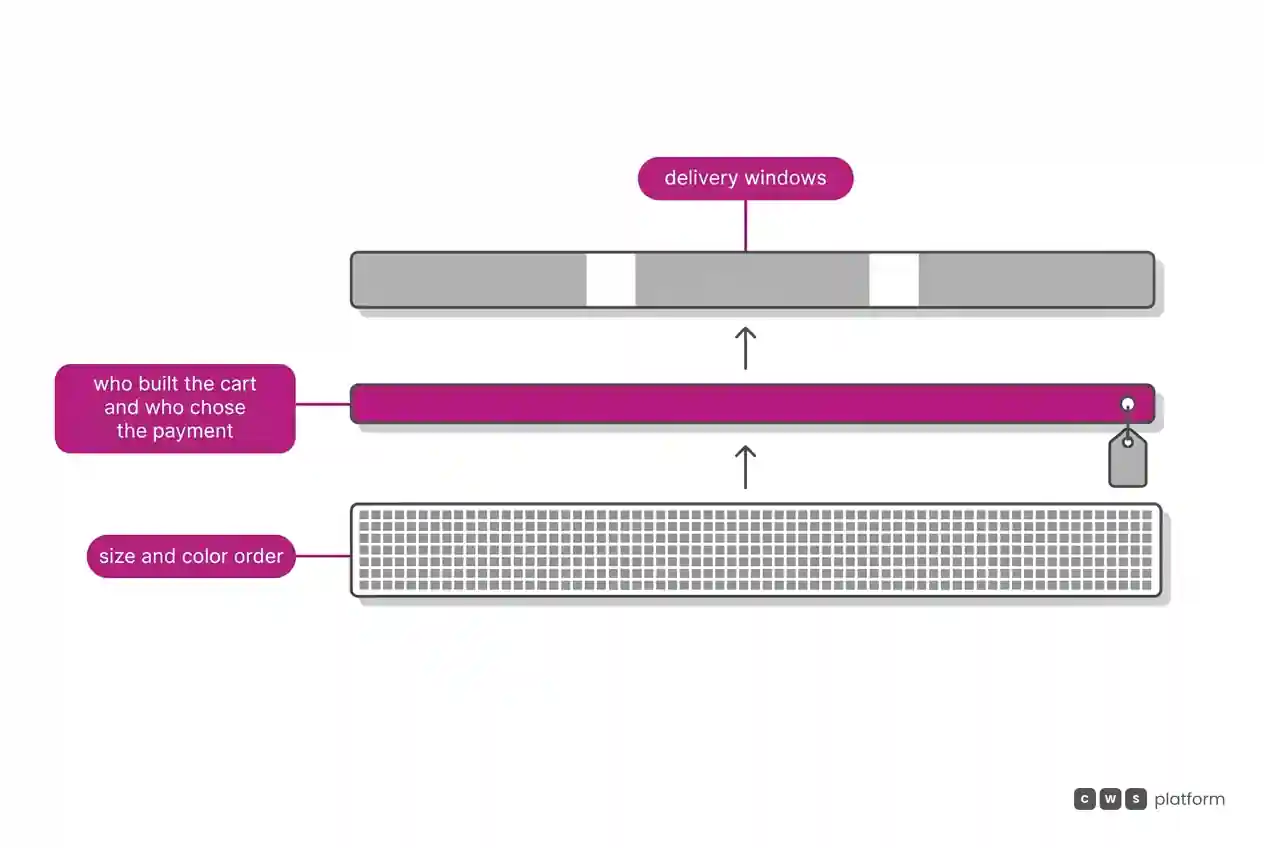
Three questions bring this point into any evaluation. First: what was last season's largest matrix order, in SKUs, and does it go into the cart whole through the path reps actually use. Second: how does that order reach the sales team's report and the ERP, and what happens once it passes a few hundred SKUs. Third: does the order record who took it, so the rep's commission comes out of the system and not out of memory.
Then there is how the rep's role is designed. On CWS, one sales rep serves thousands of customers, and customer and sales rep use the same interface: the rep builds the cart, with the items and the source of each one, and sends the link for the retailer to complete the purchase. The sales rep's discount goes through multi-level approval, and thousands of promotions can run together. The rep's side of the portal, from another angle, is in the comparison on B2B sales reps.
When to choose VTEX
VTEX fits scenarios where fashion sells mainly to the end consumer:
A fashion brand selling direct to consumers. Choose this architecture when the operation is D2C and conversion depends on one-click checkout with Apple Pay and Google Pay, as the VTEX Commerce Platform page presents.
Fashion retail on marketplaces. Choose this architecture when the channel runs through marketplaces and already-integrated payment providers, on a composable, multitenant cloud platform with more than 900 ready-made integrations, as the composability page describes.
Short reorders by code. Choose this architecture when the retailer restocks a few items it already knows by code, with Quick Order by text, spreadsheet, or search.
When CWS Platform is the right choice in this scenario
CWS Platform is the right choice when the rep's matrix order is the center of the sales operation.
A large matrix order. Choose this architecture when the season order has hundreds of SKUs. The cart holds 250 line items by default and the limit is configurable; last season's largest matrix order goes into the proof.
A rep who takes the order and sends it. Choose this architecture when prebooking starts with the rep. The rep builds the cart and sends the link for the retailer to complete the purchase, and the order records who built the cart and who chose the payment.
A season delivered in windows. Choose this architecture when the same order ships across the season. Net terms work with split shipments, scheduled deliveries, multiple ship-to addresses, and multiple ship-from locations.
Commercial terms by retailer. Choose this architecture when each multi-brand retailer has its own pricing and payment terms. Tables, rules, and contracts are configurable on the platform or received from the ERP through an API, and the customer's credit limit is maintained on the platform.
Where to go from here
If your question is still which architecture fits your operation, the path is the seven questions that separate B2B commerce architectures.
If the decision depends on how your reps take orders today, it is worth talking to a CWS Platform specialist and testing, with last season's largest matrix order, the way in, the way out, and the record of who built the cart and who chose the payment before you choose. The page When Channels Fight Each Other covers the pain behind this scenario in depth, without talking about any vendor.
Read more
- B2B Sales Tax, State Nexus, and Invoicing: Managing Compliance in B2B E-Commerce
- Enterprise System Integration in B2B Sales: Priority Sequences and Architecture
- B2B Customer Portals and Self-Service Ordering
Comparisons with other vendors
To compare VTEX with other platforms, without CWS Platform in the middle:
- VTEX vs Adobe Commerce: which one handles the typical B2B order?
- VTEX vs Salesforce Commerce Cloud: can B2B and retail coexist?
- VTEX vs SAP Commerce Cloud: what can a CFO predict before signing?
- VTEX vs. commercetools: Packaged B2B Suite or Composable APIs?
- VTEX vs Spryker: which fits a B2B marketplace with sellers?
- VTEX vs Optimizely: what goes on the B2B bill?
- VTEX vs OroCommerce: what can change after an order is invoiced?
- B2B ecommerce platforms: the 9 leading options compared
Brands mentioned in this article
 VTEX



- Adobe Commerce
- Salesforce
- SAP Commerce Cloud
- Optimizely
- OroCommerce
Trademarks and logos belong to their respective owners. Mention does not imply partnership or endorsement.
"responsive, technically engaged, and willing to work through complex commercial rules (negotiated pricing, credit, customer-specific conditions) rather than pushing generic answers"
Are your channels competing for the same customer?
Request an assessment of your operation or talk straight to a specialist, whichever you prefer.
I'd rather get the next articles on channel conflict
A weekly roundup of new articles on channel conflict, only in weeks when there is one. No spam, and you can leave in one click.