Auto parts catalog: VTEX or CWS Platform?
Reads that stop at 2,500 results and spreadsheet loads up to 4.5 MB: the two paths of a high-volume catalog, from the seat of whoever maintains the integration.

Editorial note: an architecture comparison between VTEX and CWS Platform for the auto parts distribution scenario, with a catalog of hundreds of thousands of items moving between the ERP, the technical product data, and the digital channel. The person who decides here is the CIO or CTO. Every fact about VTEX comes from its public documentation and its known issues page, with the address next to it.
An auto parts distributor's catalog grows by fitment: the same brake pad fits ten models, the same filter has equivalents from several manufacturers, and every new vehicle adds rows without removing any. The storefront is the visible part of the problem. The expensive part is the path the catalog travels every day: it comes in through loads from the technical product data and the ERP, and it goes out through the reads that feed integrations and reconciliations.
For the CIO, the question that separates platforms is not whether the catalog fits in the store. It is whether it fits both integration paths: the bulk load, when the whole base changes, and the full read, when another system checks what is published. A catalog that goes in but does not come out whole turns into manual reconciliation, a transaction cost the project budget does not plan for.
This comparison looks at VTEX and CWS Platform from that angle only. It is not a feature ranking. The overall map of models is in the post on the three B2B commerce platform models, and the other comparisons in the series are in the comparisons hub, starting with the comparison of what VTEX B2B commerce delivers out of the box.
What VTEX does well
VTEX has a clear, well-documented catalog model. Per the Catalog overview, items are organized in a hierarchy of, typically, three levels (department, category, and subcategory); each product belongs to a category and a brand and has at least one SKU, the unit that reflects the physical stock variation. Categories link to specification groups, which bring together product and SKU attributes, and those specifications become navigation filters and set items apart on the storefront, as the Catalog API overview describes.
Around the catalog, the platform is broad on integration. The composability page describes a composable, multitenant cloud platform built on event-driven microservices, with more than 750 API endpoints and more than 900 ready-made integrations with payment providers and marketplaces.
On search, Intelligent Search offers contextual autocomplete, customizable filters, and typo autocorrection, with ranking that uses click and order history.
Where the architecture diverges
The divergence that matters to a CIO is in the two paths a high-volume catalog takes, and VTEX records both on its own known issues page:
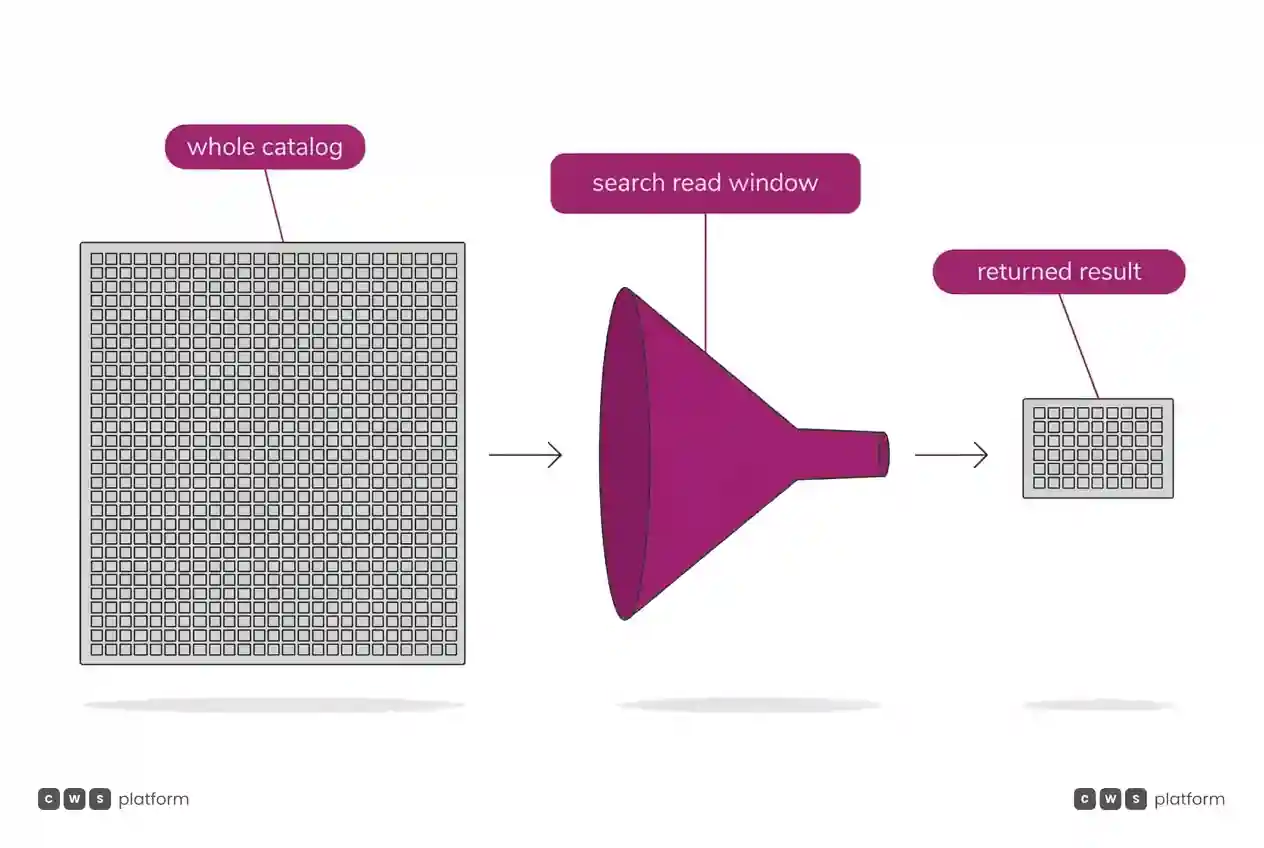
- recorded by VTEX as a known issue, published in August 2023; VTEX marked it No Fix (page accessed on November 5, 2026): the Catalog Search API returns at most 2,500 results, even if there are more products ("When using Catalog Search API the maximum results obtained is 2500, even if there are more products.", https://help.vtex.com/en/known-issues/catalog-search-api-limited-to-2500-results)
- recorded by VTEX as a known issue, still open as of November 5, 2026 (open since June 2026): product and SKU spreadsheet import fails when the file exceeds the current import flow's supported limit of approximately 4.5 MB ("This affects scenarios in which the spreadsheet file size exceeds the current import flow's supported limit, which is approximately 4.5 MB.", https://help.vtex.com/en/known-issues/product-and-sku-import-fails-for-large-size-of-spreadsheet-file)
The first record is about reading. In an auto parts catalog, 2,500 results is the size of one part family, not of the base. Because VTEX marked the item No Fix, it is a design condition, not a defect waiting for a fix. Whoever needs to read the whole catalog through that API plans the query in smaller slices and maintains the logic that stitches the pieces together: integration code that is born in the project and stays in maintenance.
The second record is about loading. A product and SKU spreadsheet with fitments and specifications easily passes 4.5 MB when the base is large. While the issue stays open, spreadsheet loads call for smaller batches, and each batch is one more thing to check when a manufacturer's table changes.
Neither record stops operations; both change the size of the team that maintains the integration. The broader reading of the public list is in the comparison on known issues and maintenance; here the focus is the catalog at volume.
On CWS Platform, the design starts from integration. CWS is API-first and headless, with REST APIs and webhooks, and price tables, rules, and contracts can be configured on the platform or received from the ERP and CRM through an API. All customers run the same version of the platform. The size of your real catalog, though, is a test that applies to any vendor, CWS included: the honest proof is to load and read the whole base before signing.
| decision | VTEX, per the mechanism and the records | CWS Platform |
|---|---|---|
| How the catalog is organized | Department, category, and subcategory; product with category, brand, and at least one SKU; specifications become filters | A question for the proof with the real base, fitments and equivalents included |
| How another system reads the whole catalog | Catalog Search API with at most 2,500 results, marked No Fix | API-first, with REST APIs and webhooks |
| How bulk loads come in | Spreadsheet with a supported limit of approximately 4.5 MB, open issue | Tables, rules, and contracts configured on the platform or received from the ERP and CRM through an API |
| How the version evolves | Composable, multitenant cloud platform | All customers on the same version of the platform |
The technical decision is how much integration code the catalog at volume will require, and who maintains that code when the base doubles.
What changes in auto parts operations
In auto parts replenishment, the catalog is the product. The buyer searches by fitment, and if the right part does not show up, they buy the wrong one or buy elsewhere. Every delay in loading a manufacturer's table is a sale that does not happen, and every mismatch between ERP and portal is a return that will.
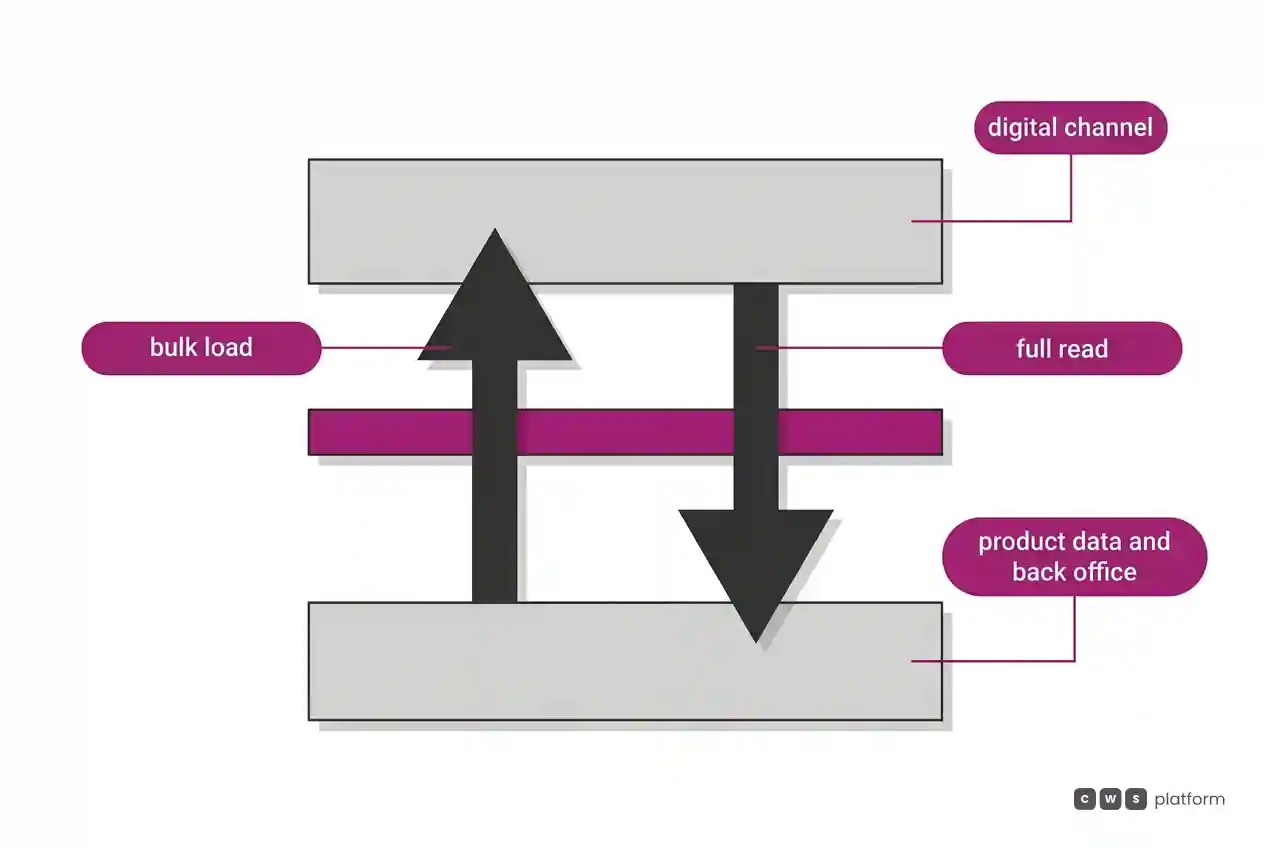
Three questions bring this point into any evaluation. First: what is the documented path to read the entire catalog, with no slicing, and how many calls does it take with today's base and with the base three years from now. Second: what is the largest supported load, in items and in file size, what happens to a batch that goes past it, and what programmatic path the vendor documents for loads above that limit, with what volume per call. Third: who maintains the slicing, retry, and reconciliation logic when the platform changes versions.
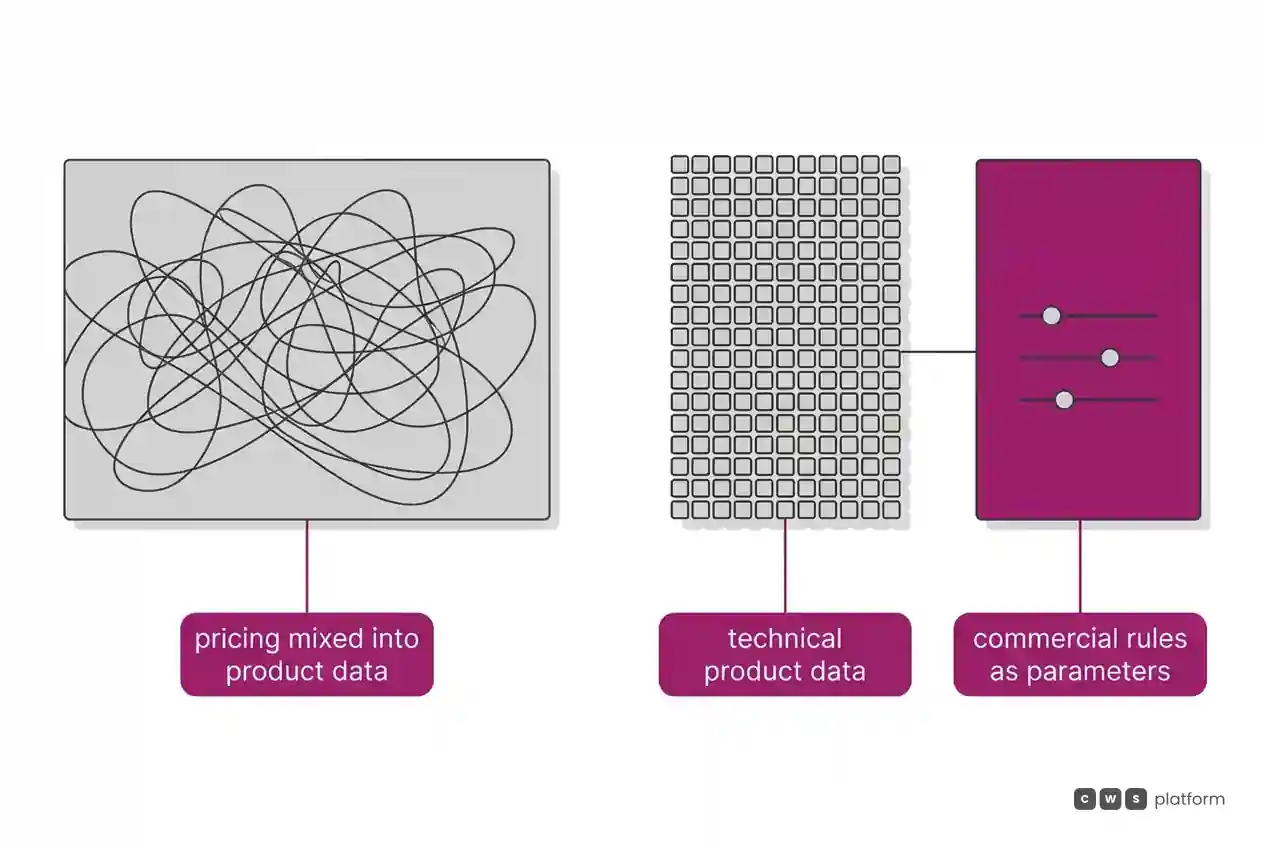
There is also the line between catalog and commercial rules. The price of the same part changes with the customer, the volume, and the payment method, and mixing that logic into the technical product data multiplies what has to be loaded. On CWS, price tables, rules, and contracts live on the platform, configurable or coming from the ERP through an API, and commercial policy sits in parameters of the Commerce Rules Engine (CDL Workspace), on the principle of configuration over code. CWS brings together 11 modules, 6 AI Agents, and 1,029 parameters.
When to choose VTEX
VTEX fits scenarios where the parts catalog talks mainly to the end consumer:
Auto parts and accessories retail to consumers. Choose this architecture when the sale is B2C and discovery depends on typo-tolerant search and ranking by clicks and orders, as the Intelligent Search page describes.
An operation that sells on retail marketplaces. Choose this architecture when the main channel is marketplaces and already-integrated payment providers, among the more than 900 ready-made integrations on the composability page.
A catalog that fits the standard hierarchy. Choose this architecture when the assortment organizes well into department, category, and subcategory, with specifications per category, as the Catalog overview describes.
When CWS Platform is the right choice in this scenario
CWS Platform is the right choice when the auto parts catalog is part of a B2B distribution operation, integrated with the ERP and the technical product data.
Integration as the main path. Choose this architecture when the ERP, CRM, and technical product data need to talk to the channel every day. CWS is API-first and headless, with REST APIs and webhooks.
Commercial rules kept apart from product data. Choose this architecture when price depends on the customer and the contract. Tables, rules, and contracts are configurable on the platform or received from the ERP and CRM through an API, with customizable decimal places.
Large replenishment orders. Choose this architecture when the customer restocks dozens of lines at once. The cart holds 250 line items by default, and that is configurable, and the sales rep can build the cart and send the link for the customer to complete the purchase.
Where to go from here
If your question is still which architecture fits your operation, the path is the seven questions that separate B2B commerce architectures.
If the decision depends on the real size of your catalog, it is worth talking to a CWS Platform specialist to design, with your fitment base and your ERP, the load and read proof before you choose. The pages When the Catalog Becomes Chaos and When Integration Breaks Everything cover the pain behind this scenario in depth, without talking about any vendor.
Read more
- Operational costs in distribution: where they hide and how to reduce them
- What is cost to serve in B2B and how to calculate it per customer
- Cost to serve and commercial sales operations
Comparisons with other vendors
To compare VTEX with other platforms, without CWS Platform in the middle:
- VTEX vs Adobe Commerce: which one handles the typical B2B order?
- VTEX vs Salesforce Commerce Cloud: can B2B and retail coexist?
- VTEX vs SAP Commerce Cloud: what can a CFO predict before signing?
- VTEX vs. commercetools: Packaged B2B Suite or Composable APIs?
- VTEX vs Spryker: which fits a B2B marketplace with sellers?
- VTEX vs Optimizely: what goes on the B2B bill?
- VTEX vs OroCommerce: what can change after an order is invoiced?
- B2B ecommerce platforms: the 9 leading options compared
Brands mentioned in this article
 VTEX



- Adobe Commerce
- Salesforce
- SAP Commerce Cloud
- Optimizely
- OroCommerce
Trademarks and logos belong to their respective owners. Mention does not imply partnership or endorsement.
"responsive, technically engaged, and willing to work through complex commercial rules (negotiated pricing, credit, customer-specific conditions) rather than pushing generic answers"
Is your catalog getting in the way of the sale?
Request an assessment of your operation or talk straight to a specialist, whichever you prefer.
I'd rather get the next articles on catalog management
A weekly roundup of new articles on catalog management, only in weeks when there is one. No spam, and you can leave in one click.