Adobe Commerce vs CWS Platform, scenario by scenario
19 posts
-

commercetools vs Adobe Commerce: what changes in B2B order operations?
On commercetools, approval runs up to five sequential stages per rule and Order Search indexes only orders from the last 3 months. On Adobe Commerce, the cart caching issue remains open and Adobe published a fix for a vulnerability already being exploited. The COO's choice is who builds, looks up and fixes the order after the click. -

Spryker vs Adobe Commerce: which price reaches the B2B order?
Spryker records that the storefront shows the default price when it is lower than the merchant relation price, and that the Data Exchange API does not support customer-specific pricing. Adobe records that Commerce rounds all prices to two digits, and that Payment on Account is not supported for orders with multiple shipping addresses. In both, the deciding test is a real order at the negotiated price. -

Optimizely vs Adobe Commerce: what changes with each new version?
Optimizely calculates customer pricing in its own matrix, quotes with the rep, and integrates the ERP through an agent on the customer's network; Adobe Commerce lets you choose between SaaS and dedicated PaaS, with a headless storefront and B2B as an extension of the store. The documentation records version work on both sides: a mandatory Search v1 replacement and a front end rewrite from Classic to Spire at Optimizely, the end of PHP 8.2 and 8.3 support in 2.4.9 and an upgrade that involves fixing code conflicts at Adobe. The choice depends on which work your team is willing to take on. -

B2B ecommerce platforms: the 9 leading options compared
There is no single best B2B ecommerce platform: commercetools and Spryker serve companies that build, OroCommerce and Optimizely those that want out-of-the-box B2B, SAP, Salesforce, Adobe, and VTEX those already in the vendor's ecosystem or starting from retail, and CWS Platform those that bring the commercial policy into the platform. For the CEO, the decision is what work the company takes on after signing. One cut question per model narrows the list before the demo. -

OroCommerce vs Magento B2B: what weighs on order operations?
In OroCommerce, B2B capabilities are described in the product; in Adobe Commerce, B2B is an extension that sits alongside B2C. The documentation records limits on both sides: posted invoices that cannot change and a 100-entity synchronous batch in OroCommerce, queue consumers and RabbitMQ in Adobe Commerce. The choice depends on who will run those queues and how the company wants to bill and invoice. -

Salesforce Commerce Cloud vs Adobe Commerce: where does the catalog limit live?
Salesforce publishes its catalog limits: a store accepts 4 million products, search covers up to 1 million, and search, filter, and sort attributes add up to at most 70 per store. On Adobe, quotes and shared catalogs ship in the B2B extension, and the records sit in operations: on-schedule indexers stuck in an open issue and 20 items per synchronous API request with input limiting enabled. The CTO's question is where the limit lives and who answers for it. -

SAP Commerce Cloud vs Adobe Commerce: what drives the three-year cost?
SAP records that returns, refunds, and cancellations do not reduce the GMV counted toward the license, and Adobe records that every accepted order counts as a transaction, even if returned. In both, standing still has a deadline: SAP's Cloud Portal will not build an unlisted release, and Adobe's security-only period for versions 2.4.4 to 2.4.6 will not be extended. The three-year cost depends on measured volume and upgrade cost. -

VTEX vs Adobe Commerce: which one handles the typical B2B order?
VTEX assembles B2B from B2B Suite apps, with organizations, cost centers, and their own price tables. Adobe Commerce brings B2B as an extension of the store, on SaaS, dedicated cloud, or open source. On both, the typical account order has points to test in the demo. -

Mandatory Updates: Who Pays for Customization at Each Version in SAP, Salesforce, and Adobe
What SAP, Salesforce, and Adobe publish about version cycles, end of support, and migration, and how CWS Platform treats the same point: one version for all customers, with no framework change on the customer side. -

Adobe Commerce vs CWS Platform: Who Upgrades When Versions Hit EOL?
A comparison of Adobe Commerce and CWS Platform through the CTO lens: on one side, a published lifecycle, with versions and dependencies that go out of support; on the other, a single version for all customers, with no upgrade project on the customer side. -

What It Costs to Grow: The License Tied to Volume Sold in SAP, Salesforce, and Adobe
What SAP, Salesforce, and Adobe publish about B2B commerce license measurement, by value sold or by orders, and how CWS Platform charges: a platform and integration license with no percentage on sales. -

Adobe Commerce vs CWS Platform: Do Returned Orders Count Toward Licensing?
A comparison of Adobe Commerce and CWS Platform through the CFO lens: on one side, every accepted order counts as a transaction, even if it is later refunded or returned; on the other, a platform and integration license with no percentage on sales. -
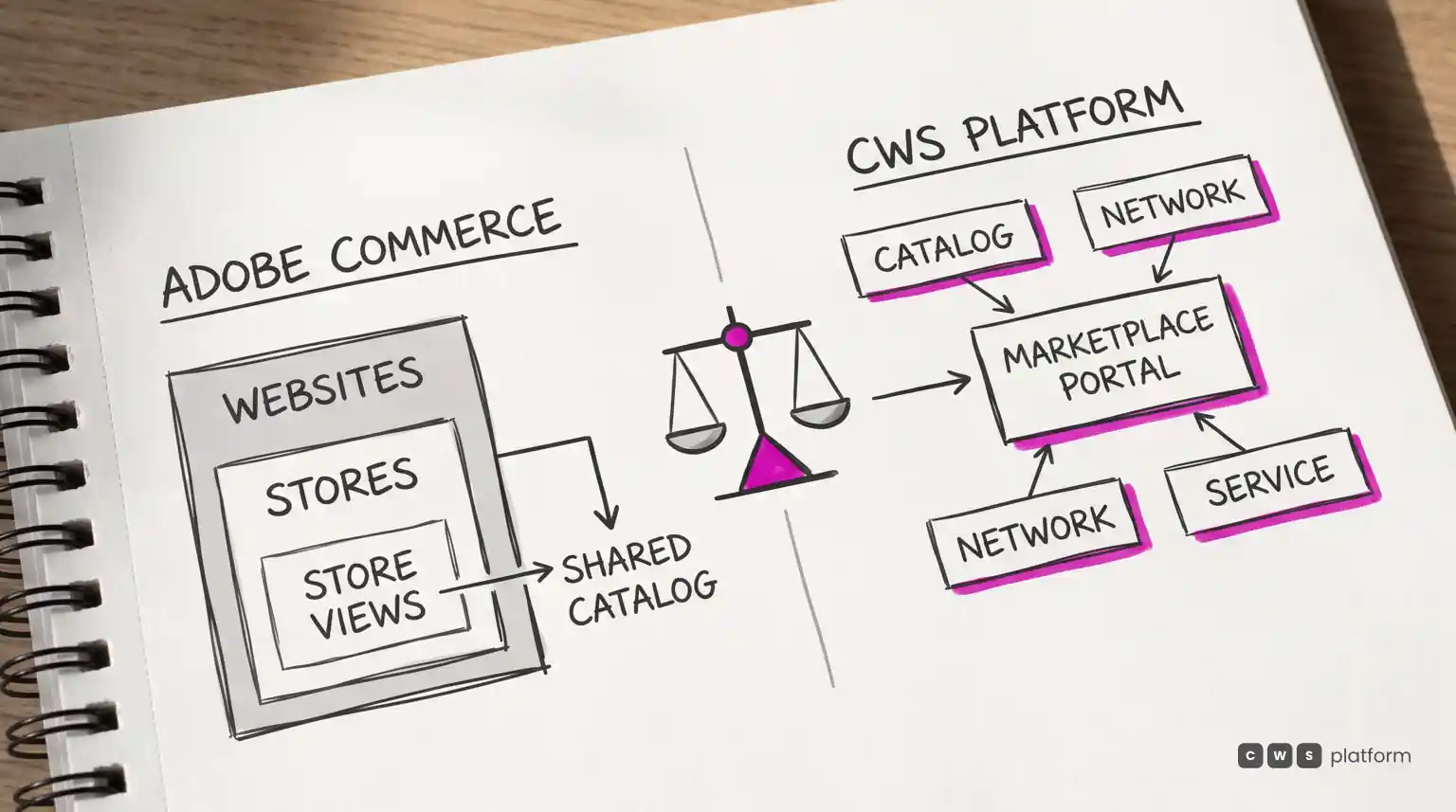
Dealer Marketplace: Adobe Commerce or CWS Platform for Catalog, Network, and Service Operations?
Adobe Commerce structures commerce through websites, stores, store views, and B2B capabilities. CWS Platform keeps fitment catalog data, regional rules, distributed inventory, assisted selling, and source-level fulfillment within the same transaction flow. -
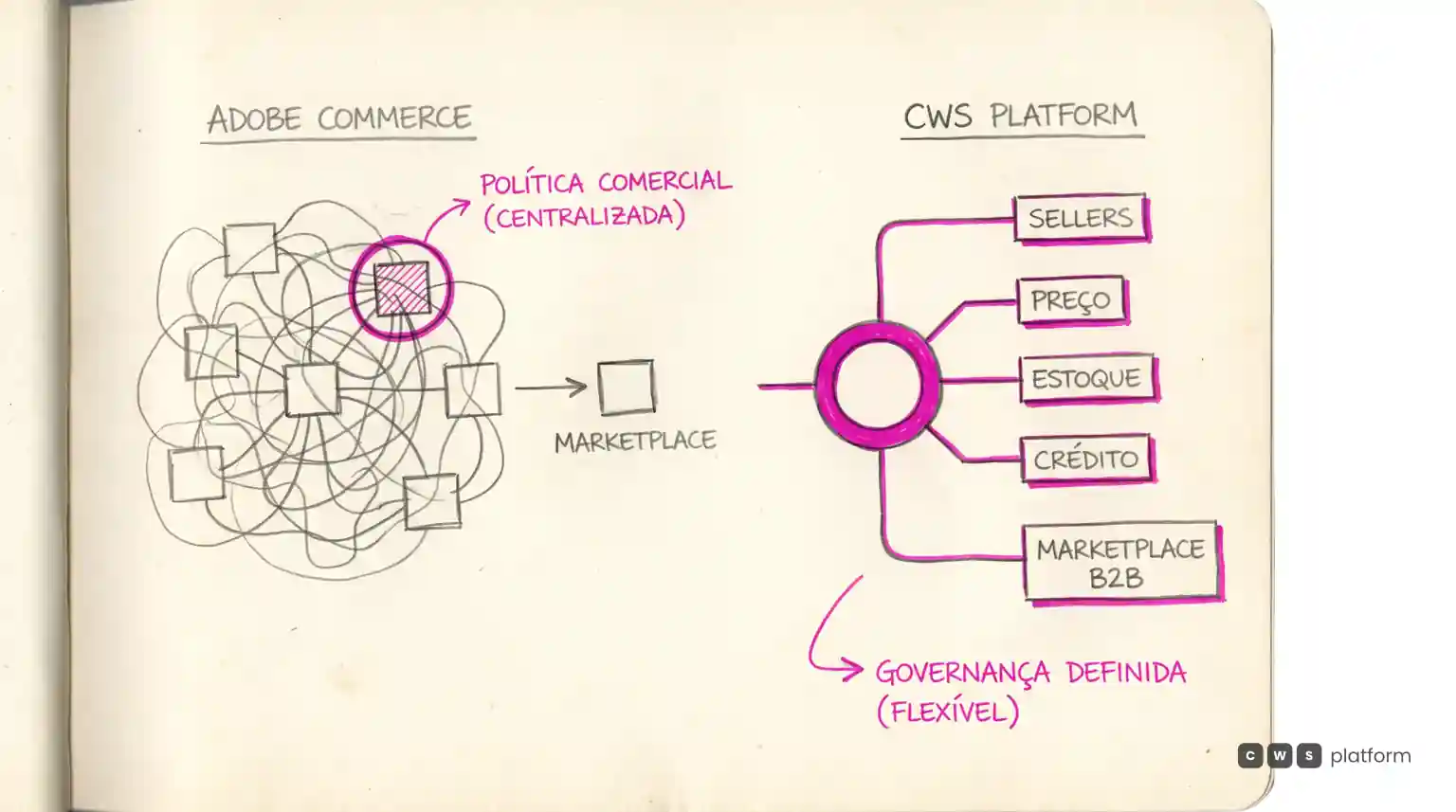
Adobe Commerce vs. CWS Platform: What Architecture Does a B2B Marketplace With Sellers Require?
Adobe Commerce centers B2B governance on company accounts, shared catalogs, permissions, quotes, and purchase orders. CWS Platform centers the operating model on sellers, offers, credit, fulfillment sources, and linked seller orders within the same transaction. -
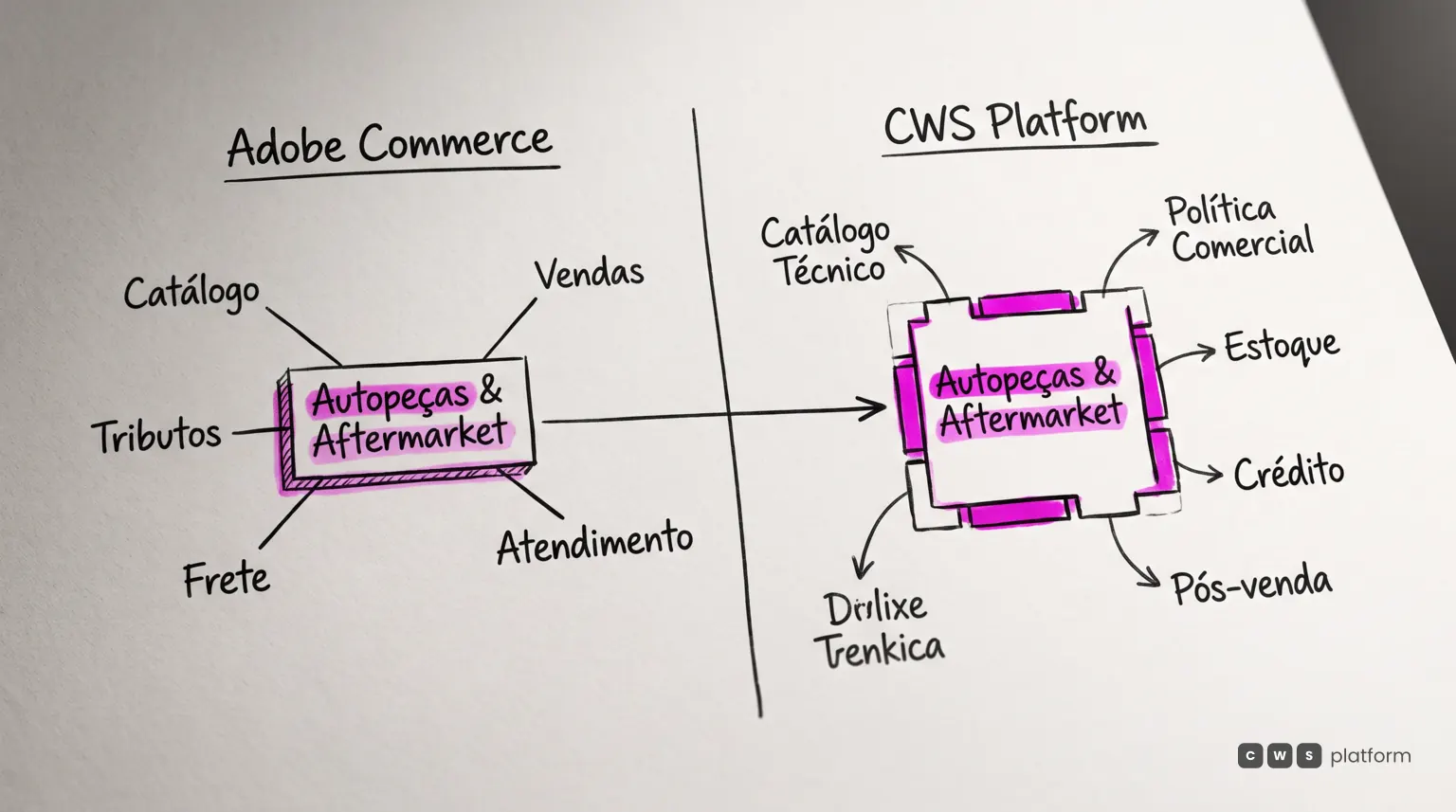
Adobe Commerce vs. CWS Platform: Which Architecture Does Auto Parts Distribution Require?
Adobe Commerce centers governance on company accounts, roles, shared catalogs, quotes, purchase orders, and multi-site structures. CWS Platform centers the contextual transaction, connecting vehicle fitment, customer pricing, warehouse inventory, credit, tax, shipping, returns, and warranties. -

Adobe Commerce vs. CWS Platform: Who Does the CEO Depend On?
Adobe Commerce emphasizes storefronts, a technical ecosystem, and code-based extensibility. CWS centers pricing, credit, inventory, approvals, and assisted selling on configurable operating rules. For a CEO, the choice depends on who should control day-to-day business changes. -

Adobe Commerce vs. CWS Platform: Where Should Replenishment Policies Run in a B2B Procurement Marketplace?
Adobe Commerce organizes company accounts, shared catalogs, negotiated quotes, and purchase orders within the commerce environment. CWS Platform connects pricing, rules, credit, warehouse inventory, and order management to validate policy within the same transaction. -
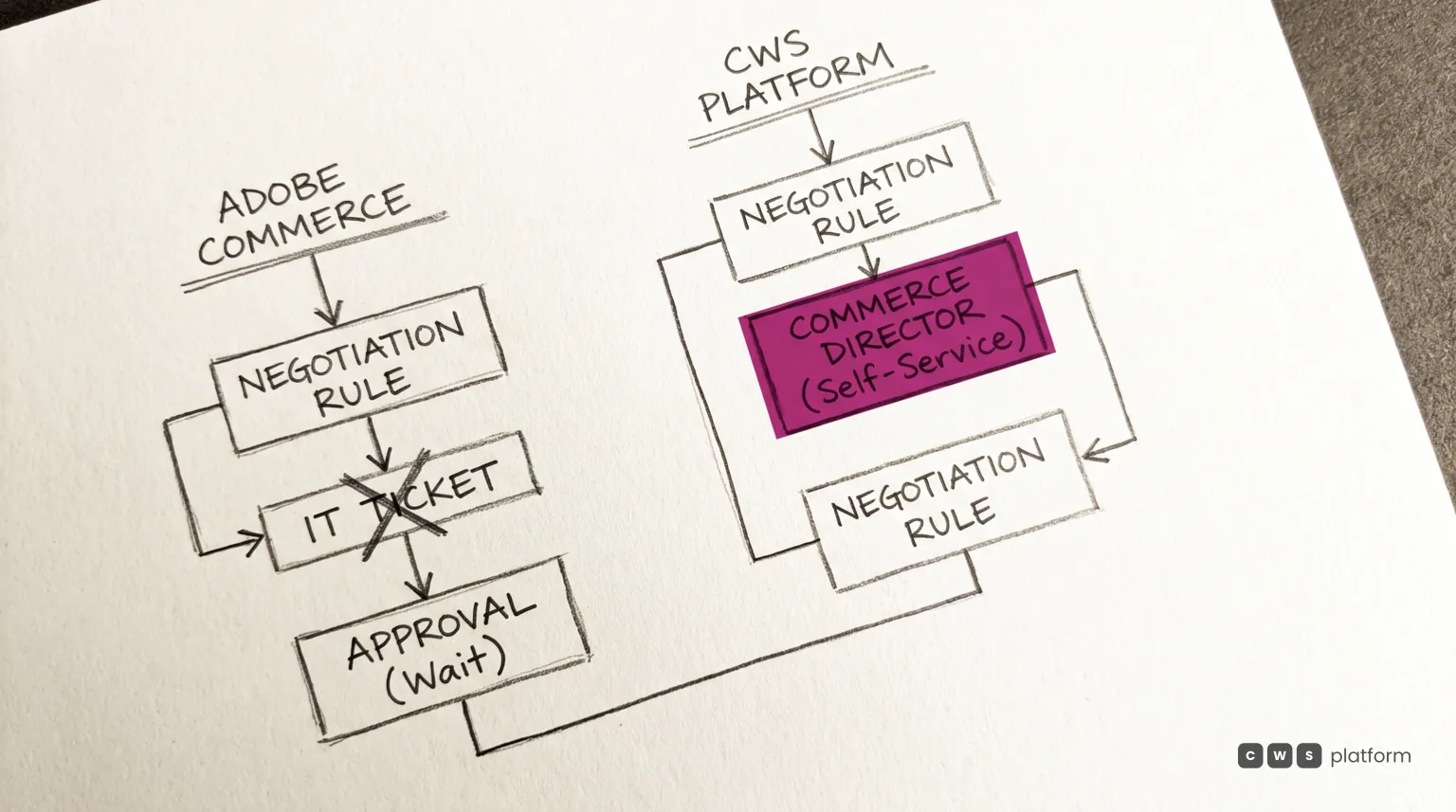
Adobe Commerce vs. CWS Platform: Can You Change a Negotiation Rule Without Opening a Ticket?
Adobe Commerce organizes B2B self-service around company accounts, shared catalogs, and bilateral quotes, per its public documentation. CWS Platform concentrates commercial policies in a deterministic rules engine with mandatory reason codes, contextual pricing, assisted selling, and a credit-first checkout. For a Director of Commerce, the practical question is where the exception is born, who can change it, and which controls follow it through order execution. -

B2B Portal Meets Counter and Field Sales: Adobe Commerce vs. CWS Platform, Side by Side
In distribution, CAC often climbs because of measurement error, not weaker campaigns: when the portal, the branch counter, and field reps don't share one transaction, the sale loses its digital origin and the campaign that actually converted gets no credit. The core divergence between Adobe Commerce and CWS Platform is who computes the commercial terms at the moment of sale — assigned pricing from a shared catalog versus a pricing function with contract > rule > price list precedence. The post also names four scenarios where Adobe Commerce is the right choice.
No posts match this combination. Remove a filter.