Salesforce vs CWS Platform, scenario by scenario
8 posts
-

Mandatory Updates: Who Pays for Customization at Each Version in SAP, Salesforce, and Adobe
What SAP, Salesforce, and Adobe publish about version cycles, end of support, and migration, and how CWS Platform treats the same point: one version for all customers, with no framework change on the customer side. -

What It Costs to Grow: The License Tied to Volume Sold in SAP, Salesforce, and Adobe
What SAP, Salesforce, and Adobe publish about B2B commerce license measurement, by value sold or by orders, and how CWS Platform charges: a platform and integration license with no percentage on sales. -

Salesforce vs. CWS Platform: Who Rebuilds the Storefront When Frameworks Change?
A comparison of Salesforce and CWS Platform through the CTO lens: on one side, the migration of Aura stores to LWR, with components replaced; on the other, a single version for all customers, with no framework change on the customer side. -

Cost Per Order in Three Years: Salesforce vs. CWS Platform
An architectural comparison between Salesforce and CWS Platform focused on 3-year cost-per-order dynamics. Examines commercial rule execution, complex terms, and operational leverage without revenue-share penalties. -

Salesforce or CWS Platform: Who Governs Commercial Execution Without Vendor Lock-In?
Salesforce excels at global CRM pipelines and corporate record aggregation. CWS Platform provides a deterministic engine for contextual pricing, warehouse-level autonomy, and rep-assisted ordering without recurring proprietary re-platforming costs. -

Assisted Sales and Digital Counter: Salesforce or CWS Platform?
Deciding between Salesforce and CWS for assisted sales depends on your main operational bottleneck: relationship pipeline management or transaction-level order execution. Salesforce organizes global territories and enterprise pipelines, while CWS enforces deterministic margin guardrails, shared carts, and multi-branch stock during checkout. -

Salesforce vs. CWS Platform: Which Architecture Supports Branch-Level B2B Self-Service?
Salesforce centers the architecture on a configurable storefront, accounts, permissions, managed data, and a customized checkout. CWS Platform makes the serving warehouse part of the transaction context, validating inventory, pricing, credit, and tax before creating a governed order. -
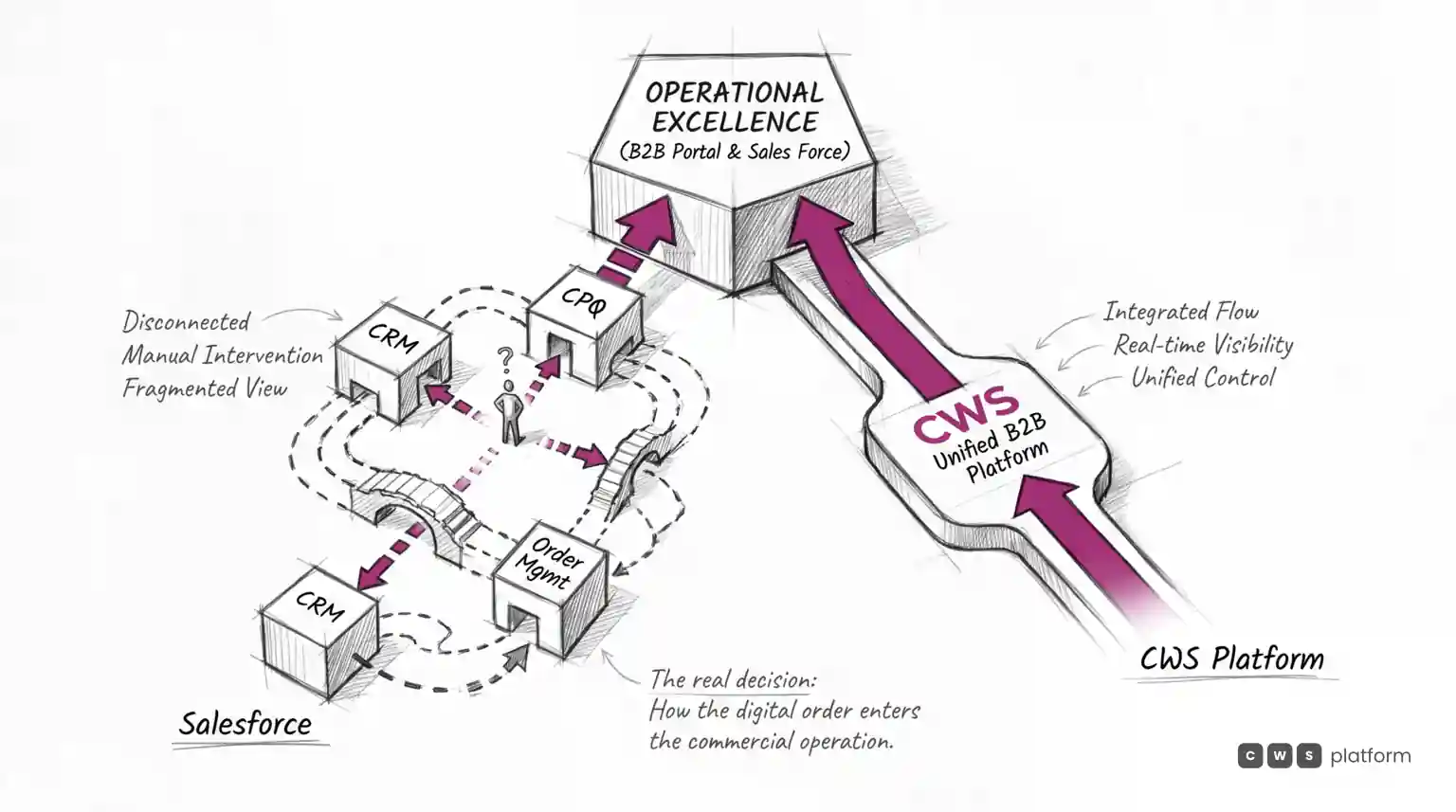
Salesforce vs. CWS Platform: Which Architecture Helps a B2B Portal Sell With Your Sales Team?
Salesforce combines a B2B storefront, buyer access controls, and enterprise sales records. CWS Platform centers the architecture on a shared cart, contextual pricing, and commercial validations before order creation. The right choice depends on which operational complexity the portal must absorb.
No posts match this combination. Remove a filter.