Salesforce vs CWS Platform, scenario by scenario
16 posts
-

OroCommerce vs Salesforce Commerce Cloud: which price applies in B2B?
OroCommerce resolves price through chains of lists or a single list in Flat mode, where a missing price stays missing in the store, and only one quote workflow can be active per application. Salesforce Commerce Cloud evaluates at most 25 price books per call and uses a custom B2B checkout, where calculating shipping requires extending an Apex class. The Director of Commerce's question is which list each buyer's price comes from and how a quote becomes an order. -

Spryker vs Salesforce Commerce Cloud: who handles the large B2B order?
Spryker organizes the large order around the buying company, with business units, role purchase limits, approvals, quotes with the rep, and an agent in the store; Salesforce puts the B2B store in your Salesforce org, with accounts and buyer groups, and documents sales management in Sales Cloud. The documentation records limits on both sides: approval confined to the approver's own unit and agents limited to carts saved in the database in Spryker, a 500 line cart in most stores and an index of 2,000 buyer groups per product in Salesforce. The choice depends on where the large orders in your book get stuck. -

B2B ecommerce platforms: the 9 leading options compared
There is no single best B2B ecommerce platform: commercetools and Spryker serve companies that build, OroCommerce and Optimizely those that want out-of-the-box B2B, SAP, Salesforce, Adobe, and VTEX those already in the vendor's ecosystem or starting from retail, and CWS Platform those that bring the commercial policy into the platform. For the CEO, the decision is what work the company takes on after signing. One cut question per model narrows the list before the demo. -

commercetools vs Salesforce Commerce Cloud: who decides the rebuild?
commercetools delivers B2B as APIs plus a storefront template the team maintains, and records that projects created after August 31, 2026 can no longer activate Product Projection Search. Salesforce Commerce Cloud delivers the store from a template, and Salesforce records that migrating an Aura store to LWR means replacing all Aura components. The CTO's question is who sets the rebuild date. -

VTEX vs Salesforce Commerce Cloud: can B2B and retail coexist?
VTEX adds B2B to a unified retail operation, with native promotions and price tables per organization. Salesforce Commerce Cloud runs B2B and D2C in the same org, with shared data and processes. With both, measure how B2B promotions and price tables coexist with B2C ones. -

Optimizely Configured Commerce vs Salesforce B2B Commerce: where do reps sell?
Optimizely puts the rep inside the portal, quoting within discount and margin limits; Salesforce puts the B2B store in your Salesforce org, with accounts and buyer groups, and documents territories, forecasts, and Spiff for commissions in Sales Cloud. The documentation records limits on both sides: five price breaks per quote and promotions turned off by a quoted price in Optimizely, the account switcher and the buyer group index in Salesforce. The choice depends on where your reps work. -

Salesforce Commerce Cloud vs Adobe Commerce: where does the catalog limit live?
Salesforce publishes its catalog limits: a store accepts 4 million products, search covers up to 1 million, and search, filter, and sort attributes add up to at most 70 per store. On Adobe, quotes and shared catalogs ship in the B2B extension, and the records sit in operations: on-schedule indexers stuck in an open issue and 20 items per synchronous API request with input limiting enabled. The CTO's question is where the limit lives and who answers for it. -

SAP Commerce Cloud vs Salesforce Commerce Cloud: who talks to the ERP?
SAP documents connectivity to its own ERP: in the Cloud ERP edition, pricing, inventory, and orders are queried from SAP Cloud ERP, and quotes run through SAP CPQ. Salesforce places the B2B store in the Salesforce org, with an always customized checkout, and recommends extensions over the checkout integrations framework. Both record changes of path, and the CIO's question is who maintains the conversation with the ERP when that happens. -

Mandatory Updates: Who Pays for Customization at Each Version in SAP, Salesforce, and Adobe
What SAP, Salesforce, and Adobe publish about version cycles, end of support, and migration, and how CWS Platform treats the same point: one version for all customers, with no framework change on the customer side. -

What It Costs to Grow: The License Tied to Volume Sold in SAP, Salesforce, and Adobe
What SAP, Salesforce, and Adobe publish about B2B commerce license measurement, by value sold or by orders, and how CWS Platform charges: a platform and integration license with no percentage on sales. -

Salesforce vs. CWS Platform: Who Rebuilds the Storefront When Frameworks Change?
A comparison of Salesforce and CWS Platform through the CTO lens: on one side, the migration of Aura stores to LWR, with components replaced; on the other, a single version for all customers, with no framework change on the customer side. -

Cost Per Order in Three Years: Salesforce vs. CWS Platform
An architectural comparison between Salesforce and CWS Platform focused on 3-year cost-per-order dynamics. Examines commercial rule execution, complex terms, and operational leverage without revenue-share penalties. -

Salesforce or CWS Platform: Who Governs Commercial Execution Without Vendor Lock-In?
Salesforce excels at global CRM pipelines and corporate record aggregation. CWS Platform provides a deterministic engine for contextual pricing, warehouse-level autonomy, and rep-assisted ordering without recurring proprietary re-platforming costs. -

Assisted Sales and Digital Counter: Salesforce or CWS Platform?
Deciding between Salesforce and CWS for assisted sales depends on your main operational bottleneck: relationship pipeline management or transaction-level order execution. Salesforce organizes global territories and enterprise pipelines, while CWS enforces deterministic margin guardrails, shared carts, and multi-branch stock during checkout. -

Salesforce vs. CWS Platform: Which Architecture Supports Branch-Level B2B Self-Service?
Salesforce centers the architecture on a configurable storefront, accounts, permissions, managed data, and a customized checkout. CWS Platform makes the serving warehouse part of the transaction context, validating inventory, pricing, credit, and tax before creating a governed order. -
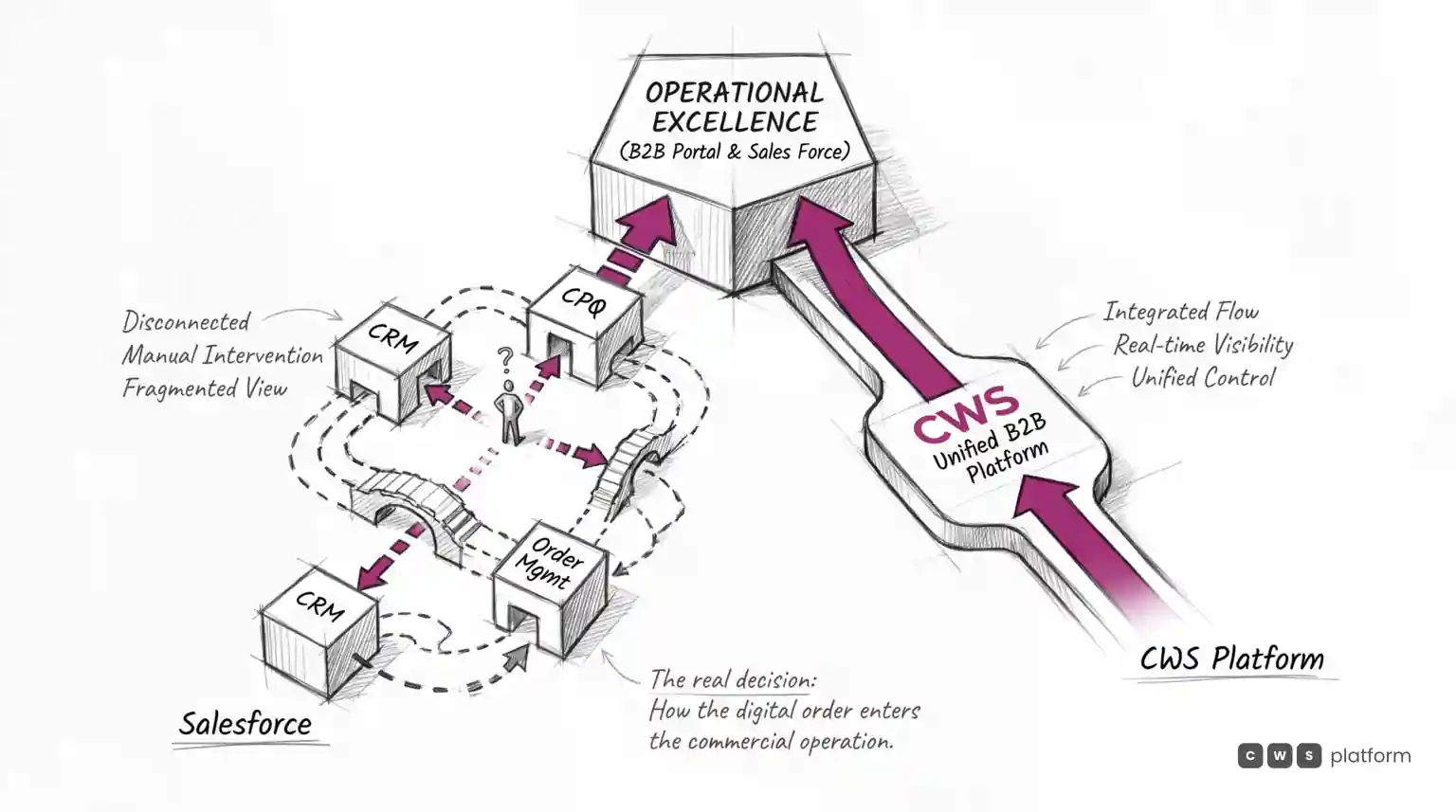
Salesforce vs. CWS Platform: Which Architecture Helps a B2B Portal Sell With Your Sales Team?
Salesforce combines a B2B storefront, buyer access controls, and enterprise sales records. CWS Platform centers the architecture on a shared cart, contextual pricing, and commercial validations before order creation. The right choice depends on which operational complexity the portal must absorb.
No posts match this combination. Remove a filter.