The 5 value layers of a digital platform
Why storefront-first projects stall at residual volume — and the sequence that finally moves revenue online
Your digital platform stalled at the storefront and revenue never migrated
You approved the digital platform project. Six months later, transaction volume is negligible. Reps are still closing deals over text and email, buyers still call before placing an order, and leadership is starting to ask whether the investment made sense. The creative looks good, the media is running, the portal is live. Even so, the real operation never migrated.
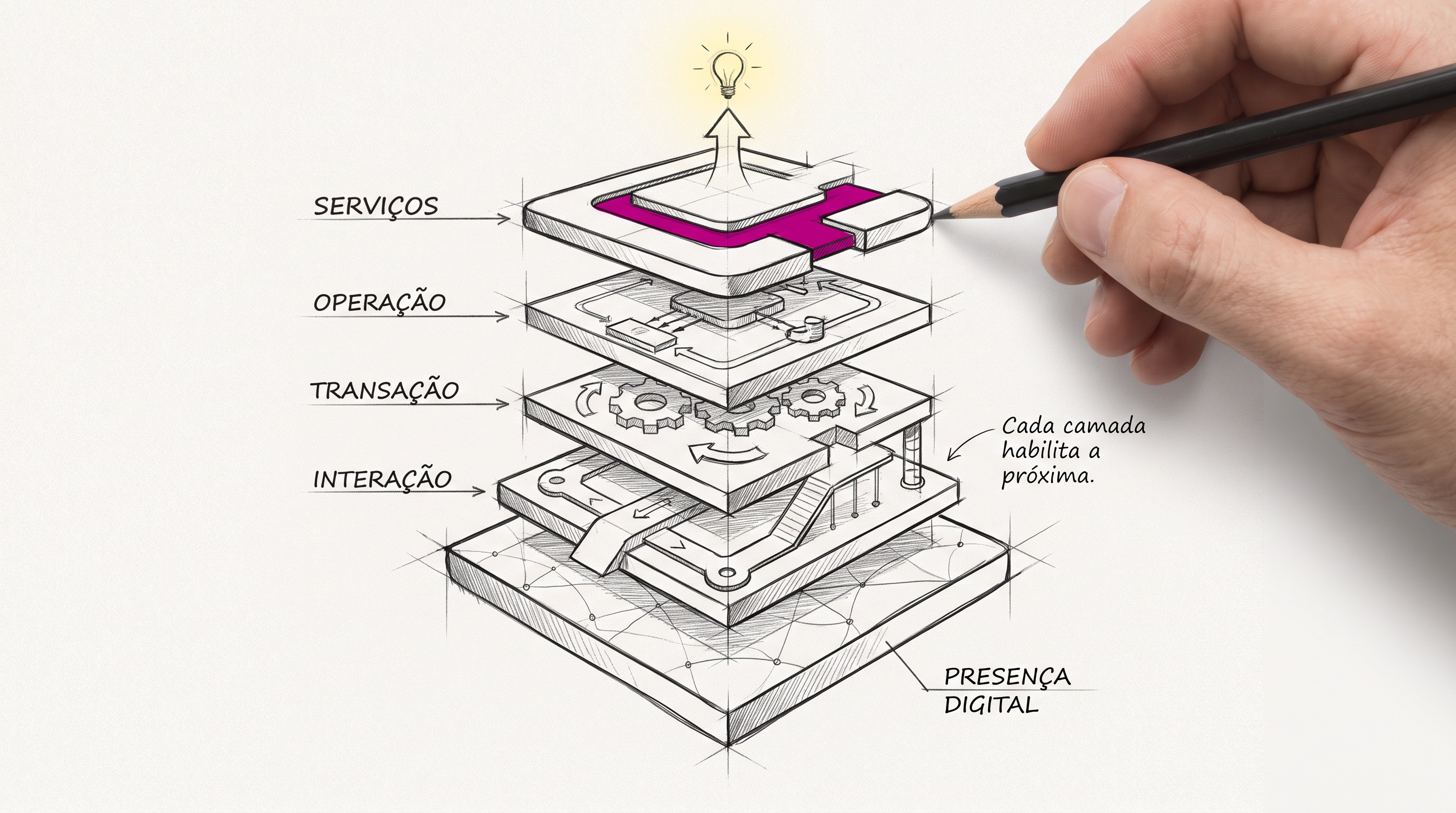
The problem is rarely the technology. It's the sequence. A platform that starts with the storefront instead of the operation is born without the foundation that would support the layers above it. A platform's value doesn't appear all at once: it's built in layers, and each one enables the next. When you jump straight to the top, the top can't bear the weight.
TL;DR
- B2B platform value is built in layers: digital presence, governed commercial decision-making, systems orchestration, AI operating safely, and services at the top. Each layer depends on the one before it.
- Projects that start with the storefront (marketplace as the goal) tend to end up with negligible volume because the digitized decision layer underneath is missing.
- Without price, terms, discount, credit, and inventory governed in the system, no campaign, search engine, or AI agent converts consistently.
- In ag, a published public case shows quote times dropping from 5 days to 8 minutes when the flow is structured end to end, not when you automate the chaos.
Why doesn't the storefront convert what the operation already sells?
Start with the most visible layer, digital presence, and observe where it fails. In CWS's own thesis-driven reading of conversion-loss signals, the pattern repeats: the buyer abandons the cart at the payment-terms or discount step because the answer depends on manual approval; the campaign drives traffic to the portal, but the displayed price doesn't reflect that customer's negotiated terms, so they call the rep before closing; segmenting a promotion by customer or channel requires a ticket to IT because the rules live in spreadsheets.
CWS's diagnosis in these cases is straightforward: "In these cases, the conversion problem isn't media. It's commercial governance." The storefront is the top layer. It only works when the layer below it, the commercial decision layer, is digitized. Price, terms, discount, segmentation, inventory, and identity need to be governed in the system. Without that, the portal becomes a reference catalog, and the transaction keeps happening over the phone.
It's the same logic as the thesis "Marketplace is output, not objective": when the marketplace becomes the destination, the project starts with the storefront instead of the operation. There's no habit of digital record-keeping, no integration with the real order, no reason for behavior to migrate. The reverse path is to digitize the network that already sustains revenue today. The order becomes a structured record, friction drops, and data starts to exist as a byproduct of the process. In the words of the thesis itself: "The marketplace that appears at the end isn't a project deliverable. It's the name you give the operation once it runs digitally."
The layers, in the order that bears weight
It's worth spelling out the stack, because the order is the argument.
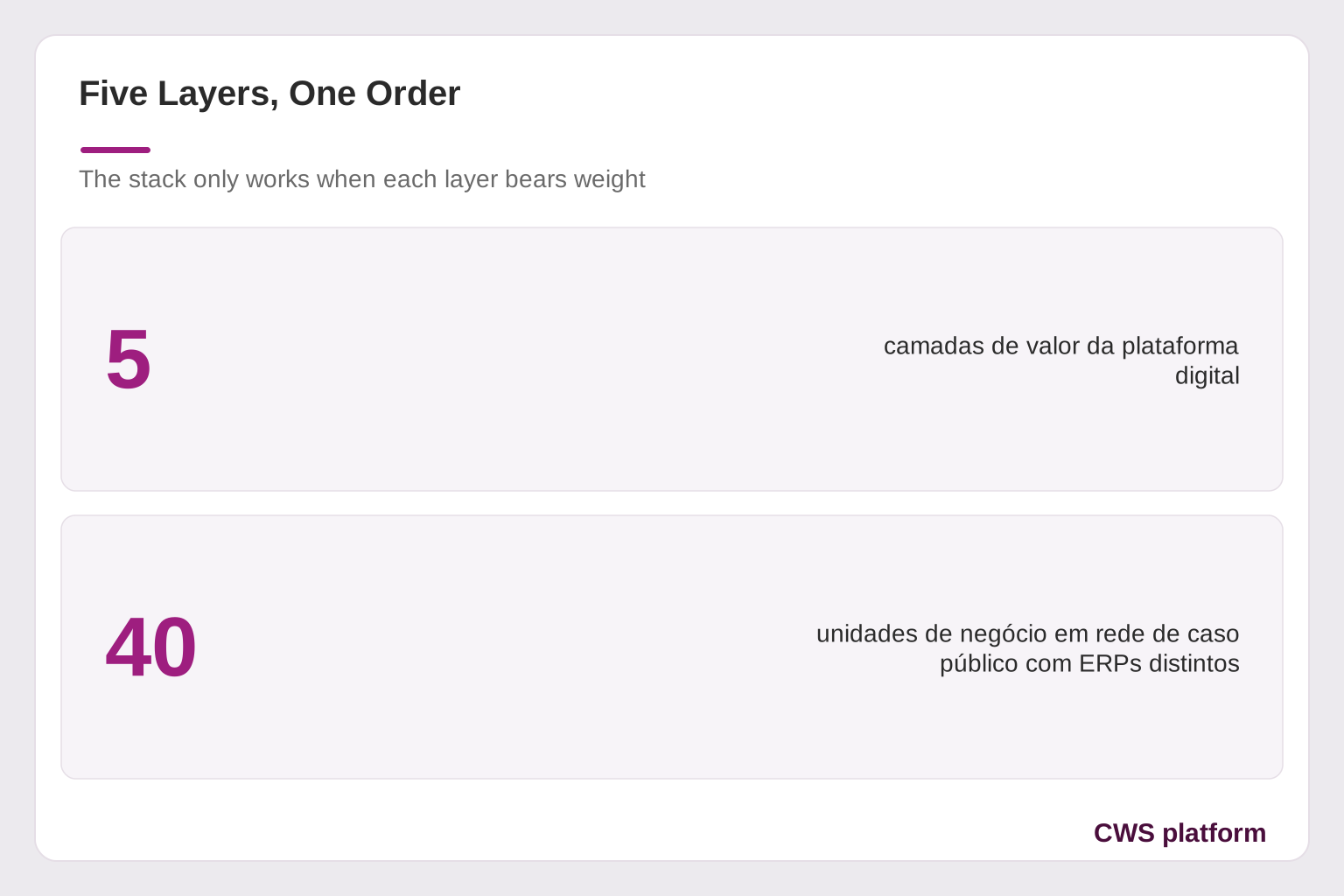
- Layer 1, digital presence: the channel exists, the customer finds the company. Necessary, but insufficient on its own.
- Layer 2, governed commercial decision-making: contextual pricing, credit, terms, discount, and inventory recorded as rules in the system, not in spreadsheets. This is where most projects fail by omission.
- Layer 3, systems orchestration: a layer above local ERPs that centralizes the rule and returns to each point what that context authorizes. In a public case reported to CWS, a network with 40 business units, distinct ERPs, and different terms by branch solved the inconsistency without replacing a single system: "what was missing was a layer that centralized the rule and returned to each point of the operation only what that context authorized." The ERP remains the local system of record; the layer above becomes the commercial source of truth.
- Layer 4, AI operating safely: agents only act well on recorded rules. The partnership between Lianlian DigiTech and UnionPay International, announced by PR Newswire Asia, illustrates this: AI agents handle global procurement, but payment requires "deterministic, fixed, and auditable limits" and human approval. "The decision comes before the agent."
- Layer 5, services: customer base reactivation, embedded credit, new revenue flows. They only emerge when the four layers below exist. An AI-supported Trading Desk, for example, can only reactivate a dormant customer because the history is structured and the pricing and inventory rules are already governed.
The Cost of Inaction
Postponing the decision layer until "after the storefront is up and running" has a measurable cost. The first is transaction cost that never comes down: the field sales rep becomes a data-entry clerk, the cycle stretches, and the commercial window stays exposed. In the public ag case reported to CWS, one customer said that "a large quote takes 5 to 10 days: pricing by region and crop, credit tied up in barter arrangements, all in spreadsheets." As long as that persists, the platform exists on paper, but the operation lives outside it.
The second cost is digital CAC climbing with no return. Clicks and sessions get measured; where the negotiation actually stalled doesn't. The company pays to drive traffic to a storefront that doesn't close, and wrongly concludes the problem is media.
The third is the risk of automating chaos. Without governance at the base, AI "just produces exceptions faster." Scale applied to a disorganized process scales the disorganization.
Principles for building in the right order
- Start with the decision, not the storefront. Digitize price, terms, discount, credit, and inventory before investing in the facade.
- Govern before you automate. A recorded rule is a precondition for AI, not a consequence of it.
- Orchestrate without replacing. A layer above the ERPs preserves local autonomy and delivers consistency.
- Treat data as a byproduct of the process, not as a separate project.
- Let the marketplace and the services emerge at the top. They are the output of the layers below.
FAQ
Do I need to replace my ERPs to get commercial governance? No. The public case reported to CWS shows orchestration installed above existing ERPs, with no migration.
Will AI fix my low digital conversion? Only after the commercial decision has been digitized. Without recorded rules, the agent gets it wrong and the buyer walks away.
Where do I start if I already have a stalled portal? At layer 2. Bring the rule from the spreadsheet into the system; volume tends to migrate when the portal reflects the customer's actual terms.
Where CWS fits
The layered reading explains why a B2B Commerce Platform for Governed Negotiation positions decision governance as the foundation, not the finishing touch. CWS's proposition is not to replace the negotiation DNA of the commercial operation, but to turn it into a governed, scalable, AI-enabled process. It's the layer that structures quoting, contextual pricing, credit, and execution, and reduces transaction cost, so the storefront and the services at the top have something to stand on.
Who's already living this
On the GetApp portal, Paulo R., Digital Sales Coordinator, sums up the effect of aligned layers: "Online store working perfectly in sync with our entire traditional sales operation." (GetApp, https://www.getapp.com/all-software/a/cws-platform/)
A case in point
The public ag case (LI-966729) corroborates the thesis that low digital penetration doesn't start with the channel, it starts with negotiation governance. By structuring quoting, contextual pricing, credit, and barter in an integrated flow, a quote that used to take 5 days came down to 8 minutes, and a R$ 1 million CPR (a commodity-backed rural credit note) was processed via barter at checkout. The field sales rep went back to the grower as a technical advisor.
About this publication
"The Cost of the Sale" is the CWS Platform blog about B2B commercial operations, decision governance, and transaction cost. We write for decision-makers: CEOs, boards, and commercial leaders who need to see the concrete pain before discussing architecture.
Sources
- CWS proprietary thesis, "The 5 value layers of the digital platform": the basis of the layered-construction argument.
- Public case LI-966729, ag (CWS blog): https://cws-platform.com/blog/pt/trading-desk-receita-incremental-reativacao-inativos, quote time from 5 days to 8 minutes and barter at checkout.
- Proprietary thesis, "Marketplace is output, not objective": https://cws-platform.com/blog/pt/marketplace-e-output-nao-objetivo, the sequence that makes volume migrate.
- PR Newswire Asia news, Lianlian DigiTech and UnionPay International: https://en.prnasia.com/story/541916-0.shtml, governance of AI agents in B2B payments.
- Public case LI-042 (CWS proprietary thesis): orchestration layer above multiple ERPs with no migration.
- GetApp, review by Paulo R.: https://www.getapp.com/all-software/a/cws-p
"The support model is differentiated — the project team actually understands B2B complexity and stays close throughout implementation."
Want to see this in your operation?
Real B2B operations already run on it.