Deterministic module
Product Catalog & MDM (Catalog Engine)
The buyer looks for a part, does not find it, and buys from a competitor. In complex B2B that is a catalog problem, not a storefront problem. Missing technical attributes, incomplete application tables and poorly mapped equivalences produce costly returns and lost sales, and no campaign fixes that.
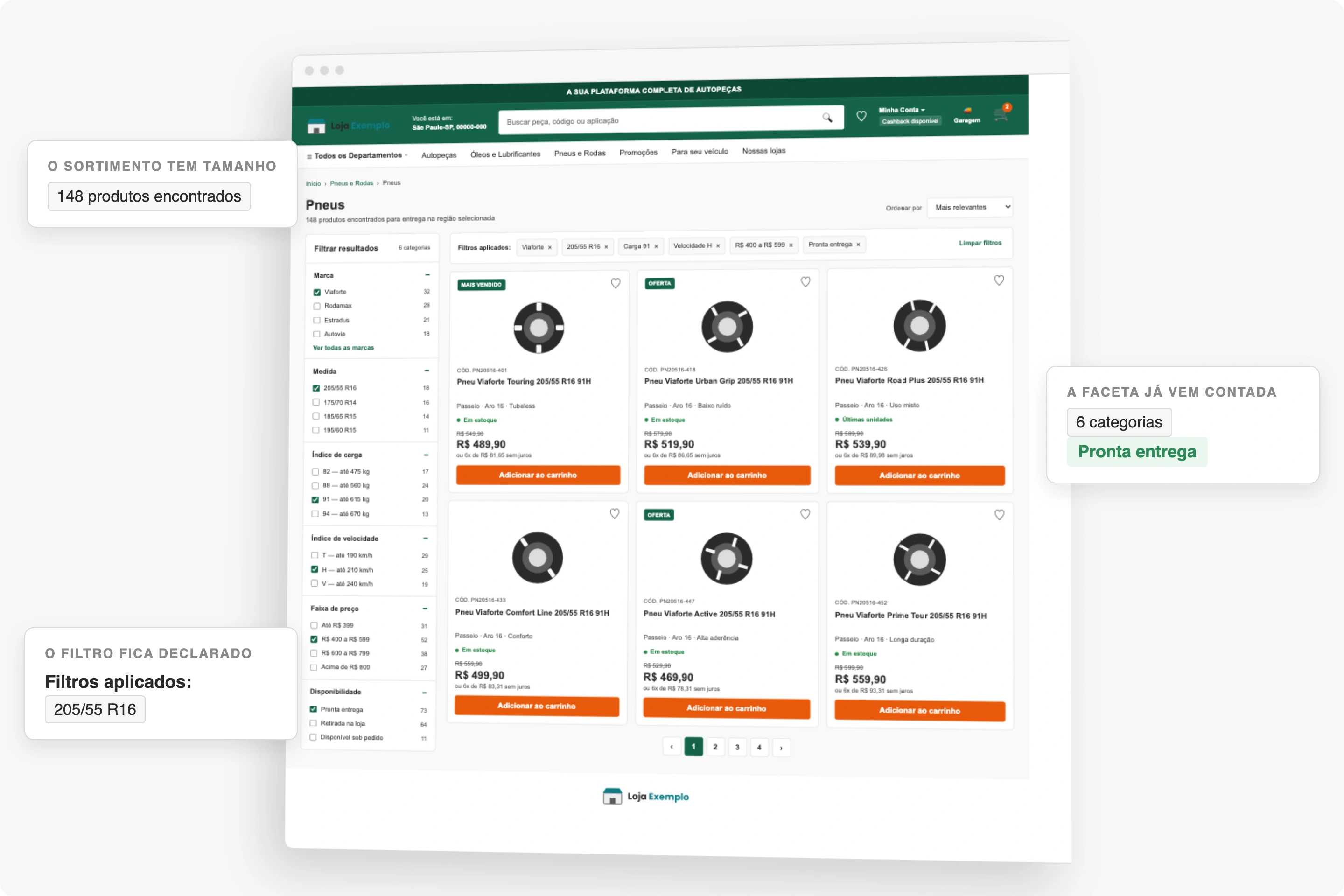
The assortment arrives structured, not stacked
The category with 148 products, facets carrying the count for each option, the filters already applied visible above the grid, and stock status item by item.
- The count comes before the clickEach brand, size or price-range option shows how many items sit behind it, so filtering is not a gamble.
- Applied filters stay in sightThe six active filters sit above the grid, each removable on its own, with no need to reopen the column.
- Availability is a facetReady-to-ship, store pickup and made-to-order are filters, not a surprise at the shipping step.
A large catalog is no advantage on its own — it becomes a problem the moment the buyer cannot find anything. What the module delivers is the structure that makes the assortment navigable, and it is all here: every facet states how many items sit behind it, so the buyer knows the size of the choice before clicking. Applied filters stay visible and individually removable, and availability is a facet like any other.
What it is
The module that treats catalog data as a critical operational asset. It ties the product into an integrity chain that runs from product to SKU, from SKU to inventory and from inventory to warehouse, and it supports the four selling compositions: unitary, pair, kit and set. Price, availability and orders all rest on those records afterwards. A bad catalog does not stay a catalog problem — it becomes a wrong order.
The capability nobody replicates
Component-level traceability in compositions
A kit is not a façade SKU. The platform knows every component in it, and if a part is missing the kit offer is suspended instead of becoming an order that the warehouse discovers later. Integrity applies at the sale, not at the picking bench.
Cross-brand equivalence and application tables
Cross-reference links competing codes, and the application links the SKU to the vehicle or equipment it fits. This is what a B2C-origin storefront does not model: it indexes products, and the aftermarket needs to index compatibility.
The catalog ladder, and why it is commercial
Richer records are not a master-data indulgence. They decide whether the item is findable. The ladder below gives the catalog a measurable axis, and moving from one rung to the next is an operational goal with a direct effect on sales.
- N1 The code The item exists and carries the manufacturer code. This is the floor: it can be ordered, but almost nobody finds it without knowing the code by heart.
- N2 Name and dimensions The item gains a readable name, a spec sheet and filterable attributes. It starts showing up in search and in filters, not only in direct lookup.
- N3 Application and image The item gains an image, an application and equivalences. It becomes findable by people who do not know the code, which is most of the demand.
In practice a catalog starts concentrated at N1 and thins out toward the top. Lifting the bulk from N1 to N2, and the fast movers to N3, is the catalog work CWS Platform delivers alongside the technology.
In operation
Imdepa · auto parts distribution
about 23,000 SKUs
in a portfolio serving roughly 16,000 corporate customers across 9 states, in the agricultural, industrial and automotive segments.
With the catalog intact, the buyer assembles an order of more than 250 SKUs in a single cart, unassisted. What holds that order up is not the screen — it is the records behind it.
Read the Imdepa case →Frequently asked questions
Our records have missing attributes and inconsistent part names. Can we go live like that?
Yes, and that is how nearly every operation starts. The catalog comes in as it is and improves by level: first the manufacturer code, then name and dimensions, then application and image. Each additional level raises the chance the item is found and bought, so improving the catalog becomes an operational goal with visible progress, not a prerequisite that stalls the project.
Does the platform know that one brand's part replaces another's?
Yes. Cross-reference links equivalent codes across manufacturers, and the application table links the SKU to the vehicle or equipment it fits. The buyer arrives with the code they already know, with a serial number, or through the exploded view of an assembly, and still lands on the right item.
Do headquarters and branches have to maintain the same catalog twice?
No. Global versus local governance keeps the master data with headquarters, while branches and sellers inherit that data and extend it with regional offers. A new partner captures the catalog that already exists instead of re-entering it from scratch, which shortens their go-to-market.