Portals · by profile
Assisted Selling
In complex B2B, the rep spends much of the day quoting instead of selling. Assisted Selling is the rep's digital negotiation table: the Assisted Selling Platform (Sales Hub), with the customer, the margin and the rules in plain sight.
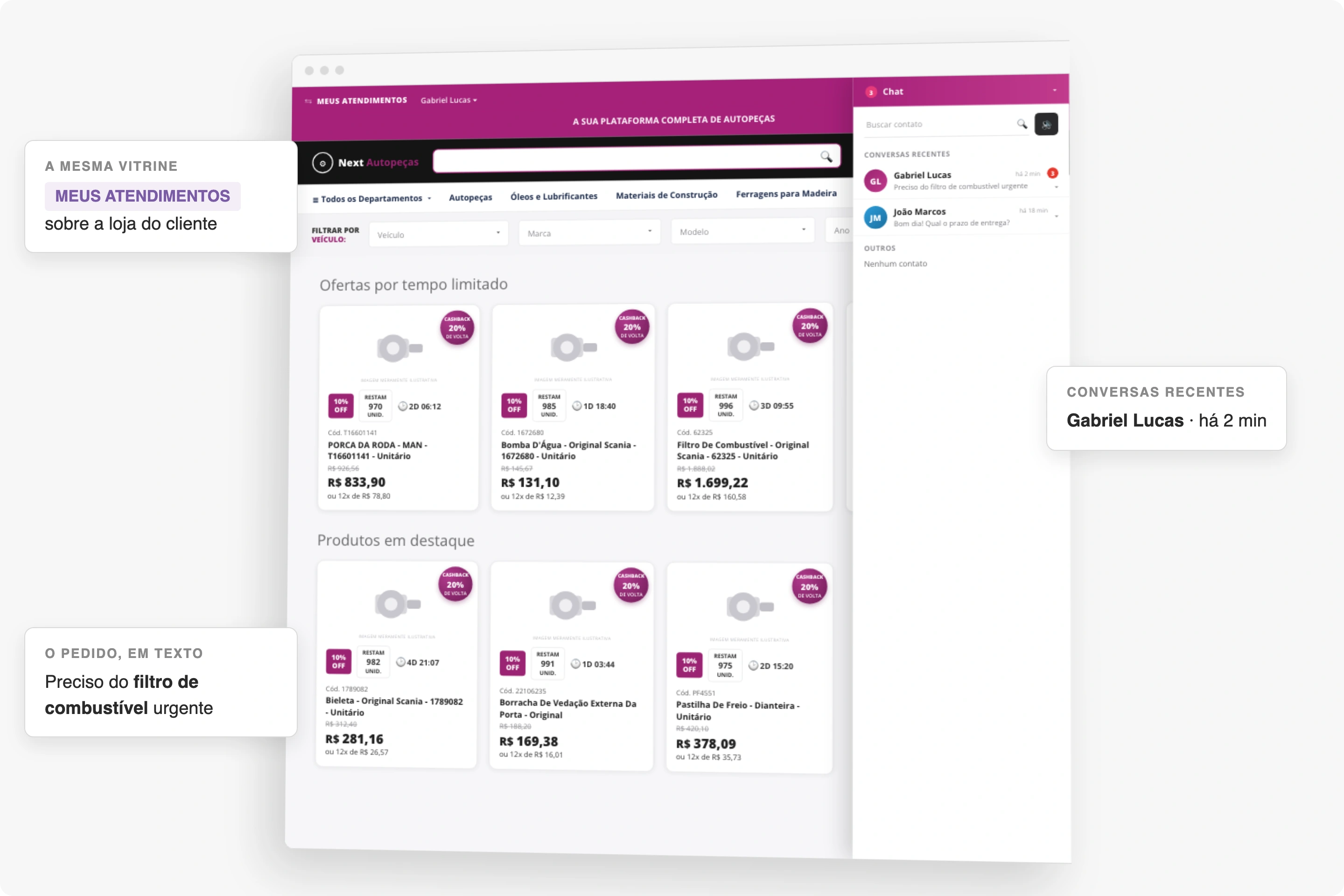
The salesperson joins the same negotiation
The buyer's storefront with the salesperson's service bar on top, and the recent-conversations panel showing the order the customer typed two minutes ago.
- One screen, two rolesThe salesperson's bar opens over the buyer's own storefront, not in a parallel system that syncs afterwards.
- The customer arrives identifiedThe session carries who is on the other side, so price and terms are already that customer's.
- The conversation sits next to the catalogThe order written in plain text and the part to be added live on the same screen, with no alt-tab.
This is the proof that assisted selling and digital selling are not two products. The salesperson does not open a CRM on the side: they step into the same storefront, with the customer identified and the conversation next to the catalog.
From order-taker to governed negotiator
The rep's role evolves through four stages: attendant, facilitator, governed negotiator and consultant with AI. The Sales Copilot does the behind-the-scenes work: account ranking, margin and inactivity alerts, and builds the quote. The Customer Intelligence Panel brings up the customer's context in one click.
Freedom to negotiate, on rails
The rep moves price, terms, freight and composition on the spot, and every concession goes through the same Commerce Rules Engine rules: Approval Workflows, Pre-Submission Guardrails, Discount Stacking Prevention and Reason Codes. The company gains speed without losing control of margin.
For the commercial director
Every discount has an author and a justification, approval limits are by profile, and account ranking shows where the team wins and where it leaves margin on the table. Governance without taking away the freedom to negotiate.
In real production · Imdepa
At Imdepa, the same machine that processes the simple transaction frees the rep from about 70% of the time spent on processing, redirecting it to proactive consulting. The portal led to 3x more customers activated in three years, without growing the team in the same proportion.
"O valor real não é a receita que se vê nos números. É a operação que você consegue sustentar com o mesmo custo de estrutura. Crescemos 3x em clientes sem contratar 3x mais vendedores."
Paulo R. S. Pereira, Digital Sales Coordinator at Imdepa · read the case
Seller configurations, from least autonomy to most4
Seller autonomy is a configuration, not a culture. An operation starts at the first level, with no margin risk, and moves up as the team gains confidence, without changing platforms.
- Attendant
- Zero pricing autonomy. The seller builds the order and runs the conversation, and the price is whatever the engine derived. It is where an operation starts when it wants no risk at all.
- Facilitator
- Low autonomy, typically freight only and within a narrow band. It serves the transition: the seller gains a real lever, and product margin stays untouched.
- Negotiator with thresholds
- Governed autonomy over price, freight and terms, with mandatory justification and a block before an unviable order exists. This is the level where the platform starts to look like a risk desk.
- Consultant with AI
- The greatest autonomy, with the Sales Copilot alongside suggesting the next offer and anticipating what would not pass. The agent queries the same rule that constrains the human.
The journey is dual, and both run on the same core3
What changes between them is who is in front, not the engine behind. When they are two systems, the portal's price and the seller's price drift apart, and the buyer learns not to trust the portal.
- Self-service
- The buyer identifies themselves, sees the table for their own profile, gets automatic campaigns applied and closes on their own. The trail is browsing and order history.
- Assisted
- The seller identifies the customer and receives credit, outstanding items and history before building any proposal. They adjust price and freight within their threshold, and each adjustment requires a justification.
- The same cart
- The two meet in the same cart: the seller joins a negotiation that started self-service, or sends the link for the buyer to finish. There is no handover between systems because there are not two systems.
Frequently asked questions
Does the CWS Platform take the rep out of the equation?
No. The Assisted Selling Platform (Sales Hub) gives the rep a better tool: seller and buyer in the same Real-Time Shared Cart, with context and approval limits. Some operations run 100% through it.
How does the manager control the discount each rep grants?
Through Approval Workflows applied by the Commerce Rules Engine, with approval limits by profile and a mandatory Reason Code, so every concession has an author and a justification.
What does the rep see about the customer?
The Customer Intelligence Panel brings up the customer's history, credit and context in one click, and account-based access ensures each rep sees only their own base.