AI Agent with Business Guardrails
Catalog Enrichment Agent
A catalog with thousands of items does not enter the platform through the front door. It enters through a spreadsheet with truncated descriptions, the supplier code where the name should be, and a folder of photos taken at the counter. The work of turning that into a catalog that sells is real, it is large, and it is why so many B2B digital projects stall before going live.
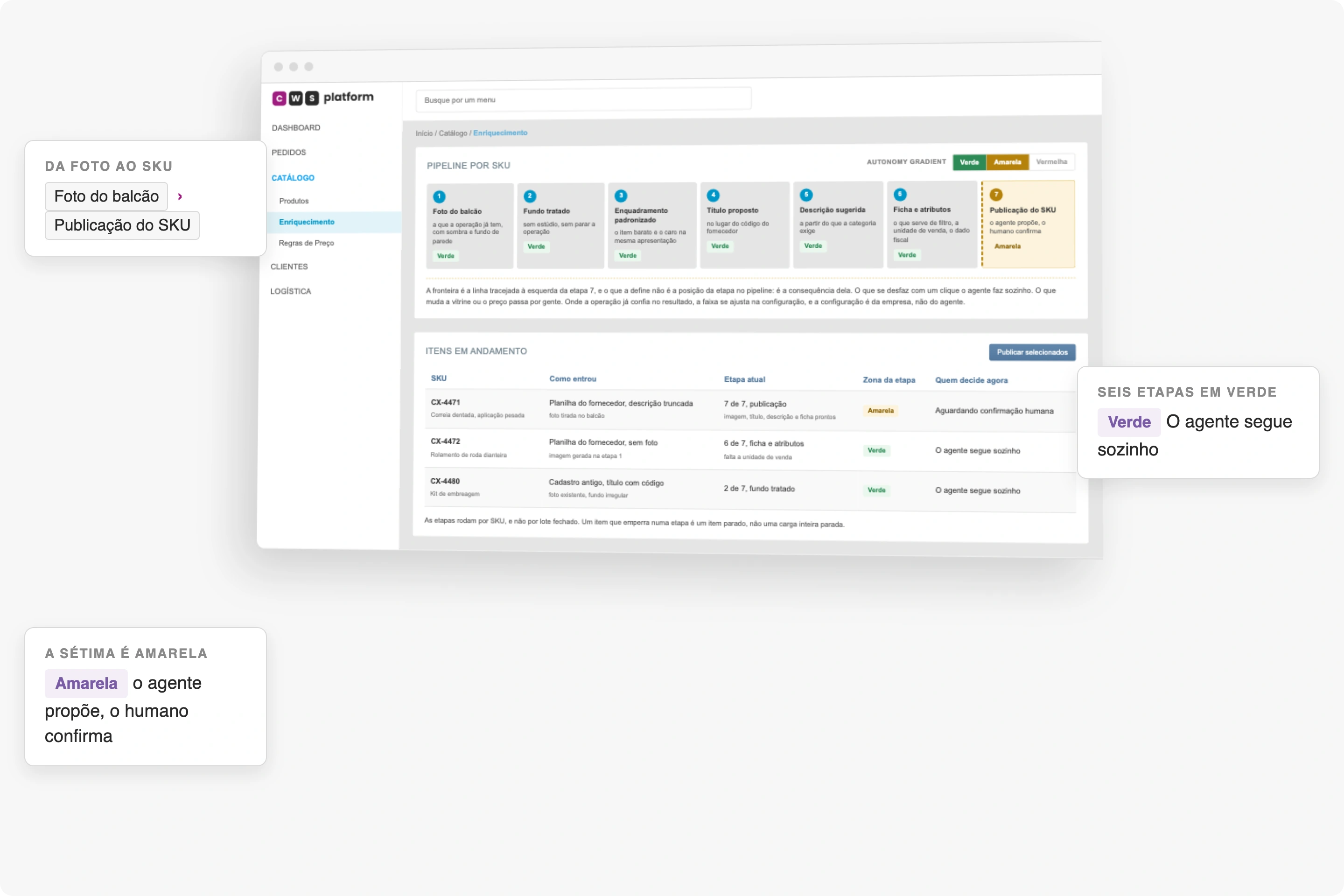
Six steps run on their own, the seventh waits for you
The pipeline's seven steps with each one's zone, from the counter photo to publishing the SKU, and the items in flight with the step they reached and who decides next.
- The photo is the one that existsStep 1 starts from the picture taken at the counter, shadow and wall background included, with no studio and no pause to the operation.
- Consequence sets the bandWhat undoes with a single click the agent does alone; what changes the storefront or the price goes through a person.
- Per SKU, not per batchSteps run item by item, so one SKU stuck at step 6 does not hold back the ones already at step 7.
This is the clearest screen for explaining that the Autonomy Gradient's boundary is not the step's position but its consequence. Treating a photo, proposing a title, a description and a product record all undo with one click, so they run alone. Publishing the SKU is the only step the buyer sees, and the only yellow one. The pipeline runs per SKU rather than per closed batch, so a stuck item is one item stopped, not a whole load.
What it is
The agent that turns an ordinary photo into a catalog item ready to sell. The pipeline has 7 steps, from photo to publication per SKU, running through professional image, product record and publication into Product Catalog & MDM. It is the agent that attacks the entry bottleneck: catalog onboarding at scale, which otherwise consumes weeks of manual work and delays everything else in the project.
The capability no one replicates
The counter photo becomes a catalog image, with no studio
Treated background, standardized framing, and the same presentation for the cheap item and the expensive one. The gain is not aesthetic: a catalog with inconsistent visual standards teaches the buyer to distrust whatever looks amateur, and they distrust the item, not the photo. Standardizing presentation is what lets thousands of SKUs share one storefront without dragging each other down.
A pipeline per SKU, not a batch that passes or fails
The 7 steps run item by item, so the catalog reaches production while it is still being enriched, rather than after the last photo is done. A SKU stuck at one step is one SKU stopped, not an entire load stopped. For an operation that has to launch with the catalog live, that difference decides whether the project delivers in waves or waits for the end.
The 7 steps, and where the human comes in
Generating an image with AI and proposing a title and description are reversible, low-risk actions, so they run on their own: that is the green zone of the Autonomy Gradient. Publishing the product changes what the buyer sees, so publication is the step where the agent proposes and the human confirms. The rule deciding this is not the step's position in the pipeline, it is the step's consequence: what a click undoes, the agent does; what changes the storefront or the price goes through a person. Where the operation already trusts the output, the zone is adjusted in configuration, and the configuration belongs to the company, not to the agent.
In operation
Circuito de Compras (CDC) · apparel wholesale in Brás, São Paulo
Inside MayaApp CDC, the white-label app that serves merchants in five languages and accepts international payments, a CWS Platform AI agent runs product cataloging and curation. This is a qualitative case by release decision: we tell the mechanism and the reach, not numbers. The agent's personification, including the name merchants call it by, is the customer's decision and not the platform's.
Read the Circuito de Compras case →Frequently asked questions
Do I need a photo studio to use the pipeline?
No, and that is the agent's starting point. It was built for the photo the operation already has: the one taken at the counter, with shadows and a wall in the background. The pipeline treats the background, standardizes the framing and returns a presentable image matching the rest of the catalog. Where studio photography already exists it enters the same flow; what the agent solves is the case where it does not exist and will never exist for thousands of items.
What happens when it gets a SKU record wrong?
The error stays in the step before publication, which is where it costs little. Generating the image, proposing a title and suggesting a description are reversible actions, so they run on their own; publishing the SKU changes what the buyer sees, so it goes through human confirmation. Correcting before publishing is routine review. The order of the steps exists so that the error always falls on the cheap side of that line.
Can it handle a catalog with thousands of items?
That is exactly the problem it exists for. The 7 steps run per SKU rather than per closed batch, so the catalog goes live in waves: finished items publish while the rest is still being enriched. An item stuck at one step is one item stopped, not an entire load stopped, and the operation does not wait for the last SKU to open the store.