Deterministic module
Credit-First B2B Checkout (Checkout & Payments)
B2B buys on terms, not with a card on every order. When the digital checkout does not know how to handle credit, the order does not close. The Credit-First B2B Checkout treats credit as a native payment method, and validates the whole order before letting it advance.
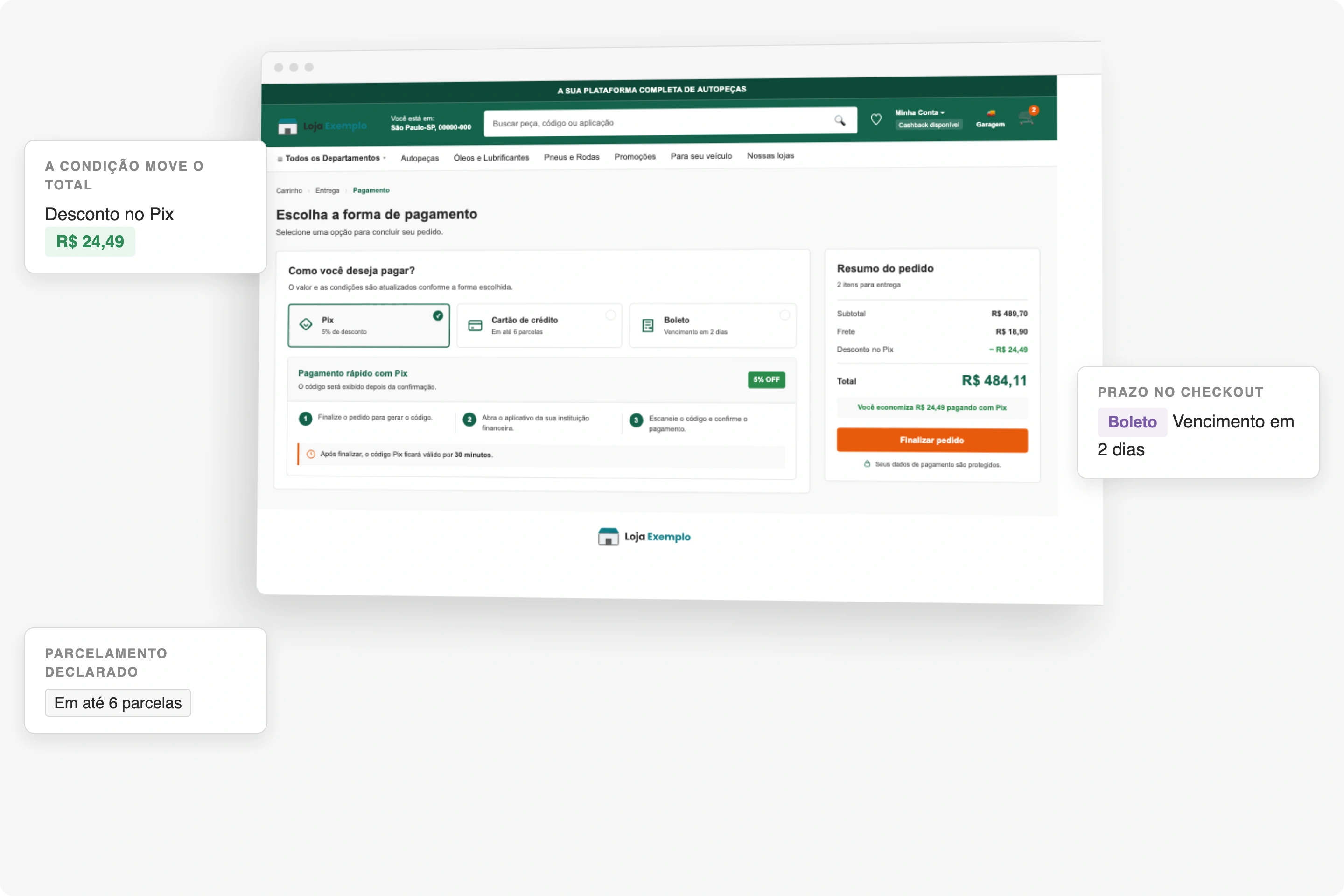
The payment method recalculates the whole order
The three payment methods with their conditions, and the summary beside them adding up subtotal, shipping and the discount the choice has just produced.
- The condition becomes a numberChoosing Pix applies the 5% and the summary shows the discount and total already corrected.
- Terms are a payment methodThe boleto arrives with its due date declared, in the same place the card declares its instalments.
- The summary keeps upSubtotal, shipping and discount stay visible next to the choice, with no extra step to check them.
Checkout is not a billing screen bolted to the end of the flow — picking the payment method rewrites the order value on the spot, with the discount and the term coming from the same rule. This is the module deciding, not recording.
What it is
The close of the negotiation, where the negotiated agreement becomes a transaction. Credit as a native payment method, with Net Terms 30/60/90, multi-split for multiple sellers with escrow, combination of payment methods and Barter in agribusiness. Delinquent and blocked tags integrated with the ERP in real time. Card data never passes through the platform.
The capability no one replicates
Credit as negotiation, native
Credit comes in as a variable of the agreement, not as a separate app tacked on afterward. In the market, B2B credit is usually a standalone app; here it is the heart of the checkout.
4-Point Checkout Validation
Stock, credit, tax and price checked at the same time. The order does not advance with any of the four invalid, so risk is validated in the flow, not afterward.
It governs the payment dimension
The native payment methods6
Each has its own approval flow, and that difference is what separates a B2B checkout from an adapted retail one. They can be combined in a single order, and what is offered is filtered by the profile and financial status of whoever is buying.
- Credit limit
- Approved by credit validation rather than by a gateway. It is the dominant B2B payment method, and its absence is the most common reason a buyer goes back to the sales rep.
- Bank slip
- Approved after bank clearing. The order waits for the buyer's payment cycle without anyone having to track reconciliation by hand.
- Instant transfer
- Instant approval. It is usually the method that remains when a customer has an outstanding balance, which is why it is never the only door.
- Credit card
- Automatic gateway approval, with fraud screening in the gateway layer. Card data never passes through the platform.
- Barter
- In agribusiness, grain settles the order after physical and tax validation of delivery. The balance is managed per customer, like a current account in grain.
- In-store
- Manual confirmation by the counter operator. The order starts digital and closes in person, without becoming two orders in two systems.
The levels of split, which are different things3
The market uses one word for three mechanisms that behave differently. Conflating them is what makes a checkout look sufficient in a demo and fail in production.
- Cart split
- Items in one order ship from different sellers or warehouses and generate independent invoices, each with its own tax document and tracking. A delay in one does not block the others.
- Split delivery
- One order is delivered in parts, to different addresses or dates, with freight, tax and approval thresholds calculated per fraction.
- Combined payment methods
- One order paid with more than one method at once. Each method is processed on its own, and final approval only lands once all of them confirm.
When the sale does not end on screen3
- Pickup and counter
- The buyer builds the order digitally and completes it in the shop, with payment confirmation in the hands of the in-person operator.
- Quote that becomes an in-person sale
- The quote built during remote service is the same one that closes at the counter, with the pricing and governance that already applied.
- Saved carts
- They work as an instant quote, with correct pricing, verified stock and governance applied, and can be sent as a link for the buyer to complete on their own.
In operation
Imdepa · auto parts distribution
The buyer assembles an order of more than 250 SKUs and the platform calculates IPI, ICMS, tax substitution, freight and the pre-approved credit in seconds. Credit risk is validated within the flow, not checked in separate stages afterward.
Read the Imdepa case →Frequently asked questions
Can you sell B2B on terms with the CWS Platform?
Yes. The Credit-First B2B Checkout (Checkout & Payments) has Net Terms 30/60/90 as a native payment method, with a credit limit validated in real time alongside stock, tax and price, in the 4-Point Checkout Validation.
How does the order avoid advancing with the wrong credit or tax?
The 4-Point Checkout Validation checks stock, credit, tax and price at the same time before confirming; any one of them being invalid blocks the order from advancing. The delinquent and blocked tags come from the ERP in real time.
Does it work for agribusiness with Barter?
Yes. The Agro Commerce Suite treats grain as a payment method (Barter), with CIF and inverted FOB and fractional delivery by property.