AI Agent with Business Guardrails
Procurement Agent
A distributor's buyer needs to assemble an eighty-line order with items from different suppliers, and the only window where they can do it without interruption is after seven in the evening. That is exactly the hour when there is nobody on the other side to say which item substitutes which, whether that price already reflects the contract, and whether the credit limit covers the whole order.
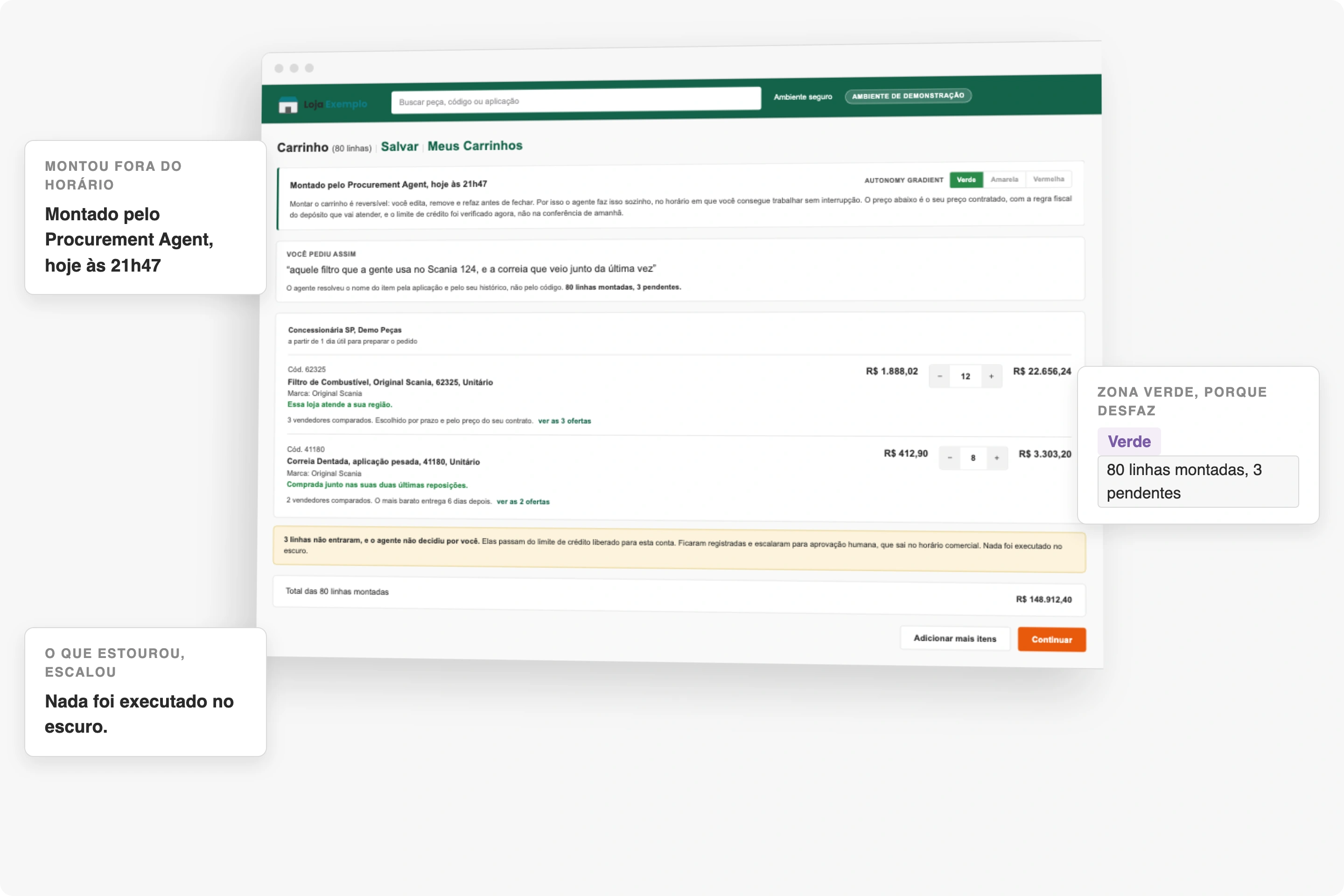
The cart assembles itself at 21:47, because undoing is cheap
The 80 lines assembled after hours from the buyer's plain-language request, with contract pricing and the comparison across sellers, plus the 3 lines left out on credit.
- Reversibility is the licenceA cart can be edited, trimmed and rebuilt before closing, and that reversibility is what puts the action in the green zone.
- The name comes from the applicationThe agent resolves each item by vehicle fitment and the buyer's own history, not by the supplier's part code.
- The credit limit holdsThree lines exceeded what was released, did not go through, and escalated for human approval during business hours.
This is the green zone's criterion explained by a screen rather than a slide: assembling a cart is reversible — you edit, remove and redo it before closing — so the agent does it alone, overnight. The proof that the band has an edge sits in the three lines it did not execute: they exceeded the credit limit, were logged, and escalated to a person. The screen closes by stating that nothing was executed in the dark.
What it is
The agent that runs the buying cycle on the demand side. It performs semantic search across the catalog, compares offers from different sellers, assembles the cart and handles reordering, all in natural language and 24 hours a day. What separates this from a support chatbot is where the answer comes from: it operates under exactly the same Commerce Rules Engine rules as a human buyer. It does not bypass approval authority, does not ignore credit limits and does not invent prices, because it is not the one calculating the price.
The capability no one replicates
Semantic search solves the problem of the item's name
In B2B the buyer almost never knows the manufacturer code, and often not even the official name of the part. They know what it does and which machine it goes into. Exact-keyword search fails precisely there, and the consequence is not an empty results page: it is an order that comes out smaller than it could have, because the item existed and was not found. Semantic search works from the description of what the buyer needs, not from the spelling they happened to get right.
Multi-seller comparison that does not hide the comparison
When the same item exists across several sellers, the agent opens the offers with what genuinely separates them: price for that buyer, lead time from that warehouse, and payment terms. The decision stays with the buyer, and that is what keeps the comparison from becoming a disguised recommendation. A platform that ranks offers without showing the criterion teaches the buyer to distrust the ranking.
Outside business hours, and inside the same rules
Being available 24 hours is the easy part, and on its own it is a trap: a night channel that accepts anything produces a morning queue of orders to undo. What makes availability usable is that the agent consults the same deterministic engine that serves the rep during the day. The price it shows at night is that buyer's contracted price, with the tax rule of the warehouse that will fulfill. The credit limit is checked right then, not in the next day's review. And whatever needs human approval is not executed in the dark: it is recorded and escalated. The buyer finishes their work at night, and the decision that belongs to a person is still taken by a person.
Frequently asked questions
Can the buyer place an order outside business hours?
Yes, and without that turning into a correction queue the next morning. The agent works 24 hours a day by consulting the same deterministic engine that serves the rep during the day: the price shown at eleven at night is that buyer's contracted price, with the tax rule of the warehouse that will fulfill, and the credit limit is checked right then. Whatever needs a human decision is recorded and escalated rather than executed in the dark.
How does it compare offers from different sellers?
By putting side by side what actually separates one from another: the price valid for that buyer, the lead time from the warehouse that would fulfill, and the payment terms available. The choice stays with the buyer, and that is what keeps the comparison from becoming a disguised recommendation. A single order can close with different sellers line by line, each with its own lead time.
Does it respect the credit limit and the approval my company requires?
Yes, because it defines neither of them. Credit limit, approval authority and payment terms are Commerce Rules Engine parameters, and the agent consults those parameters the way a human buyer would. An order that exceeds the limit is neither refused nor released on the agent's own initiative: it follows the same approval path it would have followed if it had been assembled by hand.