Platform
Determinism plus AI, under the same rules.
You don't have an e-commerce problem, you have a negotiation problem: price, credit, freight and mix decided case by case, today scattered across a spreadsheet, the ERP and the rep's head, and now under the threat of an AI that hallucinates rules. CWS Platform digitizes the whole decision on a deterministic engine, with governed AI layered above.
11 deterministic modules + 6 AI Agents + 4 layers + 1,029 parameters + 5 dimensions.
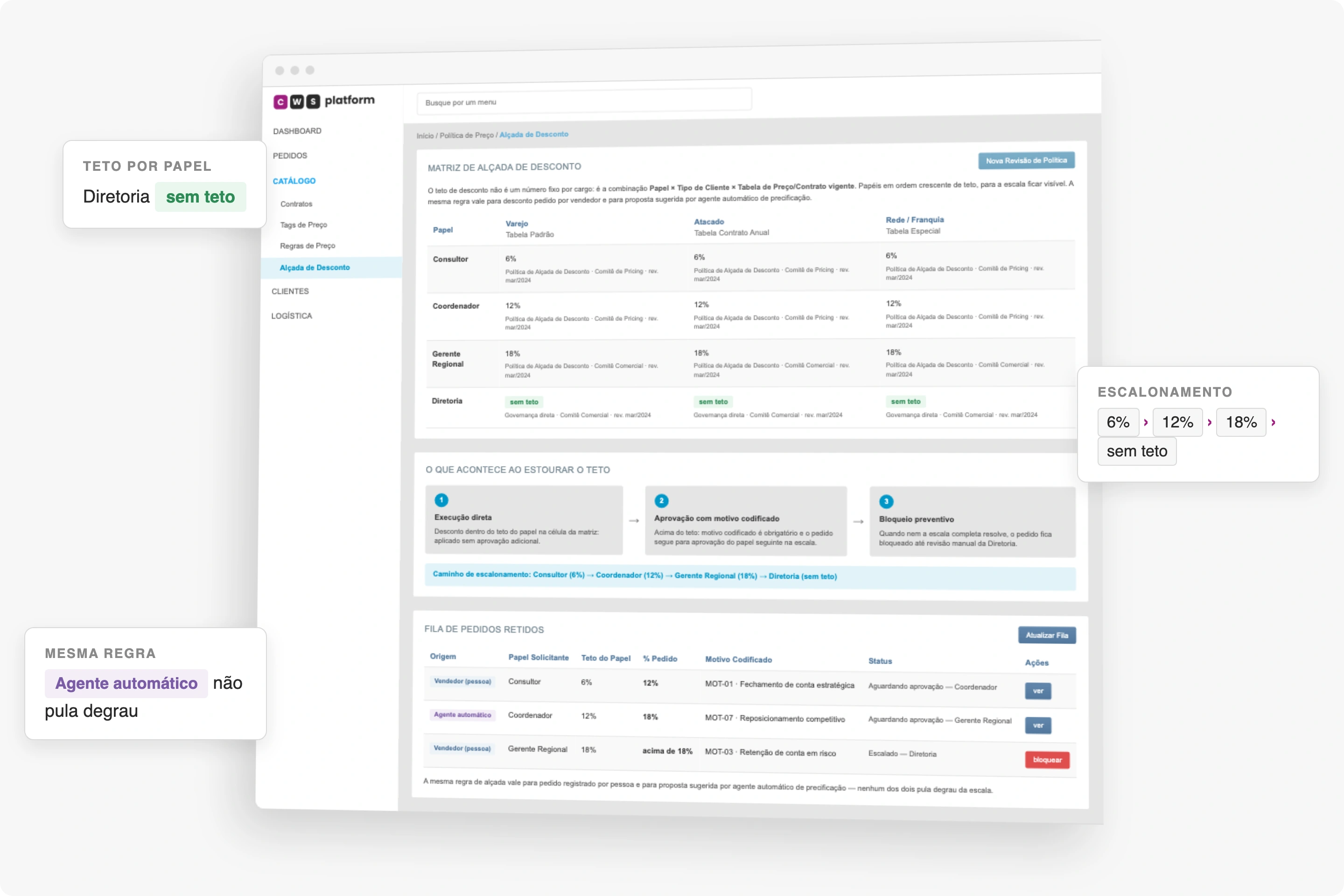
The rule decides before the order exists
The approval matrix: every role has a discount ceiling that crosses with the customer type and the pricing table of the contract in force.
- Ceiling by roleThe discount limit crosses who is selling with the customer type and the pricing table of the contract in force.
- Tiers from 6% to no ceilingEvery step has an owner: what exceeds the ceiling moves up a level instead of becoming an exception.
- Automated agent, same ruleIn the held-orders queue, the agent is bound by the same limit as the salesperson.
Leadership shows as "no ceiling"; below it the tiers run from 6% to 18%. In the held-orders queue, the "Automated agent" row is bound by the same ceiling as the salesperson's.
This is the platform's thesis happening inside the product, not an illustration of it: what breaks the ceiling does not become a discount, it becomes a queue. And the same rule governs person and agent — which is what separates governance from reporting.
A platform, not a toolbox
One rules engine, not eleven
The 11 modules and 6 agents run under the same Commerce Rules Engine (CDL Workspace). Approval limits, credit and tax rules apply the same everywhere, with no standalone-tool silo.
Determinism underneath, AI on top
The Core executes the rule by code, at zero inference cost. The AI Agents interpret intent and orchestrate the Core via MCP, under exactly the same rules as a human seller.
A layer over the ERP, not a replacement
The platform orchestrates negotiation over the ERP, through APIs and webhooks. The ERP remains the vault; CWS Platform is the commercial manager. Public integrations include SAP, TOTVS, Senior and Sankhya.
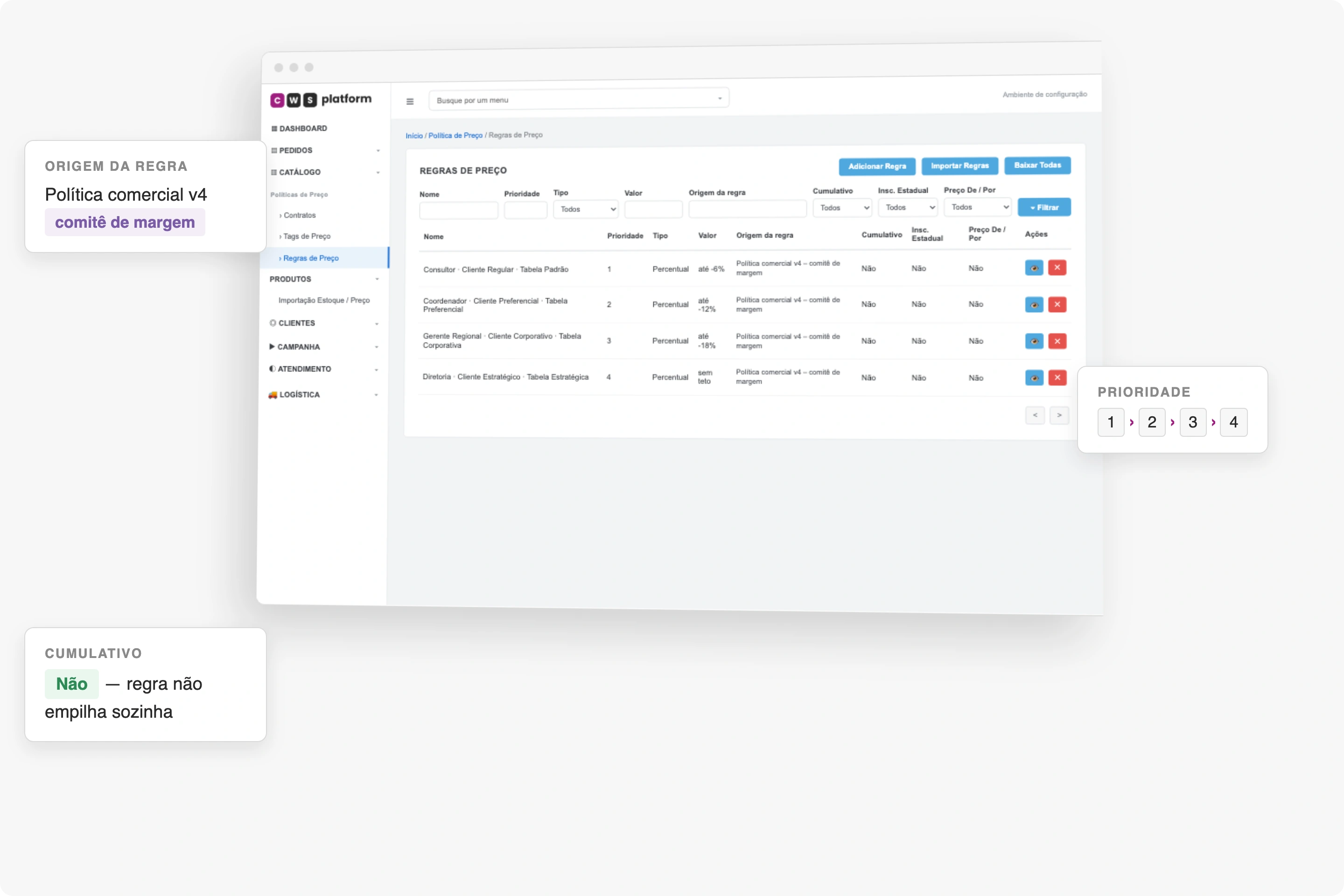
Price comes from a rule, not a spreadsheet
The Pricing Rules screen: each row carries priority, type, value, whether it stacks, and the commercial policy it came from.
- Every rule has an originAll four rows point to the same commercial policy v4, approved by the margin committee.
- Priority settles the tieWhen two rules reach the same order, the ordering decides, not whoever opened the spreadsheet first.
- Stacking is a decision, not a side effectNone of the four stack by default: piling up discounts becomes a declared choice.
This is the mechanism underneath the approval matrix. The four rules are not screen examples: they are the same commercial policy v4 written as four tiers, with explicit priority so there is no tie — which is exactly what a spreadsheet does not have.
In real production
Company founded in 2012; platform in production since 2013.
+10 points of margin
at Tracbel, on portal orders, with ~131k SKUs (100% of the portfolio) and 6 years integrated with SAP.
3x more customers
at Imdepa, 153 customers activated in 3 years on the B2B portal, without growing the team in the same proportion.
Governance by infrastructure
the rule blocks what isn't allowed before it happens, for the human seller and for the AI.
In-depth content
Estimate the margin gain on your order volume
Leave your email to unlock.
Calculate my gain →The 11 deterministic modules
The Core that executes the business rules by code. The four that underpin the negotiation have a dedicated page.
Commerce Rules Engine
CDL Workspace
The rules of the game in executable form. 1,029 configurable parameters.
View module →Assisted Selling Platform
Sales Hub
The rep's digital negotiation table. 140+ features.
View module →Contextual Pricing
Pricing Engine
Price by product, warehouse, profile and tax rule, in milliseconds.
View module →Credit-First B2B Checkout
Checkout & Payments
Credit as native payment (Net Terms 30/60/90) and 4-Point Checkout Validation.
View module →Product Catalog & MDM
Catalog Engine
Cross-cutting catalog with 4 compositions, Global vs. Local governance.
View module →Distributed Inventory
Inventory Hub
Multi-warehouse inventory, physical and logical, in real time.
View module →Shipping & Fulfillment
Logistics Engine
Multi-DC freight, CIF/FOB, split delivery, Freight Negotiation Thresholds.
View module →No-Code Storefront Builder
CMS Builder
No-code portal, single dynamic template, native SEO.
View module →Commerce Marketing & Promotions
Marketing Suite
Inventory-aware activation. 166 features.
View module →Marketplace Management Platform
Marketplace Center
Multi-seller 30+, buybox, split, anti-disintermediation.
View module →Order Management System
OMS (also Seller Center)
Orchestrates the order across 10 states. READY requires a tax invoice (Nota Fiscal), SHIPPED requires tracking.
View module →The 6 AI Agents with Business Guardrails
They consume the deterministic Core via MCP, under the same rules (CDL) as human sellers. If the AI goes down, the Core keeps operating.
Rules Auditor Agent
Audits 1,029 parameters in 45s, detects conflicts, prevents leakage. It suggests, the human decides.
View agent →Sales Copilot
Account ranking, margin and inactivity alerts, builds the quote.
View agent →Procurement Agent
Semantic search, multi-seller comparison, builds the cart, reorders.
View agent →Merchandising Agent
Monitors the store, incomplete listings, suggests campaigns.
View agent →Catalog Enrichment Agent
A 7-step pipeline, from photo to publication per SKU.
View agent →Replenishment Agent
Redistributes across DCs, stockout alerts, suggests purchases.
View agent →5 negotiable dimensions
Negotiated at the same time, in the same order, under intelligent rules.
- Price
- Delivery
- Payment
- Quantity
- Composition
Autonomy Gradient
AI governance by infrastructure, not by prompt.
- Green: the agent executes on its own (reversible, low-risk action).
- Yellow: the agent proposes, the human confirms with one click.
- Red: the agent never acts. It informs and escalates to the human.
The concept behind it all
CWS Platform treats the cart as a negotiation table, where each dimension moves within rules the company defines and that record every decision. This is what we call Governed Negotiation.
Frequently asked questions
What exactly does the platform digitize in a negotiation?
The five dimensions a B2B sale negotiates at once: price, delivery, payment, quantity and composition. All of them run through the same rules engine, so the terms the digital channel shows are the terms that close, not a number a sales rep has to rework later over the phone.
Why a platform and not standalone modules from several vendors?
Because the 11 modules and 6 AI Agents run under the same rules engine (Commerce Rules Engine). Standalone tools create silos, each with its own pricing rule and approval limits; here the rule is a single one, applied the same to the human seller and to the agent.
What runs by code and what does the AI orchestrate?
The deterministic Core executes the rules by code, at zero inference cost, and negotiation runs on it. The AI Agents orchestrate that Core via MCP, under the same rules engine as the 11 modules.