Concept
Governed Negotiation
In complex B2B commerce, price, delivery, payment, quantity and composition aren't fixed, they're negotiable. CWS Platform treats the cart as a negotiation table, where each of these dimensions moves within intelligent rules. This is what we call Governed Negotiation.
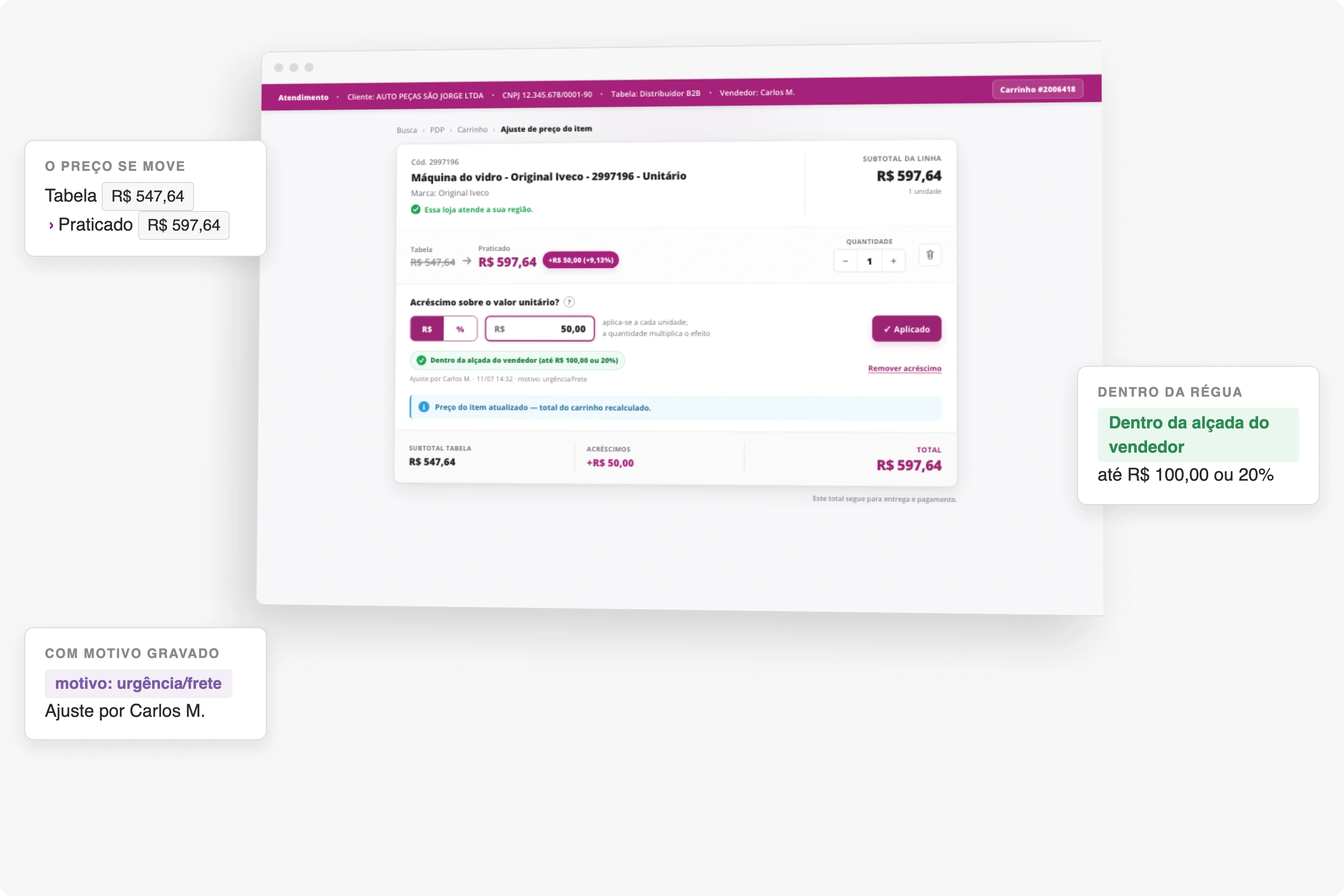
The cart is the table, and the rule sits at it
List price and practised price side by side, the markup in both currency and percentage, the seller's ceiling spelled out, and the record of who adjusted it, when and…
- The price moves in front of the sellerList and practised prices sit side by side, with the markup shown in currency and percentage at once.
- The ceiling is spelled outThe confirmation states the limit as a number, so the seller knows where they stand before needing approval.
- Reason is mandatoryAuthor, timestamp and reason stay on the line item itself, giving a trail without demanding a report later.
List price and practised price side by side, the markup in both currency and percentage, the seller's ceiling spelled out, and the record of who adjusted it, when and why.
This is Governed Negotiation inside a single line item: the price genuinely moves, and what holds it is not an audit afterwards but a ceiling declared at the moment, with a mandatory reason. The rule does not prevent negotiation — it lets negotiation happen without turning into a counter-side concession.
Why it isn't e-commerce
E-commerce is the front end, the storefront that records a fixed price. CWS Platform is the infrastructure beneath it: a B2B Commerce Platform for Governed Negotiation. It doesn't swap B2B negotiation for a rigid checkout, it digitizes the entire negotiation, with the company's rules built in.
The freedom to negotiate, with every concession auditable
Governing the negotiation isn't about straitjacketing it. It's about letting the rep, or the AI agent, move within rails the company defines and that record every decision. Four mechanisms make this concrete:
Approval Workflows
Approval limits: what passes straight through and what escalates to a one-click confirmation.
Pre-Submission Guardrails
Locks before submission and prevents the order that would be born dead (Dead-on-Arrival).
Discount Stacking Prevention
Stops the stacking of discounts that erodes margin without anyone noticing.
Reason Codes
Every concession carries its why. Margin becomes something auditable, not a mystery at month's end.
Why the platform resembles a risk desk
CWS Platform did not start as e-commerce. It started from an observation its founder made while working as a trader at an investment bank: if there is software to transact currency, equities and energy, there would be software to transact any product, and especially the ones that behave like commodities, from tyres to grain, from spare parts to chemical inputs. The platform was built on that logic from the outset, in production since 2013 and already multi-warehouse, with the catalogue held separately from stock.
It is why governance here does not take the shape of an approval queue bolted on afterwards. On a trading desk the limit is not a step in the process, it is the condition of operating: whoever negotiates moves fast because the system already knows how far they may go. The Commerce Rules Engine is that same idea applied to product, and the seller is the one operating under it.
The entry spectrum
Almost nobody starts by negotiating. Adoption tends to climb a ladder, and each rung creates the need for the next, which is what matters to a decision-maker: you can enter at the first level with no margin risk and reach the last without changing platforms along the way.
- 1
Classic portal
Catalogue and checkout, with pricing by profile, and no active seller in the journey.
The operation notices that the large order still arrives by phone.
- 2
Seller present
The same portal, now with the seller visible: name, photo, a conversation available. They help, but do not yet negotiate.
The operation wants to give the seller real autonomy, without opening up the margin.
- 3
Governed negotiation
Shared cart, approval thresholds, mandatory justification. The seller negotiates within rails, and every concession is recorded.
The operation wants to scale without hiring in the same proportion.
- 4
Trading with AI
Agents operating under the same rules engine that constrains the human, with replenishment and enrichment anticipating demand.
It is the state in which negotiation governance applies to person and agent without distinction.
The first two levels are B2B Digital Selling; from the third onwards, Assisted Selling.
Determinism plus AI, under the same rules
The deterministic Core executes the rules by code, at zero inference cost. The AI Agents interpret intent and orchestrate that Core via MCP (Model Context Protocol), under exactly the same rules as a human seller. If the AI goes down, negotiation continues. And the AI never hallucinates a business rule, because it doesn't invent a rule, it consumes one.
Not a lab concept
Governed Negotiation has been running in real production since 2013. At Tracbel, portal orders carry 10 extra points of operating margin, with 100% of the portfolio available (about 131k SKUs). At Imdepa, the B2B portal led to 3x more customers activated in three years, without growing the team in the same proportion.
See the 5 dimensions in detail
Price, delivery, payment, quantity and composition, one by one.
Frequently asked questions
Does governing the negotiation straitjacket the rep?
No. Governing means letting the rep, or the AI agent, move within rails the company defines and that record every decision (Approval Workflows, Reason Codes). It's the freedom to negotiate with every concession auditable, not a rigid checkout.
How is it different from a CPQ or a B2B e-commerce?
In e-commerce the storefront records a fixed price; in a CPQ, the quote is an isolated step. In Governed Negotiation, the five dimensions (price, delivery, payment, quantity and composition) move at the same time, in the same order, under the same Commerce Rules Engine.
Does the AI negotiate outside the same rails as the rep?
No. The AI Agents query the rules engine via MCP, under exactly the same rules as a human seller. They interpret intent and suggest; the rule itself is executed by the deterministic Core, and the human decides what gets escalated for approval.