AI Agent with Business Guardrails
Rules Auditor Agent
A mature B2B operation does not have one discount rule, it has hundreds, written at different times by different people. Then someone adds one more to unblock a large account, and it silently contradicts a rule from three years ago. Nobody notices that day. They notice at month-end close, when the margin does not add up and it is no longer possible to tell which of the two charged the wrong price.
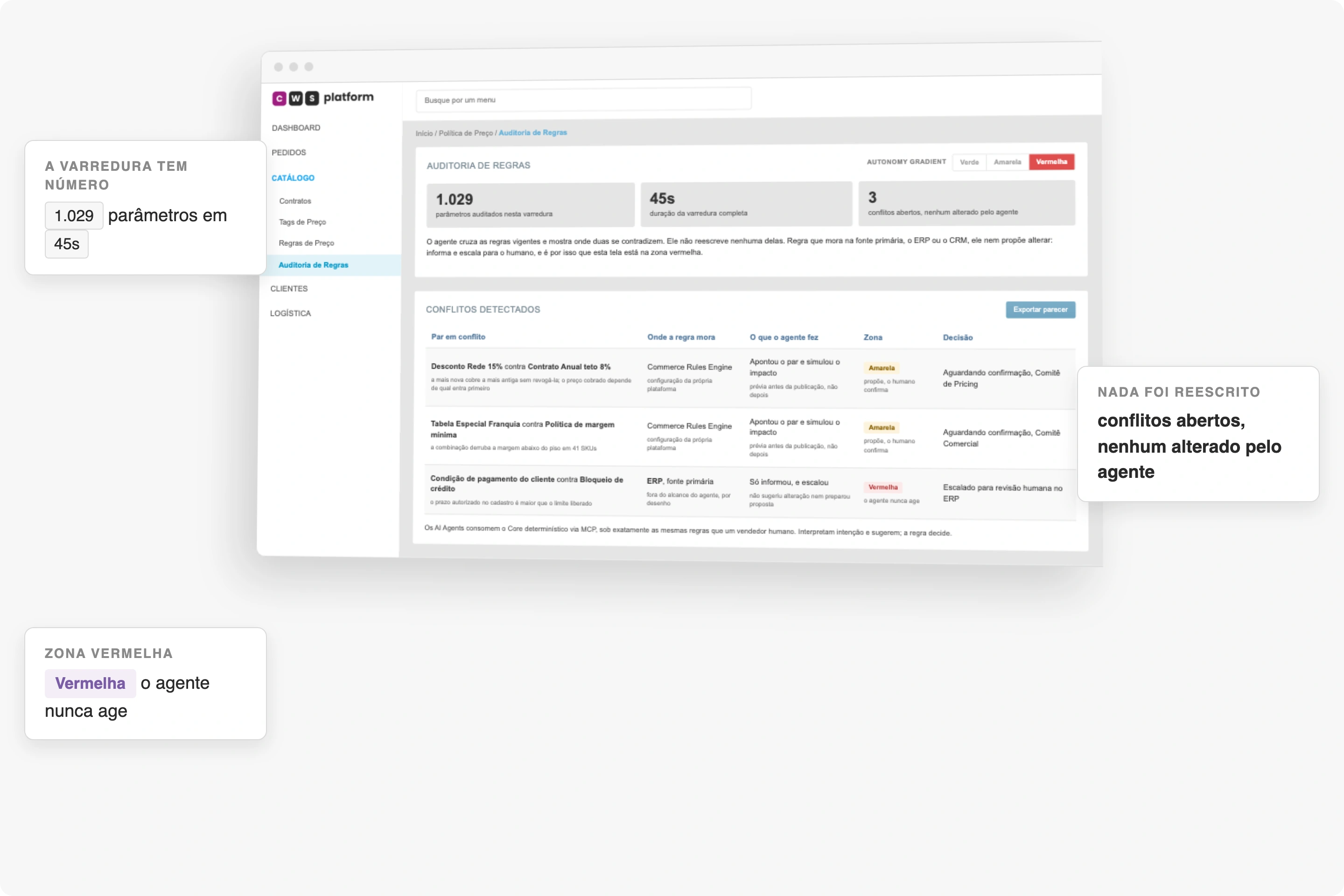
The conflict surfaces, and the rule stays standing
The sweep of 1,029 parameters in 45s and the three open conflicts, each with the contradicting pair, where the rule lives, and the Autonomy Gradient zone that decides…
- The audit carries numbers1,029 parameters swept in 45s, with the conflicts listed one by one instead of collapsed into a countless alert.
- Where the rule lives sets the zoneA conflict inside the platform's own configuration becomes a yellow-zone proposal; one sourced in the ERP falls red and only escalates.
- Zero changes by the agentThe column for what the agent did records pointing and simulating, and none of the conflicts was touched by it.
The sweep of 1,029 parameters in 45s and the three open conflicts, each with the contradicting pair, where the rule lives, and the Autonomy Gradient zone that decides who may act.
This is the Rules Auditor Agent doing what CWS Platform promises — and stopping where it promises to stop. It cross-checks the rules in force, shows the contradiction and rewrites none of them: the screen itself states the open conflicts were not altered by the agent. The pair whose rule lives in the ERP falls into the red zone, so it only informs and escalates. The piece shows the refusal, not just the capability.
What it is
The governance agent for the Commerce Rules Engine. It reads the 1,029 configurable parameters, cross-checks them against one another looking for contradiction, and shows the effect of a change before it reaches production. That is the difference between publishing a rule and publishing a rule knowing what it will do. The business still decides what the rules are; the agent is what can read all 1,029 at once, which no manager can.
The capability no one replicates
Conflict is not found by reading, it is found by cross-checking
Reading rule by rule finds typos, not contradictions. A contradiction is always a pair: two rules that are each correct on their own and that together produce a price nobody authorized. The agent cross-checks the parameters against each other instead of reviewing them one at a time, which is why auditing all 1,029 fits in 45 seconds rather than becoming a project. The full sweep starts to fit the frequency at which the operation changes its mind.
Impact preview comes before publishing, not after the damage
The expensive way to discover a rule's effect is to publish it. The agent simulates: with this rule active, these customers, these products and these conditions change price in this way. The manager decides by looking at the consequence rather than the intention. It is the same deterministic engine that will execute the rule afterwards, so preview and production do not diverge.
It architects above the source, and never rewrites the source
Auditing is half the work. The other half is building: the agent operates the Commerce Rules Engine APIs to assemble new pricing, campaign and promotion dynamics, looking for the optimal profitability point within what the configuration already allows. And there is a boundary it does not cross: the rule that lives in the primary sources, the ERP and the CRM, it does not alter. What it does is architect a layer of possibilities above those boundaries. On a base rule change, it suggests and the human decides, and that decision is recorded as a human decision.
Frequently asked questions
How long does it take to find out that two rules contradict each other?
A full sweep of the 1,029 configurable parameters of the Commerce Rules Engine takes about 45 seconds. What matters in that number is not the speed itself, it is the frequency it allows: an audit that fits in 45 seconds can run every time someone touches a rule, rather than once a quarter, which is when the contradiction has already charged its price.
How do I see the effect of a change before publishing it?
Through the impact preview. Before the rule reaches production, the agent projects what it does against the real base: which customers, which products and which conditions start pricing differently, and in which direction. The simulation runs on the same deterministic engine that would execute the rule afterwards, so what shows up in the preview is what the operation will do, not a parallel estimate.
Does it audit a parameter nobody documented?
Yes, and that is the most common case. The agent reads the configuration as it is, not as someone wrote that it should be. A parameter created in a hurry two years ago, with no owner and no record, enters the sweep along with everything else. That is the difference between auditing the documentation and auditing the system.