Industry solution · Auto parts
Hundreds of thousands of SKUs, and margin walking out the door with every order.
In the aftermarket, the pain is volume: fitment by vehicle, price by customer and region, reverse freight, returns and warranty, and the end-of-month reconciliation with the automaker. Every order carries a transaction cost that eats into margin before the part even leaves the warehouse. CWS Platform digitizes the decision, not just the channel, without taking the counter off the stage.
Target profile
R$ 100M to R$ 1.5B in revenue, 3 to 30 branches, mixed channel (independent workshops, chains and fleets).
Core pain
Exploding SKU count (200,000 or more), price by customer and region, reverse freight, returns and warranty, reconciliation with the automaker.
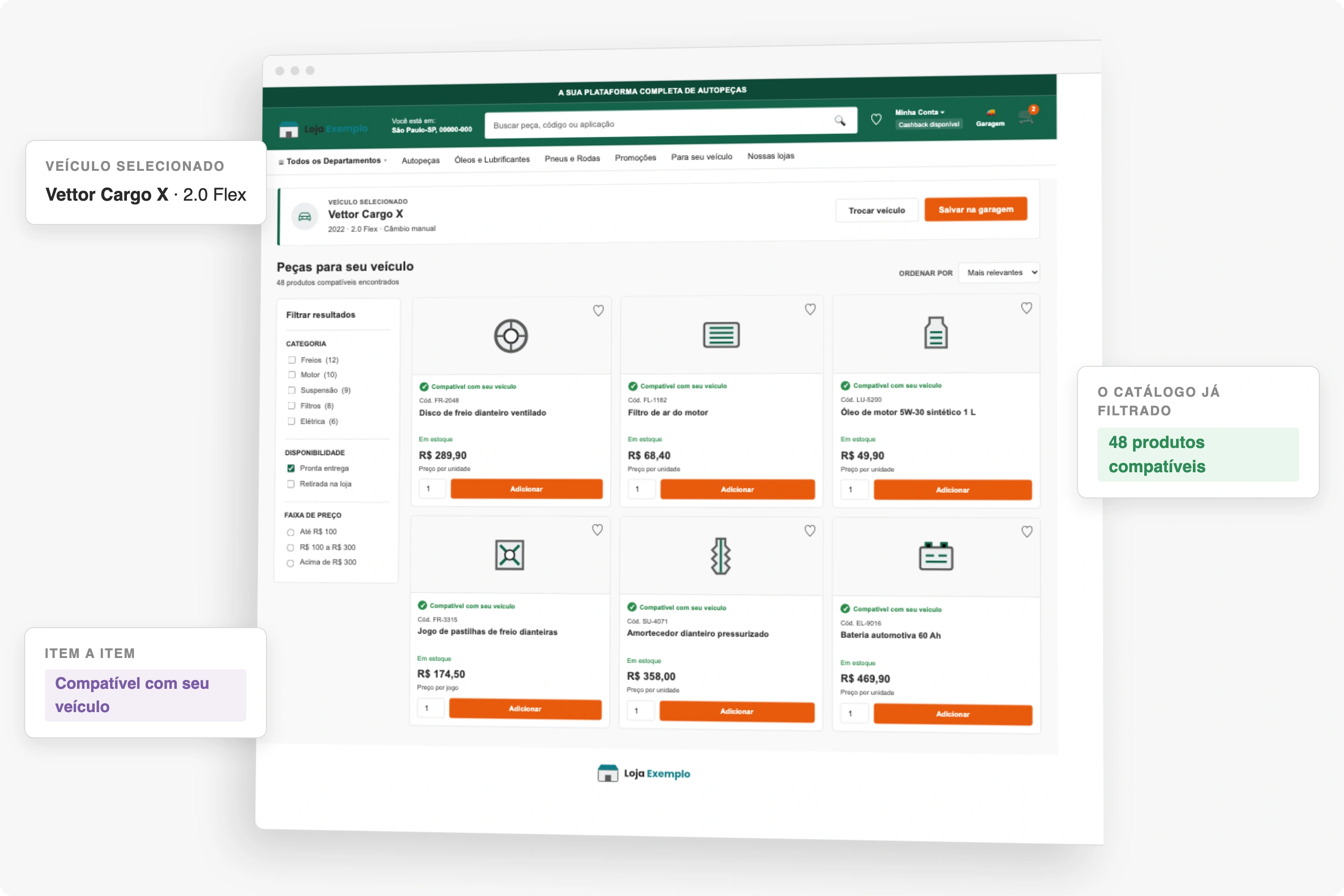
The part that fits this car, and only that one
The catalog after the vehicle is chosen: 48 compatible products, with the compatibility mark repeated on every part in the list.
- The vehicle filters the catalogChosen once, the vehicle holds for the whole session, including the lists that come later.
- 48 that fit, not 4,800 resultsThe list starts out narrowed to what fits, instead of returning everything and pushing the checking onto the buyer.
- Compatibility marked on the partEvery item repeats the compatible badge: the information lives on the product, not only in the filter that produced the list.
Vehicle compatibility is the signature of the auto parts vertical — it is what separates the platform from a generic catalog with a search box. The screen shows the filter already applied, not the promise that it exists.
What changes
The counter stays for those who prefer the phone. CWS Platform covers after-hours and reorders and, above all, changes how the part is found: the buyer searches by context and fitment, not just by code, and discovers items they didn't know existed. Price by customer and region, the taxes (IPI, ICMS, ST), freight and warranty are governed by rule and calculated in the same order (Contextual Pricing and Credit-First B2B Checkout). The rep moves out of the order-processor role and becomes a consultant, without the repair shop having to learn a new interface.
By decision-maker angle
CEO
The pain: The younger buyer already does everything digitally, and the sale I don't capture leaks to the gray market.
What changes: The digital aftermarket brings that demand into the official channel, with the physical counter preserved.
Commercial Director
The pain: Outside business hours the sale stops, and the reorder depends on someone remembering to call.
What changes: 24/7 coverage and predictable reorders, with the rep focused on the book of business and margin, not on keying in orders.
CFO
The pain: Revenue grows but margin disappears, eroded by the wrong price, untraceable concessions and the transaction cost per SKU.
What changes: Margin per SKU and turnover under governance, with traceable concessions (Reason Codes) and taxes calculated without error at checkout.
CIO
The pain: The fitment catalog, the ERP and the WMS don't talk to each other, and yet another digital initiative risks becoming a stalled project.
What changes: Orchestration over the ERP, integrated with the fitment catalog and inventory, in a parallel, auditable layer.
The capability no one replicates
Finding the part by context, not just by code
Search by vehicle and fitment that solves the order for someone who doesn't know the exact code and surfaces compatible items the customer wouldn't ask for on their own.
Price and taxes by customer, in the same order
Price by customer, region and profile governed by rule, with IPI, ICMS, ST, freight and pre-approved credit calculated in seconds at checkout, with no price list exposed to everyone.
The negotiation rails, in aftermarket vocabulary
In operation
Imdepa · auto parts distribution
3x more customers
153 customers activated in 3 years on the B2B portal, without growing the team in the same proportion.
The buyer builds an order of more than 250 SKUs and the platform calculates IPI, ICMS, tax substitution, freight and pre-approved credit in seconds. Credit risk is validated inside the flow, not checked in separate steps afterward.
"O valor real não é a receita que se vê nos números. É a operação que você consegue sustentar com o mesmo custo de estrutura. Crescemos 3x em clientes sem contratar 3x mais vendedores."
Paulo R. S. Pereira, Digital Sales Coordinator at Imdepa
Read the Imdepa case →Tracbel · Volvo dealer
+10 points of margin
on portal orders, with ~131k SKUs (100% of the portfolio) available. Named the best Volvo dealer in the world (Volvo Gold, 2025).
Read the Tracbel case →"Excelente, estávamos a quase 2 anos tentando implantar uma solução B2B, com a CWS, implantamos em 60 dias."
On the industry side, CWS Platform also powers manufacturers' own aftermarket channels. Pirelli, through Pirelli Conecta, the portal where the manufacturer orchestrates purchasing by its authorized resellers alongside selected distributors, and MTE-Thomson, an industry that created its own digital sales channel, are CWS Platform customers.
Frequently asked questions
My repair shop calls the counter. They won't use a portal.
The counter stays. Digital captures what's lost today — the after-hours order and the reorder. Those who prefer the phone stay on the phone, without taking the rep off the stage.
Each customer has their own negotiated price. I can't expose a price list.
And you don't. Price is by customer, region and profile, governed by rule (Contextual Pricing), and each one sees their own, with IPI, ICMS, ST and freight already calculated on the order.
What about reverse freight, returns and warranty? Does the order cover that?
Yes. Freight, including reverse, and the returns and warranty terms enter as a rule in the same order, instead of becoming a manual negotiation after the sale.