AI Agent with Business Guardrails
Sales Copilot
Ask a B2B rep with three hundred accounts who they plan to call tomorrow. The honest answer is usually: whoever called in. The portfolio is not worked by priority, it is worked by whoever makes noise, and the customer who quietly stopped buying is exactly the one nobody notices until the quarter closes.
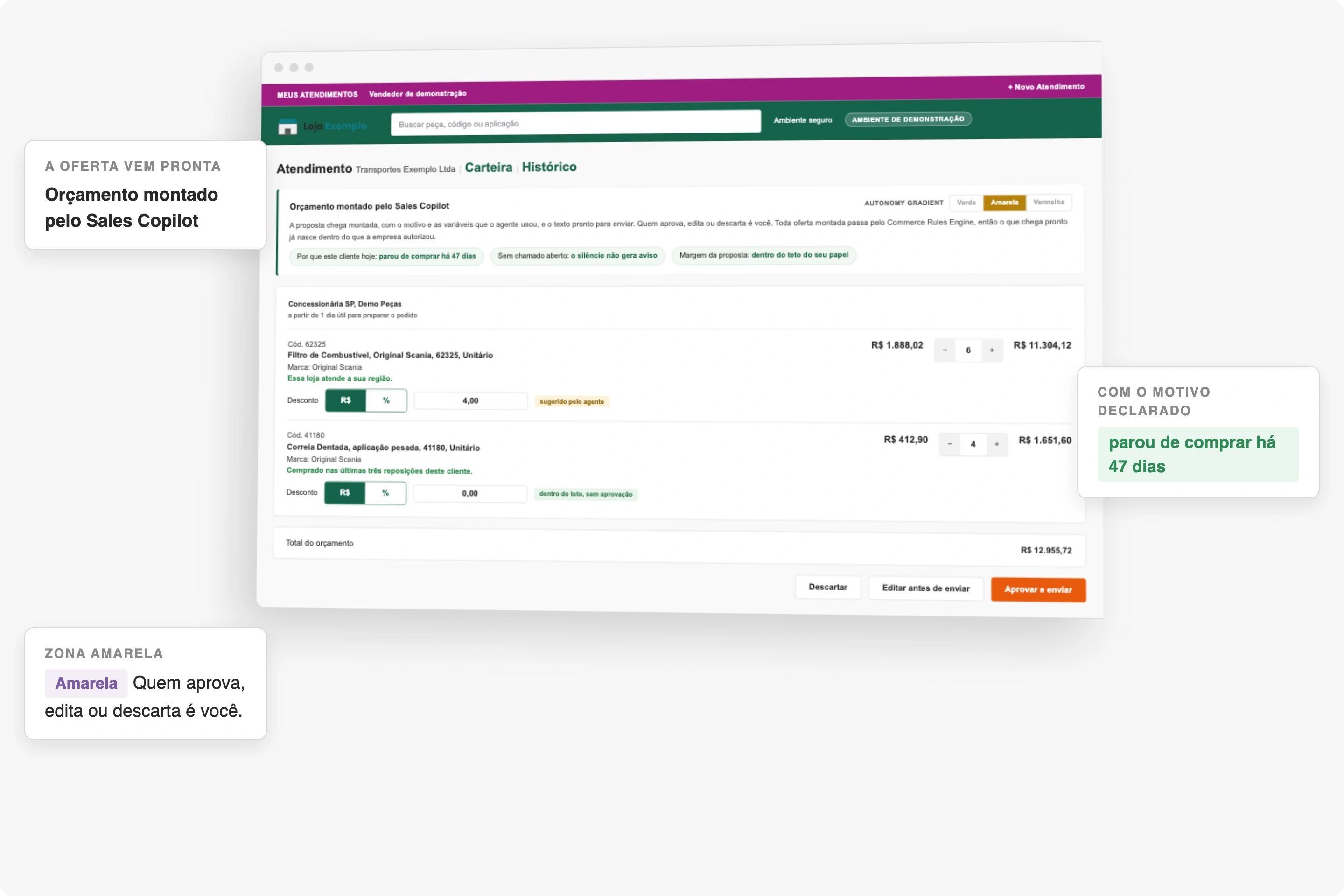
The proposal arrives assembled, and the call stays with the rep
The quote assembled by the agent with the reason to prioritise this customer today, the suggested discount item by item and the total, with discard, edit and approve…
- The reason travels with itThe proposal states why this customer today: they stopped buying 47 days ago and the silence raised no flag of its own.
- The discount is suggested, not appliedEach line shows the percentage the agent suggested and whether it fits the cap, item by item, before anything is sent.
- Three exits, all humanDiscard, edit before sending and approve and send stay with the rep, which is exactly what makes the action yellow.
The quote assembled by the agent with the reason to prioritise this customer today, the suggested discount item by item and the total, with discard, edit and approve left to whoever is serving the account.
This is the Autonomy Gradient's yellow zone in actual use: the agent does the whole job of assembling and explaining, then stops precisely before sending. What it produced has already passed through the Commerce Rules Engine, so the finished offer is born inside what the company authorised, and the margin is declared as within the role's cap. The three buttons at the bottom are the proof that the last word is not the agent's.
What it is
The agent that runs on the Assisted Selling Platform as the salesperson's copilot. It ranks the portfolio by purchase propensity, flags when an account goes inactive and when a negotiation starts leaking margin, assembles quotes automatically and suggests what makes sense to offer alongside. It is not a report the rep opens at the start of the month. It is the day's queue, rebuilt whenever the data moves.
The capability no one replicates
It orders the portfolio, and the order comes with a reason
A ranking without justification is a guess with a nice interface. Every position in the queue carries the why: this account used to buy every fortnight and stopped, this one is due to restock the item it always takes, this last negotiation closed below that customer's usual margin. The rep does not have to trust the score, they read the reason and decide whether they agree. That is what makes the suggestion accepted or dismissed on the merits, rather than obeyed blindly.
The margin alert arrives during the negotiation, not at closing
Margin leakage is almost never one bad decision, it is the sum of many defensible ones. Each discount fits the rule on its own; the combination does not fit the result. The agent follows the negotiation while it is happening and warns when the composition starts drifting from that customer's or that mix's pattern. Arriving before the acceptance is the difference between fixing and explaining.
The offer arrives ready, and the rep approves it
The inversion the agent proposes is this: instead of the rep starting from scratch and building the proposal, the proposal arrives built and they decide what to do with it. The quote comes with the reason, with the variables the agent used and with the message ready to send. The rep approves, edits or discards. It is worth saying what this is not: it is not the agent selling in the rep's place. What it gives back is time, and that time returns to the part of selling where the rep is irreplaceable, which is the hard conversation, the exception and the relationship. Every assembled offer passes through the Commerce Rules Engine, so what arrives ready is already inside what the company authorized.
Frequently asked questions
How does it decide which customer the rep should call first?
By purchase propensity, computed over that portfolio's own history: reorder rhythm, items the customer always restocks, time since the last order, and deviation from their usual pattern. The queue arrives with the reason written next to each position, and the rep is free to disagree. The order is an informed suggestion, not a mandatory queue.
Does the quote it assembles already fall within what the rep can approve?
Yes. The quote is assembled by consulting the Commerce Rules Engine, the same engine that validates what the rep does by hand, so price, discount and terms already come out within that rep's limit. When the requested composition goes past that limit, the quote is not silently blocked: it escalates for approval with the request on record, exactly as it would if the rep had assembled everything manually.
Does this become one more screen for the rep to open?
The agent runs inside the Assisted Selling Platform, which is already where the rep builds quotes and negotiates. The portfolio queue, the margin alert and the quote appear in the flow where the work already happens. A productivity tool that requires opening yet another system usually costs more attention than it gives back, which is why this agent has no screen of its own.