Deterministic module
Distributed Inventory (Inventory Hub)
Selling what you do not have costs cancellations and trust. Hiding what you do have costs the whole sale. A multi-warehouse operation with balances out of sync across channels does both on the same day, and the sales rep ends up checking stock by phone before promising a date.
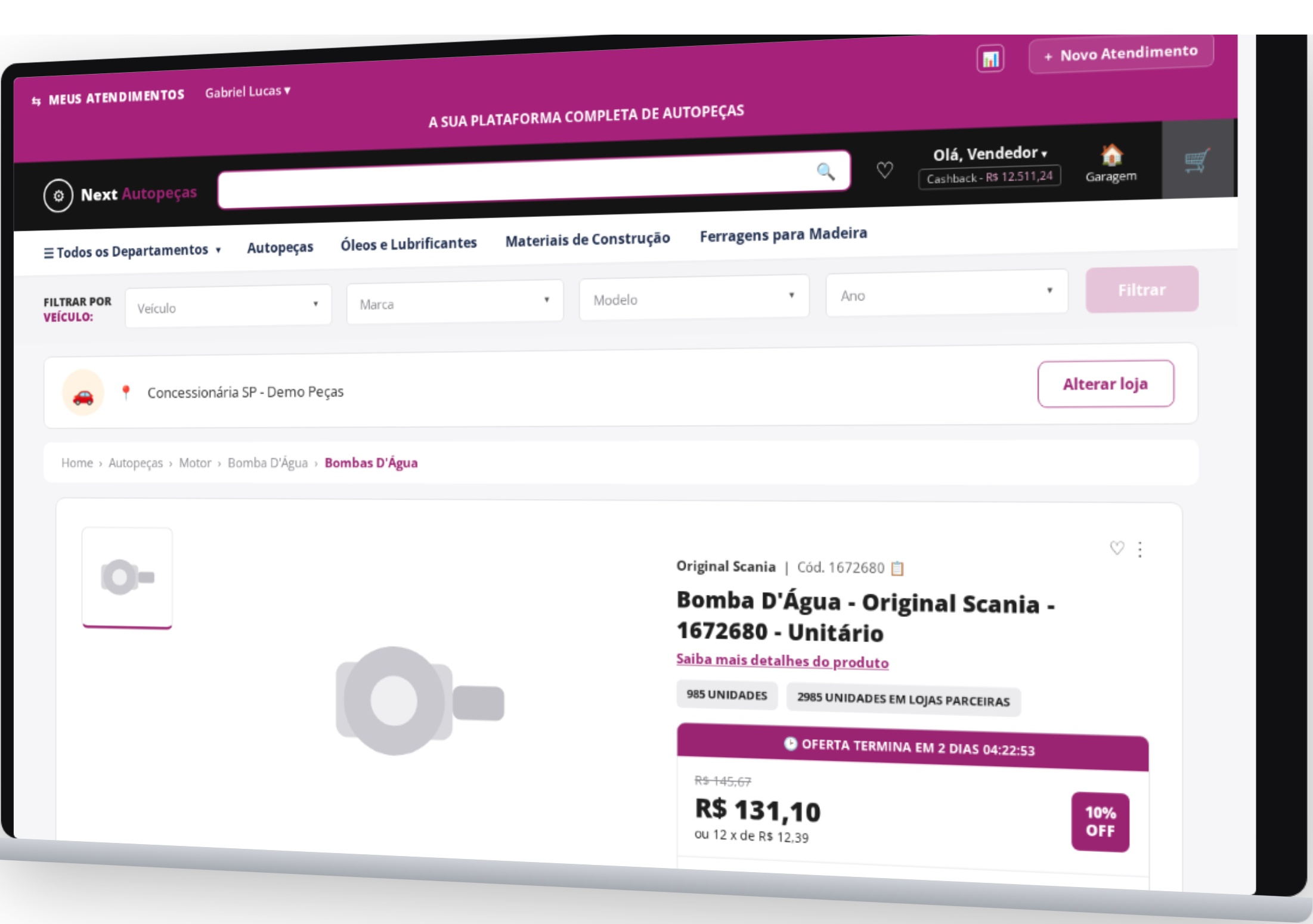
Loja de demonstração: os produtos, valores e quantidades exibidos pertencem a um ambiente demo.
Estoque da rede disponível ao vendedor
Página de produto no atendimento da loja de demonstração.
- Estoque próprio e parceiroa disponibilidade da loja e da rede aparece na mesma página de produto.
- Loja selecionadao contexto da unidade atendida permanece visível e pode ser alterado.
No topo aparecem o cashback do cliente e a loja selecionada. A disponibilidade indica 985 unidades e outras 2985 unidades em lojas parceiras. A página também exibe uma oferta com prazo, preço de e por, parcelamento e desconto.
O Inventory Hub transforma estoques físicos e lógicos em disponibilidade comercial para o atendimento. Esta tela entra aqui porque prova que a CWS Platform não opera como uma vitrine isolada, ela apresenta ao vendedor o estoque da loja e da rede no ponto em que a venda acontece.
What it is
The module that answers a single question, and answers it the same way on every channel: where is this item, and can it be sold to this customer. It manages multiple warehouses per SKU, with physical and logical balances, and it is the source of availability that the portal, the sales rep and the AI Agents all consult. Multi-inventory has been native since 2013, not an adaptation bolted on later to a B2C-origin platform.
The capability nobody replicates
An idempotent update key
Balance updates are identified, not accumulated. Reprocessing the same batch duplicates nothing, so ERP integration can run at high frequency without building a reconciliation layer around it to repair what it breaks itself.
Availability derived, not declared
A set has no balance of its own: it is computed from its components, per warehouse. One item missing there, and the set leaves the shelf there. That is the difference between blocking at the sale and finding out at picking.
One SKU, five different balances
In B2B, "in stock" is not a boolean. The same SKU can be available to one customer and unavailable to another at the same instant, and that is a business rule, not an inconsistency. These are the balances the platform tells apart:
Physical
What is in the warehouse right now, per SKU and per stocking point.
Virtual
The logical balance of pre-sale and scheduled replenishment, sellable without being on the shelf.
Partner
Inventory from partner stores added to your own, in a priority order you define.
Segmented
A slice of the balance reserved for a customer segment, with its own order restrictions.
Region-restricted
The balance exists, but it is only sellable inside the area the store or seller covers.
In operation
Tracbel · Volvo dealer
100% of the portfolio available
about 131,000 SKUs visible in the portal (Tracbel, named best Volvo dealer in the world, Volvo Gold 2025).
The buyer began to see the entire catalog and to buy what they did not know existed. Publishing the whole portfolio is only possible when availability per warehouse is trustworthy item by item. There are operations running with 15 active distribution centers.
Read the Tracbel case →Frequently asked questions
Does the balance shown in the portal match the ERP, or is it always one step behind?
It matches, and the reason is that the inventory key is idempotent. Resending the same update neither double-counts nor corrupts the balance, so the integration can run at high frequency against the ERP without fear of duplication. Balances also arrive through the API, one by one or in batches, and through incremental spreadsheets for operations that have not integrated yet.
Can we offer an item that has not reached the warehouse yet?
Yes, through virtual stock. Alongside the physical balance there is a logical one, used for pre-sale and scheduled replenishment, and the offer stays separate from what is on the shelf today. It is how a distributor sells a future harvest or contracted replenishment without promising what it does not have.
If one part of a kit runs out in a warehouse, does the kit stay on sale there?
No. Kit availability is derived from its components: if any of them becomes unavailable in that warehouse, the kit offer is suspended in that warehouse, and only there. The other warehouses keep selling normally, because the decision is made per stocking point rather than globally.