Deterministic module
Assisted Selling Platform (Sales Hub)
Your team negotiates over WhatsApp, with no authority limits, no ranking, no customer context, and you cannot see what was granted. The Assisted Selling Platform is the sales rep's digital negotiation table, where rep and buyer stay in the same cart, in real time, under automatic governance.
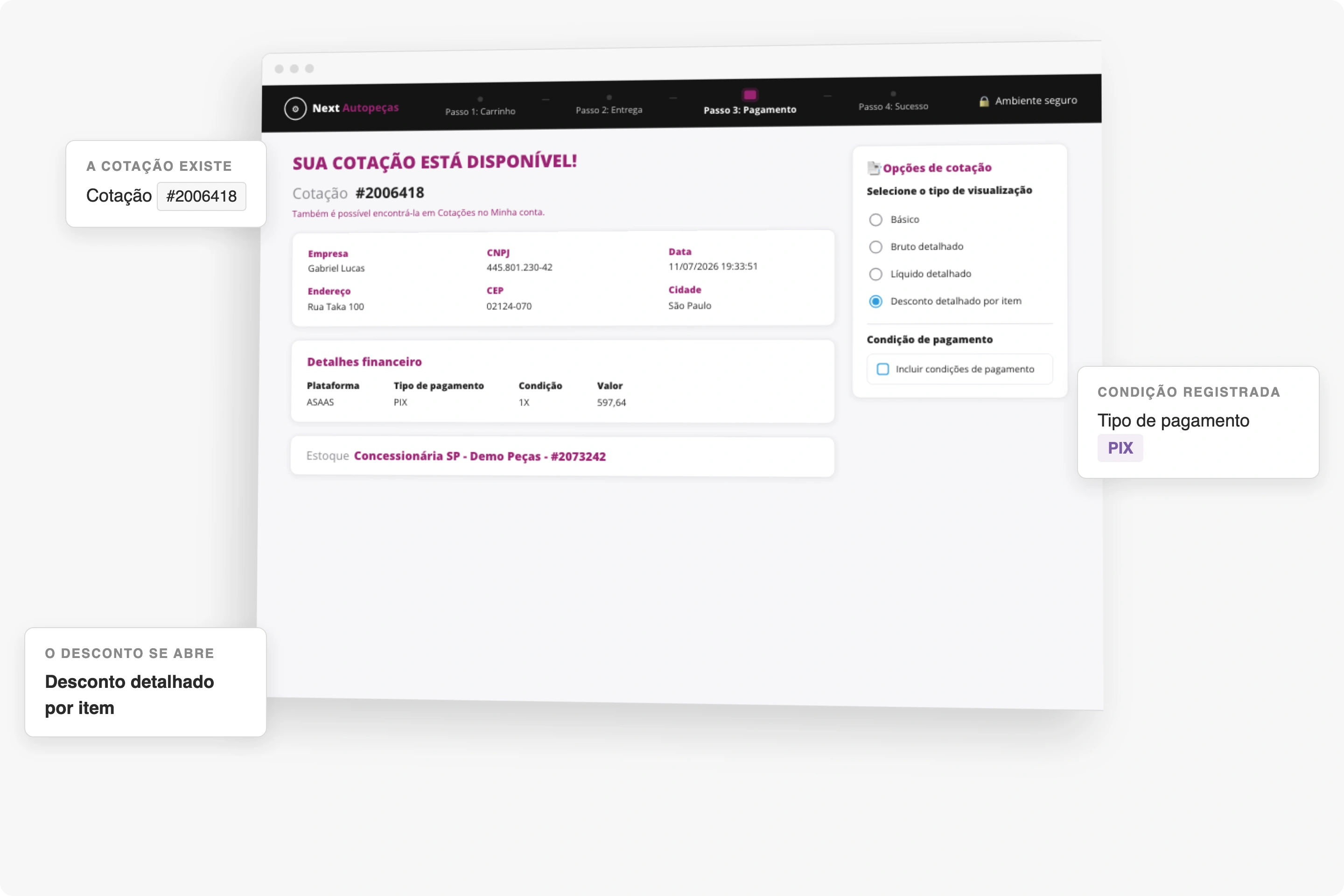
The seller's negotiation comes out as a document
The generated quote with the company, the tax ID, the payment condition and the warehouse that serves it, plus the options that break the discount down item by item.
- Customer and terms on one pageCompany, tax ID, payment type and condition come out together, rather than depending on what the seller remembers to write down.
- The source warehouse is namedThe quote states which centre the part ships from, so lead time and availability stop being a vague promise.
- Discount item by itemThe detailed view opens what was granted line by line, which is what makes the concession auditable later.
This is what the sales desk delivers at the end — not a screenshot of a chat, but a document carrying customer, condition and stock origin. The per-item discount view is the proof that what was granted stays auditable instead of vanishing at closing.
What it is
The interface of the digital sales force, with more than 140 features. Rep and buyer share a Real-Time Shared Cart and negotiate price, terms, payment and quantity under the Approval Workflows and the credit applied by the Commerce Rules Engine. The Customer Intelligence Panel loads history, credit and buyer context in one click. The sales rep evolves through four profiles: attendant, facilitator, governed negotiator and AI consultant, supported by the Sales Copilot.
The capability no one replicates
The shared journey
Rep and buyer in the same cart, with governance applied in real time. In the market, the sales rep (in the CRM) and the buyer's checkout stay separate.
Dead-End Negotiation Prevention
The system avoids time lost on an unviable proposal, blocking beforehand whatever would not pass the authority limit.
Where the sales rep operates the five dimensions
The operations that close here and would not close elsewhere5
- Barter
- In agribusiness, grain is the currency. Pricing accounts for harvest, crop, index currency, CIF or FOB and rural taxation, and the grain balance is managed per customer.
- Order split
- The seller splits delivery across addresses and methods within a single order, with freight, tax and approval thresholds independent per fraction.
- ByRequest
- A stockout becomes an opportunity rather than an error. An item without price or balance stays in the catalogue and opens demand capture, instead of vanishing and taking the customer with it.
- Multidimensional search
- Search by manufacturer part code, partner part code, technical attribute and commercial context. In a large technical catalogue, it is the difference between finding an item in seconds and finding it in minutes.
- Off-channel service
- Demand that arrived by message or phone is brought inside the platform: the seller builds the cart, shares the link, and the negotiation gains governance and an audit trail.
The account base belongs to the seller, and the system enforces it3
Without this, the portal becomes a threat to commission and the sales force undermines it. The architecture resolves the conflict, instead of asking people to rise above it.
- Seller and selling entity are distinct
- The seller is the authenticated person who serves the customer. The selling entity is the legal entity that holds stock, tax liability and master data. The hierarchy runs from seller down to SKU, through selling entity, warehouse and balance, and it is what determines what can be promised.
- No stepping on each other's accounts
- Sensitive data for customers outside a seller's base is inaccessible, and conversations are segregated per seller. Whoever serves the account knows the base is theirs.
- Customer Intelligence Panel
- On identifying the customer, the seller receives financial health, available credit, commercial terms, cluster and history. It avoids the waste of building a proposal for someone who would be blocked at checkout.
In operation
Imdepa · auto parts distribution
3x more customers
153 customers activated in 3 years, without growing the team at the same rate.
"The real value is not the revenue you see in the numbers. It is the operation you can sustain at the same structural cost. We grew 3x in customers without hiring 3x more sales reps."
Paulo R. S. Pereira, Digital Sales Coordinator at Imdepa
Read the Imdepa case →Frequently asked questions
What is the Real-Time Shared Cart?
It is the table of the Assisted Selling Platform (Sales Hub): sales rep and buyer in the same cart, at the same time, with context and authority applied right there. There are operations that run 100% through it.
Does the Sales Hub have a discount rule of its own?
No. The module applies the Approval Workflows of the Commerce Rules Engine, with authority by profile and a mandatory Reason Code, so every concession has an author and a justification.
What does the Customer Intelligence Panel show?
History, credit and customer context in one click, and access by portfolio ensures each rep sees only their own base.