Deterministic module
Marketplace Management Platform (Marketplace Center)
Opening the portal to third parties looks like a technology problem, and it isn't. The hard part starts afterwards: two sellers list the same part and the buyer sees two prices under your brand, one of them promises a region it cannot actually deliver to, and a third works out that closing the deal off-platform is cheaper. Without rules, the ecosystem that was meant to widen the assortment erodes both price and trust.
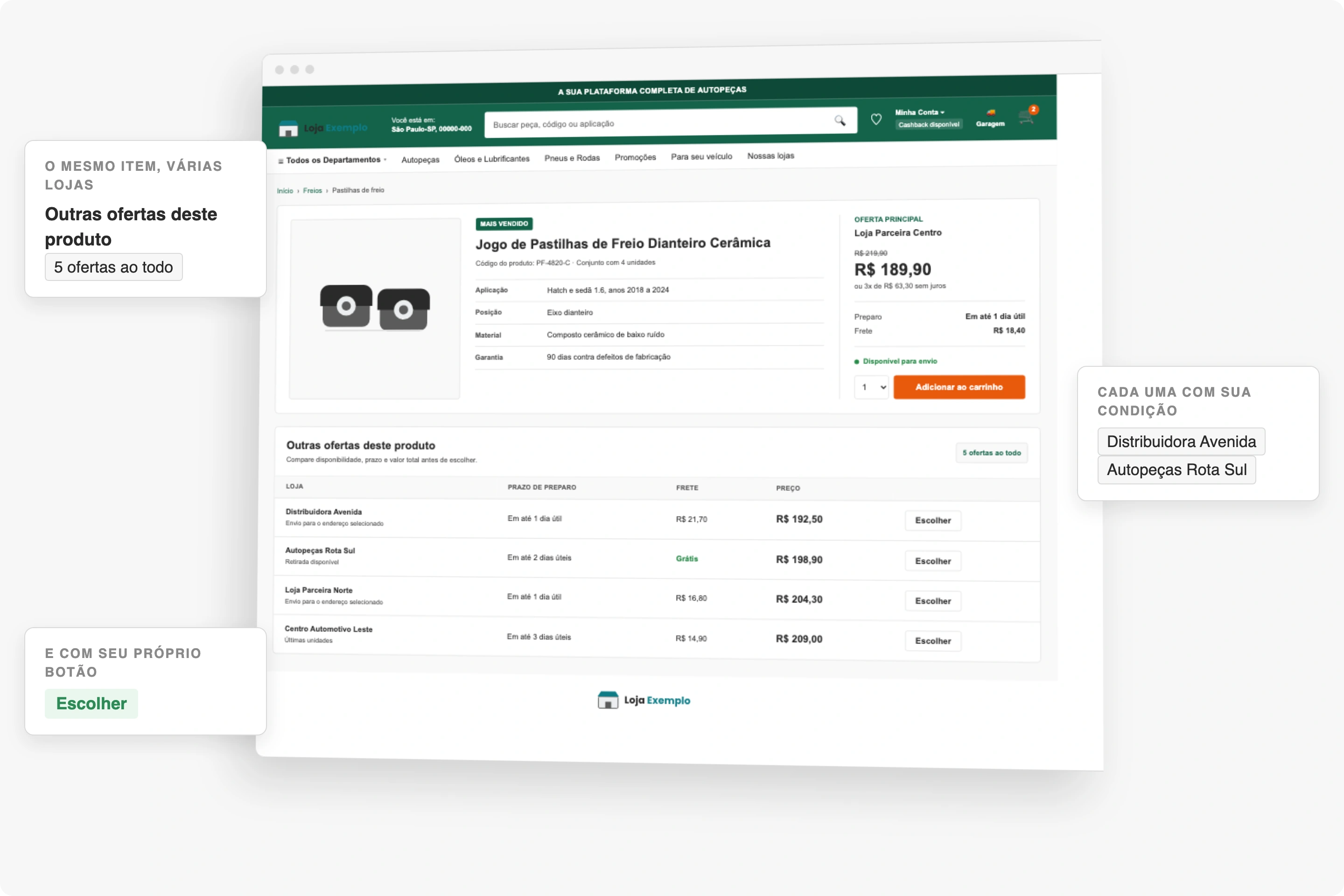
The whole network competes for the same item, in plain sight
The main offer and, below it, the other offers for the same product: one row per network store, with preparation time, freight, final price and its own button.
- Comparison instead of repetitionThe five offers for one SKU sit in a single table rather than as five loose search results.
- Freight joins the mathsLead time and freight appear per store, so the lowest sticker price cannot pass for cheapest without being it.
- Each store closes its own saleEvery row carries its own choose button, and store pickup shows up as a condition of the store offering it.
Multi-seller usually degrades into a repeated catalog, where the same item shows up five times and the buyer chooses blind. Here the comparison is the screen itself: the five offers sit in one table with lead time, freight and final price side by side, and the page asks in words that total value be compared before choosing. Freight counts, because the cheapest offer is not always the one that arrives cheapest.
What it is
The module that governs the ecosystem of sellers. It answers the questions of whoever runs the network, not those of someone tracking a single order: who is allowed to sell here, what each party may expose, how offers compete with one another, which region each store serves, and how the value of a sale divides between the parties. On the merchant's side, the same machinery is the store channel, with catalog, price, inventory and orders isolated per seller. On the operator's side, it is the console where ecosystem policy becomes a parameter. What happens to an order once it exists belongs to the Order Management System.
The capability no one replicates
The ecosystem either competes or complements, and that is a configured decision
A marketplace runs on combined stores, in a competitive regime, with a featured offer and the remaining offers alongside it. Or it runs on partner stores, in a complementary regime, and then the offer comparison disappears from the entire portal: when the main store's stock runs out, the partner supplies on the same product page, in the priority order you parameterized. These are two different market designs, and a marketplace runs on one or the other. Switching regimes is not a new project, it is configuration.
The storefront governance is the same one that decides price, inventory and credit
In a marketplace assembled from different vendors' parts, the exposure rule lives in one place and the commercial rule in another, and they drift apart. Here both come out of the Commerce Rules Engine (CDL Workspace), so the offer that wins the storefront is already consistent with that customer's price, that warehouse's balance, and the region that store actually serves. A seller cannot advertise what the operator's rule did not authorize, and the operator does not have to audit afterwards what the system never allowed to happen.
What the operator decides, and where each decision lands
Governing a network of sellers is less rhetoric and more a set of explicit levers. What follows are the four that define how the ecosystem behaves, and none of them calls for a new software release. They are parameters, and the platform has 1,029 configurable parameters in total.
- Who gets in Store invitation and seller acceptance, with sent and received requests on each side, self-service signup from the portal itself for those applying to sell, and a link that only completes once the split contract is configured.
- Who shows up Featured-offer criteria by lowest price or nearest seller, different display for identified or anonymous visitors with or without location, options for suggested price and for price only after login, and exclusivity on items held in your own stock.
- Who serves where Postal-code range restrictions store by store, with a nickname per region, bulk import of nationwide ranges, and deliberate overlap when more than one store should serve the same area.
- Who gets what A marketplace-to-store contract with a percentage per party, who bears the fees, the primary recipient, whether freight is included in the charge, custody until delivery, and a change history for every contract.
A note on direction rather than on screens: a marketplace is rarely the goal of the company that arrives asking for one. The path that works starts by digitizing the operation that already exists, with the network of customers, sales reps and suppliers the company already has, and the ecosystem shows up as a consequence of that. A marketplace without participant buy-in, without reliable product and lead-time data, without liquidity on both sides and without clear governance is not a late software project — it is a project without the conditions to exist.
In operation
Tracbel · Volvo dealer
a 40-unit network
on a single portal, with roughly R$ 235 million accumulated since launch (Tracbel, named the world's best Volvo dealer, Volvo Gold 2025).
The same machinery that governs third-party sellers governs a network of owned units: each branch is a distinct product origin, with its own service area and its own stock, and the buyer still sees a single portal. It is ecosystem governance applied inward, before it is ever applied outward.
Read the Tracbel case →Frequently asked questions
What stops a seller from taking our customer off the platform?
The relationship rule belongs to the marketplace operator, and it is configured. A seller sees the customer records needed to invoice and ship, because without them there is no tax document and no delivery, and the operator decides whether direct contact beyond that is allowed, restricted, or centralized in a single support desk acting on the seller's behalf. Every order carries both the store it originated in and the store fulfilling it, so who sold what, in which environment, stays recorded and auditable.
If we hold the item in stock, do we have to show a competitor's offer next to ours?
No. There is an exclusivity setting that suppresses other sellers' offers on the products you keep in stock, and it applies across your whole portfolio at once. If your operation is not built on competition, the decision comes earlier: in the partner-store model the offer comparison simply does not exist on the portal, and the partner comes in as stock backup rather than a rival on the same product page.
How does each seller get paid, and what holds the payout until delivery?
The split comes from a configured contract between marketplace and store, not from manual reconciliation: each party's percentage, who bears the fees, who is the primary recipient, and whether the charge applies to the order with or without freight. On top of that contract sits custody, which holds the seller's amount until the order reaches delivered status. That is why governing the money depends on the status discipline of the Order Management System: a seller who does not update the order does not release their own payout.