Deterministic module
Commerce Rules Engine (CDL Workspace)
Your discount, credit and tax rules live scattered across a spreadsheet, the ERP and the sales rep's head. And now AI threatens to hallucinate a price on top of that. The Commerce Rules Engine turns those rules into an executable constitution, applied the same way every time, that the AI respects because it queries, it does not invent.
Loja de demonstração: Os dados exibidos pertencem a um ambiente de demonstração.
Regras viram cotação verificável
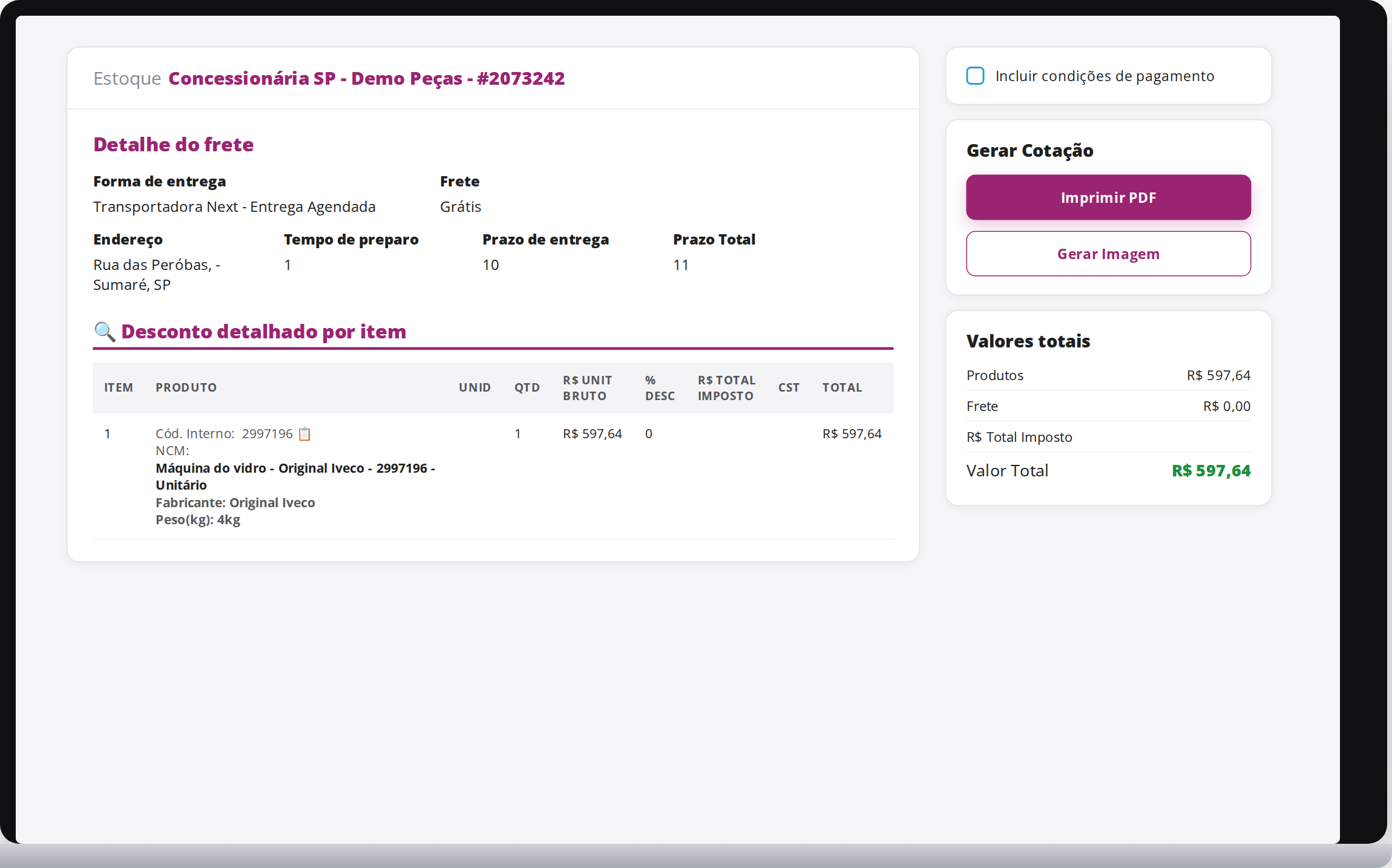
Detalhe de uma cotação na loja de demonstração, com a Transportadora Next, tempo de preparo de 1 dia, prazo de entrega de 10 dias e prazo total de 11 dias úteis.
- Prazo compostoPreparo, entrega e prazo total aparecem de forma discriminada.
- Cotação pronta para envioAs ações permitem imprimir em PDF ou gerar uma imagem.
A tela também apresenta a tabela do item com quantidade e valor, os valores totais e as ações Imprimir PDF e Gerar Imagem.
O Commerce Rules Engine (CDL) não termina na configuração dos parâmetros. Ele transforma regras em uma cotação que vendedor e comprador conseguem conferir e compartilhar. Esta tela está aqui porque mostra o resultado operacional dessas regras, reduzindo consultas, conferências paralelas e retrabalho na transação.
What it is
The deterministic heart of the platform. It holds the business rules, approval limits, credit, tax compliance and agent permissions, as 1,029 configurable parameters that execute in code, at zero inference cost, and are exposed to the AI Agents via MCP (Model Context Protocol). The philosophy is configuration over code: every change requires a Reason Code and a comment.
The capability no one replicates
Governance by infrastructure
Approval Workflows by seniority, Pre-Submission Guardrails that block the unviable proposal before it reaches the manager, Discount Stacking Prevention and Reason Codes. The rule blocks on its own, it does not depend on a memo.
The answer to Shadow AI
AI in silos, with no audit trail, becomes governed and auditable AI: the agent queries the same engine in real time, under the Autonomy Gradient (green, yellow, red).
Where the market falls short: fixed-price platforms have no native discount authority by seniority; in the CRM model, the equivalent requires building CPQ, approval workflows and pricing rules separately and custom.
One engine, the five dimensions
It is the module that governs price, delivery, payment, quantity and composition, with the same mechanisms for human sales reps and for the AI Agents.
The way into the ecosystem, not only the rules engine5
This is what a single market term does not capture. The same environment that holds the rule also distributes access to it, and that is what lets an operation grow without scattering systems.
- Role-adaptive interface
- The same door serves distinct profiles. Whoever enters sees no function they cannot perform and no data outside their own scope, and the adaptation is functional, not cosmetic.
- Structural base of the Seller Center
- The seller manages warehouses, balances, lead times and order status in a view of the same central interface, with no separate login and no system of their own.
- Structural base of the Marketplace Center
- The administrator's view governs catalogue master data, approval thresholds, freight policy, commissioning and each seller's reach by geography, segment and catalogue.
- Chained enablement
- The administrator enables the seller, and the seller enables their own team. The operation grows without anyone distributing credentials for five systems to five teams.
- Support with governed access
- The support team enters the specific environment to resolve an issue, by authority level, with no login switching, no request for a local password and no credentials in circulation.
In operation
A distributor with millions of price rules and approval limits by seniority, today with no record of who granted which discount, now has every concession with an author and a justification. On integration, here is what customers say publicly:
"Excelente, estávamos a quase 2 anos tentando implantar uma solução B2B, com a CWS, implantamos em 60 dias."
Frequently asked questions
What governs negotiation on the CWS Platform?
The Commerce Rules Engine (CDL Workspace), with 1,029 configurable parameters. It is governance by infrastructure: the system automatically blocks whatever falls outside the Approval Workflows, without relying on instructing the sales rep or prompting the AI.
Is the rule written by the AI in the CDL Workspace?
No. The AI Agents query the engine via MCP, audit, detect conflicts and simulate impact, but never alter a rule directly. They suggest; the human decides.
How does it integrate with my ERP without becoming lock-in?
As an orchestration layer on top of the ERP, not a replacement, through APIs and webhooks. The ERP remains the vault; the Commerce Rules Engine is the commercial manager. Publicly associated integrations include SAP, TOTVS, Senior and Sankhya.