Industry solution · Fashion
The collection that doesn't move becomes dead capital, and no one sees it.
In wholesale fashion, the money gets stuck in the collection: the pre-sale happens in the book, the rep jots it on a clipboard, production follows the order, and whatever doesn't move becomes dead capital. Worse, the sell-out, what actually sold at the point of sale, is invisible to whoever produced it. CWS Platform keeps the showroom and the relationship that sell the collection, and covers what escapes: replenishment and the read on real turnover.
Target profile
R$ 80M to R$ 800M in revenue, own brand or multi-brand, a collection twice a year.
Core pain
Pre-sale in the book that turns into production, a rep with a clipboard, a stalled collection as dead capital, and invisible sell-out.
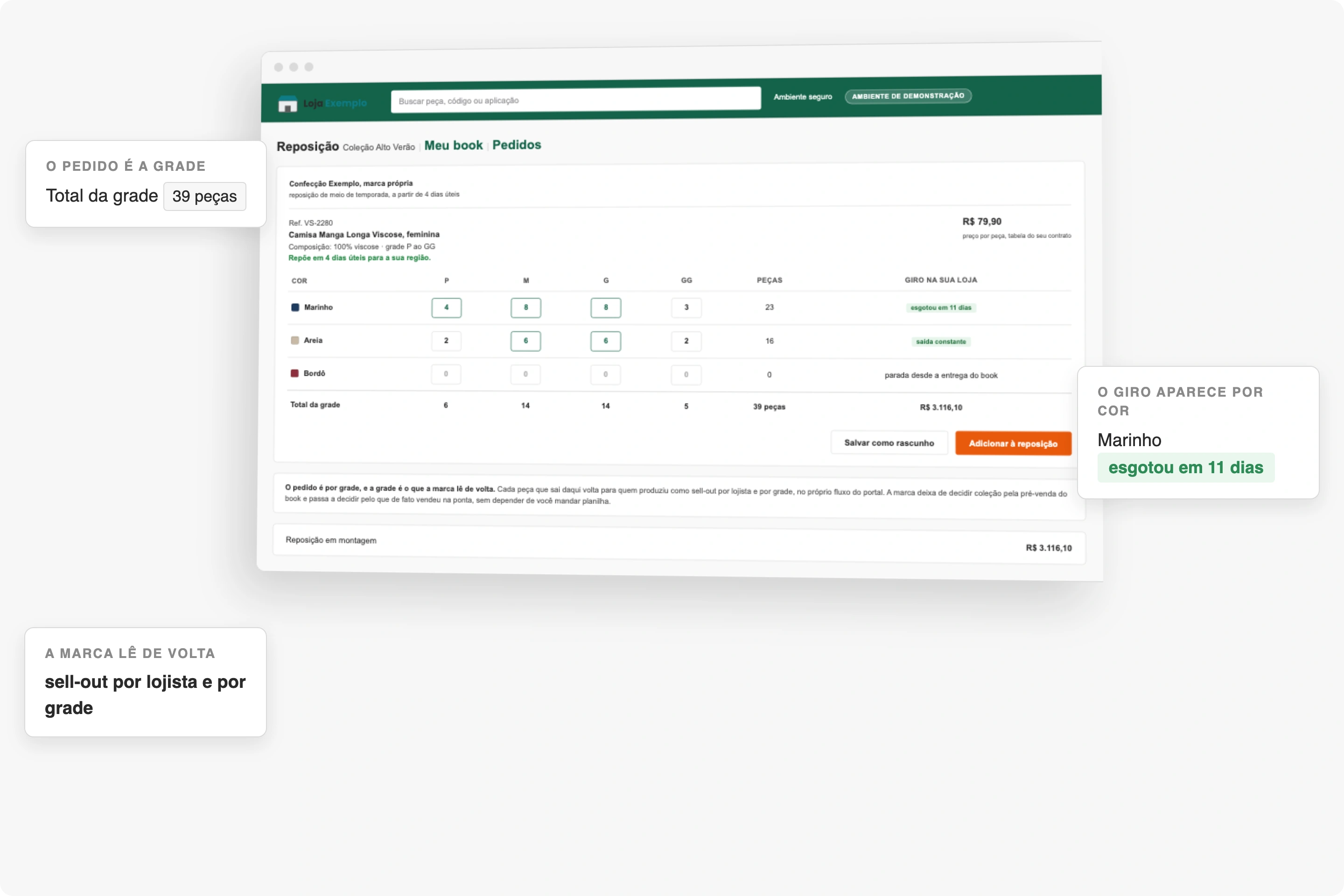
The order is placed by size grid, and the grid returns to whoever made it
The mid-season replenishment built by colour and size, with the quantity in each cell of the grid, how each colour has been selling, and the total in units and in value.
- The grid is the unitQuantities go in by colour and size in a single matrix, and the total comes out in units and in value with no second step.
- Sell-through sits beside the choiceEach colour shows how it moved in the store, from the one that sold out in 11 days to the one untouched since the book was delivered.
- Sell-out returns on its ownWhat ships from here goes back to the maker per retailer and per grid, inside the flow, without waiting on a spreadsheet.
Fashion does not buy units, it buys size grids, and a portal that ignores that forces the retailer to translate their own order into the system's format. Here the grid is the unit of purchase itself, with sell-through beside each colour so the decision happens on one screen. And the loop closes: what leaves comes back to whoever produced it as sell-out per retailer and per grid, inside the portal's own flow — so the brand plans the collection from what actually sold at the counter rather than from the pre-season book.
What changes
The showroom keeps selling the collection through the relationship. CWS Platform covers what escapes afterward: automatic, inventory-aware replenishment, and the read on sell-out by retailer and size grid, blind today. The book and the size grid become a governed order in a no-code retailer portal (Assisted Selling Platform and No-Code Storefront Builder), the retailer replenishes without friction, and the brand starts seeing real turnover at the point of sale. The stalled collection stops being a surprise on the balance sheet.
By decision-maker angle
CEO
The pain: I produce in the dark, without knowing what actually sold at the point of sale, and the stranded collection only shows up on the balance sheet.
What changes: Visible sell-out, with the brand seeing the point of sale and deciding the collection on data, not on a guess.
Commercial Director
The pain: The initial sell-in (book) closes in the showroom, but replenishment depends on the rep remembering each retailer.
What changes: Automatic replenishment on top of the book, with the rep focused on the relationship and the next collection.
CFO
The pain: Capital gets locked in a collection that doesn't turn, and the cost to serve the small replenishment order doesn't add up.
What changes: Collection turnover and dead capital under control, with low-ticket replenishment made viable at the same operating cost.
CIO
The pain: POS, ERP and production don't talk to each other, and sell-out dies in the retailer's spreadsheet.
What changes: From POS to ERP to production in a single flow, with sell-out captured and fed back into the collection decision.
The capability no one replicates
Inventory-aware automatic replenishment
Replenishment becomes a suggestion governed by stockout and turnover, with the AI in Autonomy Gradient (it proposes, the team confirms), so the retailer can replenish without depending on someone remembering.
Sell-out read by retailer and size grid
What actually sold at the point of sale, by retailer and by size grid, stops being invisible and feeds the collection decision, separating what turns from dead capital before the balance sheet.
The negotiation rails, in the vocabulary of the collection
In operation
In apparel wholesale, CWS Platform powers the Circuito de Compras (CDC), the wholesale mall for value retail in Brás, São Paulo. Built on CWS Platform technology, the CDC runs a portal that aggregates multiple banners and unifies the operation, already available and running for retailers, with catalog governance at the center. The same foundation powers MayaApp CDC, the white-label mobile app aimed at the small retailers of Brás and of Brazil, with international reach and a CWS Platform AI agent for catalog curation. It's the scale-without-mass thesis applied to fashion: keeping the relationship that sells and gaining digital reach without bloating the structure.
Frequently asked questions
Selling in the showroom is about relationships. A portal doesn't replace that.
And it shouldn't. The showroom and the book remain how the collection is sold. Digital covers what the showroom can't reach: mid-season replenishment and the read on sell-out.
Won't automatic replenishment just push the collection that's already stranded?
No. Replenishment is aware of inventory and turnover, and the AI proposes for the team to confirm (Autonomy Gradient). The goal is to replenish what sells, not to offload what stalled.
How will I see sell-out if the retailer doesn't report to me?
Sell-out is captured in the retailer portal's own flow, by retailer and by size grid, and comes back to the brand as a read on turnover, without depending on the retailer sending a spreadsheet.