Deterministic module
Contextual Pricing (Pricing Engine)
Your revenue grows and margin disappears, eroded by stacked discounts and by a price table that keeps up with neither contract nor region. Contextual Pricing treats price as the starting point of the negotiation, not as a fixed value, and protects margin by architecture.
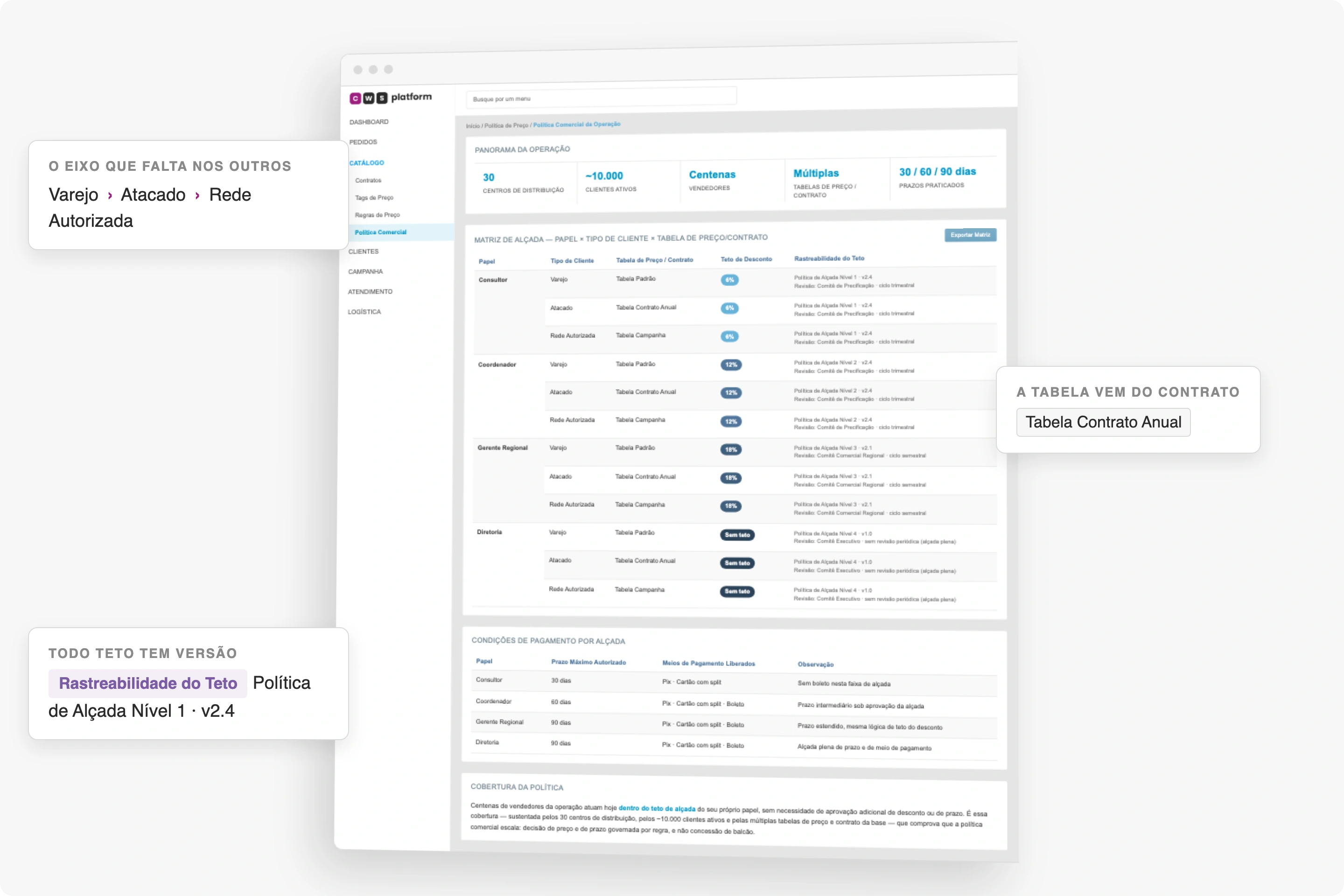
Price comes from the contract, not from a single table
The matrix crossing role, customer type and price table or contract, with the policy that authorises each ceiling shown alongside it, version and review cycle included.
- Three axes, not oneThe ceiling emerges from crossing the seller's role, the customer type and the standing price table or contract.
- Ceiling traceabilityEvery band names the policy and version that authorises it, so the rule has provenance instead of being a verbal agreement.
- Review with a dateThe review cycle is written on the row itself, which separates a living policy from a forgotten table.
This is the pricing engine shown as a rule rather than as a result. The same SKU shifts ceiling when the customer type or the standing contract changes, and the traceability column names which policy decided that and when it returns to committee. Derived pricing has provenance.
What it is
The engine that derives the price in milliseconds from multiple variables at once: the product, the source warehouse, the customer profile and the tax rule. Price types by identity apply wholesale or retail automatically at login, with support for future price lists, temporal validity and the best automatic coupon. In agribusiness, price is indexed to a commodity with a validity of minutes.
The capability no one replicates
Discount Stacking Prevention
The sales rep's manual discount automatically cancels the coupons, protecting margin by architecture and not by auditing afterward, always with a mandatory Reason Code.
Price is negotiable, not fixed
The price moves within Approval Workflows. No one treats stacking prevention as an architectural concept; in the market, B2B usually uses fixed tables per organization, with no native authority limits.
It governs the dimension that pays the bill
It operates under the Commerce Rules Engine (CDL Workspace): every pricing rule applies the same to the human sales rep and to the AI Agents.
The dimensions price resolves at once8
This is not a cascade of rules applied in sequence. The dimensions are processed simultaneously, and the result is a single price, the same one for the portal and for the seller.
- By customer
- Price types tied to the profile. A reseller tax ID reaches the wholesale table, an individual sees the retail price, and the switch happens at login.
- By region
- The origin postcode determines the tax calculation, so the same item carries a different price depending on the state it is invoiced from.
- By warehouse
- The origin of the stock defines the price. The logistics cost and the tax rule of the distribution centre enter the calculation, not a step after it.
- By seller
- In a marketplace, each seller prices over the shared catalogue, under the central governance of the Marketplace Management Platform.
- By contract
- Price lists with controlled validity, with a start and an expiry date. The negotiated agreement applies on its own within the agreed window.
- By category and manufacturer
- Price tags segment by catalogue attribute, which allows a dedicated condition for one manufacturer's line without creating a new table.
- By cluster and account base
- Commercial groups configured in the Commerce Rules Engine, such as reseller or rural producer, carry their own terms.
- By volume
- Progressive discounting with a progress bar, which shows the buyer how far the next tier is instead of letting them find out at the end.
Pricing that is already scheduled4
- Future price lists
- The list is loaded in advance and activates on its own on the date. In operations with harvests, seasonality or time-bound agreements, nobody needs to be awake at the turn.
- Price tags
- Configuration markers that segment by a trait of the product, the operation or the commercial context that does not fit the standard dimensions.
- Fixed and to-be-fixed pricing
- In agribusiness, the quote can be locked at closing or left open to be fixed later. These are two distinct regimes, and the engine treats each as such.
- Hidden pricing
- There are operations where price only appears to an authenticated, qualified visitor. Hiding it is a configuration, not a customisation.
Tax belongs inside price formation
In an interstate operation, tax changes the price, not the invoice. When it is calculated afterwards, the number the buyer saw in the catalogue is not the number they will pay, and the digital channel becomes a quote to be checked with a sales rep. Here the tax rule is one of the variables in the derivation, so the price that shows up is already the price that closes. It is also why the Credit-First B2B Checkout verifies price, stock, credit and tax at the same time: the four were resolved together.
In operation
Tracbel · Volvo dealer
+10 points of margin
of operating margin on orders placed via the portal (Tracbel, named best Volvo dealer in the world, Volvo Gold 2025).
With 100% of the portfolio available, about 131,000 SKUs, the buyer began to see the entire catalog and to buy what they did not know existed. Removing the friction changed buying behavior, and margin rose along with it.
Read the Tracbel case →Frequently asked questions
Is the price on the CWS Platform fixed?
No. The Contextual Pricing (Pricing Engine) generates the starting price of the negotiation, derived from product, warehouse, customer profile and tax rule. It is negotiable within Approval Workflows and protected by Discount Stacking Prevention.
How does the CWS Platform protect margin from stacked discounts?
By architecture. Discount Stacking Prevention makes the sales rep's manual discount cancel out the automatic coupons, with a mandatory Reason Code, so the final price always has a record and a justification.
Can the same SKU have a different price by customer and by warehouse?
Yes. The price is derived by profile (individual or company), source warehouse and tax rule in milliseconds, with no divergence between the portal and the sales rep.