Deterministic module
Order Management System (OMS, also Seller Center)
The sale closed, and that is where the work nobody demos begins. The order reads "picking" to the buyer, "invoiced" in the ERP, and as an open question in the sales rep's chat thread. Someone marked it shipped before it left the dock, the customer calls the rep, the rep calls the warehouse, and the cost of that reconciliation shows up on no spreadsheet.
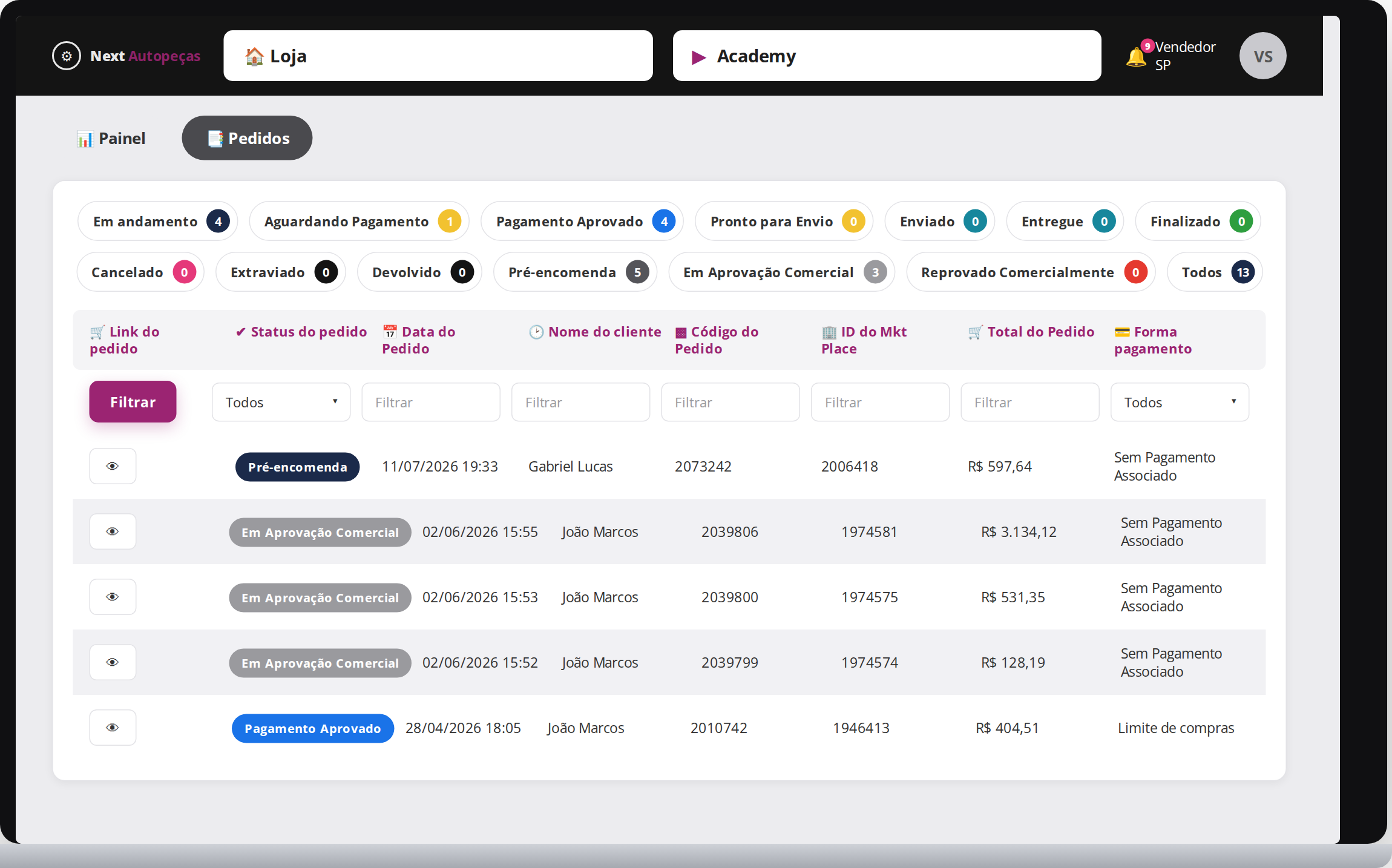
O pedido continua sob gestão
Painel do Vendedor da loja de demonstração, com chips de status e contagens, incluindo Em andamento 4, Pré-encomenda 5 e Em Aprovação Comercial 3.
- Ciclo de vida visívelos chips organizam os pedidos pelos diferentes estados da operação.
- Aprovação comerciala negociação mantém um ponto explícito de decisão humana.
- Filtros operacionaisstatus, data, cliente e outros campos ajudam a localizar pedidos na tabela.
Abaixo, filtros por coluna e uma tabela de pedidos.
O OMS entra neste ponto para provar que a jornada não termina na criação do pedido. Cada negociação segue por estados operacionais visíveis, inclusive pela aprovação comercial, onde o vendedor atua como decisão humana dentro de um fluxo digital mensurável.
What it is
The module that orchestrates the order's life cycle once the order exists. Ten event-driven states, from pre-order through delivered and completed, plus the canceled, lost and returned outcomes, and the order only changes state when the corresponding event actually happens. It is one machine seen from two sides: the merchant calls it the store channel, operations and the ERP call it the Order Management System. Who may sell, how offers compete and how value is divided are questions for the Marketplace Center; here the question is where this order is and what has already happened to it.
The capability no one replicates
A state does not advance because someone clicked, it advances because the condition was met
In most systems status is a label someone switches, which is exactly why it lies. Here every stage has an entry condition: READY requires the Nota Fiscal, SHIPPED requires the tracking code, and a shipping method that needs package dimensions will not let the order leave without them. Status stops being what the operation says it did and becomes what it proved, and that difference is what makes the data reliable enough for finance and for the customer to depend on.
One order, three readings that cannot drift apart
The buyer follows it in the portal, the merchant works it in the store channel, and the ERP reads and updates it over the API. These are not three copies synced now and then, it is the same record read from three places, and every order carries where the sale originated and who is responsible for delivering it. On a multi-seller order that stops being a detail: without that marking, nobody knows which party owes which part.
Canceling an order is a permission, not a button
Letting a seller cancel unilaterally looks like an operational courtesy, and it is the front door to a marketplace's worst behaviors. The platform treats this as a governance decision and keeps it closed by default, because it knows what happens when it is opened without criteria:
- Stock that isn't there. The item shows as available, the order comes in, and cancellation becomes the patch for a listing that was never true.
- Renegotiation after the sale. The price agreed on the portal turns into an opening bid, and "out of stock" turns into leverage to ask for more.
- Cherry-picking orders. Sellers keep the good orders and hand back the bad ones, and the buyer pays for it in lead time.
- Selling off-platform. The order is canceled on the platform and redone privately, using the buyer's details the platform handed over.
So the permission is granted store by store, from CWS Platform's admin console rather than the marketplace operator's, cancellation requires a recorded reason, and an order already approved by the payment method stays locked even where the permission is active. It does make sense to open it where there is no contention, such as an operation in which each seller answers for a territory of its own. The point is never the button, it is who answers for its consequences.
In operation
Imdepa · auto parts distribution
roughly 60,000 orders
processed across 3 years of B2B portal, with 153 customers activated and around 25,000 sessions a month.
Volume on that order of magnitude does not survive status checked by hand. The order cycle runs on its own because every advance has an objective condition, and the rep who used to spend most of the day processing orders moved to handling exceptions, which is the only place a rep is irreplaceable.
Read the Imdepa case →Frequently asked questions
Can our customer find out where the order is without calling someone?
Yes, and without depending on someone remembering to tell them. The buyer follows the order in the portal itself, with the current stage and the tracking code whenever the shipping method has one, and gets an automatic message at the transitions that matter: order placed, payment confirmed, and dispatch. On an order with items from different sellers, each merchant reports progress on their own part, because each part has its own lead time and carrier.
Who issues the tax document, the platform or our system?
Yours. Issuing it is the company's own fiscal procedure and stays in the system that already handles it; the platform receives the document data and uses it as the order's condition to advance. That boundary is deliberate, and it is what prevents two fiscal truths: the Order Management System does not compete with your ERP over issuing, it requires proof that issuing happened before letting the order move on.
Can a seller cancel one of our orders on their own?
By default no, and that is a platform stance rather than a limitation. Where the permission does exist, it is granted store by store and from CWS Platform's own admin console, not by the marketplace operator, and cancellation requires a recorded reason. On top of that, an order already approved by the payment method cannot be canceled by the seller at all: from there only the formal request flow applies, and it leaves a trail.