Deterministic module
Commerce Marketing & Promotions (Marketing Suite)
The campaign promotes an item the regional warehouse does not carry, the coupon stacks on the discount the customer's contract already granted, and the margin only surfaces at month-end close. Marketing that runs outside the transactional engine does not fail for lack of talent — it fails for lack of access to the truth about stock and price.
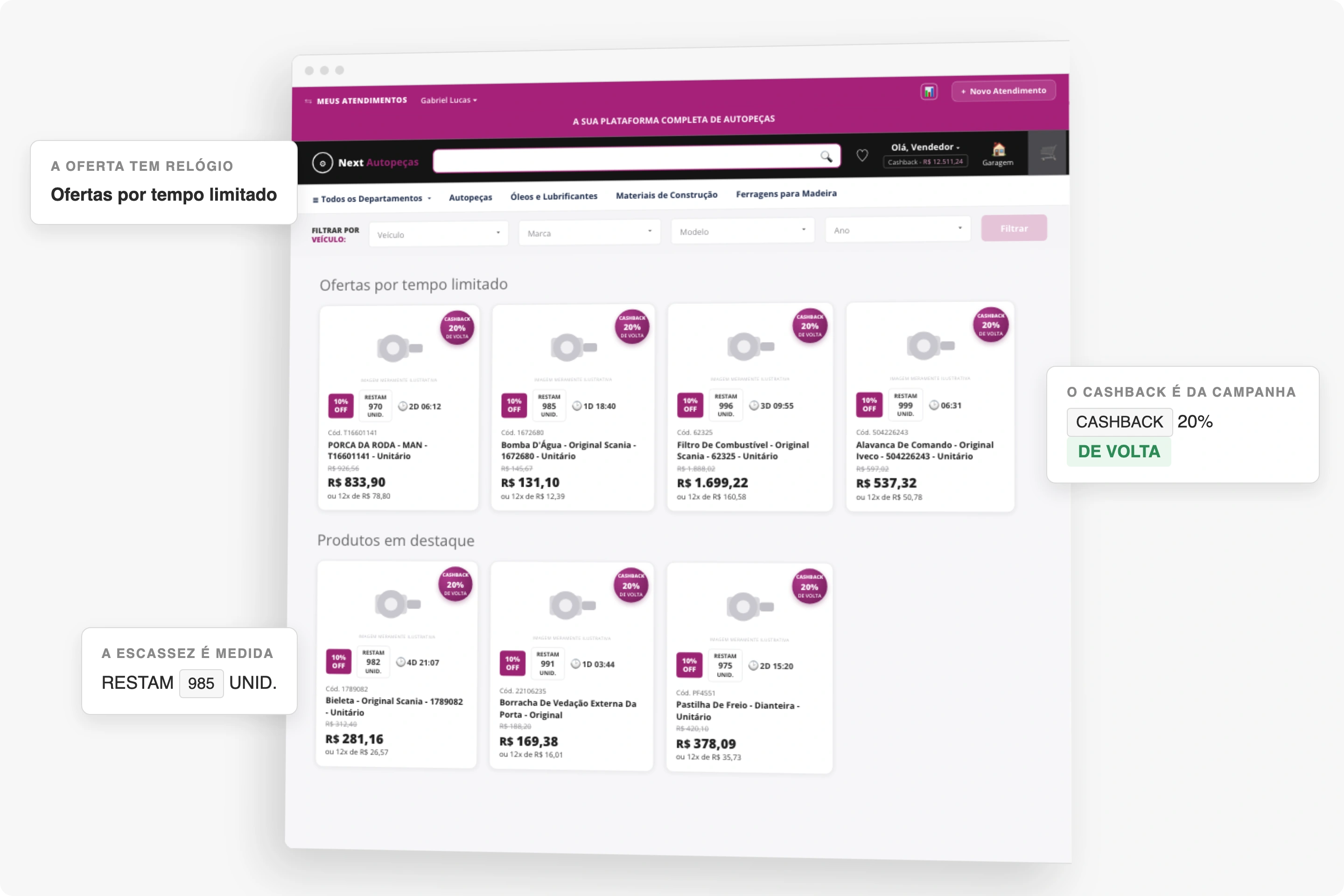
The campaign knows how much stock is left
The offers storefront with discount, cashback, countdown and remaining units on every card, assembled inside the sales rep's service screen.
- Stock goes on the cardRemaining units sit next to the discount, so the offer cannot outlive the product that ran out.
- Three incentives, one assetDiscount, cashback and expiry coexist on the card instead of becoming three campaigns that disagree.
- Inside the service screenThe storefront shows up on the screen the rep is already using, not in a tab they have to remember.
A promotion still running after the product sold out burns the buyer's trust and the rep's time. What this module does differently is activate while aware of stock: each card states how many units remain, right beside the discount and the clock. And the storefront happens inside the service screen, so the campaign lands where the sale is actually being made rather than in a separate asset the rep must remember to open.
What it is
The module that runs campaigns, coupons and promotions under the same governance rules that decide the order. It sits outside the gate of catalog and pricing but reads both in real time, which is why activation cannot break the margin policy or promise an impossible delivery. Where the No-Code Storefront Builder (CMS Builder) makes the portal exist and look like your company, this module handles what happens once it does exist: attract, convert, retain and monetize.
The capability nobody replicates
The offer is validated against the operation before it appears
An external campaign tool receives a list of products and trusts it. Here the promotion is checked against the balance of the warehouse serving the buyer's address, and an item without logistics viability is hidden by region instead of becoming an order the warehouse discovers later. The campaign is always technically viable, by construction.
Promotions and contracts do not add up by accident
A campaign discount enters the same stack as the pricing rule, the customer's contract and the rep's approval limit, and accumulation is a configured decision rather than a side effect. It is the same engine that governs assisted negotiation, so marketing and sales do not run two margin policies that only meet in a report.
The full cycle, from the search engine to the customer who returns
Acquisition without retention is renting customers. The module covers all four stages on the same data, which lets you treat acquisition cost and lifecycle value as one calculation rather than two metrics owned by different teams.
- Attract Per-page meta tags and indexing, including filter and sort combinations, platform-generated sitemaps and product feeds for external channels. The quality of all this is inherited from the catalog: a page without attributes does not rank, however well configured it is.
- Convert Top, footer, mosaic and product-page banners, banner campaigns targeted by customer group, limited-time offers with a countdown, coupons by state or exclusive to the app, free shipping and payment-method discounts.
- Retain Cashback with rules for earning and spending, saved carts with a resume link, proactive replenishment from purchase history, in-app notifications and promotional email segmented by profile.
- Monetize Selling media space on your own portal, with banners and featured brands negotiated as advertising inventory. Operational data stops being a by-product and becomes a revenue line.
The stage usually missing is the last turn of the cycle: acquiring the buyer on someone else's marketplace and bringing them onto your own base, with first-party data captured at registration and login. Without it, the company grows in volume and keeps renting the relationship from whoever brokered it.
In operation
Imdepa · auto parts distribution
about 25,000 sessions a month
in a portal that activated 153 customers and processed roughly 60,000 orders in 3 years.
Analyzing those 3 years separated three usage patterns, each asking for different activation: the customer who treats the portal as daily infrastructure, the one who explores alternatives before committing and converts 70% of the time, and the one who arrives, finds and buys without talking to anyone, at 63.6% conversion per session. Segmenting campaigns on that behavior is only possible because the data comes from the order, not from a form.
Read the Imdepa case →Frequently asked questions
Can a campaign advertise a product our operation cannot deliver to that postal code?
No, and that is what running promotions inside the transactional engine buys you. The offer is checked against the stock of the warehouse that serves the region, and a product without viability is hidden from buyers outside its reach. The buyer does not discover the problem at checkout, because the offer never shows up for them.
Can a coupon add itself on top of the discount the customer's contract already grants?
Only if you decide it can. Blocking accumulation is a parameter: a coupon can be configured not to apply to an item that already carries a contract discount or a pricing rule. Without that control, promotions and contracts add up silently, and the margin disappears inside an order nobody reviewed.
How do we measure a campaign when our customer buys through a rep rather than the portal?
Through the order itself. Because assisted selling and self-service write to the same transactional engine, attribution does not depend on the buyer having clicked a banner: the campaign, the coupon and the recovered cart stay attached to the order no matter which channel closed it. That is what separates campaign data from browsing data.