AI Agent with Business Guardrails
Replenishment Agent
The most expensive stockout is not the item that ran out everywhere. It is the item that exists, with room to spare, in the wrong warehouse. The order lands in a region where the balance is zero, the buyer sees unavailable and leaves, and the same week closes with that product sitting still four hundred miles away. None of this shows up as a stock shortage in the report: it shows up as revenue that never happened.
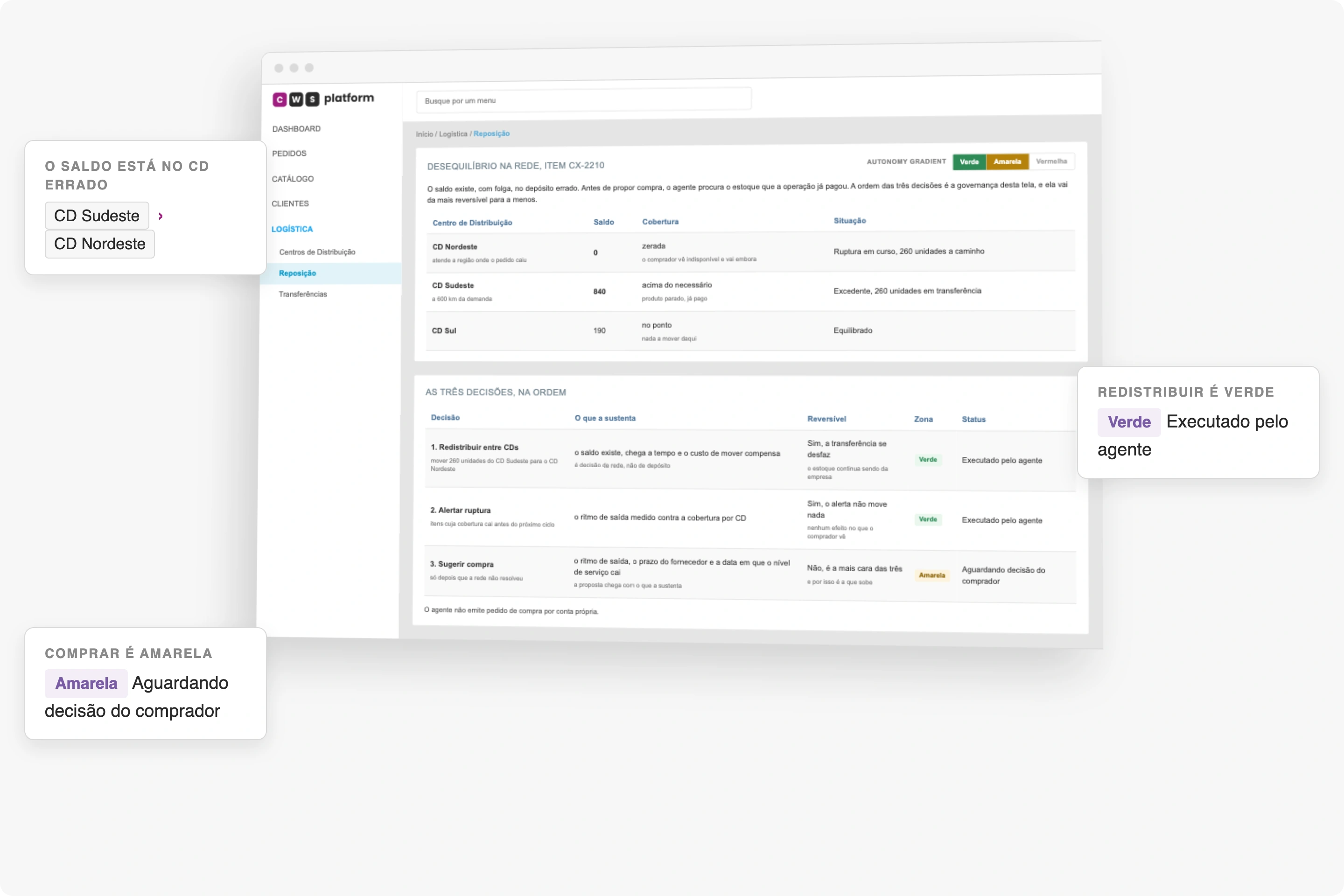
Before buying, the agent looks for what was already paid for
The balance per distribution centre, one at zero in a live stockout and another holding surplus 600 km away, and the three decisions ordered from most reversible to…
- The network resolves firstThe agent moves 260 units from the centre holding surplus to the one at zero before any new purchase is even considered.
- Reversible goes firstThe two decisions that undo come before the one that does not, and that ordering is what decides who executes what.
- The purchase escalatesSuggesting a buy arrives with the sales rate, the supplier lead time and the date service level drops, and then waits for the buyer.
The balance per distribution centre, one at zero in a live stockout and another holding surplus 600 km away, and the three decisions ordered from most reversible to least.
The order of the three decisions is this screen's governance, not a feature list. Redistributing between centres is reversible — the stock still belongs to the company — so the agent executes it. Raising a stockout alert moves nothing and is green too. Suggesting a purchase is the most expensive and least reversible of the three, so it is the one that goes up to a person, and the screen closes by stating the agent does not issue purchase orders on its own.
What it is
The agent that handles the supply chain from the inventory side. It redistributes balances across distribution centers predictively, alerts on stockout risk before it happens, and suggests purchases to hold the service level. It works on Distributed Inventory and Shipping & Fulfillment, which is where multi-warehouse stock and the cost of moving that stock are already real data.
The capability no one replicates
Predicting the imbalance costs less than fixing the stockout
By the time the stockout shows on the dashboard, the cheap decision is gone: what remains is an emergency transfer or an off-terms purchase. The agent works before that, over each item's outflow rate at each warehouse, and points at the imbalance while it is still cheap to undo. The window between the two is usually a matter of days, and that window is where normal freight fits.
Redistribution is a network decision, not a warehouse decision
Looking warehouse by warehouse produces the decision that is locally correct and globally expensive: each center asks for what it lacks and nobody sees the item sitting spare next door. Because inventory is multi-warehouse from the origin, physical and logical on the same base, the agent compares the whole network before suggesting a movement, and weighs what moving costs. Not every imbalance is worth correcting, and knowing which ones are not is part of the answer.
Suggesting a purchase is the last resort, not the first
The order matters. Before proposing a purchase, the agent looks for the balance the operation has already paid for: does it exist in another distribution center, can it arrive in time, does it justify the cost of moving? Only when the network cannot solve it does the purchase suggestion appear, and it appears with what supports it: the outflow rate, the supplier lead time and the date on which the service level drops if nobody acts. Buying is the most expensive and least reversible of the three decisions, so it is the one that escalates to a human. The agent does not issue a purchase order on its own.
Frequently asked questions
How does it anticipate a stockout before it happens?
By watching each item's outflow rate at each warehouse rather than today's balance. A balance is a snapshot, and a comfortable snapshot on a fast-moving item can mean three days of cover. The agent projects when that balance reaches the threshold the operation set as acceptable and warns while normal freight still fits instead of urgent freight. The gap between those two situations is usually a matter of days.
Does it move inventory between warehouses on its own?
It proposes the transfer, with the reason and the cost of moving. Moving inventory between distribution centers creates freight, occupies a team and changes availability at both ends, so it is an action the operation confirms. What it does on its own is the work of finding the imbalance and calculating whether correcting it pays off, which is the part nobody has time to do item by item.
Does it see inventory across every warehouse or only the nearest one?
The whole network. Inventory is multi-warehouse from the origin, physical and logical on the same base, so the agent compares every distribution center before suggesting any movement. Looking warehouse by warehouse produces the decision that is locally correct and globally expensive: each center asks for what it lacks and nobody sees the item sitting spare next door.