Your AI Agent Will Negotiate Using the Same Rules You Can't Audit Today
Agentic AI amplifies your existing decision-making structure — it doesn't replace it. B2B commercial leaders who skip negotiation governance before automating will scale errors, not efficiency.
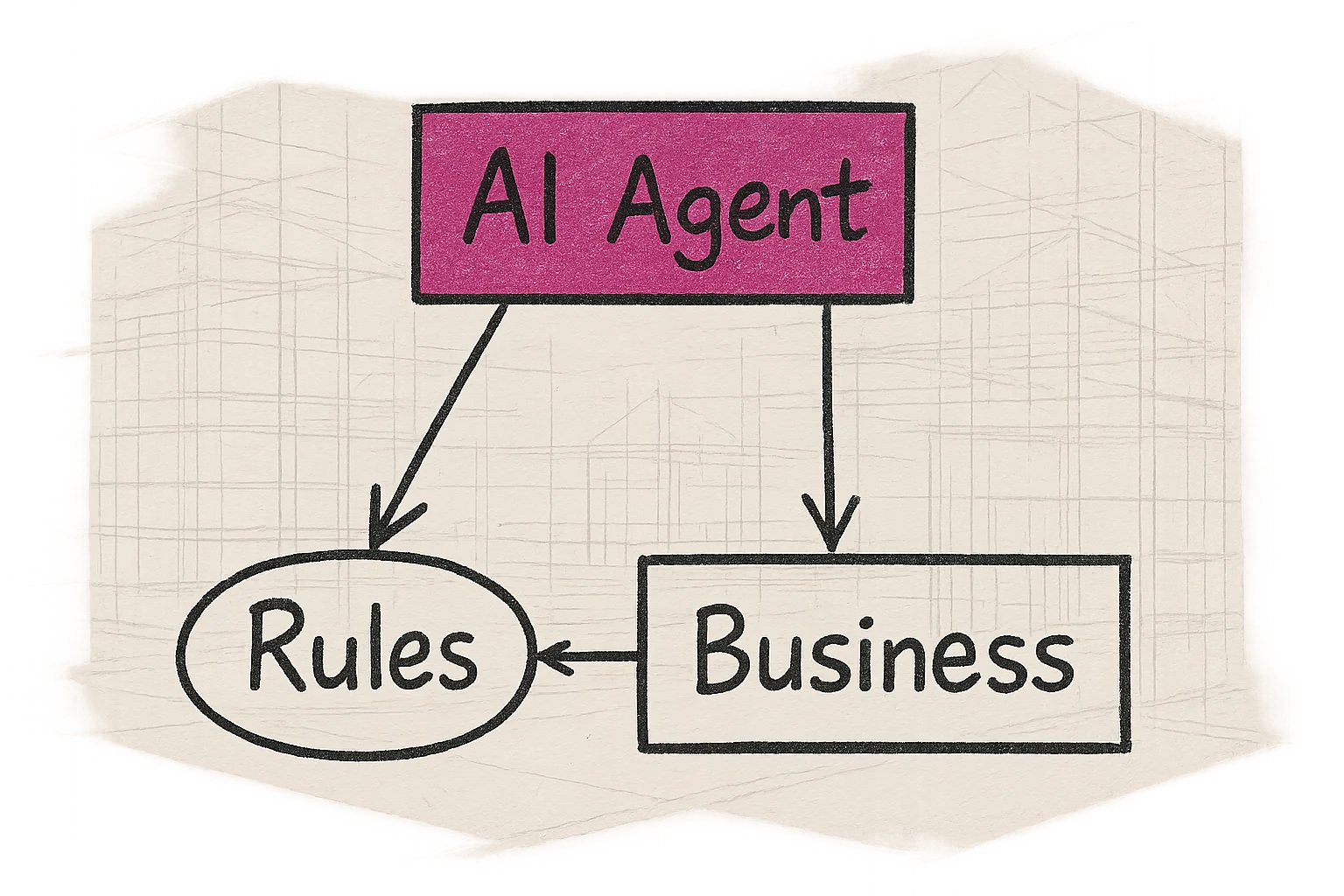
Your AI Agent Will Negotiate Under the Same Rules You Can't Audit Today
TL;DR
- A full-text scan of SEC filings (EDGAR, 2025-2026) across 22 major B2B distributors found only 3 mentioning "agentic" or "digital commerce" in regulatory filings: Ferguson, WESCO, and DNOW. GPC, Grainger, O'Reilly, and the remaining 19: zero.
- The overwhelming majority of the 278 10-Q filings containing the term "agentic" on EDGAR belong to software companies, not distributors. Agentic adoption in B2B commercial operations has not yet reached the document that needs to hold up under audit.
- This is not technological lag. It is a signal that an agent without governed rules cannot survive regulatory, financial, or commercial scrutiny.
- The competitive window is open, but it favors whoever structures the decision first, not whoever turns on the agent fastest.
Agentic AI Has Arrived in the Conversation. Why Have Almost No Distributors Put It in Their Filings?
There is a question B2B commercial leaders should be asking right now, not in the next 18 months. If agentic AI is the wave that will rewrite the sales operation, why did a full-text scan of SEC filings on EDGAR (cycle 2025-2026) find only 3 of 22 major distributors even mentioning "agentic" or "digital commerce" in their regulatory documents?
Ferguson appears in a 10-Q. WESCO and DNOW in a 10-K. Grainger, GPC, O'Reilly, LKQ, Watsco, Pool, and the other 15: zero occurrences. The universe of 278 10-Q filings containing "agentic" on EDGAR is dominated by software companies. B2B distribution, as a sector, has not yet brought agentic AI to the document that needs to survive an external auditor, a board, and a regulator.
That says something about technological maturity. But it says more about a structural problem that agentic AI is about to make urgent for everyone who has not yet solved it.
What Is Missing Is Not the Agent. It Is the Rule the Agent Will Execute.
An AI agent operating in a B2B commercial environment does, at non-human speed and scale, exactly what the business rules allow it to do. If the negotiated price for a specific customer is not recorded in a deterministic way, the agent will resolve that gap however it can, and the error reaches the customer before anyone notices. If the credit policy has exceptions that live in the account manager's head, the agent has no access to that exception and will operate on the generic rule, creating friction at exactly the point where the relationship was being preserved.
This is not an algorithm problem. It is a decision governance problem. And the regulatory filing is only the most visible symptom: if the negotiation logic is not structured enough to be audited, it is also not structured enough to be automated.
B2B distribution is the environment where this becomes most exposed. Margin by SKU, pricing by customer, channel-negotiated terms, credit rules by segment: these are layers of commercial decision-making that, in most operations, live in spreadsheets, in email, and in institutional memory. Turning on an agent in that environment does not solve the problem. It amplifies it.
Inaction Has a Cost, but Premature Automation Has a Larger One
There is real pressure to adopt agentic AI now. The software sector narrative, which dominates the 278 "agentic" filings on EDGAR, holds that the agent resolves operational complexity. For a software company with relatively homogeneous product logic, that may be true. For a distributor with 40,000 SKUs, 3,000 customers, and 200 negotiated price tables, an agent without a deterministic foundation is not efficiency. It is commercial risk at scale.
The JOKR case, a quick-commerce company that reached EBITDA break-even after five years of rebuilding its operation around AI and automation (Retail Tech Innovation Hub, June 2026), illustrates this point from the positive side: AI-driven automation worked because the decision logic was already designed before implementation. The AI amplified a structure that existed. Where the structure does not exist, AI amplifies the chaos.
The cost of inaction is real: whoever does not govern negotiation before the market forces automation will arrive at the next cycle without the capacity to compete on speed. But the cost of premature automation is more immediate: a contract repriced incorrectly, a credit condition applied to the wrong customer, a commercial exception lost at the agent's scale.
What Needs to Exist Before the Agent
Several principles emerge clearly from the EDGAR filing analysis and from observed adoption behavior:
- Commercial decisions must be deterministic before they can be automated: price, credit, terms, and exceptions must be recorded as auditable rules, not as human memory.
- The agent is only as good as the governance it executes: improving the AI model without improving the underlying commercial rule base is optimizing the speed of the error.
- Auditability is the real maturity benchmark: if the negotiation logic cannot go into a regulatory filing, it is also not ready to be executed at scale by an agent.
- The competitive window belongs to whoever structures first: the 19 distributors that do not appear on EDGAR with "agentic" are not all behind; those structuring governance now have an advantage over those who will try to automate without it.
- Negotiation DNA is an asset, not a process: the terms negotiated with each customer over time represent commercial intelligence that must be preserved as structured data, not lost to team turnover.
The Cost of Inaction
Every sales cycle that passes without structuring negotiation logic is a cycle that transfers commercial knowledge to people rather than to systems. When the pressure for automation arrives, and the SEC filing movement suggests it is coming to B2B distribution later than it came to software, the operation without a deterministic foundation will need to build governance and an agent simultaneously, under competitive pressure. That is the real cost of inaction: not the absence of technology, but the absence of the conditions required to use it.
FAQ
Is agentic AI already being used in B2B distribution? Yes, in isolated cases. But the EDGAR scan (2025-2026) shows that only 3 of 22 major distributors brought the topic to a regulatory document. Adoption still belongs to software, not to distribution operations at scale.
Why does the regulatory filing matter as an indicator? Because a filing must hold up under audit. If the negotiation logic behind an agent is not structured enough to be described in a 10-K or 10-Q, it is also not structured enough to be executed reliably in live operations.
Is the problem technological or process-related? It is a decision governance problem. The agent technology exists. What is missing, in most B2B distribution operations, is the deterministic foundation of commercial rules that the agent will execute.
What is the practical first step? Audit where commercial decisions live today: negotiated price, credit conditions, customer-specific exceptions. If the answer is "in the account manager's spreadsheet" or "in the email from the last renewal," the priority is to structure that before any conversation about agents.
Who Already Lives This
A verified reviewer on Software Advice, with a profile in the automotive sector (company with 5,001 to 10,000 employees), describes what they found when dealing with structured commercial complexity:
"The support and project team, responsive, technically engaged, and willing to work through complex commercial rules (negotiated pricing, credit, customer-specific conditions)."
The observation is direct: complex commercial rules, negotiated pricing, credit, and customer-specific conditions are the core of the problem. It is no coincidence that these are exactly the layers an AI agent will need to execute with auditable consistency.
Source: Software Advice, verified review by Maite S. (https://www.softwareadvice.com/product/546664-CWS-Platform/)
A Case That Illustrates the Point
The JOKR trajectory, a quick-commerce company that reached EBITDA break-even after five years of rebuilding its operation around AI and automation, is the positive counterpoint to the argument in this piece: automation worked because the decision logic was already designed. The AI amplified a structure that existed, rather than substituting for one that was missing.
For B2B distribution, the path is analogous: structure before the agent. Governance before automation.
Source: Retail Tech Innovation Hub, June 2026 (https://retailtechinnovationhub.com/home/2026/6/25/quick-commerce-firm-jokr-reaches-ebitda-break-even-after-five-year-rebuild-around-ai-and-automation)
About This Publication
"The Cost of the Sale" is the CWS Platform publication on B2B commercial operations, transaction cost, and negotiation governance. CWS Platform is a B2B Commerce Platform for Governed Negotiation: infrastructure so that commercial rules
"The support model is differentiated — the project team actually understands B2B complexity and stays close throughout implementation."
Want to see this in your operation?
Real B2B operations already run on it.