Your AI Agent Is Already Negotiating. Did Anyone Set the Rules?
The B2B sales leader's blind spot: automating execution before governing the decision — and discovering the agent is operating in a policy vacuum
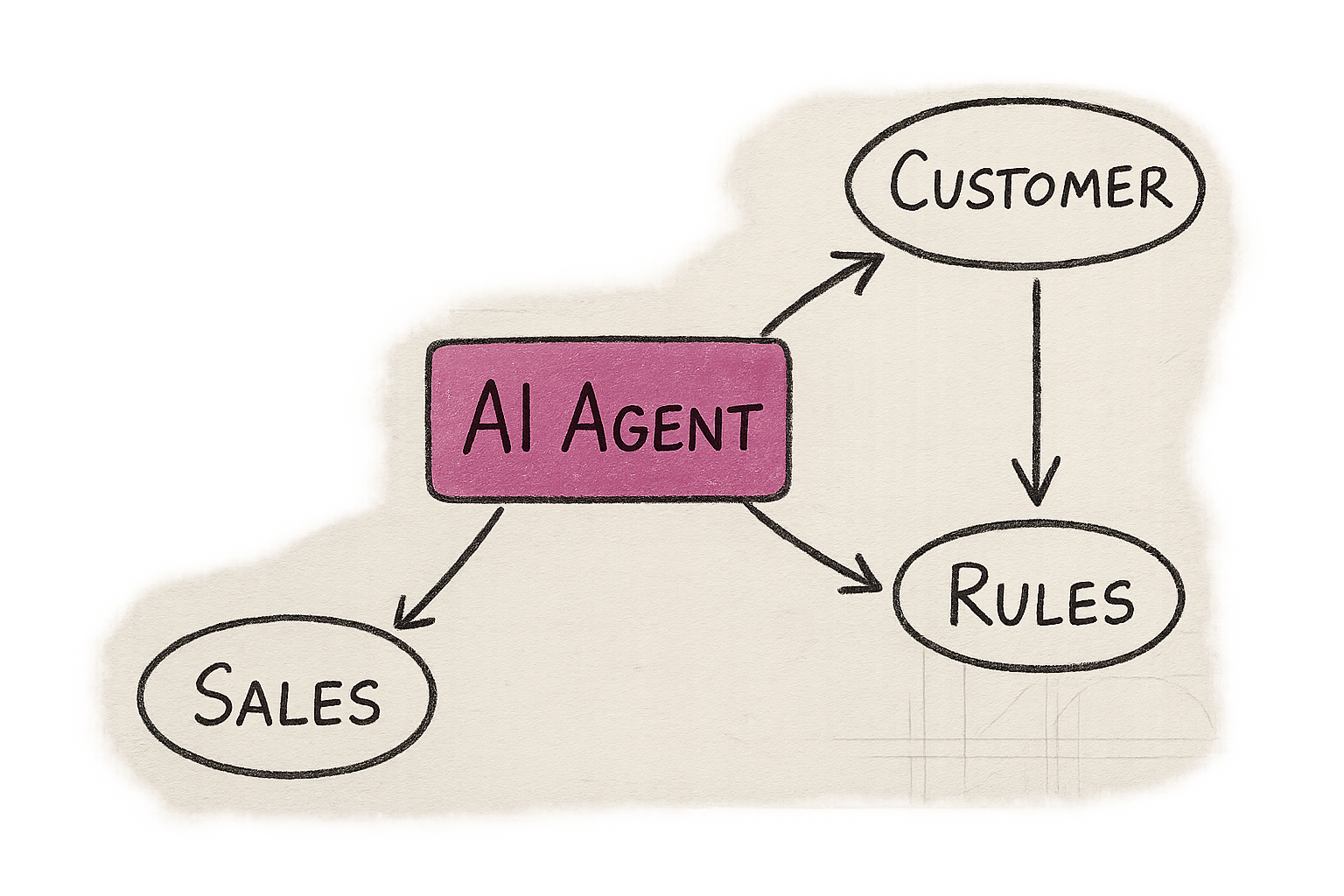
Your AI Agent Is Already Negotiating. Has Anyone Set the Rules?
TL;DR
- Autonomous AI agents are already executing commercial tasks on behalf of companies, but most B2B operations have not defined who authorizes what before deploying the agent.
- The absence of verification of human intent behind the agent is not a technical failure: it is a decision governance failure.
- Veratad launched a toolkit to verify whether there is a real, authorized human behind each agent request, signaling that the agentic governance market is beginning to institutionalize.
- For B2B commercial operations, the risk is not the agent making one mistake: it is the agent making mistakes at scale, at speed, with no auditable trail.
Do you know who authorized the last commercial decision your agent made?
The question sounds rhetorical. It is not.
In July 2026, Veratad Technologies, an American company with twenty years of experience in digital identity verification, launched the Veratad VX Agent Toolkit. The proposition is straightforward: the toolkit answers, in minutes, the question "is there a real, verified human behind this request, and did that person authorize it?" The product is built on Anthropic's Model Context Protocol (MCP) and operates across three layers: verification within chatbot conversations, verification of autonomous agents with no user interface (the so-called "headless agents"), and a centralized identity platform (Veratad VX/IDV).
The launch itself is a market development. What matters to the B2B commercial leader is the problem it reveals.
If a company specializing in identity verification had to build an entire layer just to answer "who actually authorized this?", it is because that question was not being answered. Agents were acting. Authorization was implied.
What changes when the agent enters the commercial operation
Autonomous AI agents are not science fiction in 2026. They are tools already quoting prices, checking inventory, sending proposals, adjusting terms, and interacting with buyers, in some cases without direct human intervention at every step. The promised efficiency is real. So is the hidden cost.
The structural problem is not agent autonomy. It is that most B2B commercial operations were built on a layer of informal human decision-making: the sales rep who knows how far they can go on a discount, the manager who approves an exception over the phone, the relationship history that justifies a special pricing arrangement. That layer was never formalized into policy. It lived in people's heads and in face-to-face negotiations.
When the agent enters, it needs explicit rules. Without rules, it operates in a vacuum, or worse, it operates based on historical patterns that encode exceptions as if they were standard policy.
The agentic governance market, as Biometric Update describes in its coverage of the Veratad launch, "continues to heat up with new product releases." This means the technology sector has already recognized the gap. The question is whether B2B commercial leadership recognized it before deploying the agents.
The sequencing mistake that costs margin
There is a recurring pattern in operations that digitize the sales interface without first digitizing the pricing decision: negotiations continue to happen outside the system. The agent or digital platform operates on the official price list; the sales rep operates on the real exceptions. The result is invisible governance, where margin and auditable data remain inaccessible to the ERP and to management. (LI-036)
With autonomous agents, this problem does not disappear. It scales. An agent can execute hundreds of interactions in the time a sales rep would complete ten. If the decision rule is wrong, the error multiplies at the same rate. If authorization is not verified, accountability vanishes.
Veratad articulated the core issue clearly: it is not enough to know that an agent executed a task. You need to know whether a real human authorized it, and whether that authorization was legitimate. For B2B commercial transactions, the parallel is immediate: it is not enough for the system to log the order. The pricing, terms, and conditions decision that preceded the order must have been made within a clear, traceable policy.
The cost of inaction
Every sales cycle with agents operating without formalized decision governance is a cycle that produces dirty data. Discounts that do not appear as discounts. Exceptions that become standard practice without formal approval. Margins that the ERP cannot reconcile with what was actually negotiated.
The direct cost is financial: unmonitored margin erosion. The indirect cost is strategic: the company loses the ability to learn from its own commercial data, because the data on record does not reflect the decisions that were actually made.
When the reckoning arrives, whether through an audit, a pricing review, or a change in commercial leadership, what is found is a system that looks organized and an operation that ran around it.
Principles for leaders who want to govern before they automate
- Define the decision before defining the agent: what the agent can decide independently, what requires human validation, and what is outside the scope of any automation.
- Make negotiation rules explicit and auditable: if a rule cannot be written into policy, it cannot be delegated to an agent.
- Track authorization, not just execution: knowing that the agent acted is not enough; you need to know who authorized it, with what authority level, and whether that level was within current policy.
- Treat negotiation data as an asset: every agent interaction must generate clean, reconcilable data, not noise the ERP cannot process.
- Govern the negotiation playbook before scaling it: special pricing arrangements, concession patterns, and segment-level discount limits are the most valuable asset in the commercial operation. They need to exist as policy before they exist as code.
FAQ
Can an AI agent operate in B2B sales without decision governance? Technically, yes. Commercially, the risk is the multiplication of out-of-policy decisions at a scale and speed that human oversight cannot keep up with.
What does the Veratad launch have to do with B2B commercial operations? Veratad addresses the problem of verifying whether there is a real, authorized human behind each agent action. The parallel for B2B sales is direct: every commercial decision executed by an agent needs a clear policy as its antecedent, and an authorization trail as its evidence.
Where do you start? With a decision diagnostic: map where commercial exceptions actually happen today, who authorizes them, and whether that process is visible to management. Only then does it make sense to define what can be delegated to an agent.
From the field
"We had been trying to implement a B2B solution for almost 2 years. With CWS, we went live in 60 days."
EDIVALDO C., verified reviewer, automotive sector, company of 201–500 employees. Source: Software Advice (https://www.softwareadvice.com/product/546664-CWS-Platform/)
The time lost before implementation is rarely just a technical problem. It is the time the operation ran without visible governance: negotiations outside the system, unreconcilable data, decisions with no trail.
A pattern worth examining
The pattern described in LI-036 is precise: digitizing the B2B sales interface without digitizing the pricing decision creates invisible governance, where real negotiations happen outside the system and margin data becomes inaccessible to the ERP and management. With autonomous agents, that same pattern replicates at industrial speed. The solution does not change: the decision must be governed before it is automated.
About this publication
"The Cost of the Sale" is a publication of CWS Platform, B2B Commerce Platform for Governed Negotiation. It addresses the visible and invisible costs of B2B commercial operations: pricing, negotiation, decision governance, and the role of technology in reducing transaction costs between companies. For operations that need to scale without losing margin control and commercial policy, CWS offers an architecture that places decision governance before execution automation.
Sources
- Veratad Technologies, "Veratad launches toolkit to verify human intent behind AI agents," Biometric Update, July 2026. Coverage of the Veratad VX Agent Toolkit launch and the agentic identity governance market. (https://www.biometricupdate.com/202507/veratad-launches-toolkit-to-verify-human-intent-behind-ai-agents)
- Software Advice, verified review by EDIVALDO C., automotive sector, CWS Platform. Public testimonial on B2B solution implementation. (https://www.softwareadvice.com/product/546664-CWS-Platform/)
"The support model is differentiated — the project team actually understands B2B complexity and stays close throughout implementation."
Want to see this in your operation?
Real B2B operations already run on it.