The distributor that doesn't die from tech disruption dies from high operating costs
The real threat isn't manufacturers going direct — it's the competitor next door running leaner operations with tighter margin control
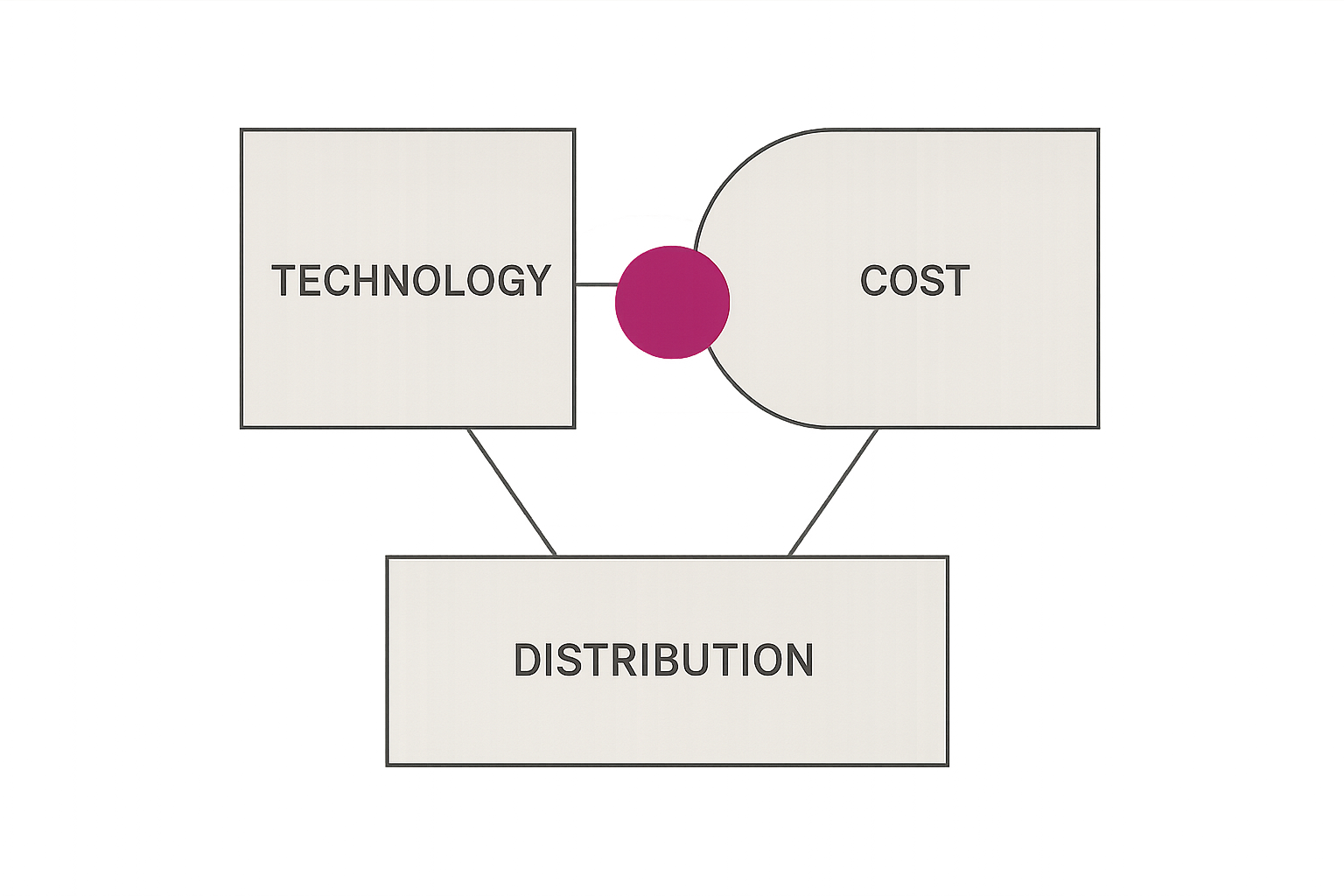
The Distributor That Doesn't Die From Technology Dies From High Costs
Every time a manufacturer announces a direct channel, someone in distribution declares the death of the middleman. The narrative is old and recurring: technology will eliminate the distributor, manufacturers will sell direct, the channel will shrink until it disappears.
The diagnosis is wrong. And operating with the wrong diagnosis carries a cost that shows up slowly, in the margin, until it can no longer be ignored.
TL;DR
- Distributors don't disappear because of technological disintermediation; they disappear when their transaction costs run higher than the competitor next door.
- The threat is lateral, not vertical: it's not the manufacturer going direct, it's another distributor operating with less friction, fewer pricing errors, and tighter credit control.
- Scaling digital volume without pricing governance doesn't solve the problem: it amplifies fragile margins at a scale the physical channel could never reach.
- Competitive advantage in B2B distribution is migrating from portfolio and relationships to operational architecture, and those who are slow to recognize it pay with market position.
Is the Distributor Fighting the Right Enemy?
Ronald Coase explained in the 1930s why firms exist: organizing transactions inside a coordinated structure is cheaper than negotiating each exchange in the open market. The distributor exists by the same logic. It reduces the cost of connecting manufacturers and end buyers. That role doesn't disappear with technology. It changes shape.
What technology actually does is redistribute where transaction costs concentrate. If a distributor carries high costs for processing orders, mispricing, and granting discounts without criteria, those are the points where the structure becomes weak. Not weak against the manufacturer, weak against the competitor next door who has already solved those problems.
The confusion starts when disintermediation is treated as an inevitable destination. It isn't. It is a consequence of high cost, not of technology. The distributor that exits the market won't exit because the manufacturer went direct. It will exit because another distributor operates with a lighter structure, prices better, and serves the same customer with less friction.
That is the diagnosis most commercial leaders are not making. And it is what determines who stays.
What Market Numbers Are Saying
W.W. Grainger's Q1 2026 results, disclosed in an SEC filing, are a useful signal for reading the industry. The company named eCommerce and artificial intelligence as its central bets for the period. The Endless Assortment model, operated through Zoro and MonotaRO, puts millions of SKUs in play with the premise that a broad catalog combined with intelligent navigation replaces portfolio control and sales force as the primary source of value.
What this move reveals is not that every distributor needs to replicate the Grainger model. It reveals where competitive differentiation is migrating: from portfolio control and relationship management to purchase experience architecture. In the traditional model, the distributor controlled access to the product. In the model that is emerging, access is a given. What differentiates is the quality of the transaction, the speed of decision-making, and the confidence in the price shown on the screen.
For the mid-market distributor not operating at Grainger's scale, the practical read is this: the B2B buyer is becoming accustomed to deciding with less friction. Whoever introduces more friction loses position, regardless of whether they have the right product in stock.
The Problem Digital Alone Doesn't Solve
There is a common misconception in the distribution digitization narrative: the idea that opening a digital channel solves the competitiveness problem. It doesn't. In many cases, it makes it worse.
Publicly traded U.S. distributors have been demonstrating this in recent filings. GMV rises. Net revenue rises. Gross margin per digital order stays flat or falls. The market applauds the top line and ignores what is being destroyed below it.
In B2B distribution, the cost to serve is not fixed. It varies by customer, by region, by product mix, by payment terms. When a digital operation cannot price that variation, it subsidizes the margin-destroying orders with the few that still preserve it, and does so with a speed and scale the physical channel could never match.
Digital doesn't create margin. It amplifies the quality of the decision that existed before it. If the pricing logic was fragile in the analog world, in the digital world it becomes fragile at industrial scale.
The real challenge for the CFO and the VP of Sales is not how to digitize the order. It is how to ensure that every digital order carries the pricing intelligence, customer context, and margin governance the business needs to survive its own growth.
The Cost of Inaction
Operating with high transaction costs is a problem that doesn't surface all at once. It surfaces as discounts granted without criteria, as orders processed with errors, as credit approved outside policy, as a sales rep spending time building spreadsheets instead of negotiating.
Each of those points, in isolation, seems manageable. Together, they form the structure that makes a distributor displaceable by the competitor next door.
The problem with this kind of cost is that it doesn't generate a visible crisis in the short term. It generates erosion. And margin erosion in a distribution operation, where volume is high and average order value per transaction is not, compounds quickly.
By the time the commercial leader notices, the competitor already has the account, the relationship, and the cost advantage to sustain a lower price indefinitely.
Principles for Operating With a Structure That's Harder to Displace
- Treat transaction cost as a competitiveness metric, not as operational overhead.
- Separate what the sales rep does that requires human judgment from what can be executed by the operation without them.
- Don't scale the digital channel before solving pricing governance: volume without controlled margin is growth of the problem, not of the operation.
- Measure margin by order, by customer, and by channel, not just aggregate revenue.
- Understand that the competitive threat comes from the side, not from above: the competing distributor is the focal point, not the manufacturer.
FAQ
Isn't the manufacturer going direct a real threat? It is a threat in specific segments, but it is rarely the factor that explains a distributor's displacement. What explains it, far more often, is another distributor operating with lower cost and tighter control over the transaction.
Does digitizing the channel solve the competitiveness problem? Partially, and only if digitization is accompanied by pricing and credit governance. Without that, digital scales the same problems that existed in the physical channel, only faster.
What changes for the sales rep in this scenario? The rep who spends time processing operational orders is the most vulnerable. The one who moves into a consultative role, with repetitive operations handled by the platform, is the one who builds relationships that are hard for a competitor to replicate.
Who Is Already Living This
"We had been trying to implement a B2B solution for almost 2 years. With CWS, we went live in 60 days."
EDIVALDO C., verified reviewer, automotive sector, company of 201 to 500 employees, via Software Advice (https://www.softwareadvice.com/product/546664-CWS-Platform/)
A Case That Illustrates the Point
Imdepa, an auto parts distributor founded in 1960, went through this displacement from the inside out. After adopting the CWS Platform B2B portal, the company grew its customer base over three years without growing the team at the same rate. What changed wasn't just the metric: it was the role of the sales rep. They moved away from assembling orders with hundreds of line items, calculating tax and freight, and started operating as consultants. Repetitive operations stayed with the platform; human judgment stayed where it is irreplaceable.
That is the shift that separates the distributor who becomes hard to displace from the one who continues operating with a fragile structure.
About This Publication
The Cost of the Sale is CWS Platform's publication on B2B commercial operations. It covers negotiation governance, transaction cost, and commercial decision-making in distribution, wholesale, and manufacturing environments. CWS Platform is a B2B Commerce Platform for Governed Negotiation: infrastructure for distributors and manufacturers to operate with more speed and less margin loss on every transaction.
Sources
- W.W. Grainger, SEC Filing Q1 2026 (https://www.sec.gov/Archives/edgar/data/277135/000027713526000053/gww-20260331.htm): first quarter 2026 results, in which the company named eCommerce and AI as central bets and detailed the Endless Assortment model with Zoro and MonotaRO.
- LI-025, CWS Platform proprietary thesis: analysis of transaction cost as the central variable in distributor survival, with reference to Ronald Coase's theory of why firms exist.
- LI-023, CWS Platform proprietary thesis: analysis of the risk of scaling the digital channel without pricing governance.
"The support model is differentiated — the project team actually understands B2B complexity and stays close throughout implementation."
Want to see this in your operation?
Real B2B operations already run on it.