The Distributor Without an Operational Brain Is Making Decisions in the Dark
Automating before structuring your internal decision logic doesn't generate intelligence — it amplifies noise. The path starts from the inside out.
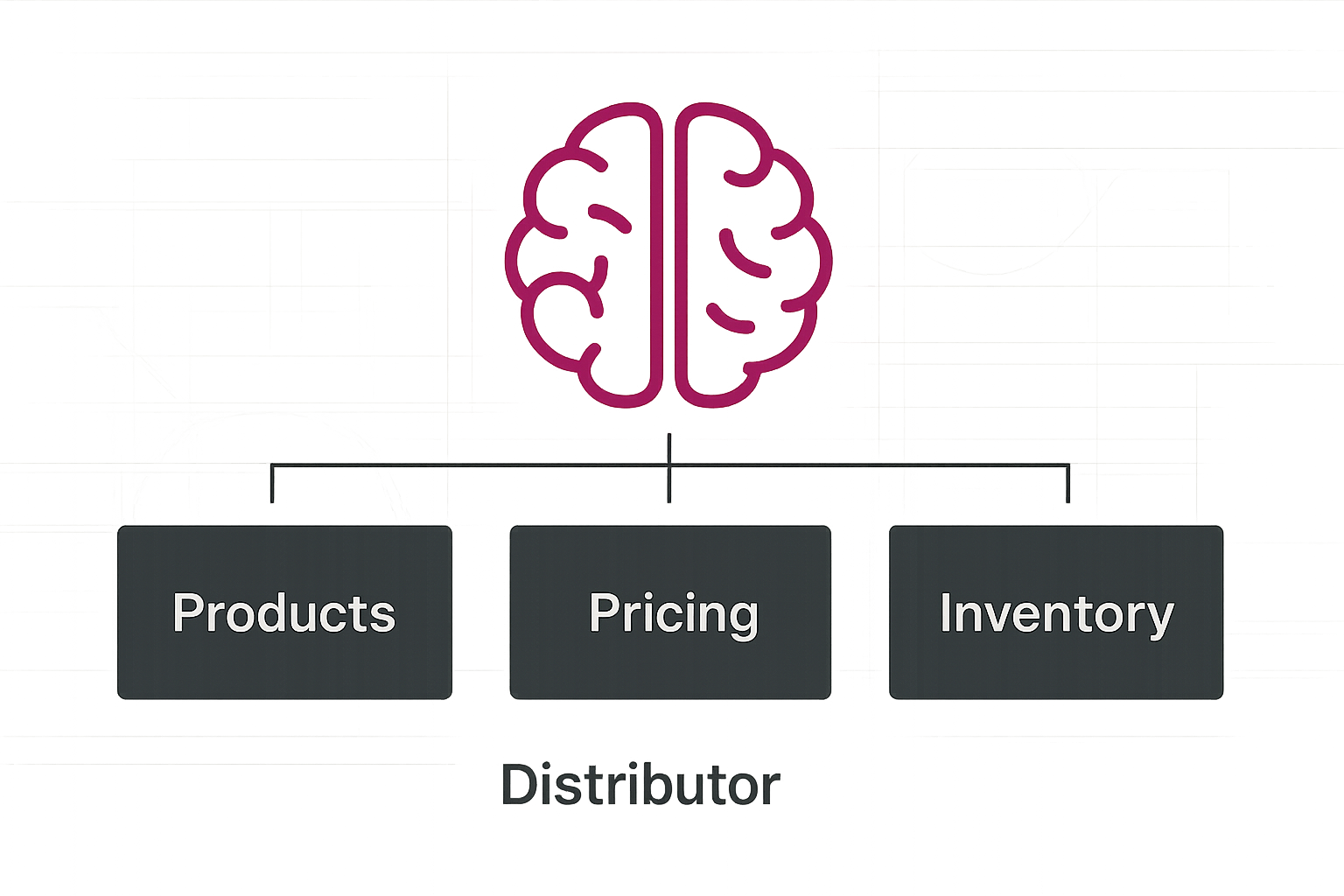
The Distributor Without an Operational Brain Is Making Decisions in the Dark
TL;DR
- B2B distributors grow in volume, but the decision logic guiding pricing, credit, product mix, and customer service remains fragmented across people, spreadsheets, and intuition.
- Implementing AI on top of an operation without an organized cognitive structure amplifies noise—not intelligence.
- The path starts from the inside out: founder vision, operational structure, team, customers, and only then the market.
- Companies that have completed this journey reduce operating costs and grow revenue with the same organizational structure because AI operates with real context rather than approximation.
Your business is growing. Is your ability to make sound decisions growing too?
There is a quiet tension in most B2B distribution operations: transaction volume rises, the customer base becomes more diverse, the product assortment expands, and the team grows to keep up. Yet the logic governing decisions—who can negotiate what, at what price, under which credit terms, for which customer profile—still lives in the heads of three people or in a spreadsheet no one knows who maintains anymore.
This is the real pain point for the modern distributor: it is not a lack of data. It is a lack of structure for turning data into reliable, repeatable decisions.
When this environment meets pressure to automate and deploy artificial intelligence, the result is often disappointing. Tools are purchased, pilots are run, and the promise of efficiency fails to materialize. The problem is not the technology. It is the absence of what could be called an operational brain: the layer that connects purpose, structure, team, and customer into a coherent logic before any automated agent enters the picture.
What an operational brain actually is
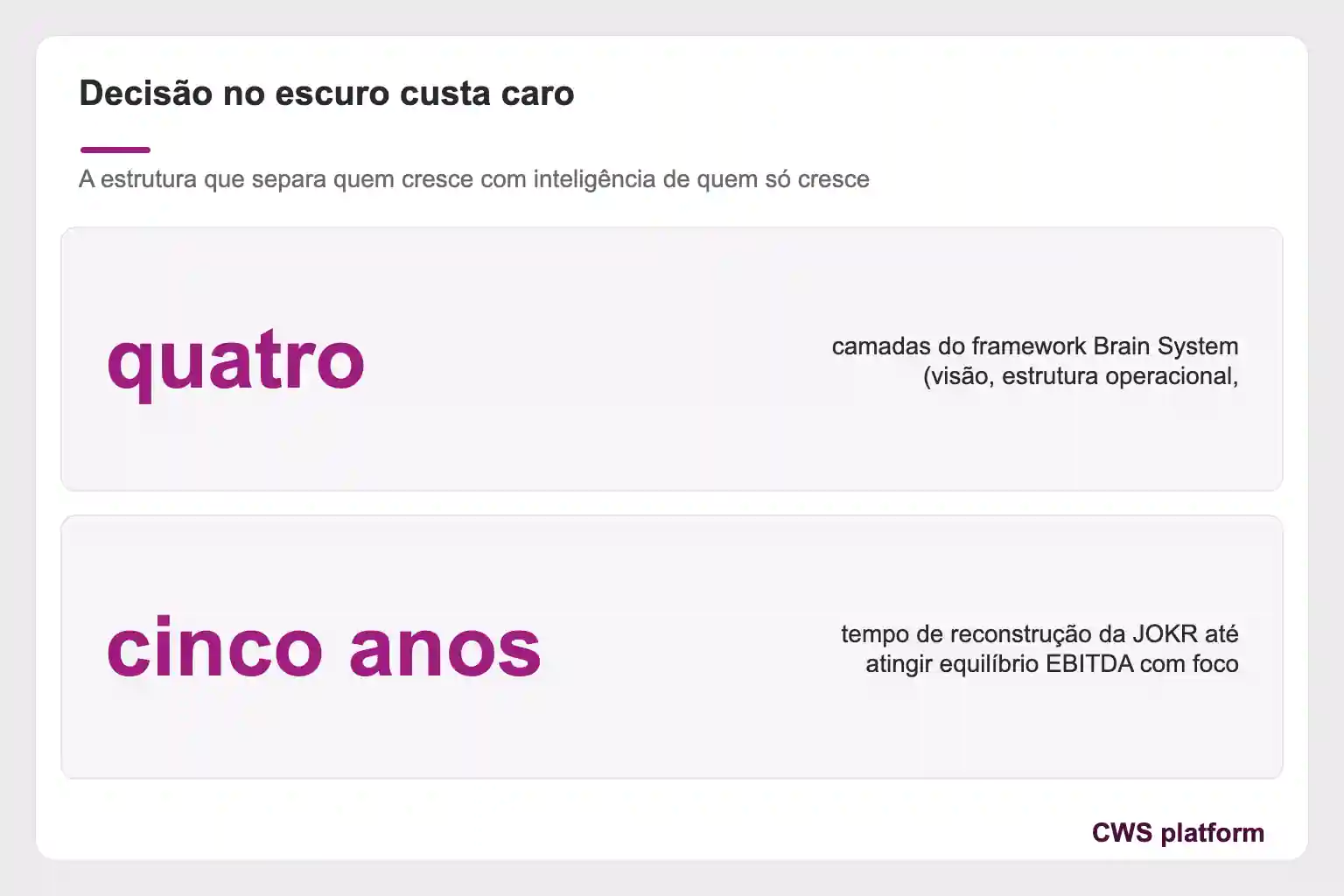
The Brain System concept, developed by CWS Platform for distribution and complex retail operations, is based on a framework that moves from the center outward. The logic is straightforward: before automating anything, a company must organize its knowledge into layers.
The first layer is the founders’ vision. What the company wants to become. What its positioning values are. What it is unwilling to compromise on. This layer is abstract, but it provides direction for everything that follows.
The second layer is operational structure: how the business works, what services it provides, its logistics capacity, its pricing policy, and its strengths and weaknesses relative to competitors. Here, the act of documenting already creates order because it forces the company to see what was never written down.
The third layer is the team: how it is organized, what each role does, and how the vision translates into behavior in day-to-day commercial activity.
The fourth layer is customers: profiles, negotiated terms, history, preferences, and relationship criteria. This is where data governance takes root—not in internal systems, but at the endpoint, with the people receiving the information.
When these four layers are built and connected, artificial intelligence has enough context to operate without hallucinating. It can propose a commercial offer for a specific customer profile. It can distinguish between a conversation with a procurement manager and one with a store operator. It can run a media campaign with precision because it knows where the strengths and gaps are. And it does all of this within the right guardrails because governance was built beforehand, not afterward.
The core argument is precise: without this internal structuring work, AI operates in a vacuum. With it, AI amplifies what is already working well in the operation.
Evidence that the sequence matters
The case of JOKR, a quick-commerce company that reached EBITDA breakeven after a five-year rebuild focused on AI and automation, documented by Retail Tech Innovation Hub, illustrates this point exactly. The turning point was not adopting technology. It was rebuilding the decision logic before automating it. AI agents generate results when rules, criteria, and processes are already designed. When the structure does not exist, automation accelerates errors.
For a B2B distributor with a diverse customer base, a broad product assortment, and a distributed sales team, this risk is multiplied. Every sales rep carries a slightly different version of the rules. Every customer has a term that “only one person knows.” Every campaign starts with a market assumption that has never been systematically validated.
The Cost of Inaction
Maintaining the current operation—with fragmented decision-making and superficial automation—has a cost that rarely appears in the P&L under that name, but it is everywhere:
- Margins eroded by ungoverned discount concessions because sales reps lack clear parameters and the most aggressive customer always gains the advantage.
- Longer sales cycles because a commercial proposal depends on manual approval from someone who is always busy.
- Low-return campaigns because they were created without real context about who buys and why.
- Revenue growth that does not translate into margin growth because the structure grows alongside volume, without meaningful efficiency gains.
- Dependence on key people who carry operational knowledge in their memory, creating business continuity risk.
The distributor that structures its operational brain before automating can make two moves at the same time: grow revenue with the same organizational structure because AI can perform qualification, offer creation, and follow-up more consistently than any team can do manually; and reduce operating costs because processes that depended on constant human judgment can be orchestrated by agents with real context.
Principles for building this capability
- Start with vision, not the tool: before choosing which AI to implement, document what the company wants to become and which decisions cannot be delegated without explicit criteria.
- Treat operational knowledge as an asset: pricing, credit, customer-specific terms, and logistics capacity are all data that exist within the company but are rarely organized in a way that is accessible to a system.
- Build governance around the destination of information: who receives the proposal, campaign, or offer? Data governance starts there, not in the internal database.
- Do not automate what does not yet work well manually: AI amplifies what already exists, for better or worse.
- Assess the maturity of each layer before moving to the next: consolidate vision before documenting structure; document structure before involving the team; align the team before integrating customer data.
Questions leaders are asking
If we already have a CRM and ERP, do we really need this structuring work?
CRMs and ERPs store transactions and records. An operational brain organizes the decision logic that should guide those transactions. They are different layers. Most operations have the systems but lack documented, connected decision logic.
How long does it take to build this type of structure?
It depends on the complexity of the operation and how much of the vision and processes has already been made explicit. The building process itself has diagnostic value: it reveals contradictions, gaps, and dependencies the operation has been carrying without realizing it.
Won’t AI learn on its own over time, making this initial structuring unnecessary?
Language models and AI agents learn patterns, but without structured context, they learn the wrong patterns too. Initial governance is what ensures that learning takes place within the right guardrails.
Those already experiencing it
In a public review on Software Advice, Maite S., a verified reviewer in the automotive sector at a company with 5,001 to 10,000 employees, described her experience with CWS Platform this way:
"The support and project team, responsive, technically engaged, and willing to work through complex commercial rules (negotiated pricing, credit, customer-specific conditions)."
What stands out is the combination: technical engagement and willingness to work through complex commercial rules. Negotiated pricing, credit, and customer-specific conditions. This is exactly the kind of knowledge that must be structured before any automation can make sense.
Source: Software Advice
A case that illustrates the point
JOKR, a quick-commerce company, publicly documented its path to EBITDA breakeven after a five-year rebuild centered on AI and automation. The conclusion that emerges from the case is direct: AI agents only generate consistent results when the decision logic—rules, criteria, and processes—has been designed before implementation. The technology amplified a structure that had been rebuilt. It did not replace that structure.
For B2B distributors evaluating how to begin this journey, the JOKR case provides a concrete reference that the sequence matters as much as the choice of tool.
Source: Retail Tech Innovation Hub
The role of transaction architecture
CWS Platform operates as a B2B commercial operations platform with negotiation governance. In practice, this means commercial rules, customer-specific terms, and pricing, credit, and product-mix criteria can be organized and made operational before any automation layer is introduced. When AI agents enter this environment, they operate on a structure that already exists, with real context rather than approximations.
That is exactly what the Brain System concept proposes: build the operational brain from the inside out, ensuring artificial intelligence works with the right logic from day one. Transaction costs decline not because AI is inexpensive, but because decisions become governed, repeatable, and auditable at every point in the commercial chain.
About this publication
The Cost of Selling is a publication by CWS Platform, the B2B Commerce Platform for Governed Negotiation. We analyze the real costs of B2B commercial operations: negotiation, pricing, decision governance, and the role of technology in making these processes more reliable and efficient.
Sources
Brain System B2B, CWS Platform (proprietary thesis): framework for building operating systems orchestrated by AI agents for distribution and complex retail operations, structured in inside-out layers (vision, structure, team, customers). Foundational material for this analysis.
Retail Tech Innovation Hub, JOKR case (June 2026): documentation of the quick-commerce company’s path to EBITDA breakeven through a rebuild centered on AI and automation; evidence that decision logic must be structured before technology implementation. Link
Software Advice, verified CWS Platform review: public testimonial from an automotive-sector user at a company with 5,001–10,000 employees regarding the platform’s ability to handle complex commercial rules, including negotiated pricing, credit, and customer-specific conditions. Link
"The support model is differentiated — the project team actually understands B2B complexity and stays close throughout implementation."
Want to see this in your operation?
Real B2B operations already run on it.