Your B2B portal accepts orders that will never close
When dealers and service shops can't see credit limits and payment terms at the start of the buying journey, the hidden cost falls on sales reps, cash flow, and the business relationship
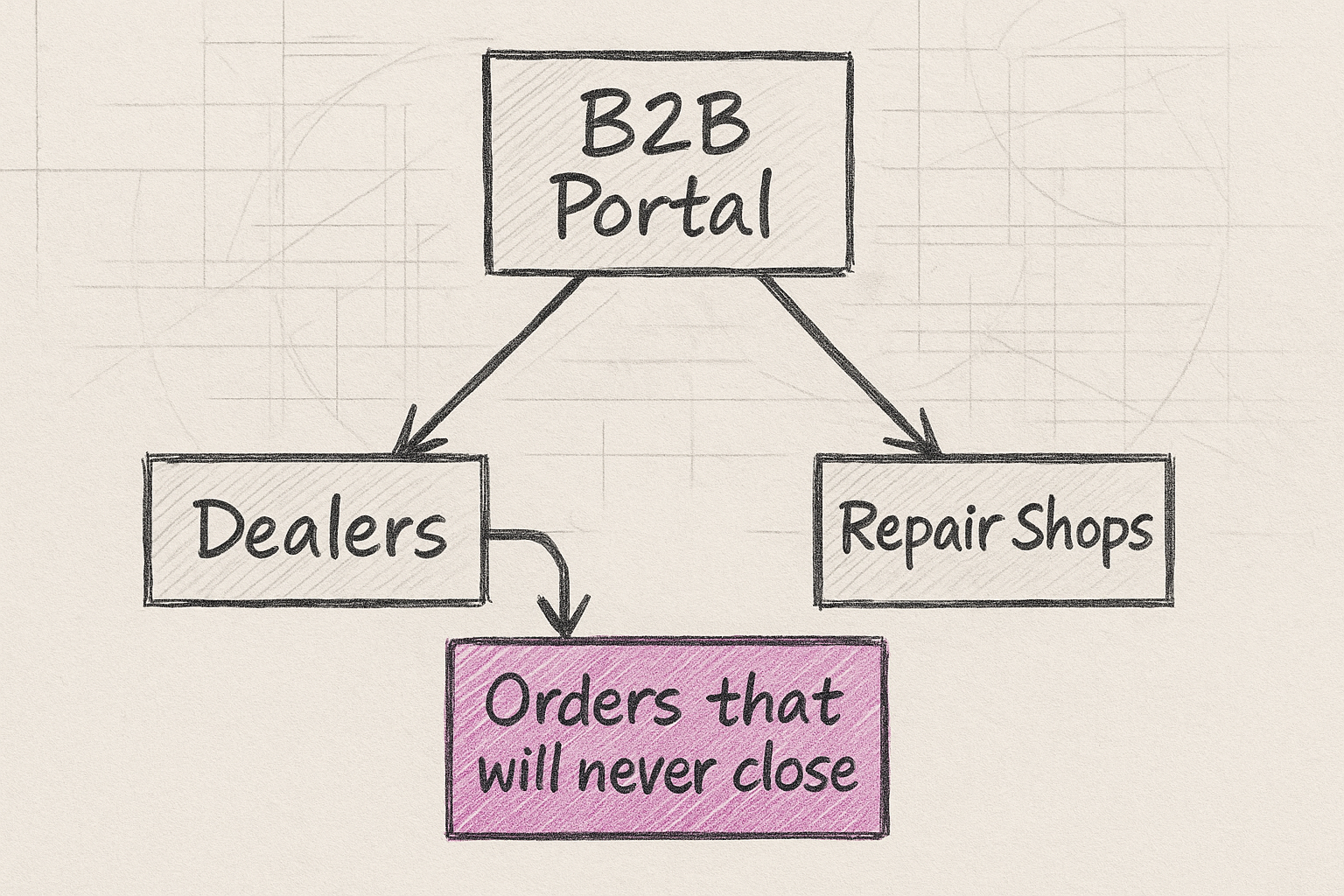
Your B2B Portal Is Accepting Orders That Will Never Close
TL;DR
- Distributors and dealers who can't see their credit limit and payment terms at the start of the buying journey generate orders that reach the sales team already dead on arrival.
- The rep wastes time qualifying and negotiating a deal that credit will kill at the gate.
- The friction isn't about price: it's about information asymmetry. The buyer didn't know what they could purchase; the rep didn't know the buyer didn't know.
- Displaying payment terms, conditions, and credit status in real time, for both sides, is a closing factor, not an operational detail.
Why a B2B Portal That Hides Credit Data Costs More Than It Looks
Picture this: a tire distributor logs into the manufacturer's portal, builds a reasonable replenishment order for the month, submits it, and waits. The rep receives it, pulls up the credit history, sees a blown credit limit or a payment term that doesn't match what the buyer selected, and the adjustment cycle begins: phone call, renegotiation, reduced order, updated terms, resubmission. What should have been a digital transaction turns into a phone negotiation using data that was already sitting in the ERP before the cart was ever opened.
This isn't a hypothetical. It's the pattern reported across B2B distribution operations, including the case raised by Luiz Machado (Pirelli), who describes exactly this pain point: dealers and service shops operating without real-time visibility into credit limits and payment terms, creating friction at closing and wasting time on the sales side.
The number that stands out isn't the volume of rejected orders. It's that the rejection happens too late, after the buyer has already invested time building the order and the rep has already received the request as if it were a live deal.
Information Asymmetry Is the Cost Nobody Measures
In B2B distribution operations, the buyer, whether a dealer, a service shop, or an independent reseller, frequently has no access to their own available credit limit, the payment terms negotiated for their account profile, or their current outstanding balance. They enter the portal operating in the dark.
On the other side, the rep holds that information but receives the order after it's already been built. The result is predictable: a significant share of orders that enter the pipeline have no realistic path to closing under the terms in which they were submitted.
This is the most silent transaction cost in a sales operation: not the cost of processing an order, but the cost of processing an unworkable order. It includes the rep's time to identify the problem, the buyer's time to rebuild the order, the risk of purchase abandonment, and the erosion of trust in the digital channel.
In distribution with compressed margins, auto parts, tires, industrial supplies, where transaction volume is high and average order value per line can be relatively low, that friction scales fast.
The Portal Became a Bottleneck, Not a Channel
There's a reasonable expectation on the commercial leadership side: digitize the channel to gain productivity. The B2B portal should reduce rep dependency for replenishment orders, free the team to develop accounts and negotiate special terms, and give buyers the autonomy to operate outside business hours.
None of that works if the buyer can't see what they're allowed to purchase before they start purchasing.
A portal that hides credit limits and payment terms doesn't decongest the rep, it just shifts the problem. The conversation that should have happened before the order now happens after, with more cost and more friction for both sides.
What the Pirelli case points to as a solution is structural: display payment terms, conditions, and credit status at the very beginning of the buying journey, for both sides. Not as a warning screen, but as contextual data that informs order building before the cart is ever opened.
The Cost of Doing Nothing
Every month a distribution operation runs this model generates:
- Orders that enter the system with no path to approval as submitted, consuming rep and credit team time for triage and adjustment.
- Buyers who abandon the digital channel and go back to the phone because "the portal doesn't work," erasing the productivity gain the platform was supposed to deliver.
- Reps who spend part of their time managing order adjustments instead of developing accounts or expanding the product mix.
- Contaminated demand data: what shows up as an order in the pipeline doesn't represent real demand, it represents purchase attempts made without credit context.
The sum of these items rarely appears in a cost report. But it exists, and it grows proportionally to the number of buyers using the portal.
Principles for Addressing This Pain
- Available credit, payment terms, and current pricing for that specific buyer must be visible before the order starts being built, not after it's been submitted.
- ERP synchronization must be real time: an outdated credit limit is just as damaging as a hidden one.
- The rep should see the same context the buyer sees, so that any adjustment conversation, when necessary, starts from a shared information baseline.
- Credit policy and payment terms must be formalized in the system, not stored in the rep's head: when the rule lives in the digital workflow, response time stops depending on human availability.
Frequently Asked Questions
Is this an ERP problem or a portal problem? It's an integration and governance problem. The ERP has the data. The portal doesn't display it because the integration was never designed for that, or because the credit policy was never formalized enough to be consumed by a digital system.
Doesn't showing the credit limit to the buyer create commercial risk? The bigger risk is the opposite: a buyer who doesn't know their limit builds unworkable orders, creates rework, and loses confidence in the channel. Showing the data clearly is protection, not exposure.
Does this solve the cart abandonment problem in B2B portals? A meaningful share of cart abandonment in B2B portals isn't about price, it's about uncertainty over whether the order will actually be approved. Visible credit reduces that uncertainty before the cart is built.
Who's Already Living This
"We had been trying to implement a B2B solution for almost 2 years. With CWS, we went live in 60 days."
EDIVALDO C., Verified reviewer, Automotive sector, company of 201–500 employees, via Software Advice.
The most relevant data point here isn't the implementation timeline: it's that the difficulty was in finding a solution that could handle the specific requirements of a B2B operation, not in executing the rollout itself.
A Case That Illustrates the Point
In B2B operations, the productivity bottleneck is rarely human capacity: it's the absence of rules formalized in the system. When pricing policy, credit, and exception handling move out of the rep's head and into the digital workflow, response time stops depending on human availability. That's the central argument in CWS internal analysis LI-038, and it applies directly here: a portal that displays credit in real time only works if the credit policy was formalized enough to be read by a system. Where it wasn't, the visibility project forces that formalization, and that's a collateral gain that stands on its own.
About This Publication
"The Cost of the Sale" is CWS Platform's publication on B2B commercial operations: credit, negotiation, order governance, and the real cost of every transaction. CWS Platform is a B2B Commerce Platform for Governed Negotiation, built for operations where price, credit, and payment terms need to live in the digital workflow, not in the head of whoever picks up the phone.
Sources
- Direct account, Luiz Machado (Pirelli): Case reported directly to CWS, describing the pain of credit and payment term visibility in B2B distribution portals for dealers and service shops. Primary source for this analysis.
- Software Advice, verified review by EDIVALDO C.: Public software review platform; user testimony from the automotive sector on the CWS Platform implementation. https://www.softwareadvice.com/product/546664-CWS-Platform/
- CWS internal analysis, LI-038: Internal analysis on commercial policy formalization (pricing, credit, exceptions) as a prerequisite for productivity in digital B2B operations.
"The support model is differentiated — the project team actually understands B2B complexity and stays close throughout implementation."
Want to see this in your operation?
Real B2B operations already run on it.