Your ERP Isn't the Problem. What Governs Everything on Top of It Is.
CIOs and B2B operations leaders stuck in ERP replacement cycles while commercial negotiation keeps happening outside any real governance layer.
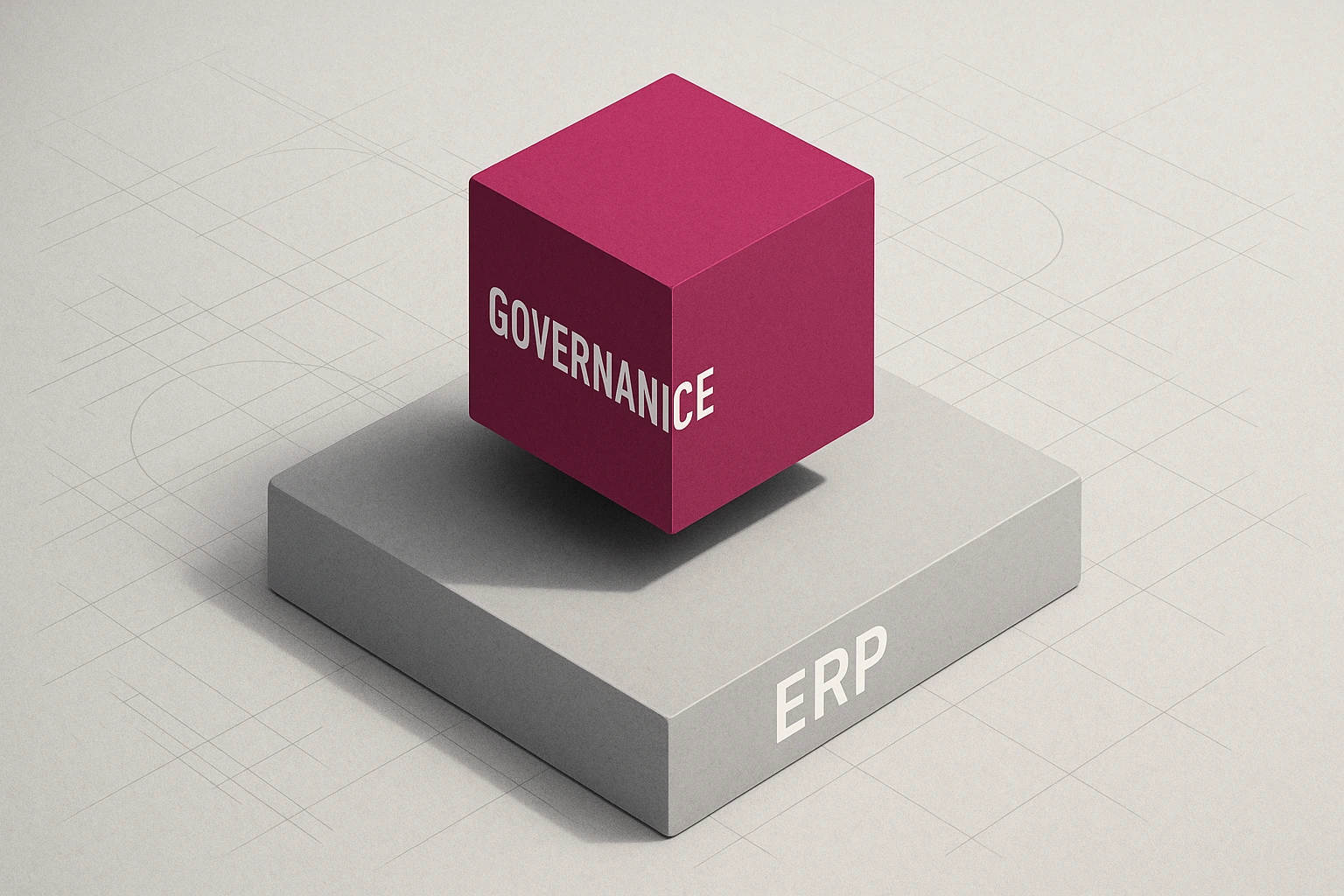
Your ERP Is Not the Problem. What Governs What Happens on Top of It Is.
TL;DR
- Replacing SAP, Oracle, or Microsoft Dynamics consumes three to five years and does not solve the core problem: lack of governance over what happens between the purchase order and the invoice.
- The distinction that matters is between system of record (ERP) and system of decision (orchestration): the first stores the data, the second governs judgment in real time.
- LKQ, by consolidating all of Europe onto a single ERP with a phased rollout, built a rules layer on top of the system, not in place of it: pricing, approval, credit limits, all governed before the order is processed.
- Companies that understand this distinction stop justifying migrations and start justifying governance projects, without abandoning what already works.
Is the CIO Solving the Wrong Problem?
There is a predictable cycle in mid-market and enterprise B2B operations. The sales team complains that the system cannot keep up with the complexity of negotiations. The CIO opens an RFP. Migration proposals surface. Leadership weighs the cost. The project stalls, or drags on for years consuming energy that could go toward the business.
The underlying diagnosis is wrong.
SAP, Oracle, and Microsoft Dynamics were built to record what has already happened: accounting, tax compliance, inventory, regulatory reporting. They perform that function with decades of accumulated customization, deep integrations, and processes no company wants to rewrite from scratch. Replacing that core is a three-to-five-year project, with real risk of operational disruption.
The problem is not the ERP. It is the absence of a layer that governs what happens before the order ever reaches it.
Negotiated pricing by channel, credit terms by customer, margin policy by product line, auditable approval by authority level: none of that is a function of a system of record. The ERP was never designed for it. When a company has no layer governing those decisions in real time, they migrate to the most dangerous place possible, the individual judgment of each sales rep, or the informality of approvals handled over Slack or email.
Integration Is Not Orchestration
For decades, the technology answer to this problem was to connect systems. EDI, then APIs, then AI layers on top of the APIs. Each generation connected more things, faster.
But connecting is not the same as coordinating.
Integration links two systems. Orchestration governs an entire chain: who decides what, in what order, under which rule. In an orchestrated model, APIs execute within deterministic rules. The human exits the operational loop and enters where genuine decision-making exists. Management authority stays with whoever organizes the rules. Execution power is distributed, coordinated, and traceable.
A useful analogy comes from an unexpected place. Bitcoin's design solved a governance problem every B2B company knows well: how to guarantee that a transaction is valid without relying on a human intermediary at every step. The answer was to make the rules deterministic, keep them visible, and ensure each block carried the trail of the one before it. Governance and decentralized execution are not opposites when the rules are explicit and auditable.
That is precisely what is missing in typical B2B deal-making: explicit rules that allow the sales team to act with freedom within known boundaries, without depending on manual approval for every pricing variation or term adjustment.
What LKQ Chose to Build
LKQ, the global distributor of automotive parts and accessories, disclosed in its Q1 2026 earnings report the consolidation of its entire European operation onto a single ERP with a phased rollout, alongside the launch of its own B2B portals (OrderKeystone.com and Keyless). The report is public and filed with the SEC.
What stands out is not the system change. It is the sequence.
LKQ built a governance layer on top of the ERP before scaling the portals. Pricing, terms, approval, credit limits: all governed in that intermediate layer, not inside the system of record, and not left for the field to resolve case by case.
That is the correct sequence, and it confirms a pattern beginning to repeat across the most operationally mature B2B organizations: the ERP stores the data, governance governs the judgment. ERP without governance is data without judgment. Governance without ERP is policy without context. Together they form the rails that allow the operation, and eventually AI agents, to perform with quality, not just speed.
The Cost of Inaction
When the governance layer does not exist, the cost distributes itself silently.
- Pricing negotiated outside policy becomes the informal standard for that customer.
- Approvals handled over text or email leave no auditable trail.
- Credit exceptions granted without visibility accumulate exposure the balance sheet only sees later.
- The sales team learns to work around the management system, not within it.
- AI trained on that data learns the deviations, not the policies.
The ERP replacement project that never gets off the ground is not the only cost. The real cost is the operation that keeps running without governance while the debate over the right system drags on.
Principles for Anyone Structuring This Decision
- Map what happens between purchase intent and invoice: every step that depends on informal human judgment is a risk point.
- Separate system of record from system of decision before any technology evaluation begins.
- Assess whether the problem is integration (connecting systems that do not talk to each other) or orchestration (governing who decides what, in what order).
- Require auditable traceability in pricing, credit, and approval as a selection criterion, not as a nice-to-have feature.
- Consider that AI only performs with quality when the governance rails already exist: automating over data without explicit policy amplifies deviation, not efficiency.
Frequently Asked Questions
Does this mean the ERP needs to be replaced? No. The logic described here is compositional, not substitutional. The ERP keeps its function as the system of record for accounting and compliance. The orchestration layer operates before the order reaches it.
Who should lead this project: IT or Sales? Both. The governance layer is technological in implementation and commercial in the design of its rules. Projects led by IT alone tend to deliver integration without policy. Projects led by Sales alone tend to deliver policy without traceability.
When does it make sense to evaluate this layer? When the operation has pricing variation by customer, channel, or terms; when exception approvals are recurring and informal; when the sales team is working around the management system; or when a commercial AI project is being considered and no governed data layer yet exists.
Who Already Lives This
On the Software Advice platform, verified reviewer Maite S. (automotive sector, company with 5,001 to 10,000 employees) describes her experience with the CWS Platform:
"The support and project team, responsive, technically engaged, and willing to work through complex commercial rules (negotiated pricing, credit, customer-specific conditions)."
The excerpt is representative of what differentiates an orchestration layer from a generic integration: the ability to model real commercial rules, with their customer-specific nuances of pricing, credit, and negotiated terms.
Source: Software Advice, verified review
A Case That Illustrates the Point
LKQ's European consolidation, documented in its Q1 2026 report filed with the SEC, is a public example of the sequence described in this article: building governance on top of the ERP before scaling B2B portals. The case confirms that operational maturity is not about which system you use, but about how much control exists over what happens between the purchase order and the invoice.
Access the filing: LKQ 10-Q, Q1 2026, SEC EDGAR
About This Publication
The Cost of the Sale is the CWS Platform publication on B2B commercial operations. CWS Platform is a B2B Commerce Platform for Governed Negotiation: it orchestrates pricing, credit, and approval within the commercial workflow, in composition with the existing ERP, without replacing it.
Sources
- LI-024 (CWS Platform original thesis): distinction between system of record and system of decision; central argument for orchestration as an alternative to ERP migration.
- LI-017 (CWS Platform original thesis): deterministic governance and traceability as design principles; Bitcoin model analogy for explicit rules and distributed execution.
- LI-018 (CWS Platform original thesis): difference between integration and orchestration; displacement of the human toward genuine decision points.
- LKQ 10-Q, Q1 2026, filed with the SEC: https://www.sec.gov/Archives/edgar/data/1065696/000106569626000033/lkq-20260331.htm
"The support model is differentiated — the project team actually understands B2B complexity and stays close throughout implementation."
Want to see this in your operation?
Real B2B operations already run on it.