The Evolution of Power and Loyalty (By Decade)
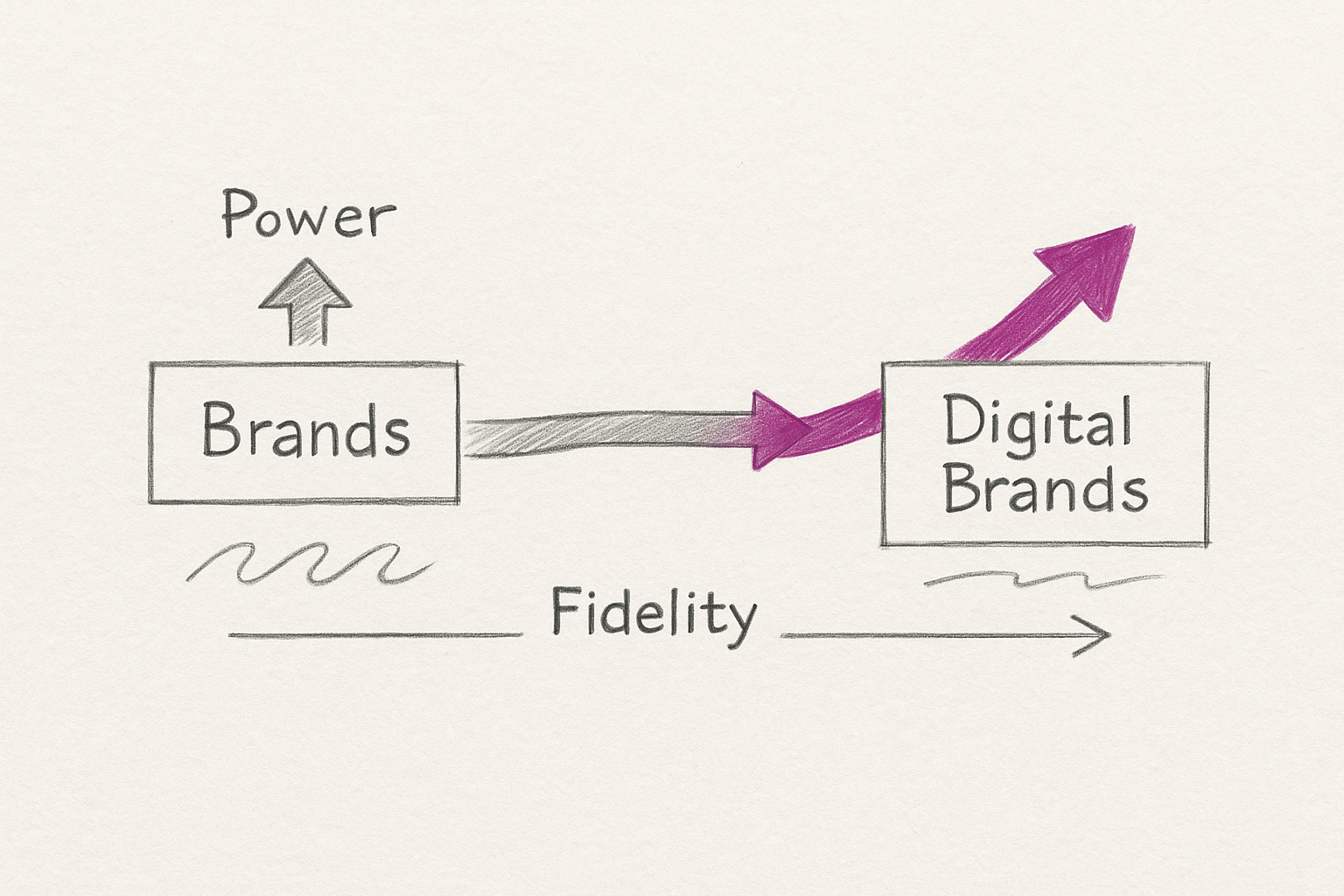
How power shifted from brands to consumers and now to customer-centric digital brands
TL;DR
- Bargaining power in B2B and B2C commercial relationships has changed hands three times in twenty years: from brands and retailers, to digital consumers mediated by marketplaces, and now to digital brands that orbit the customer.
- Loyalty based on repetition and contractual lock-in has given way to a relationship built on continuous, personalized, trust-driven engagement.
- Anyone still operating with 2000s-era logic (product at the center, channel as destination) is paying a rising cost of acquisition, retention, and churn reversal without realizing where that cost is coming from.
- The strategic question isn't "how do I build loyalty?" but "how do I build engagement that lowers my transaction cost over time?"
Business power has always lived somewhere: do you know where it is now?
There's a recurring trap in sales planning meetings: the diagnosis runs on today's data, but the strategic logic still breathes the air of a decade ago. The commercial leader's mental map was formed during a period when influence over the purchase decision belonged to whoever controlled the product or the point of sale. That period is over. And the cost of continuing to operate with that outdated map is real, measurable, and growing.
Understanding how power has shifted, in which direction, and through what mechanism isn't a retail history exercise. It's a prerequisite for any decision about go-to-market strategy, pricing, channel structure, or customer relationship policy.
The decade of the brand and the retailer: the 2000s
In the 2000s, the equation was relatively stable. The brand held the perception asset, and the retailer held the access asset. The consumer, even with growing internet access, still depended on physical intermediaries or nascent digital ones to compare, choose, and buy. The channel for recommendations was editorial, advertising-driven, or word-of-mouth, and the relationship cycle had a long time horizon.
In that landscape, loyalty was a concrete operational concept: the customer came back because the cost of searching for alternatives was high, information was asymmetric in favor of the brand or retailer, and the relationship was sustained by inertia as much as by satisfaction. Loyalty programs functioned as reinforcement of exit barriers, not as mechanisms for creating perceived value.
Power resided wherever access resided. And access was scarce.
The shift to the consumer: the 2010s
The expansion of marketplaces and aggregators destroyed the information asymmetry that had sustained the previous model. Within a few years, consumers gained the ability to compare price, delivery time, seller reputation, and product reviews in seconds, within a single environment. Power shifted.
The channel for recommendations stopped being the brand and became the marketplace's algorithm and the review history left by other buyers. The relationship became transactional: the dominant decision criterion became price and convenience, and the relationship horizon shrank to the short term. Loyalty, in this context, lost substance as a strategic concept. What existed was repeat purchasing as long as the price stayed competitive, and immediate abandonment the moment a competitor offered a better deal.
For brands and retailers, this was a decade of margin compression. Acquisition cost rose because the auction for visibility inside marketplaces created an environment of competition for paid placement. Retention cost rose because loyalty was no longer a variable manageable through an internal program. Power had migrated outside the organization, and most companies responded by increasing paid media spend without restructuring the underlying relationship logic.
The model emerging now: the 2020s
What we observe in the current decade is not a return to brand power in the 2000s sense. It's a different structure, where power belongs to digital brands that have organized their operations around the customer, not the product and not the channel.
The channel of influence stopped being the ad and became the experience and the share. The core message shifted from "my product is better" to "you can trust us." The relationship evolved into something committed, personalized, and close, where the customer feels the brand knows them, responds with consistency, and delivers value beyond the one-off transaction.
In this model, loyalty isn't a binary state (loyal or not loyal). It's a continuum of engagement, where the customer who engages the most has a lower transaction cost for the company and a higher contribution margin over time. Engagement is measurable, manageable, and built by design, not by inertia.
The structural difference compared to previous decades is that the customer-centric digital brand actively lowers the customer's own transaction cost: it simplifies the purchase, personalizes the offer, anticipates needs, and eliminates friction. This creates reciprocity. The customer whose transaction cost has been lowered tends to consolidate purchases with that company, refer others, and tolerate occasional price variations because the perceived value of the relationship outweighs the value of any single transaction.
The cost of inaction
For the CEO or sales leader still operating with metrics and strategies calibrated for 2010s or 2000s logic, the cost of inaction shows up in at least three dimensions:
- Rising acquisition cost: without building engagement, every sale depends on paid external stimulus, and the auction for attention won't get any cheaper.
- Margin compressed by price competition: without differentiation through experience and trust, the customer's decision criterion falls back on price, and competing on price with a traditional cost structure is unsustainable.
- Loss of relational data: without closeness to the customer, the company accumulates transactional data but not relational data, and relational data is what enables real personalization and demand anticipation.
The sum of these three effects is a business that only grows when it spends more on acquisition, without building relational assets that lower the cost of future growth.
Principles for operating in today's decade
- Diagnose where your influence actually lives today: in the product, in the channel, or in the experience you deliver.
- Measure engagement with the same rigor you apply to sales volume; a smaller, more engaged customer base can have a lower transaction cost and higher margin.
- Build trust before building campaigns; messaging without operational consistency generates noise, not relationship.
- Personalize using data you actually hold about the customer, not just about the transaction; there's a difference between knowing what a customer bought and knowing what they need.
- Evaluate your transaction cost across the customer lifecycle, not per order; the efficiency that matters is systemic, not one-off.
FAQ
Is loyalty as a concept still valid? Yes, but its substance has changed. Loyalty today is a byproduct of consistent engagement, not of artificial exit barriers. Programs that create lock-in without delivering perceived value are expensive and have a short shelf life.
Can small and mid-sized B2B operations apply the logic of customer-centric digital brands? Scale isn't the determining factor. The logic applies regardless of operation size: what matters is orientation, not the volume of technology investment.
How do you balance short-term efficiency with building long-term engagement? The argument here is that engagement lowers transaction cost over the medium term, making it compatible with efficiency. The tension between the two time horizons diminishes as the base of engaged customers grows.
About this publication
The Cost of Selling is CWS Platform's publication for commercial leaders, CEOs, and B2B operations managers making decisions where margin, efficiency, and customer relationships intersect. CWS builds architectures that help companies reduce transaction cost across the entire commercial chain, from supply intelligence to the end customer experience.
"The support model is differentiated — the project team actually understands B2B complexity and stays close throughout implementation."
Want to see this in your operation?
Real B2B operations already run on it.