The Rep Knows the Real Path. The System, Not Always.
When the actual quoting workflow diverges from the formal process, the rep's pain becomes invisible cost for B2B sales leadership.
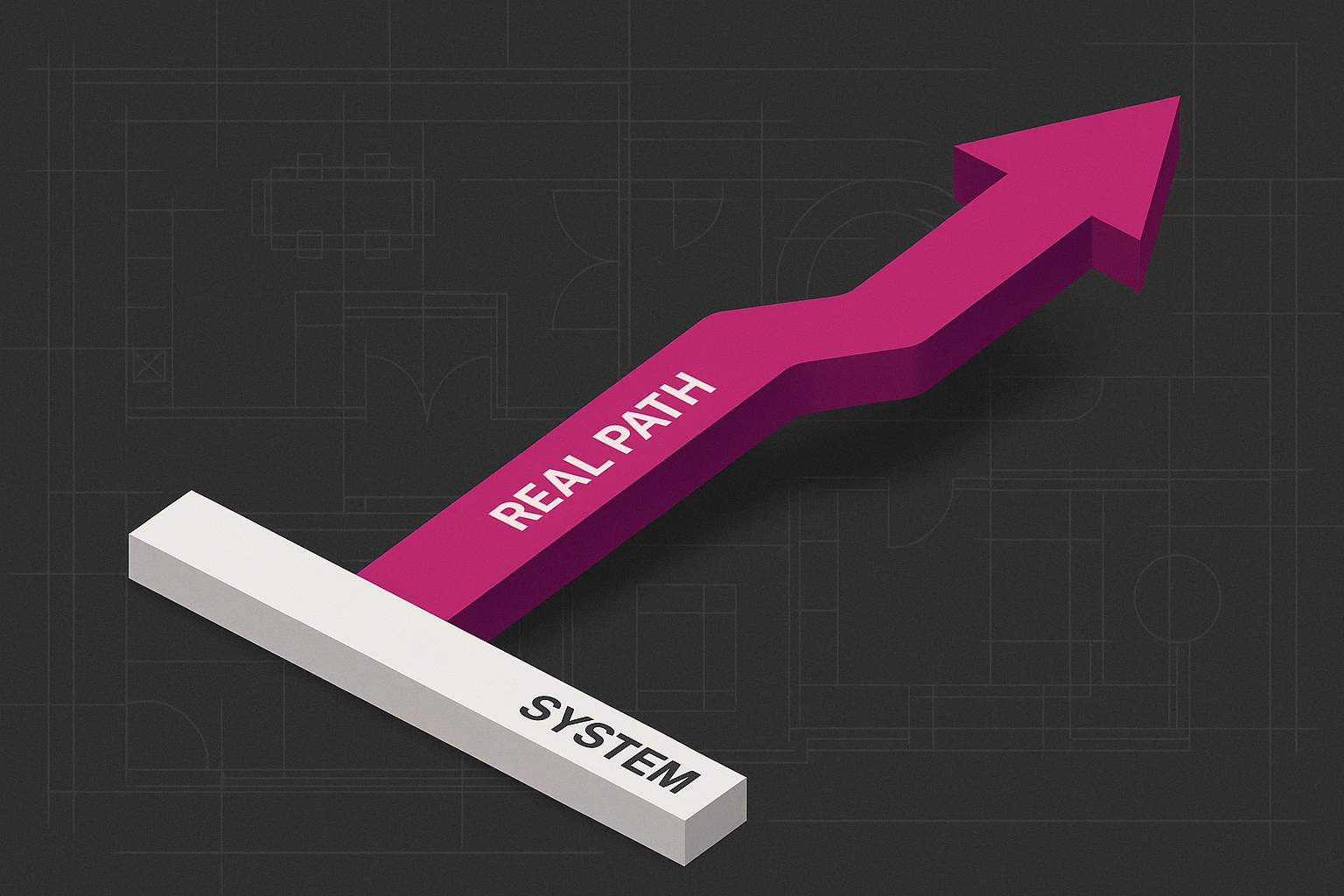
The salesperson knows the real path. The system doesn't always.
TL;DR
- The formal quote-to-order process is rarely the workflow salespeople actually follow: the gap between the two is where business pain begins.
- Pricing rules and commercial terms often live in places salespeople access outside the official system—through spreadsheets, memory, or a call to the back office.
- Configuring a platform around the formal process while ignoring the real workflow guarantees low adoption and rework.
- The right discovery process maps where pain is greatest in practice before any solution decision is made.
Why is your documented sales process not the process that actually happens?
Every B2B sales operation has two versions of the same workflow. The first is the official version: the pipeline diagrammed in PowerPoint, the proposal process approved by leadership, the pricing policy stored somewhere in a shared drive. The second is the version the salesperson executes at six o’clock in the evening, when the customer needs an answer before month-end.
Those two versions rarely match.
A salesperson serving distributors in the auto parts industry, for example, does not consult the official price list for every quote. They have their own logic, built over months: they know that a specific customer has a negotiated term that is not in the ERP, remember that the maximum discount for Product Line X was adjusted in a meeting no one formally documented, and resolve the issue by calling someone in finance who “knows how it works in practice.” The order goes through. The sale closes. And the system records a transaction whose decision criteria were never captured anywhere.
This gap—between the formal process and the effective workflow—is the right starting point for any serious sales diagnosis. And it is exactly what most platform projects ignore.
Where the rules actually live
The question that exposes the problem is simple: where do pricing rules and commercial terms live today, and how does the salesperson access them?
In most B2B operations with a mature customer base, the honest answer is fragmented. Some rules are in the ERP, but out of date. Others are in spreadsheets maintained by one or two people on the sales or pricing team. A third set lives in the mind of the senior salesperson who built those terms over years of customer relationships. And a fourth set—the most dangerous—exists only as an informal practice that everyone follows even though no one has deliberately defined it.
When a platform is configured around the formal process without first mapping this real terrain, the predictable result is low adoption. The salesperson opens the system, cannot find the term they know exists, closes the system, and resolves it through a text message or a call. The technical project was delivered. The operation stayed the same.
The cost of mapping too late
The risk is not only operational. It is financial and strategic.
Every time the real workflow diverges from the system, the transaction happens outside established controls. That means pricing negotiated outside the platform is not traceable, relationship-based special terms are not auditable, and the true cost of each sale—including implicit discounts and accumulated exceptions—remains invisible to those making margin decisions.
What looks like a tool-adoption problem is, in practice, a commercial governance problem. And weak commercial governance carries a cost that shows up late: in margin compression with no clear explanation, in a customer who received terms that should not have been granted, in the departure of a senior salesperson who carried undocumented rules in their memory.
For operations looking to scale through automation, this cost becomes even more visible. The principle repeats across industries and has been observed directly in projects led by CWS Platform: AI agents and automation amplify the existing structure. When decision logic, rules, criteria, and processes are well designed before implementation, automation scales efficiency. When that logic is fragmented or implicit, automation scales chaos. That is why CWS Platform’s discovery methodology always starts by mapping the real workflow—not the documented process: configuring around the wrong workflow is faster and more expensive than configuring nothing at all.
The Cost of Inaction
Maintaining the gap between the formal process and the real workflow has cumulative consequences that rarely appear on a single line of the P&L:
- Pricing rules and commercial terms that exist in practice but not in the system create audit exposure and a risk of customer-level inconsistency.
- The rework cost for salespeople who access parallel sources to complete a quote is invisible in productivity metrics, but real in cycle time.
- Dependence on specific people to interpret undocumented rules is a continuity risk that only becomes apparent when those people leave.
- Platform projects configured around the formal process, without discovery of the real workflow, have a documented history of low adoption and costly reconfiguration.
Principles for discovery that serves the operation
- Map the real workflow before documenting the ideal process: follow the salesperson, not the manual.
- Ask where pricing rules and commercial terms live today, not where they should live.
- Identify workarounds—the moments when the salesperson leaves the system to get something resolved—as symptoms of where pain is greatest.
- Treat the divergence between the formal process and the effective workflow as configuration data, not as a team behavior failure.
- Only propose a solution after mapping the real terrain: a platform configured around the real workflow has a lower adoption cost and delivers results faster.
Frequently asked questions
Shouldn’t the formal process be the real process?
It should, and that is what the platform is for. But the sequence matters: first understand why the real workflow diverged, then configure the system to accommodate what is legitimate and govern what is not. Imposing the formal process without understanding the real workflow creates resistance and workarounds.
How can you identify where undocumented rules are?
Interview the salespeople who sell the most and those who request the most exceptions. Map orders that required manual approval. Review the spreadsheets the sales team maintains outside the ERP. These are the symptoms of the real workflow.
Does this mapping need to happen before selecting a platform?
Not necessarily before selecting one, but it must happen before configuration. A platform configured without this input will need to be reconfigured later, at a cost and with a loss of internal credibility.
Who is already living this
In the automotive sector, where customer portfolios include negotiated terms, credit arrangements, and customer-specific pricing, this kind of complexity is routine. A verified Software Advice reviewer in the Automotive industry at a company with 5,001 to 10,000 employees described what they found while working with CWS Platform:
"The support and project team, responsive, technically engaged, and willing to work through complex commercial rules (negotiated pricing, credit, customer-specific conditions)."
(Software Advice, verified review, available at: https://www.softwareadvice.com/product/546664-CWS-Platform/)
What the review describes—a willingness to work through complex commercial rules—is exactly what the right discovery process must capture before any configuration begins. Negotiated pricing rules, credit, and customer-specific terms are not exceptions: they are the commercial DNA of the operation.
A case that illustrates the point
CWS Platform’s discovery methodology is based on a recurring finding across projects conducted with complex B2B sales operations: when the implementation team enters a new operation and asks where pricing rules and commercial terms are documented, the answer is almost never “in the system.” The real answer is a combination of spreadsheets, old emails, the memory of specific individuals, and informal practices that everyone follows even though no one has deliberately defined them.
The work that precedes any platform configuration is therefore to make this logic explicit. Not to replace it, but to make it governable. Rules that exist only in the mind of a senior salesperson are not scalable, auditable, or resilient to turnover. When those rules are mapped, formalized, and configured as decision criteria within the platform, what was a continuity risk becomes a structural asset for the operation.
This is the principle that guides CWS Platform discovery: the operation’s negotiation DNA, built over years of customer relationships, is the most valuable asset the platform needs to capture—not ignore.
About this publication
The Cost of Selling is CWS Platform’s publication about governed B2B sales operations. Each edition starts with a real business pain point to discuss how decision-making, process, and technology relate to the cost of every transaction. CWS Platform is a B2B Commerce Platform for Governed Negotiation: it enables complex sales operations where pricing, terms, and credit must be governed, traceable, and configurable through business rules.
Sources
- CWS Platform discovery methodology guideline (internal input): guidance on capturing the real quote-to-order workflow before proposing a solution, distinguishing the formal process from the effective workflow as input for platform configuration; includes the principle that automation amplifies the existing structure, observed in projects conducted by CWS Platform.
- Software Advice, verified review, Maite S. (Automotive, 5,001–10,000 employees): public testimonial about experience with complex commercial rules on CWS Platform. https://www.softwareadvice.com/product/546664-CWS-Platform/
"The support model is differentiated — the project team actually understands B2B complexity and stays close throughout implementation."
Want to see this in your operation?
Real B2B operations already run on it.