The sales rep who approves everything alone is the bottleneck hiding in your P&L
When commercial rules live only inside the rep's head, you scale volume but stall on margin
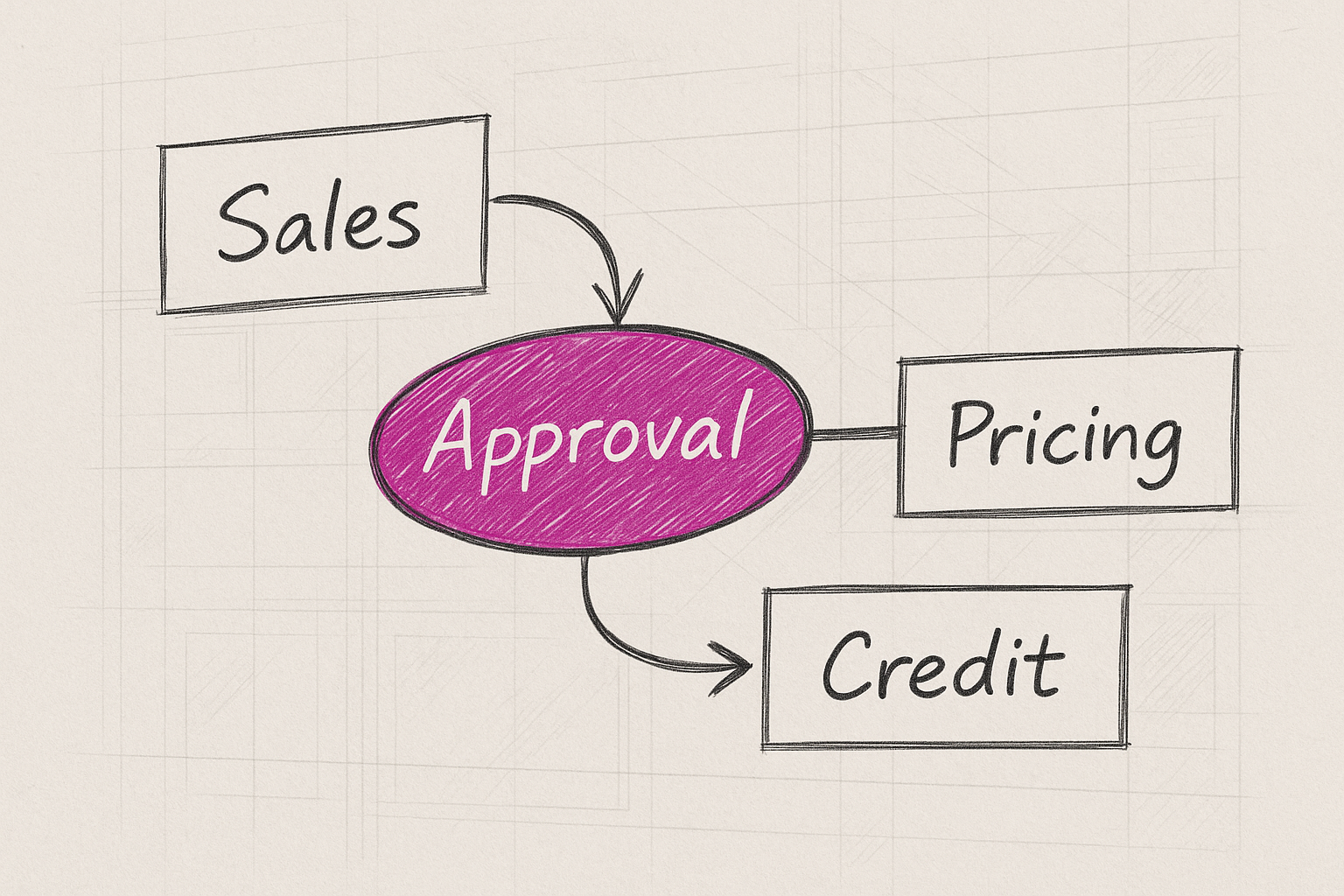
The Sales Rep Who Approves Everything Alone Is the Bottleneck You Don't See in Your P&L
TL;DR
- The sales rep never left the B2B buying process, and won't: by definition, they are the human in the loop.
- The problem isn't human involvement, it's that today's reps spend judgment on tasks that don't require judgment.
- When pricing rules, credit policies, and exception workflows move out of the rep's head and into the operation's flow, the human is freed for what only humans can do.
- The measurable result is a lower average cost per order and higher productivity without adding headcount.
Why Does Your Sales Operation Grow in Volume but Not in Margin?
There is a tension that surfaces early in any B2B operation that scales: the sales team grows, order volume grows, but the cost of processing each order doesn't fall, and operating margin doesn't improve at the expected rate. The most common diagnosis is "we need better process" or "we need better tooling." Rarely does the diagnosis reach where the problem actually lives: the sales rep is still the sole repository of the company's commercial rules.
Every discount policy, every payment term exception, every out-of-standard credit approval runs through one person's memory and judgment. That isn't a character flaw in the rep, it's an architectural flaw in the operation. And the cost of that flaw shows up in ways the P&L records but leadership rarely traces back to the root cause: orders stalled waiting for approval, discounts granted without consistent criteria, margins eroded by exceptions that become standard practice because they were never formally documented.
The Sales Rep Was Always the Human in the Process, and That's the Asset, Not the Problem
The conversation around sales automation tends to create a false dichotomy: either you automate and remove the human, or you keep the human and accept the inefficiency. That dichotomy is wrong at the premise.
The sales rep has always been the human in the B2B purchasing process. The account manager, the territory rep, the enterprise account executive, all of these roles are, technically, what systems designers call the "human in the loop": the point where human intelligence enters to handle what a rule alone cannot resolve. That hasn't changed. What has changed, or needs to change, is what that human is actually deciding.
Today, in most B2B operations, the rep decides whether customer X qualifies for the 8% discount they've always received, whether net-60 terms can be approved for that account, whether the special price tier applies to this week's order. Those are not human decisions. They are lookups against policies that should already be formalized in the system. The rep becomes a search engine for commercial policies the company never digitized.
The consequence is twofold: the operation slows down because it depends on human availability to answer questions a system would resolve in milliseconds, and the human burns judgment capacity on mechanical lookups, leaving less bandwidth for what actually matters: reading the customer, negotiating strategic terms, defending margin under pressure, building long-term relationships.
What Changes When Rules Move Out of the Rep's Head
When pricing policy, credit rules, and exception workflows migrate from the rep's memory into the operation's digital flow, three things happen simultaneously.
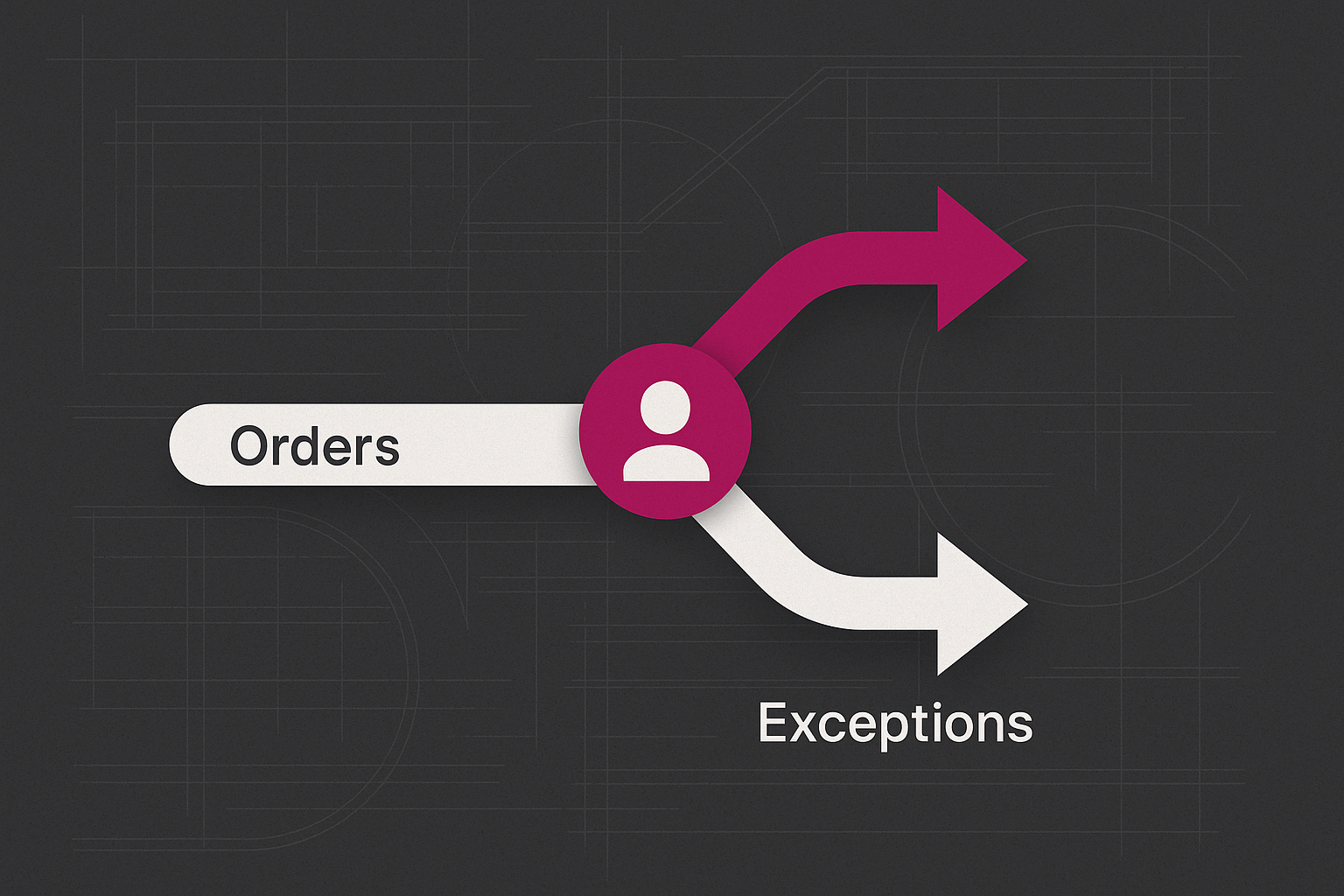
First, response time for standard orders stops depending on human availability. Orders that fall within formalized rules flow through without waiting. The rep only enters the picture when an order genuinely requires judgment, meaning there is an out-of-policy condition that demands contextual interpretation, relationship awareness, or a strategic call.
Second, margin per order becomes auditable. If the rule lives in the system, the discount granted has a paper trail. The approved exception has a record. The manager can look back and see where policy was followed and where it was negotiated, and with what financial outcome. That visibility is the prerequisite for any serious conversation about pricing optimization.
Third, the average cost per order falls. Not because you reduced headcount, but because the same rep can handle more orders, with higher quality judgment, because they stopped doing work the system should be doing. Real sales productivity isn't the rep working more hours, it's the rep applying human judgment where human judgment adds value.
The Cost of Inaction
Every month the operation runs with unformalized commercial rules carries a cost that doesn't show up in the bank account, but does show up in margin:
- Non-uniform discounts for accounts with identical profiles, because every rep has their own interpretation of the price schedule.
- Exception approvals that take days because the approving manager was in a meeting, traveling, or simply wasn't looped in at the right moment.
- Lost orders due to slow response time, especially in segments where the customer has multiple qualified vendors.
- Inability to scale the channel without scaling headcount at the same rate, because the bottleneck is human by design.
Inaction is not neutral. In B2B operations that are growing, the absence of formalized governance in the commercial process is technical debt that compounds: the larger the operation grows under this model, the more expensive it becomes to fix.
Principles for Putting the Human Back Where They Add Value
- Map what the rep decides today and classify each decision: is it a rule lookup or is it contextual judgment?
- Everything that is a rule lookup must be formalized in the system before any conversation about automation begins.
- The exception framework needs to live in the workflow, not in the manager's head: what can be approved, by whom, up to what limit, with what documentation.
- The rep as "gatekeeper" works when they are guarding defined boundaries, not when they are the only source of definition.
- Sales productivity is measured by orders, margin per order, and cycle time, not by activity volume.
Frequently Asked Questions
If I formalize the rules in the system, does the rep lose negotiating power? No. They gain precision. Knowing exactly where the rule boundary sits is what allows negotiating with margin awareness, instead of negotiating in the dark and discovering the impact later.
Does this work for operations with high order variability? Yes, especially for those. High variability doesn't justify the absence of rules, it justifies more sophisticated rules, with more parameters. A system can process complexity that human memory doesn't scale.
How long does it take to formalize these rules? It depends on the current degree of informality. Operations starting from scratch tend to underestimate the discovery work required to surface implicit commercial policies. The technical implementation time is usually shorter than the internal decision time about what the rule actually is.
Who Already Lives This
"We had been trying to implement a B2B solution for almost 2 years. With CWS, we went live in 60 days."
Edivaldo C., verified reviewer, automotive sector, company of 201–500 employees. Source: Software Advice
The relevant data point here isn't the 60-day timeline itself, it's the contrast with two years of failed attempts. Operations that cannot implement B2B solutions in reasonable cycles are usually stuck in the same trap: they cannot formalize the commercial rules because those rules were never made explicit internally. The technical implementation is fast; the work is governance.
A Case That Illustrates the Pattern
In B2B operations, the productivity bottleneck is rarely human capacity, it's the absence of rules formalized in the system. When pricing policy, credit rules, and exception workflows migrate from the rep's head into the digital flow, response time stops depending on human availability. This pattern repeats across different industries and company sizes: scale doesn't come from more people, it comes from rules that scale without people. (CWS internal reference: LI-038)
About This Publication
"The Cost of the Sale" is CWS Platform's publication on governed B2B commercial operations. We cover decision-making, margin, productivity, and transaction cost for leaders operating in high-complexity commercial environments. CWS Platform is a B2B Commerce Platform for Governed Negotiation.
Sources
- CWS Platform original thesis: conceptual foundation on the role of the sales rep as "human in the loop" in B2B commercial processes, and the relationship between rule formalization and lower average cost per order. Primary source material for this article.
- Software Advice, review by Edivaldo C.: verified user review from the automotive sector on the CWS Platform implementation experience. https://www.softwareadvice.com/product/546664-CWS-Platform/
- CWS archive, LI-038:
"The support model is differentiated — the project team actually understands B2B complexity and stays close throughout implementation."
Want to see this in your operation?
Real B2B operations already run on it.